

Imagine it’s Black Friday. Your ads are running, traffic is surging, and then… your site goes down. This nightmare scenario, a direct result of the wrong foundation, is why finding reliable web hosting for ecommerce is one of the most critical decisions you’ll make for your online store. It’s about more than just keeping the lights on; it’s about delivering the speed that prevents cart abandonment, the security that builds customer trust, and the rock-solid uptime that turns peak traffic into maximum profit.
But with so many options, how do you separate the essential features from the expensive add-ons? In this guide, we cut through the noise. We’ll compare the top providers for 2026, helping you find the perfect host that guarantees performance, scales with your growth, and provides the 24/7 expert support you need for total peace of mind. Get ready to build a store that’s not just open for business, but optimized for success.
Key Takeaways
- True reliability is more than just uptime. Learn how factors like server speed and security protocols directly impact your sales and brand reputation.
- Choosing between an all-in-one platform and a self-hosted solution is a critical first step. We’ll help you decide which path offers the right balance of control and ease of use for your store.
- The most reliable web hosting for ecommerce includes non-negotiable features like PCI compliance, automated backups, and a robust CDN to keep your store fast and secure.
- Our 2026 provider comparison cuts through the noise. Discover which hosts deliver the best performance and support, with clear recommendations based on your store’s size and budget.
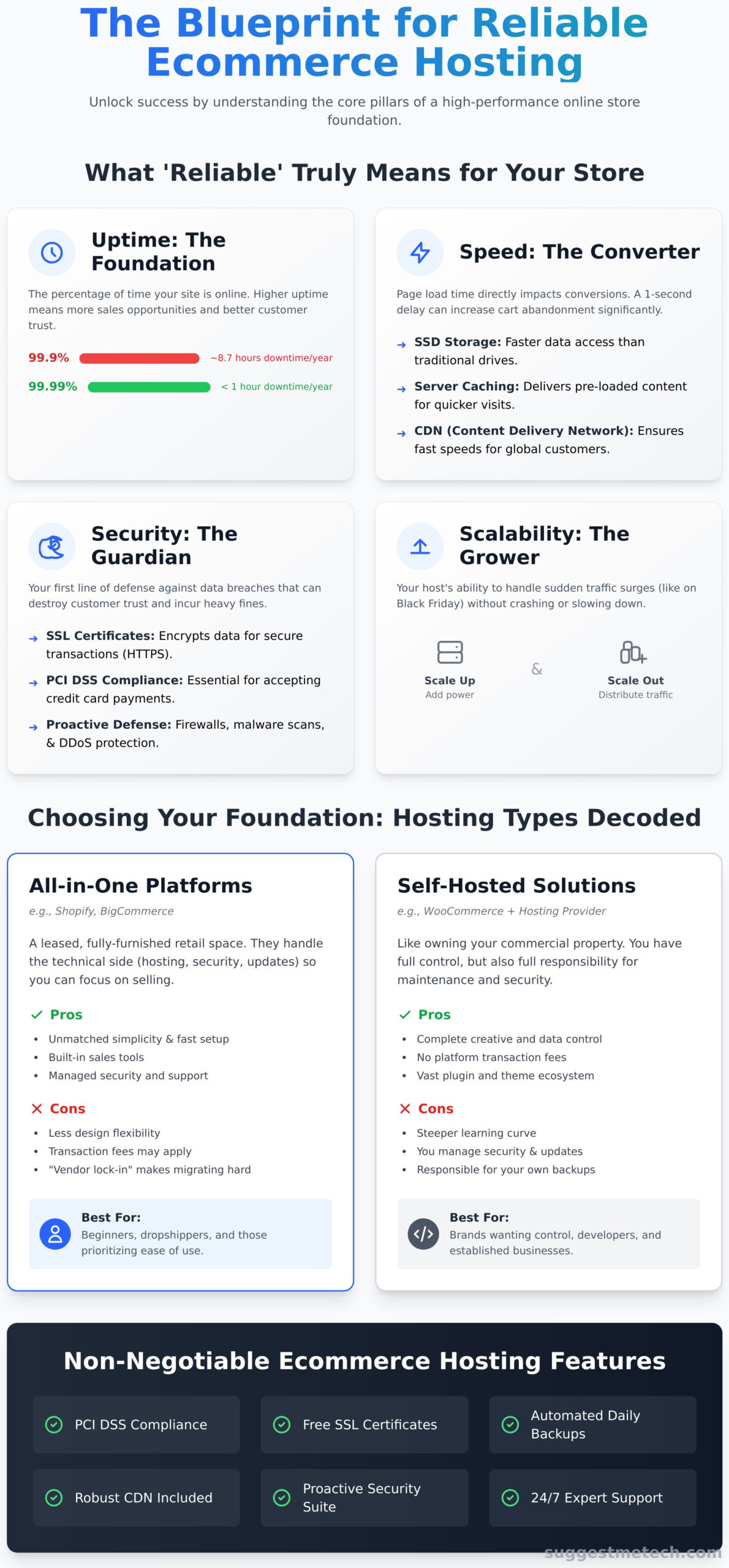
What ‘Reliable’ Actually Means for Your Online Store
When searching for reliable web hosting for ecommerce, the term “reliable” is more than just a marketing buzzword-it’s a promise. A promise that your digital storefront will be open, fast, and secure for every customer, every time. Choosing a host is a foundational business decision, not just an IT expense. Before you can compare plans, it’s critical to understand the fundamentals of what is web hosting and how its quality directly impacts your revenue and reputation. Let’s break down the four pillars of genuine reliability.
Uptime: The Foundation of Trust and Sales
Uptime is the percentage of time your website is online and accessible. While 99.9% sounds great, it translates to over 8 hours of downtime per year. A 99.99% uptime guarantee cuts that down to under an hour. Downtime means lost sales, frustrated customers who may never return, and a negative signal to search engines. Always check the host’s Service Level Agreement (SLA) to see how they compensate you if they fail to meet their uptime promise.
Speed: Your Silent Conversion Rate Optimizer
In ecommerce, speed equals revenue. Studies consistently show that even a one-second delay in page load time can increase cart abandonment and decrease conversions. Truly reliable hosting optimizes for speed using:
- SSD Storage: Solid-State Drives (SSDs) are significantly faster than traditional hard drives, leading to quicker data retrieval for your product pages.
- Server Caching: Caching stores copies of your site’s files to deliver them to visitors faster on subsequent visits.
- Content Delivery Network (CDN): A CDN distributes your site’s content across a global network of servers, ensuring fast load times for customers no matter where they are.
Security: Protecting Your Customers and Your Business
A single security breach can destroy customer trust and lead to significant financial penalties. Your hosting environment is your first line of defense. Non-negotiable security features include:
- SSL Certificates: Encrypts data between your customer’s browser and your server (enabling HTTPS), which is essential for trust and SEO.
- PCI DSS Compliance: A set of security standards required for any business that accepts credit card payments.
- Proactive Defense: Regular malware scanning, robust firewalls, and DDoS (Distributed Denial-of-Service) attack protection are crucial.
Scalability: Growing Without Crashing
What happens when your marketing campaign goes viral or Black Friday hits? Scalability is your host’s ability to handle sudden traffic surges without slowing down or crashing. A reliable host provides the resources to manage these spikes, whether by “scaling up” (adding more power to your current server) or “scaling out” (distributing traffic across multiple servers). This ensures you can capitalize on your biggest opportunities without performance hiccups.
Decoding Hosting Types: Which Is Right for Your Ecommerce Business?
When starting an online store, the first major decision is choosing your foundation. Do you opt for an all-in-one platform where everything is included, or do you build your store on a self-hosted solution for ultimate control? Finding the most reliable web hosting for ecommerce depends entirely on your answer to that question. Let’s break down the two main paths to help you decide.
All-in-One Ecommerce Platforms (e.g., Shopify, BigCommerce)
Think of these platforms as a leased, fully-furnished retail space. You can move in and start selling almost immediately because they handle the technical heavy lifting-security, updates, and hosting-so you can focus on your products and customers.
- Pros: Unmatched simplicity, built-in sales tools, and managed security. Setup is fast, and support is readily available.
- Cons: Less design flexibility, transaction fees on top of monthly costs, and “vendor lock-in” that makes it difficult to migrate away later.
- Best For: Beginners, dropshippers, and business owners who prioritize ease of use over deep customization.
Self-Hosted Solutions (e.g., WooCommerce)
This path is like buying your own commercial property. Using an open-source platform like WooCommerce with a dedicated hosting provider gives you complete freedom. This offers unparalleled control over your brand and data, but it also means you’re responsible for maintenance, security, and solving any ecommerce infrastructure challenges that arise as you grow.
- Pros: Full creative control, no transaction fees from the platform, and access to a massive ecosystem of open-source plugins and themes.
- Cons: A steeper learning curve and the responsibility of managing your own security, backups, and software updates.
- Best For: Entrepreneurs who want maximum control, plan to scale significantly, or need a highly customized shopping experience.
How to Choose: A Quick Decision Guide
Your perfect fit comes down to a trade-off between convenience and control. Use this quick checklist to find your path.
- Technical Skill: Do you prefer a hands-off, “it just works” approach (All-in-One) or are you comfortable with basic web management (Self-Hosted)?
- Budget: Do you want a predictable monthly fee with transaction costs (All-in-One) or a lower base cost where you pay for add-ons as needed (Self-Hosted)?
- Time Commitment: How much time can you dedicate to setup and ongoing maintenance? Less time favors an All-in-One solution.
- Business Focus: Is your priority perfecting a physical product, like fresh meals, rather than managing server configurations? Many direct-to-consumer brands choose managed solutions for this reason. To see a great example in the food delivery space, check out Eat Better Meals.
- Customization Needs: Do you need a unique design or specific features not available out-of-the-box? If so, Self-Hosted is your answer.
Ultimately, the right technical foundation allows you to focus on what truly matters: your products and customers. To see an example of an e-commerce store that excels in its niche, you can discover TipTop360.
If you’re leaning towards a self-hosted solution for its flexibility, your next step is picking the right provider. Still unsure? See our full guide on WordPress Hosting to compare top options.
Essential Features of a Reliable Ecommerce Hosting Plan
Choosing your hosting provider is one of the most critical technical decisions you’ll make after deciding to launch an online business. While many hosting plans look similar on the surface, the right features can mean the difference between a thriving store and a frustrating experience for your customers. As you move from planning to execution-a process detailed in this helpful U.S. Small Business Administration guide to selling online-use this checklist to evaluate providers like a pro.
The best and most reliable web hosting for ecommerce doesn’t just give you server space; it provides a secure, high-performance foundation built specifically for transactions.
Security and Compliance Features
For an online store, security isn’t optional-it’s the bedrock of customer trust and your business’s reputation. Look for these non-negotiables:
- Free, Auto-Renewing SSL Certificate: This encrypts customer data and puts the secure padlock icon in a browser’s address bar. It’s the absolute minimum for any site asking for personal information.
- PCI Compliance Support: If you accept credit cards directly on your site, you must adhere to the Payment Card Industry (PCI) Data Security Standard. A good host provides a compliant environment to make this process easier.
- Automated Daily Backups: Think of this as your ultimate safety net. If your site is compromised or an update goes wrong, you can restore a clean version with minimal downtime and data loss.
- Web Application Firewall (WAF): This acts as a digital security guard, proactively filtering and blocking malicious traffic and hacking attempts before they can even reach your store.
Performance-Boosting Technology
Speed directly impacts your conversion rate. A slow site frustrates shoppers and hurts your search engine rankings. Prioritize hosting plans with modern performance tech:
- SSD Storage: Solid-State Drives (SSDs) have no moving parts and can access data up to 20 times faster than traditional Hard Disk Drives (HDDs). This translates to faster-loading product pages and a snappier checkout process.
- Built-in Caching: Server-level caching stores copies of your pages so they can be delivered to visitors almost instantly. This dramatically reduces server load and improves site speed without requiring complex plugins.
- Integrated CDN: A Content Delivery Network (CDN) stores copies of your site’s assets (like images) on servers around the world. This ensures international customers get the same fast loading experience as local ones by serving content from a location geographically closer to them.
- Latest PHP Versions: For stores built on platforms like WordPress/WooCommerce or Magento, running the latest version of PHP is crucial for both speed and security. A quality host makes it easy to switch to the most current, stable version.
Top 5 Reliable Web Hosting Providers for Ecommerce in 2026
After extensive testing of speed, uptime, and support, we’ve narrowed down the top contenders. Choosing the right platform is the most critical step in building a successful online store, and this curated list will help you find the most reliable web hosting for ecommerce based on your specific needs, budget, and technical skill level.
SiteGround: Best Overall for WooCommerce
SiteGround earns its reputation for reliability through a multi-layered approach to security, consistently excellent uptime, and some of the best customer support in the industry. They handle the technical heavy lifting, from server optimization to threat detection, so you can focus on growing your store with confidence.
- Key Features: Ultrafast PHP implementation, free CDN for global reach, and automated daily backups.
Best for: Businesses using WordPress and WooCommerce who value expert, responsive support.
Shopify: Best All-in-One Platform for Beginners
For entrepreneurs who want to avoid server management entirely, Shopify is the gold standard. Its reliability comes from a fully managed global infrastructure that you never have to touch. With built-in security, unlimited bandwidth, and guaranteed uptime, your store is always ready for customers.
- Key Features: Global CDN, automatic Level 1 PCI DSS compliance, and 24/7 dedicated platform support.
Best for: Entrepreneurs who want to focus 100% on product and marketing, not technical maintenance.
Hostinger: Best for Stores on a Tight Budget
Hostinger proves that you don’t have to sacrifice performance for affordability. It offers a surprisingly robust and speedy environment for the price, backed by a 99.9% uptime guarantee. It’s a solid foundation that ensures your new store remains online and accessible as you start to build traffic.
- Key Features: LiteSpeed web servers for enhanced performance, free SSL certificate, and automated backups.
Best for: New online stores and startups that need a cost-effective but dependable hosting solution.
Bluehost: Best for Integrated WordPress/WooCommerce Experience
As one of the few hosts officially recommended by WordPress.org, Bluehost offers a seamless and trusted environment for WooCommerce. Its reliability is built on a strong security framework and an intuitive, guided setup process that minimizes errors and gets your store online quickly and correctly.
- Key Features: Free domain for the first year, dedicated IP address options, and an integrated store builder.
Best for: Users who want the most straightforward, all-in-one setup experience for their new WooCommerce store.
Nexcess (by Liquid Web): Best for High-Growth Stores
When downtime is not an option, Nexcess delivers enterprise-grade reliability. This premium managed host provides auto-scaling to handle unexpected traffic spikes during sales or promotions, ensuring your site never slows down. Proactive monitoring means their experts often fix issues before you even notice them, making it a truly reliable web hosting for ecommerce at scale.
- Key Features: Proactive performance monitoring, built-in performance tools, and access to ecommerce experts.
Best for: Established stores that need elite performance and cannot afford any amount of downtime.
Choosing the Right Foundation for Your Online Store
Selecting a host for your online store is a foundational business decision. As we’ve covered, true reliability is more than just uptime-it’s a powerful combination of consistent speed, robust security, and responsive customer support. The right hosting type, whether a scalable cloud plan or a powerful VPS, provides the framework your business needs to grow without interruption.
Our goal is to help you confidently select the most reliable web hosting for ecommerce for your specific needs. The recommendations in this guide are based on hours of hands-on testing and performance analysis, trusted by thousands of business owners. We update our data regularly to reflect the latest pricing and features, so you always have the most current information at your fingertips.
Ready to make a fully informed decision? See our full comparison of the Best Web Hosting Providers for 2026 and give your business the powerful, dependable foundation it deserves.
Frequently Asked Questions
Can I start an ecommerce store on cheap shared hosting?
While technically possible, it’s a risky choice for a serious business. Cheap shared hosting plans split server resources among hundreds of websites. This can lead to slow load times during traffic spikes and potential security vulnerabilities, both of which can drive away customers and hurt sales. For a reliable foundation, we recommend starting with a hosting plan specifically optimized for ecommerce, such as a managed VPS or a dedicated ecommerce plan.
Do I need a dedicated IP address for my online store?
Yes, a dedicated IP address is highly recommended for an online store. It is often a requirement for installing a private SSL certificate, which is essential for securing customer data and building trust. A dedicated IP also ensures that your website’s reputation is not affected by the actions of other sites on a shared server. This can improve email deliverability for your transactional emails and protect your site from being blacklisted due to others’ mistakes.
How much does reliable ecommerce hosting typically cost per month?
The cost for reliable ecommerce hosting varies, but you can generally expect to pay between $20 and $100 per month. Entry-level managed ecommerce plans suitable for new stores often fall in the $20-$40 range. As your store grows in traffic and product volume, you may need a more powerful VPS or dedicated server, which can cost $80 or more. This investment covers crucial features like speed, security, and expert support that protect your revenue.
What is the difference between web hosting and an ecommerce platform?
Web hosting is the service that provides the server space and technology to make your website accessible on the internet-think of it as the digital land your store is built on. An ecommerce platform, like WooCommerce or Magento, is the software that you use to build and manage your store’s features, such as product pages and the checkout process. Some platforms (like Shopify) are all-in-one solutions that include hosting, while others require you to purchase hosting separately.
How does my choice of web host affect my store’s SEO?
Your web host plays a critical role in your store’s SEO performance. Search engines like Google favor websites that are fast, secure, and consistently available. Choosing reliable web hosting for ecommerce ensures excellent server response times and high uptime, which are direct ranking factors. A quality host also provides essential security features, like an SSL certificate, which is another requirement for building trust with both users and search engines, ultimately boosting your visibility.
Is it difficult to migrate my existing store to a new, more reliable host?
Migrating a store can be complex, but most reputable hosting providers make the process straightforward. Many top-tier hosts offer free or low-cost professional migration services to handle the entire transfer for you. Their expert teams will move all your website files, databases, and settings with minimal to no downtime. Before signing up with a new provider, always confirm if they include a managed migration service to save you time and prevent technical headaches.