
Your smartphone takes incredible photos, but you know you could be capturing something truly special. The problem? Stepping into the world of dedicated cameras can feel overwhelming, with a confusing maze of technical terms like ‘megapixels’ and ‘sensor size.’ You’re not alone if you’ve wondered whether an expensive camera is truly better than your phone, or what the real difference is between a DSLR and a Mirrorless. Choosing your first digital camera shouldn’t be an intimidating process filled with the fear of making the wrong choice.
That’s exactly why we created this guide. We’re here to cut through the noise and give you clear, practical answers. In the next few minutes, you will learn the main types of cameras available today, understand which features actually matter for taking amazing pictures, and feel confident selecting the perfect model for your creative goals and budget. It’s time to demystify the technology and unlock your true photographic potential.
Beyond the Smartphone: Why You Still Need a Digital Camera
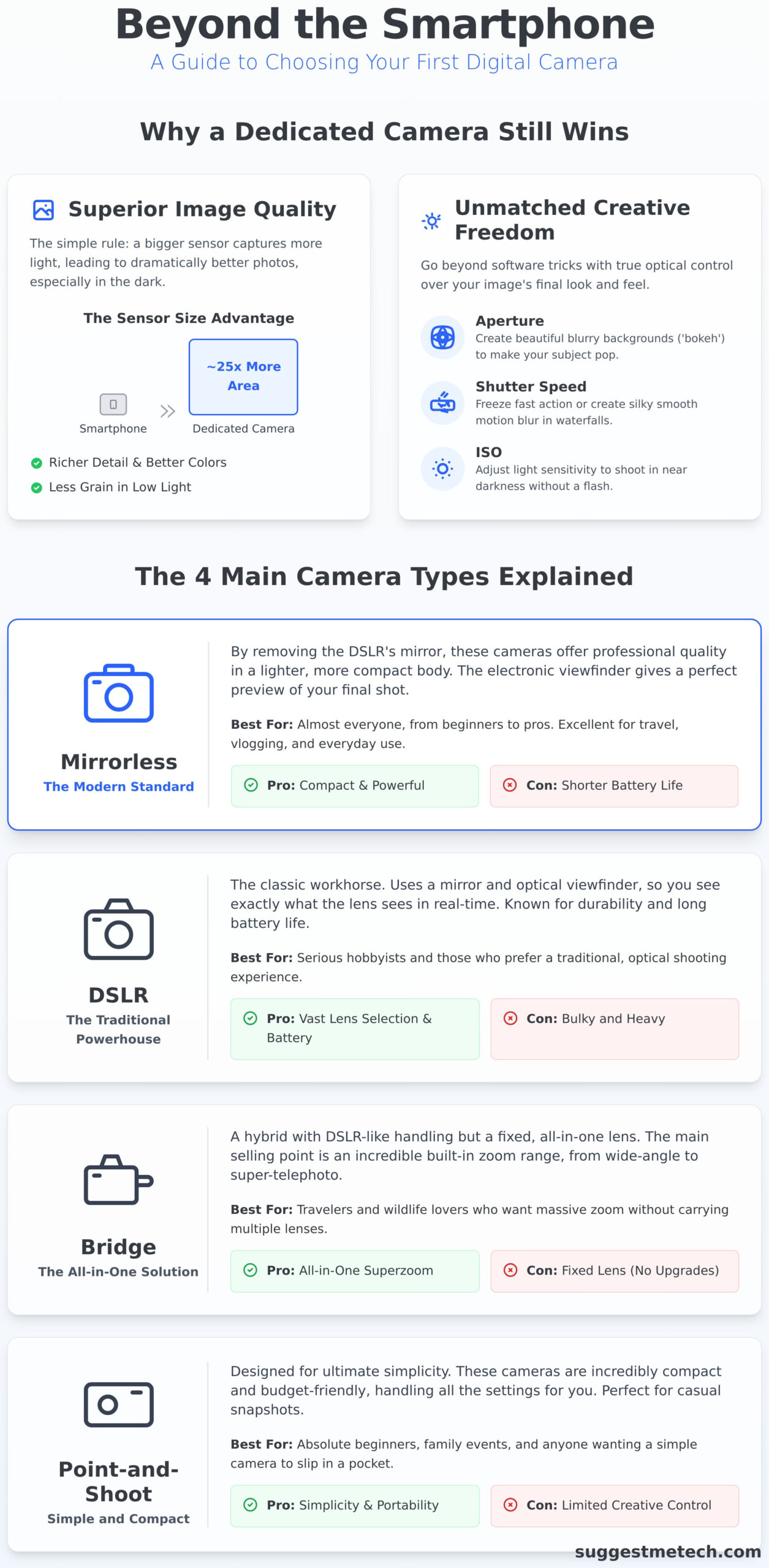
Let’s be clear: the camera in your pocket is incredible. Modern smartphones capture stunning, share-worthy photos with a single tap. But when you’re ready to move beyond point-and-shoot and take true creative control over your images, a dedicated camera is an essential tool. The biggest advantages come down to two key areas: superior image quality and unmatched creative freedom.
Image Quality: The Sensor Size Advantage
At the heart of every digital camera is a sensor-a small chip that captures light to create your photo. The simple rule is: bigger is better. A dedicated camera’s sensor is physically much larger than the tiny one inside a smartphone. This massive size advantage allows it to gather significantly more light, resulting in photos with richer detail, better colors, and dramatically less graininess, especially in challenging low-light situations.
Low Light Portrait: Smartphone
Low Light Portrait: Digital Camera
Creative Freedom: Lenses and Manual Controls
A dedicated digital camera opens up a world of creative possibilities that phones can only simulate with software. The ability to swap lenses lets you go from capturing vast landscapes with a wide-angle lens to zooming in on distant wildlife with a telephoto lens. More importantly, manual controls give you direct command over the final look of your image:
- Aperture: Controls how much of the scene is in focus. A wide aperture creates that beautiful, professional-looking blurry background (called ‘bokeh’) that makes your subject pop.
- Shutter Speed: Determines how long the sensor is exposed to light. Use a fast speed to freeze a speeding car in perfect clarity, or a slow speed to turn a waterfall into a silky, smooth blur.
- ISO: Adjusts the sensor’s sensitivity to light, allowing you to shoot in near darkness without a flash.
While a smartphone’s ‘portrait mode’ does a decent job faking a blurry background, it’s a computational trick. The optical depth and quality you get from a real lens and sensor are simply in another league.
The Main Types of Digital Cameras Explained
Choosing your first digital camera can feel overwhelming, but it really boils down to four main types. Each category is designed for a different kind of photographer, from the casual snapper to the aspiring pro. Understanding the basic differences in how they are built and who they are for is the first step toward finding the perfect match for your creative goals and budget.
Here’s a quick comparison to help you see the key differences at a glance:
| Camera Type | Best For | Key Pro | Key Con |
|---|---|---|---|
| Point-and-Shoot | Absolute Beginners | Simplicity & Portability | Limited Creative Control |
| DSLR | Serious Hobbyists | Lens Selection & Battery | Bulky and Heavy |
| Mirrorless | Almost Everyone | Compact & Powerful | Shorter Battery Life |
| Bridge | Travelers & Zoom Lovers | All-in-One Zoom | Fixed Lens |
Point-and-Shoot Cameras: Simple and Compact
Just as the name implies, these cameras are all about simplicity. You point, you shoot, and the camera handles the rest. They are incredibly compact and budget-friendly, making them perfect for slipping into a pocket for a family outing or a casual trip. However, their small sensors and limited manual controls mean you’ll have less creative freedom than with more advanced models.
Best for: Casual travel, family snapshots, and absolute beginners.
DSLR Cameras: The Traditional Powerhouse
DSLRs (Digital Single-Lens Reflex) are the classic workhorses of photography. They use a mirror inside the camera body to reflect light up into an optical viewfinder, so you see exactly what the lens sees in real-time. While the core principles of how digital cameras work apply to all types, this mirror mechanism is unique to DSLRs. They boast fantastic battery life and a massive ecosystem of lenses but are noticeably heavier than their modern counterparts.
Best for: Serious hobbyists and photographers who prefer a traditional feel.
Mirrorless Cameras: The Modern Standard
Mirrorless cameras are the new industry standard for a reason. By removing the bulky mirror system found in DSLRs, they offer a lighter, more compact body without sacrificing image quality. Instead of an optical viewfinder, they use an electronic one that shows a digital preview of your shot, complete with exposure changes. They excel at video and are perfect for nearly every situation.
Best for: Most users, from beginners to pros; excellent for travel and vlogging.
Bridge Cameras: The All-in-One Solution
Think of a bridge camera as a hybrid-it offers the comfortable handling of a DSLR with the simplicity of a fixed, all-in-one lens. Their main selling point is an incredible built-in zoom range, letting you shoot a wide landscape one moment and a distant bird the next. This makes them ideal for anyone who wants massive zoom without the hassle or expense of carrying multiple lenses.
Best for: Wildlife, sports, and travelers who want maximum reach.
Decoding the Jargon: Key Features That Actually Matter
Diving into the world of digital cameras can feel like learning a new language. You’re hit with terms like “megapixels,” “f-stops,” and “sensor size,” and it’s easy to get overwhelmed. Don’t worry-we’ll cut through the noise. Instead of getting lost in a spec sheet, let’s focus on the three key features that have the biggest impact on the quality of your photos.
Sensor Size: The Heart of Your Camera
Think of a camera’s sensor as its retina; it’s the surface that captures light to create an image. A larger sensor can gather more light, which is why its size is often more important than megapixels for overall image quality. This is especially true when shooting in low light, as a bigger sensor produces cleaner, less grainy photos.
[Visual: Simple graphic showing the relative sizes of Full-Frame, APS-C, and Micro Four Thirds sensors]
- Full-Frame: The largest common sensor, offering the best low-light performance and image quality.
- APS-C: A smaller, very common sensor found in many beginner to mid-range models. It’s a fantastic balance of quality and cost.
- Micro Four Thirds: The smallest of the three, allowing for more compact cameras and lenses.
Megapixels: How Many Do You Really Need?
For years, marketing has told us that more megapixels (MP) are always better. That’s only half true. Megapixels determine the resolution of your photo, which matters most for two things: printing size and cropping. For most beginners sharing photos online or making standard prints, 20-24MP is more than enough. A higher megapixel count is only crucial if you plan on making massive, wall-sized prints or need the flexibility to crop your images heavily without losing detail.
Lenses: Your Camera’s Eye on the World
The lens you attach to your digital camera has a massive effect on the final image. It dictates your perspective and how much light you can capture. You’ll encounter two main types:
- Zoom Lenses: Offer a range of focal lengths (e.g., 18-55mm), giving you the flexibility to shoot wide landscapes and then zoom in on a distant subject.
- Prime Lenses: Have a fixed focal length (e.g., 50mm). They can’t zoom, but they often produce sharper images and perform better in low light thanks to a wider aperture (the ‘f-number’ like f/1.8). A lower f-number means more light and the ability to create that beautiful blurry background you see in professional portraits.
To dive deeper into this crucial component, see our guide to the best lenses for beginners.
How to Choose the Right Digital Camera for YOU
Forget the spec sheets for a moment. The best digital camera isn’t the one with the most megapixels-it’s the one that fits how you shoot. To find your perfect match, we recommend focusing on your goals instead of getting lost in the jargon. Identify your primary use case below to see which type of camera is right for you.
For the Casual Traveler and Family Chronicler
If your goal is to capture high-quality memories on vacation or at family gatherings without a heavy bag, your priorities are simplicity and portability. You need a camera that’s easy to pack and delivers excellent photos with a reliable “auto” mode. Look for helpful features like a flip-out screen for easy selfies and built-in Wi-Fi for quickly sharing photos to your phone.
Our Recommendation: A high-end point-and-shoot or an entry-level mirrorless camera will give you a massive quality boost over your smartphone without a steep learning curve. Keep an eye out for our upcoming ‘Best Travel Cameras’ guide for specific models!
For the Aspiring Vlogger and Content Creator
For future YouTube stars and TikTok creators, video is king. Your camera must be a versatile video production tool. Top priorities include outstanding video quality, great audio options, and features that make filming yourself simple. Don’t settle for less than 4K resolution, and ensure the camera has a dedicated microphone input-your audience will thank you for the clear audio.
Our Recommendation: A mirrorless camera is your best bet. Look for models with a fully articulating flip screen so you can see yourself while recording, fast video autofocus to stay sharp, and in-body image stabilization (IBIS) to keep your footage smooth.
For the Serious Hobbyist and Aspiring Pro
Are you ready to move beyond auto mode and take full creative control? If you want to master photography, you’ll need a camera that can grow with you. Your focus should be on manual controls, the creative potential of different lenses, and superior image quality from a larger sensor, like an APS-C or full-frame model.
Our Recommendation: An advanced mirrorless or DSLR camera is the right choice. These systems offer vast lens ecosystems, giving you the flexibility to shoot everything from portraits to landscapes. The ability to change lenses is the single biggest factor in unlocking your creative potential.
Now that you’ve identified the right type of digital camera for your needs, the next step is finding the perfect model. Ready to buy? Check out our Best Cameras for Beginners to see our top picks.
Getting Started: Essential Accessories for Your New Camera
Congratulations on your new digital camera! While the camera body and lens are the heart of your setup, a few key accessories will dramatically improve your experience and protect your investment. Think of these not as optional extras, but as essential tools for getting the most out of your photography from day one.
Memory Cards and Extra Batteries
Your camera is useless without power and storage. When buying an SD card, look for a speed class that matches your needs-a U3 or V30 rating is a great starting point for smooth 4K video recording and burst shooting. We strongly recommend buying at least one spare battery; there’s nothing worse than running out of power during a perfect photo opportunity. Get these essentials before a big trip, and be wary of suspiciously cheap memory cards from unknown sellers, as they are often slow, unreliable, or counterfeit.
A Comfortable Camera Bag and Strap
Protecting your gear is crucial. Choose a bag that fits your shooting style-a compact sling bag is great for city travel, while a backpack offers more room for extra lenses and is better for hiking. Look for a bag with adjustable dividers and a little extra room to grow with your collection. The strap included in the box is often an afterthought. We recommend upgrading to a more comfortable and ergonomic third-party strap; it’s a small change that makes a huge difference during a long day of shooting.
Basic Cleaning and Maintenance Tools
A clean lens is critical for a sharp photo. You don’t need a complex kit, just a few essentials to keep your gear in top shape and extend its life. Avoid using your t-shirt or a paper towel, which can leave scratches and lint.
- Microfiber Cloth: For safely wiping away smudges and fingerprints.
- Air Blower: To remove dust from the lens and camera body without touching them.
- Lens Pen: A dual-sided tool with a soft brush and a carbon-based cleaning tip for stubborn spots.
To clean your lens, first use the air blower to remove loose dust. Next, use the brush end of a lens pen for any remaining particles. Finally, use the microfiber cloth or the pen’s cleaning tip in a gentle, circular motion to remove any smudges. Proper care ensures your digital camera will perform at its best for years to come.
For more tech recommendations and guides, check out our other reviews at suggestmetech.com.
From Knowledge to Action: Finding Your Perfect Camera
You’ve now navigated the essentials, from understanding why dedicated cameras still triumph over smartphones to decoding the key features that truly impact your photos. The most important takeaway is that choosing the right digital camera isn’t about memorizing specs-it’s about matching the tool to your creative ambition, whether you’re shooting family portraits, travel vlogs, or artistic landscapes.
The next step is the most exciting one. To help you move forward with confidence, we’ve applied our expert-driven analysis to identify the top models for newcomers. Our recommendations are built on real-world use cases and explained with the same clear, jargon-free approach you found in this guide. Ready to find your first camera? See our picks for the Best Digital Cameras for Beginners!
Your photography journey is just beginning. The world is full of incredible moments-now you have the knowledge to capture them beautifully. Happy shooting!
Frequently Asked Questions
What’s the difference between optical zoom and digital zoom?
Optical zoom uses the camera’s physical lens elements to magnify a subject, just like a pair of binoculars. This method maintains the full resolution and quality of your image. In contrast, digital zoom simply crops the image and enlarges the pixels to simulate getting closer. This process significantly degrades image quality, often resulting in a blurry or pixelated photo. For the best results, always prioritize a camera’s optical zoom capabilities.
Are mirrorless cameras definitively better than DSLRs now?
For most beginners in 2026, mirrorless cameras are the superior choice. They are typically smaller, lighter, and offer more advanced technology, such as superior autofocus systems and video features. While DSLRs still offer rugged builds and longer battery life, all major brands are now focusing their innovation on the mirrorless market. This makes a mirrorless camera a more future-proof investment for anyone starting their photography journey today.
How much should I expect to spend on my first digital camera?
A great entry-level digital camera with a versatile kit lens will typically cost between $600 and $900. This price point provides excellent image quality and all the core features you need to learn the fundamentals of photography. If your budget allows, spending between $900 and $1,300 will get you a more advanced model with better autofocus, higher-quality video, and improved performance in low-light situations, offering more room to grow.
Can I use a digital camera for live streaming or as a webcam?
Yes, absolutely. Most modern cameras can function as high-quality webcams, delivering a significant upgrade over standard built-in options. Many manufacturers, including Canon, Sony, and Nikon, provide free software that lets you connect your camera directly to a computer via USB. For the most reliable, professional-quality stream, you can also use an HDMI capture card, which is a popular solution for dedicated content creators and streamers.
Is it better to buy a camera with a kit lens or body-only?
For your first camera, buying a bundle with the included “kit lens” is almost always the best and most cost-effective option. These lenses are designed to be versatile, covering the most common focal lengths you’ll need for everyday photos. Purchasing a camera body-only is generally recommended for photographers who already own compatible lenses or have a specific, more specialized lens they intend to buy separately from the start.
What are the best brands for digital cameras in 2026?
In 2026, the dominant brands remain Sony, Canon, and Nikon. Sony is widely recognized for its industry-leading autofocus technology and extensive lens selection. Canon excels with its user-friendly menus and renowned color science, making it a favorite for portraits. Nikon continues to be celebrated for its excellent ergonomics and robust build quality. Brands like Fujifilm and Panasonic also offer compelling options, known for their unique styling and powerful video capabilities, respectively.