Feeling lost in a sea of technical terms like HEPA and CADR? Worried that the ideal model is either too expensive, too loud, or just a glorified fan? We get it. Choosing the right air purifier shouldn’t require an engineering degree-it should be about making your home healthier and more comfortable, without the guesswork. You deserve to know if these devices actually work and which one is the right investment for your space and your health.
That’s why our team spent months testing the top models of 2026. We cut through the marketing noise to bring you clear, practical advice on what truly matters: performance, noise levels, and long-term costs. In this guide, we compare the best units for tackling everything from pet dander and seasonal allergies to smoke and dust. We’ll help you find a quiet, effective machine that fits your room and your budget, so you can breathe easier and feel confident in your choice.
Key Takeaways
- Identifying the specific pollutants in your home-from pet dander to VOCs-is the first step toward choosing the right filtration technology.
- Matching an air purifier’s key performance metrics, like CADR and ACH, to your room size and health goals is crucial to avoid overspending.
- Discover our top-rated models for 2026, with clear recommendations for every need, from tackling pet allergies to eliminating smoke odors.
- Look beyond the sticker price by learning how to calculate the long-term costs of filter replacements and energy consumption before you buy.
What’s in Your Air? How Purifiers Create a Healthier Home
You might be surprised to learn that the air inside your home or office can be more polluted than the air outside. Everyday life fills our spaces with a mix of invisible intruders: dust, pollen, pet dander, smoke, and even Volatile Organic Compounds (VOCs) released from furniture and cleaning products. An air purifier is designed to combat this by continuously cycling the air in a room, trapping these harmful particles and gases.
At its core, the principle behind how air purifiers work is straightforward: a fan pulls in ambient air, forces it through a sophisticated filtering system, and circulates clean, fresh air back into your space. The immediate benefits are clear, offering significant allergy relief, noticeable odor reduction, and a general boost to your wellness. However, a purifier’s effectiveness hinges entirely on its filtration technology, making it crucial to understand what’s inside the machine.
The Heart of the Machine: How HEPA Filters Work
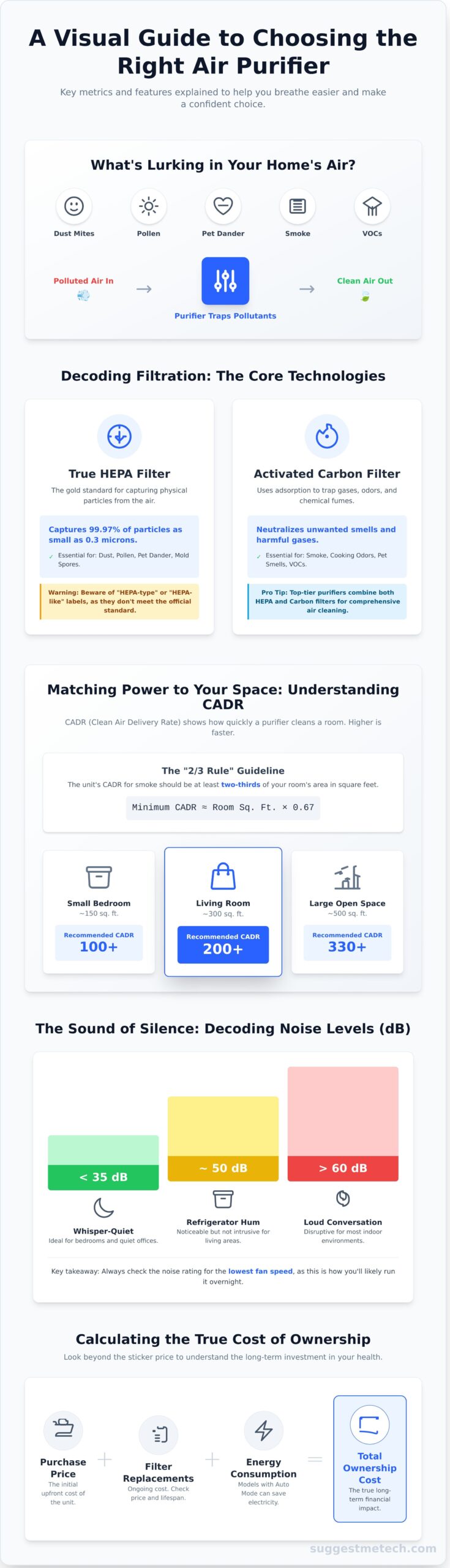
The gold standard for capturing airborne particles is the True HEPA filter. This isn’t just a marketing term-it’s a government standard of efficiency. A True HEPA filter is certified to capture 99.97% of particles as small as 0.3 microns, which includes most dust, pollen, and pet dander. Be cautious of vague labels like “HEPA-type,” as they don’t meet this rigorous standard and are less effective. For allergy sufferers, a True HEPA filter is non-negotiable.
Beyond Allergens: Activated Carbon for Odors and Gases
While HEPA filters excel at trapping solid particles, they can’t stop gases and odors. That’s where activated carbon comes in. This porous material uses a process called adsorption to trap gas molecules on its surface, effectively neutralizing smoke, cooking smells, pet odors, and harmful VOCs. The best air purifiers combine a True HEPA filter with a substantial activated carbon layer, providing a comprehensive solution for both airborne particles and unwanted odors.
How to Choose the Right Air Purifier: Key Features Explained
The “best” air purifier isn’t a one-size-fits-all solution. The ideal model for you depends entirely on your room size, specific air quality concerns, and budget. To cut through the marketing jargon and technical specs, you need to understand what the numbers on the box actually mean. This guide will demystify the key features, empowering you to make a confident and practical choice.
Before you start shopping, ask yourself these questions:
- What is the square footage of the room I need to purify?
- What are my primary concerns? (e.g., allergies, pet dander, smoke, or general dust)
- Where will the unit be placed? (e.g., bedroom, living room, or office)
- How important are quiet operation and smart features to my daily life?
CADR: Matching Purifier Power to Your Room Size
The most critical performance metric is the Clean Air Delivery Rate (CADR). In simple terms, CADR measures how quickly and effectively an air purifier removes specific pollutants like dust, pollen, and smoke from the air. A higher CADR means faster purification. A reliable guideline is the “2/3 rule”: the unit’s CADR for smoke should be at least two-thirds of your room’s area in square feet. For a more detailed breakdown, the U.S. EPA provides excellent guidance on how to choose an air cleaner based on these very metrics.
| Room Size (Approx.) | Recommended Minimum CADR |
|---|---|
| 150 sq. ft. (Small Bedroom) | 100 |
| 300 sq. ft. (Living Room) | 200 |
| 500 sq. ft. (Large Open Space) | 330 |
Noise Levels (dB): Finding the Quietest Performers
A purifier’s noise level, measured in decibels (dB), can make or break your experience, especially in a quiet space like a bedroom. For context, 30 dB is as quiet as a whisper, while 50 dB is comparable to a modern refrigerator. Always check the noise rating for the lowest fan speed, as this is how you’ll likely run it overnight. A unit operating below 35 dB on its lowest setting is generally considered whisper-quiet.
Smart Features & Controls: Convenience vs. Cost
Modern purifiers often come with features that add convenience but also increase the price. Auto Mode uses built-in sensors to detect pollutants and adjust fan speed accordingly, saving energy and eliminating guesswork. App control allows you to manage settings and create schedules from your phone, while filter life monitors tell you exactly when it’s time for a replacement. Decide if these hands-off features are worth the premium for your needs.
The Best Air Purifiers of 2026: Our Top Picks
After weeks of rigorous testing and analysis, we’ve identified the top models that deliver an exceptional blend of performance, value, and ease of use. Choosing the right air purifier can have a tangible impact on your well-being, a fact supported by a comprehensive scientific review on air quality that links cleaner indoor air to significant health benefits. Our picks are designed to help you breathe easier, whether you’re working, sleeping, or relaxing.
Best Overall: Coway Airmega AP-1512HH Mighty
Best for: Most people seeking a reliable, set-and-forget solution.
This model has been a top performer for years, and for good reason. It offers a fantastic balance of power, price, and intelligent features. Its auto mode is highly responsive, adjusting fan speed in real-time based on your room’s air quality, while its four-stage filtration system effectively captures dust, pollen, and odors. For proven durability and all-around excellence, the Mighty is hard to beat.
- CADR: 246 (Dust) / 240 (Pollen) / 233 (Smoke)
- Room Size Coverage: Up to 361 sq. ft.
- Noise Level: 24.4-53.8 dB
Best on a Budget: Levoit Core 300S
Best for: Small spaces and budget-conscious buyers.
The Levoit Core 300S proves you don’t need to spend a fortune for an effective air purifier. It delivers impressive performance for its compact size and includes smart features like app and voice control-a rarity at this price point. Its sleek, cylindrical design fits seamlessly into bedrooms, dorms, or home offices without drawing attention.
- CADR: 141 (Smoke) / 140 (Dust) / 145 (Pollen)
- Room Size Coverage: Up to 219 sq. ft.
- Noise Level: 22-47 dB
Best for Large Rooms: Blueair Blue Pure 211i Max
Best for: Large, open-plan areas like living rooms or combined kitchen-dining spaces.
When you need to clear a lot of air quickly, the Blueair Blue Pure 211i Max is our top choice. It boasts a powerful CADR rating without sounding like a jet engine. We love its minimalist Scandinavian design and simple one-button operation, making it a stylish and effective addition to any large room where air quality is a priority.
- CADR: 400 (Smoke)
- Room Size Coverage: Up to 635 sq. ft. (in 12.5 mins)
- Noise Level: 23-53 dB
Best for Bedrooms: Blueair Blue Pure 511
Best for: Bedrooms and home offices where quiet is essential.
The Blueair Blue Pure 511 is engineered for peaceful environments. On its lowest setting, it’s virtually silent, ensuring it won’t disturb your sleep or concentration. This compact and energy-efficient unit is the perfect companion for smaller rooms, effectively filtering airborne allergens and pollutants for a healthier personal space. It’s a simple, no-fuss solution for better sleep.
- CADR: 141 (Smoke)
- Room Size Coverage: Up to 219 sq. ft.
- Noise Level: 23-49 dB
Long-Term Costs: What to Expect After You Buy
Choosing the right air purifier is a great first step, but the initial purchase price is only part of the story. Understanding the total cost of ownership ensures your device remains an effective and affordable investment in your health. This practical guide breaks down the ongoing expenses so you can manage your budget and maximize the value you get from your new appliance.
The Hidden Cost of Replacement Filters
The most significant recurring cost is filter replacement. Most HEPA and carbon filters need to be replaced every 6 to 12 months, depending on usage and air quality. To give you a clear idea, annual filter costs for our top-rated models typically range from $50 for budget-friendly units to $150 for high-performance purifiers. While it may be tempting to buy cheaper third-party filters, we strongly advise against it-using them can often void your warranty and may reduce performance.
Energy Consumption and Your Electricity Bill
Worried about your electricity bill? The good news is that most modern purifiers are highly efficient, and many are Energy Star certified. When run continuously on a low setting, a typical unit consumes less energy than a standard 60-watt incandescent light bulb. To further reduce costs, use features like “Auto Mode,” which adjusts fan speed based on real-time air quality, or set a schedule so the unit only runs when you need it most.
Tips for Extending Your Air Purifier’s Lifespan
A little maintenance goes a long way in protecting your investment and keeping it running efficiently. Follow these simple tips to get the most out of your machine:
- Clean the pre-filter regularly. Most units have a washable pre-filter that catches larger particles like hair and dust. Cleaning it every 2-4 weeks helps the main HEPA filter last longer.
- Give it space to breathe. Proper airflow is critical. Place your unit at least one foot away from walls, furniture, and curtains for optimal air intake and circulation.
- Turn it off when windows are open. If you are airing out your home for an extended period, switch off your purifier. Making it clean an endless stream of outdoor air puts unnecessary strain on the motor and filters.
By keeping these long-term factors in mind, you can ensure your device provides clean air for years to come. For more expert buying guides, explore the latest reviews on SuggestMeTech.com.
Final Thoughts: Your Path to Cleaner Air
Choosing the right device for your home is a significant step, but it doesn’t have to be complicated. The key is to match the right features, like HEPA filtration and CADR ratings, to your specific needs and room size. As we’ve covered, it’s also crucial to consider long-term costs, such as filter replacements and energy consumption, to find a solution that works for your budget. Ultimately, investing in a quality air purifier is a direct investment in a healthier, more comfortable living environment for you and your family.
Our recommendations are always based on independent, hands-on testing, with a sharp focus on practical, real-world performance and overall value. We do the research so you can shop with confidence. To continue making smarter tech choices for your home and life, explore all our tech reviews and guides. You’re now equipped to make a great decision and start breathing easier.
Frequently Asked Questions About Air Purifiers
Do air purifiers really work for allergies and asthma?
Yes, especially models equipped with a True HEPA filter. These filters are highly effective at capturing common airborne allergens like pollen, dust mites, pet dander, and mold spores. By removing these triggers from the air you breathe, an air purifier can significantly reduce symptoms and provide relief for allergy and asthma sufferers. It’s a practical tool for improving indoor air quality as part of a comprehensive management plan for respiratory conditions.
How often do I need to change the filters on my air purifier?
Filter replacement schedules vary by model and usage. As a general rule, True HEPA filters typically need to be replaced every 6 to 12 months, while activated carbon pre-filters may require changing every 3 months. Many modern units feature a filter change indicator light to alert you. Always consult your device’s user manual for the manufacturer’s specific recommendations to ensure your purifier operates at peak efficiency.
Can an air purifier help protect against viruses like the flu?
An air purifier with a HEPA filter can help reduce the concentration of airborne viruses, including those that cause the flu. These filters are fine enough to capture the tiny respiratory droplets that carry viral particles. While it can lower the risk of transmission in a room, it is not a substitute for essential hygiene practices like handwashing and vaccination. Think of it as an added layer of protection for your indoor environment.
Where is the best place to put an air purifier in a room?
For the best results, place your air purifier in a location with strong airflow, ideally a few feet away from walls and large furniture. This prevents its intake and outtake vents from being blocked. Putting the unit in the room where you spend the most time, such as your bedroom or living room, will maximize its benefit. Avoid corners or placing it under a table, as this will severely limit its circulation and effectiveness.
Do air purifiers use a lot of electricity?
Most modern air purifiers are designed to be energy-efficient. On a low fan setting, a typical unit consumes about as much power as a standard incandescent light bulb (around 50-75 watts). To ensure low running costs, look for models with an ENERGY STAR certification, which are verified to meet strict energy performance standards. Running one continuously is unlikely to cause a significant spike in your electricity bill.
Can I run an air purifier 24/7?
Absolutely. In fact, continuous operation is recommended to maintain consistently clean air. Indoor air pollutants are generated constantly, so running your purifier 24/7 ensures it is always working to remove them. Most devices are built for round-the-clock use, and running them on a low, quiet setting overnight is an excellent way to support better sleep, especially for those with allergies or respiratory sensitivities.