

The internet is flooded with advice on making money, but how much of it is real? It’s easy to feel overwhelmed by the options and skeptical of promises that seem too good to be true. If you’re tired of the hype and ready for a practical, no-nonsense guide on how to make money online, you’ve come to the right place. We’ve cut through the noise to bring you a clear, actionable roadmap for 2025, designed to help you find a legitimate path that actually fits your skills and goals.
In this guide, we’ll walk you through 10 field-tested strategies, from freelancing and content creation to e-commerce and the gig economy. We won’t just give you a list; we’ll break down what skills and effort each path requires and provide the concrete first steps you can take today. Forget the confusion and time-wasting schemes. By the end of this article, you’ll have the clarity and confidence to start earning an income online.
Key Takeaways
- Success online isn’t about get-rich-quick schemes. Learn the realistic mindset and consistent effort required to build a sustainable income stream.
- Discover the four primary paths for earning online, from freelancing for immediate cash flow to building long-term assets like a content brand.
- Learn how to make money online by matching the right strategy to your personal goals and skills-not by following a one-size-fits-all plan.
- Get a simple framework to choose your ideal method and spot the red flags of common scams before you invest your time.
Before You Start: A Realistic Guide to Earning Online
The promise of earning a living from your laptop is compelling, but it’s crucial to begin with the right mindset. This isn’t a get-rich-quick scheme; it’s a journey that demands real effort, consistency, and patience. The strategies we’ll cover are proven, but your success depends on the foundation you build right now. Before you dive in, let’s set some clear, practical expectations.
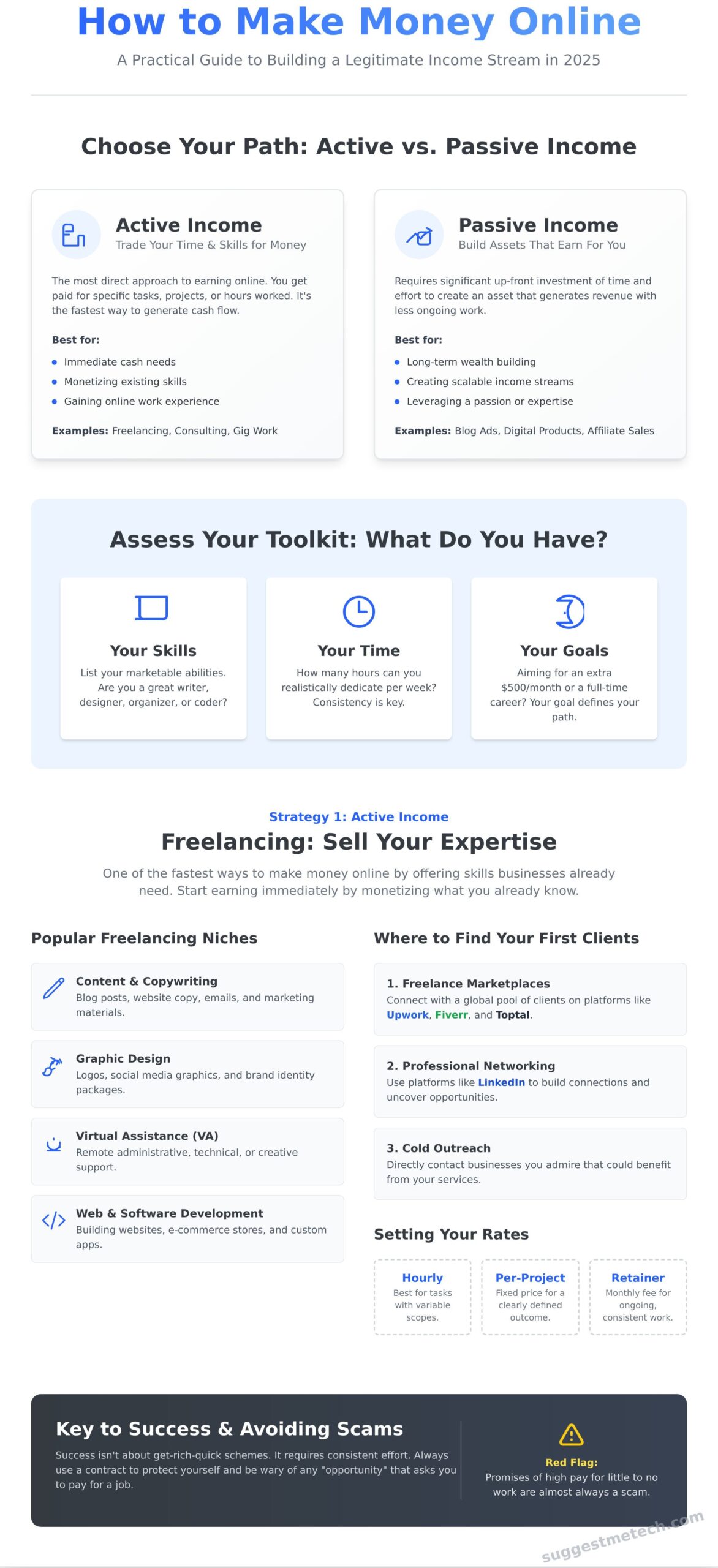
The Two Paths: Active vs. Passive Income
Your journey will likely follow one of two paths. Active income is the most direct approach: you trade your time and skills for money. Think of freelance writing, managing social media accounts, or taking on virtual assistant tasks. This often means becoming an independent contractor, a concept central to Understanding the Gig Economy, where you get paid for specific projects. It’s the fastest way to start seeing cash flow.
Passive income, on the other hand, involves building an asset that earns money with less ongoing effort. Examples include earning from a blog through ads, selling a digital course, or affiliate marketing. But be warned: the term “passive” is misleading. It requires a significant upfront investment of work to create and market the asset before it can generate revenue on its own.
Assessing Your Toolkit: Skills, Time, and Goals
To figure out how to make money online effectively, you need a clear picture of your personal resources. Start by taking an honest inventory. What are you good at, and what do you enjoy doing? A solid strategy is always built on your existing strengths.
- Your Skills: List your marketable abilities. Are you a great writer, a savvy social media user, a meticulous organizer, or a creative designer?
- Your Time: How many hours per week can you realistically and consistently dedicate? Be honest. Five focused hours a week is better than a planned twenty that never happens.
- Your Goals: What does success look like? Are you aiming for an extra $500 a month to cover bills, or are you building a full-time online career? Your goal determines your path.
Strategy 1: Freelancing & Selling Your Expertise
If you have a skill that businesses or individuals need, freelancing is one of the fastest and most direct methods for how to make money online. The concept is simple: you offer your expertise as a service to clients on a project or ongoing basis. Unlike starting a blog or an e-commerce store, you can begin earning income almost immediately by monetizing the skills you already possess. The key to success is building a strong portfolio that showcases your best work and demonstrates tangible results for potential clients.
Popular Freelancing Niches
While you can offer almost any skill, some fields are consistently in high demand. Focusing on one of these areas can accelerate your path to finding paid work. Consider these popular options:
- Content Writing & Copywriting: Creating compelling blog posts, website copy, emails, and marketing materials for businesses.
- Graphic Design: Designing logos, social media graphics, websites, and complete brand identity packages.
- Virtual Assistance (VA): Providing remote administrative, technical, or creative support, from managing schedules to handling social media accounts.
- Web & Software Development: Building and maintaining websites, e-commerce stores, and custom applications for clients.
Where to Find Your First Clients
Finding your first client is a major milestone. Start by exploring freelance marketplaces like Upwork, Fiverr, and Toptal, which connect freelancers with a global pool of clients. Beyond these platforms, professional networking on sites like LinkedIn can uncover hidden opportunities. While looking for work, it’s critical to be cautious; learning how to avoid job scams is an essential skill for any new freelancer. Finally, don’t be afraid of cold outreach-directly contacting businesses you admire that could benefit from your services.
Setting Your Rates and Getting Paid
Determining your pricing is a crucial step. Most freelancers use one of three models: hourly, per-project, or a monthly retainer for ongoing work. Research what other freelancers with your skill level and experience are charging to set a competitive rate. Always use a simple contract to outline the scope of work, deadlines, and payment terms. This protects both you and the client. For payments, use secure methods like the escrow systems on freelance platforms or trusted online payment processors.
Strategy 2: Building a Brand Through Content Creation
If you’re looking for a long-term strategy for how to make money online, content creation is a powerful path. Unlike quick gigs, this method focuses on building a loyal audience around a topic you’re passionate about. The monetization doesn’t come directly from the content itself, but from the community and trust you build over time. It’s a business, and it’s crucial to understand your tax obligations for online work from the start. Success hinges on two key factors: choosing a clear niche and maintaining a consistent content schedule across platforms like blogs, YouTube, or social media.
Blogging & Affiliate Marketing
Starting a blog remains a cornerstone of content creation. Platforms like WordPress make it incredibly accessible to set up your own site. The primary monetization method is often affiliate marketing, where you earn a commission for promoting products or services you trust. As your traffic grows, you can add other income streams like display ads or sponsored posts. The first step is a solid foundation. Choose the best web hosting for your new blog.
Starting a YouTube Channel
Video is a dominant force online, and YouTube is its king. Choose a niche you can create engaging videos about, whether it’s tech reviews, cooking tutorials, or gaming commentary. Monetization typically begins once you qualify for the YouTube Partner Program, which allows you to earn revenue from ads. Beyond ads, successful YouTubers diversify their income with brand sponsorships, merchandise sales, and affiliate links in their video descriptions.
Social Media & Niche Websites
Platforms like Instagram, TikTok, and even dedicated niche forums allow you to build a highly engaged community around a specific interest. This approach focuses on cultivating a strong following by providing immense value first. Monetization comes from brand partnerships (influencer marketing), selling your own digital or physical products, or driving traffic to an affiliate offer. The key is building trust that makes your audience receptive to your recommendations.
Strategy 3: Selling Products Online (Physical & Digital)
Moving beyond trading time for money, selling products online allows you to build a scalable business asset. The core idea is to create or curate products for a specific audience, whether it’s physical goods or digital files. This method of how to make money online offers significant growth potential, but success hinges on strong marketing and excellent customer service to build a loyal following.
E-commerce and Dropshipping
Dropshipping is a popular e-commerce model where you sell products without holding any inventory. When a customer places an order, you forward it to a third-party supplier who ships the product directly to them. Platforms like Shopify and WooCommerce make it easy to build a professional store. While startup costs are low, be prepared for thin profit margins and high competition in popular niches.
Creating and Selling Digital Products
Digital products offer some of the highest profit margins because you create them once and can sell them an infinite number of times. This is a powerful, scalable approach for anyone with specialized knowledge or creative skills. Common examples include:
- E-books and guides
- Online courses or workshops
- Digital templates (for social media, resumes, etc.)
- Stock photos or video clips
You can sell them through marketplaces like Gumroad, course platforms like Teachable, or directly from your own website for maximum control.
Print-on-Demand (POD)
Print-on-demand (POD) is a perfect low-risk entry point for creatives. You create custom designs and upload them to services like Printful or Redbubble. When a customer buys a t-shirt, mug, or poster with your design, the POD service handles all the printing, packaging, and shipping. You simply collect the profit without ever touching inventory, making it an ideal way to monetize your creativity.
Strategy 4: Leveraging the Gig Economy for Quick Wins
Not every online income stream needs to become a full-time career. If you’re exploring how to make money online for the first time, the gig economy offers some of the fastest and most accessible entry points. These methods are perfect for earning your first few dollars, testing the waters, or generating supplemental income during your spare time.
The key advantages are flexibility and an extremely low barrier to entry-you can often start earning within an hour. However, it’s crucial to manage your expectations. Think of these as “quick wins” for your wallet, not get-rich-quick schemes. The earning potential is typically lower than the other strategies we’ve covered, but the immediacy is a major benefit.
Online Surveys and Micro-tasks
This is one of the most straightforward ways to earn from your computer. Platforms like Prolific and Amazon Mechanical Turk (MTurk) connect you with businesses and researchers who need small tasks completed. These can range from data entry and content moderation to participating in academic studies. While the pay per task is small, it can add up. This is a low-income but highly flexible option you can do from anywhere.
User Testing for Websites and Apps
Do you have opinions on what makes a website easy or frustrating to use? User testing allows you to get paid for that feedback. Companies use services like UserTesting.com and Trymata to pay real people to test their digital products. You’ll typically be asked to record your screen and voice your thoughts as you complete a set of tasks. Most tests take 15-20 minutes and pay around $10 to $20, making this a more lucrative and engaging option than micro-tasks.
How to Choose Your Path and Avoid Common Scams
We’ve explored several proven strategies, but the best one for you depends entirely on your personal goals, skills, and timeline. The key is to move from learning to doing. This final section provides a practical framework to help you choose a path, stay safe, and take your first confident step toward earning online.
Matching a Method to Your Goals
To find the right fit, align your approach with your immediate needs and long-term ambitions. There is no single “best” way to make money online, only the best way for you. Consider these common scenarios:
- If you need money now: Focus on active income models like freelancing or gig work. These methods directly trade your time and skills for cash. Platforms like Upwork or Fiverr can help you land your first client and generate income within weeks, not months.
- If you want long-term growth: Concentrate on building a digital asset. An e-commerce store, blog, or YouTube channel requires significant upfront effort but can create a passive income stream that generates revenue for years to come.
- If you have a creative skill: Monetize your talent by selling digital products or using print-on-demand (POD). This allows you to create something once-like a design, template, or e-book-and sell it repeatedly with minimal overhead.
Red Flags: How to Spot an Online Scam
Unfortunately, where there is opportunity, there are also scams. Staying vigilant is crucial for protecting your time and money. Be skeptical of any offer and watch for these common red flags:
- Promises of huge returns with no effort. Legitimate online work requires skill and dedication. If an offer sounds too good to be true, it almost certainly is.
- Requiring a large upfront payment. Be wary of any “opportunity” that demands you pay hundreds of dollars for a starter kit, training, or access to a “secret system.”
- Vague job descriptions and high-pressure sales tactics. Scammers use unclear language and create a false sense of urgency to push you into a decision before you can do proper research.
- A lack of transparency. A real business has a clear online presence, verifiable reviews, and accessible contact information. If you cannot find out who is behind an offer, it’s best to walk away.
The journey to earning online is a marathon, not a sprint. Don’t feel pressured to have everything figured out at once. Start with one small, manageable step-whether that’s creating a freelancer profile, outlining your first video, or researching a product niche. The most important thing is to begin. Learn as you go, adapt your strategy, and stay persistent. You have the tools to get started today.
Your Next Step to Earning Online
The journey of learning how to make money online is less about finding a single secret and more about choosing the right strategy for your skills and goals. Whether you’re drawn to the freedom of freelancing, the creativity of content creation, or the entrepreneurial spirit of e-commerce, the key is to start with a realistic plan. Remember, consistency and choosing a legitimate path are your greatest assets in avoiding common pitfalls and achieving sustainable success.
No matter which path you choose, the right tools are non-negotiable. Find the best tech to power your online venture with our Editor’s Picks for essential business software and in-depth reviews of web hosting and productivity tools. We compare the critical features so you can make confident, practical decisions for your budget and goals.
The digital landscape is full of opportunity. With a clear strategy and the right support, you are well-equipped to turn your ambition into income. Your journey starts now.
Frequently Asked Questions
What is the easiest way to start making money online for a complete beginner?
For a complete beginner, the easiest entry points are usually freelance marketplaces and micro-task websites. Platforms like Upwork or Fiverr allow you to offer simple services based on existing skills, such as writing, data entry, or graphic design, with no upfront investment. Another option is participating in paid online surveys or user testing on sites like UserTesting.com. These methods require minimal setup and can help you earn your first online dollars quickly.
How much money can you realistically make online per month?
Your potential earnings vary widely based on the method you choose, the time you invest, and the skills you have. A side hustle like taking surveys might only net you $50-$200 per month. Part-time freelancing could generate $500-$2,000+. A full-time online business, such as a successful e-commerce store or blog, could potentially earn $5,000 or more per month. It’s crucial to set realistic expectations and understand that significant income often requires significant effort.
Do I need to pay taxes on the money I make online?
Yes, in most countries, income earned online is taxable. This is often classified as self-employment income, which means you are responsible for tracking your earnings and expenses. It’s essential to set aside a portion of your income for taxes and potentially make quarterly estimated payments. We strongly recommend consulting with a tax professional in your area to ensure you are complying with all local and national laws and maximizing your deductions.
How much money do I need to start an online business?
The startup cost depends entirely on the business model. You can start a freelance service-based business for almost $0, using existing skills and free online profiles. Starting a blog might cost under $100 for a domain and a year of web hosting. An e-commerce or dropshipping business could require a larger initial investment of $200-$1,000+ for platform fees, product sourcing, and marketing. Many strategies for how to make money online can be started on a minimal budget.
Can I make money online without showing my face?
Absolutely. There are numerous profitable online ventures that don’t require you to be on camera or use your personal image. Popular options include freelance writing, graphic design, proofreading, or managing social media accounts for businesses. You could also run a “faceless” YouTube channel using animations or stock footage, start a niche blog under a pen name, or operate a dropshipping store. Your brand can be built around your work, not your identity.
What skills are most in-demand for making money online in 2025?
Looking ahead to 2025, skills that blend technology and marketing remain highly valuable. Top skills include digital marketing (especially SEO and paid advertising), video creation and editing, UX/UI design for websites and apps, and e-commerce management. Additionally, proficiency with AI tools, such as prompt engineering and using AI for content creation or data analysis, is rapidly becoming a critical skill for gaining a competitive edge in the online marketplace.