

That $1.99/month hosting deal looks incredible… until you reach the checkout and the price suddenly triples. Or worse, you launch your site only to battle sluggish speeds and a support team that vanishes when you need them most. The search for genuinely cheap web hosting that doesn’t suck often feels like navigating a minefield of hidden fees, technical jargon, and frustrating upsells, leaving you wondering if a good deal is even possible.
We’re here to tell you it is. You shouldn’t have to sacrifice performance and peace of mind for an affordable price. We’ve spent weeks putting the most popular budget hosts to the test-running speed benchmarks, monitoring uptime, and grilling their support staff. In this guide, we cut through the marketing hype to reveal our top 2025 value picks. You’ll find reliable hosts for under $5/month, learn the critical red flags to avoid, and gain the confidence to launch a fast, secure website without breaking the bank.
Key Takeaways
- Learn to spot the common red flags of budget hosting, like hidden renewal fees and slow server speeds, before you commit.
- Discover our top-rated picks for cheap web hosting that doesn’t suck, all tested for reliable speed, uptime, and support.
- Arm yourself with a practical 7-point checklist to evaluate any budget host, ensuring you make a decision you won’t regret.
- Understand the critical difference between “cheap” and “free” hosting and why the latter is a trap for any serious project.
What Actually ‘Sucks’ in Cheap Web Hosting? (And How to Spot It)
When you search for affordable web hosting, the real goal is finding cheap web hosting that doesn’t suck. The problem is, many providers use a rock-bottom price tag to distract you from fundamental flaws. While the basics of what web hosting is-providing server space for your website’s files-are simple, the quality of that service can vary dramatically. To avoid a bad experience, you need to know what to look for. Let’s break down the four most common red flags that separate a great deal from a future headache.
The ‘Gotcha’ Pricing: Sky-High Renewal Rates
The most common trap is the introductory offer. A host might advertise a plan for $2.95/month, but that price is only for your first term. When it’s time to renew, that rate can jump to $12 or even $15 per month, turning a cheap plan into an expensive one. Always check the ‘regular’ or renewal price before committing. A truly affordable host is transparent about its long-term costs.
Glacially Slow Servers & Poor Uptime
Cheap hosts often cut costs by cramming hundreds of websites onto a single shared server. This ‘overcrowding’ leads to glacially slow loading times, which harms user experience and your SEO rankings. Similarly, poor uptime-the percentage of time your site is online-can make your site inaccessible. Look for an uptime guarantee of at least 99.9%. A slow, offline website is useless, no matter how cheap it is.
Customer Support That Goes Missing in Action
When your website goes down, you need help immediately. This is where budget hosts often fail. To keep prices low, they outsource support to agents with limited knowledge or force you into slow ticket systems. Reliable support is non-negotiable. Look for providers offering 24/7 live chat as a bare minimum so you can get real-time help when you need it most.
Constant Upsells for ‘Essential’ Features
That super-low monthly price often comes with a catch: essential features cost extra. A host that isn’t truly providing good, affordable service will constantly upsell you for things that should be standard. Watch out for extra charges on:
- SSL Certificates: For security (HTTPS). This is a must-have.
- Daily Backups: To protect your data from being lost.
- Email Accounts: For using your own domain name (e.g., you@yoursite.com).
These features are critical for any modern website, not optional add-ons.
Our Top 5 Picks for Cheap Web Hosting That Genuinely Doesn’t Suck
We’ve tested dozens of budget hosts to find the providers that deliver real value without cutting critical corners. Our evaluation wasn’t just about the advertised price; we scrutinized performance metrics, support quality, and long-term costs. We also confirmed that each provider includes essential protections, because the best security features the web host offers, like a free SSL certificate, are non-negotiable.
The hosting solutions below represent the best of the best, offering a superb balance of affordability and reliability. They prove that you can find cheap web hosting that doesn’t suck. We’ve highlighted who each option is best for to help you make a quick, confident decision.
1. Top Value Host: Best Overall Value
Best for: Users who want the lowest possible price without sacrificing performance.
This top value host delivers an incredible package for its price point. You get an extremely low introductory rate with clear, upfront renewal pricing. More importantly, they run on modern web servers, which provides a significant speed boost over older technology. Every plan includes a free SSL certificate, weekly backups, and a free domain for the first year, all managed through their intuitive, beginner-friendly control panel.
2. Flexible Billing Option: Best for Transparent Monthly Billing
Best for: Anyone who wants to avoid a long-term contract.
This flexible option stands out by offering affordable and straightforward month-to-month plans, giving you maximum flexibility. It’s a fantastic choice for bloggers and small businesses looking for an easy entry point. Their confidence is backed by an industry-leading extended money-back guarantee. A free domain and pre-installed SSL certificate are included, making setup a breeze.
3. Beginner-Friendly Pick: Best for WordPress Beginners
Best for: First-time website owners using WordPress.
This beginner-friendly provider has built its reputation on being one of the most accessible hosts available. Their guided WordPress setup and intuitive dashboard remove the technical guesswork, letting you focus on building your site. With reliable 24/7 customer support, a free domain for your first year, and a free CDN to speed up your site for global visitors, this is a solid, dependable choice for getting started online.
4. Performance Focus: Best for Speed on a Budget
Best for: Site owners who prioritize loading speed above all else.
This performance-focused host is obsessed with speed. While their base plans are solid, their optimized server options offer an incredible performance jump, promising significantly faster page loads. This focus on speed and reliability makes them a top contender in the world of cheap web hosting that doesn’t suck. They also provide helpful perks like free automatic backups and a hassle-free site migration service to get you started quickly.
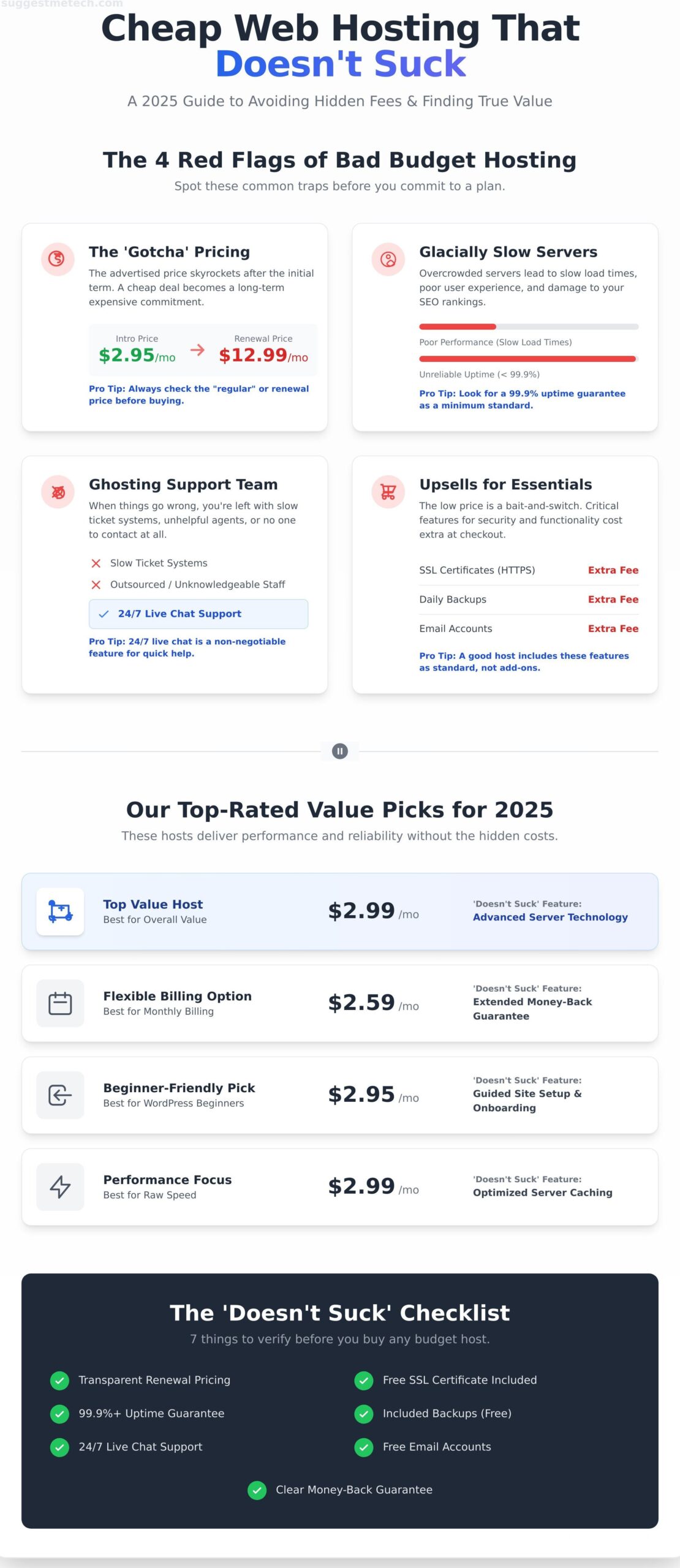
The ‘Doesn’t Suck’ Checklist: 4 Critical Checks Before You Buy
Our recommendations are a great starting point, but we want to empower you to make your own informed decisions. Any time you evaluate a budget host, use this checklist. It requires you to dig a little deeper than the flashy homepage marketing, but spending ten minutes on this research can save you months of frustration. The Federal Trade Commission even provides guidance on what to ask when hiring a web host, reinforcing the need for due diligence. Follow these steps to find genuinely cheap web hosting that doesn’t suck.
1. Find the Real Renewal Price
That eye-catching $2.95/month price is almost always an introductory offer. Before you commit, find the “regular” or “renewal” price listed in smaller print. Calculate your total cost over a 24 or 36-month term by multiplying the renewal rate by the number of months, then add the initial term’s cost. This gives you the true long-term investment and ensures it actually fits your budget.
2. Confirm SSD Storage is Standard
This is a non-negotiable technical requirement. Websites hosted on Solid State Drives (SSD) load significantly faster than those on older Hard Disk Drives (HDD). Speed is crucial for user experience and SEO. If a hosting provider doesn’t prominently advertise “SSD Storage” for their plans, you should assume they are using slower HDDs and look elsewhere.
3. Check for Free, Auto-Enabled SSL
An SSL certificate enables HTTPS (the padlock icon in a browser), which secures the connection between your site and your visitors. It’s essential for trust, security, and search engine rankings. This should be a free, one-click installation, typically provided by Let’s Encrypt. Be wary of any budget host that tries to upsell you a basic SSL certificate for $50+ per year.
4. Verify a Clear Backup Policy
Your website’s data is invaluable. A reliable backup policy is your ultimate safety net against hacks, updates gone wrong, or user error. Before signing up, find out:
- Does the host provide free, automatic daily or weekly backups?
- How simple is it to access and restore a backup yourself?
- Do they charge a fee for restoration?
A clear, user-friendly backup system is a key feature of any cheap web hosting that doesn’t suck.
Is Free Web Hosting a Trap? (Spoiler: For Serious Sites, Yes)
The allure of “free” is powerful, especially when you’re just starting. But in the world of web hosting, “free” and “affordable” are fundamentally different. Free hosting providers have to cover their costs somehow, and they do it through compromises that can seriously damage your project’s credibility and potential for growth. While you might not pay with a credit card, you pay in other, more significant ways.
The goal isn’t to find free hosting; it’s to find cheap web hosting that doesn’t suck. Understanding the trade-offs of a free plan is the first step in making the right choice for your website.
The Hidden Costs and Limitations of ‘Free’
Free hosting services come with a long list of restrictions that make them unsuitable for any serious venture. These aren’t minor inconveniences; they are major roadblocks to building a professional online presence.
- Forced Ads: The provider will place their own banners and pop-up ads on your website. You have no control over what they advertise, and it immediately makes your site look unprofessional and untrustworthy.
- Extremely Slow Performance: Free servers are notoriously slow and unreliable. They are often overloaded with thousands of other sites, leading to sluggish load times and frequent downtime that will frustrate your visitors.
- Unprofessional Subdomains: You won’t get a custom domain name (like yourbusiness.com). Instead, you’ll be stuck with a branded subdomain, such as yoursite.freehost.com, which signals a lack of investment and seriousness.
- Zero Customer Support: When your site inevitably breaks or goes offline, you are completely on your own. There is no support team to help you troubleshoot, leaving you to solve complex technical problems by yourself.
When Free Hosting *Might* Be Okay
Despite the significant drawbacks, there are a few niche scenarios where a free hosting plan can be a practical, temporary tool. These are exclusively for non-critical, short-term projects.
- For a temporary class project or portfolio. If you just need to host something online for a few weeks to get a grade, free hosting can work.
- To test a new piece of software or a website idea. It can serve as a private sandbox to experiment without any financial commitment.
- For a personal hobby site where performance doesn’t matter. If you’re sharing photos with a few family members and don’t care about speed or uptime, it’s a viable option.
For anything that represents your business, brand, or professional work, the limitations are simply too severe. The search for cheap web hosting that doesn’t suck begins by moving past the “free” trap. For any serious project, it’s essential to choose a reliable budget host.
The Final Word: Your Smart Path to Affordable Hosting
Navigating the world of budget web hosting doesn’t have to end in frustration. The key takeaway is that “cheap” and “bad” are not the same thing. By understanding the common pitfalls-like sluggish servers, surprise renewal fees, and non-existent support-you can easily sidestep the providers that truly suck and focus on those that deliver genuine value.
Ultimately, finding cheap web hosting that doesn’t suck is about making an informed choice, not just picking the lowest price tag. Our top picks and the ‘Doesn’t Suck’ checklist give you a powerful framework for evaluating your options and finding a reliable partner for your website’s growth.
Our recommendations are just the beginning. For the latest insights, explore all our expert-tested hosting reviews. Every recommendation is grounded in hands-on performance testing and unbiased analysis from our tech experts, constantly updated for 2025 to ensure complete accuracy. You’re now equipped to choose with confidence-go build something great!
Frequently Asked Questions
What is the absolute cheapest ‘good’ web hosting service?
The absolute cheapest ‘good’ web hosting often comes from providers like Hostinger or Bluehost, with introductory offers around $2-$3 per month. This is the sweet spot for finding cheap web hosting that doesn’t suck. These plans provide enough resources for a new website, including a free domain and SSL certificate. The key is to look beyond the price at essentials like uptime guarantees (aim for 99.9%) and customer support to ensure reliability.
Can I really get reliable web hosting for $3 a month?
Yes, you absolutely can get reliable hosting for around $3 a month, especially with introductory deals. Providers in this price range often deliver excellent uptime and performance for new sites. However, be aware of renewal rates. That low initial price usually increases after the first term (1-3 years). Always check the renewal cost to ensure the long-term price still fits your budget and avoids any surprises down the road.
How much should a beginner actually expect to pay for hosting per year?
A beginner should expect to pay between $35 and $70 for their first year of web hosting. This range typically includes a significant introductory discount, a free domain name for the first year, and an SSL certificate. After the initial term, budget for renewal costs to be higher, often between $100 and $150 per year. Factoring in these renewal prices when making your initial choice is crucial for long-term budget planning.
Do I need to pay extra for an SSL certificate to make my site secure?
You should not have to pay extra for a basic SSL certificate. Nearly all reputable budget hosting providers now include a free Let’s Encrypt SSL certificate with their plans. This is essential for security (the “https” in your URL) and for building trust with visitors. If a host tries to charge you extra for a standard SSL, it’s often a red flag. Always confirm a free SSL is included before you sign up for any hosting plan.
What happens if I choose a bad host? Can I switch later?
If you choose a bad host, you are not stuck forever. You can absolutely switch to a new provider later. Most new web hosts offer free migration services to make the process easier, where they will move your website files and database for you. While it can be a minor hassle, it’s far better than staying with a host that has poor performance, frequent downtime, or unhelpful support. Don’t be afraid to make a change if needed.
Is shared hosting good enough for a new website?
Shared hosting is not just good enough-it’s the perfect starting point for most new websites. It’s the most affordable option because you share server resources with other sites, which is all a beginner needs. These plans are designed for low-to-moderate traffic and come with user-friendly control panels like cPanel. It provides all the essential tools and performance needed to get your blog, portfolio, or small business site online without overpaying for resources you don’t use yet.