

For an online store owner, few things are more terrifying than a security breach. It’s not just about lost revenue from downtime; it’s about the erosion of customer trust that can take years to rebuild. If you find yourself wrestling with technical jargon like SSL, WAF, and PCI compliance, you’re not alone. The foundation of your store’s defense starts with choosing the right secure web hosting for online stores-it’s one of the most important decisions you’ll make to protect your customers and your revenue.
That’s why we created this 2026 buyer’s guide. We’re cutting through the technical noise to give you practical, clear-cut advice. You’ll learn what truly makes a host secure, how to evaluate providers with confidence, and which ones we recommend to keep your e-commerce site fast, online, and protected against threats. By the end of this article, you’ll be ready to pick a provider that safeguards your business and helps it thrive.
Key Takeaways
- Understand why standard web hosting puts your online store at risk and what specific threats you need to guard against.
- Discover the essential security features every e-commerce host must have, explained in simple, non-technical language.
- Follow our practical checklist to confidently evaluate and compare providers of secure web hosting for online stores.
- Get our 2026 expert recommendations for the top hosting providers that excel in protecting e-commerce businesses.
Why E-commerce Demands More Than Standard Web Hosting
Launching an online store involves more than just a great product and a sleek design; the foundation it’s built on is critical. While a basic plan might be fine for a personal blog, an e-commerce site is a high-value target for cybercriminals. It processes a constant flow of sensitive information, making the choice of secure web hosting for online stores one of the most important decisions you’ll make. A deeper look into understanding web hosting services quickly reveals that for transactional websites, advanced security and compliance aren’t optional extras-they are absolute necessities.
The Unique Risks Online Stores Face
E-commerce platforms are complex systems that manage data, transactions, and customer trust all at once. This creates specific vulnerabilities that standard hosting isn’t equipped to handle. Key risks include:
- Handling Sensitive Data: You are the custodian of personally identifiable information (PII) like names, addresses, and phone numbers, which are prime targets for theft.
- Processing Payment Details: Whether you process payments directly or not, your site is part of the transaction chain. A breach can expose credit card data, violating PCI DSS (Payment Card Industry Data Security Standard) compliance.
- The High Cost of Downtime: For an online store, every minute your site is offline translates directly into lost sales, frustrated customers, and a damaged reputation.
- Search Engine Blacklisting: If search engines like Google detect malware or security issues on your site, they can blacklist it, causing your traffic and sales to plummet overnight.
What Happens When E-commerce Security Fails?
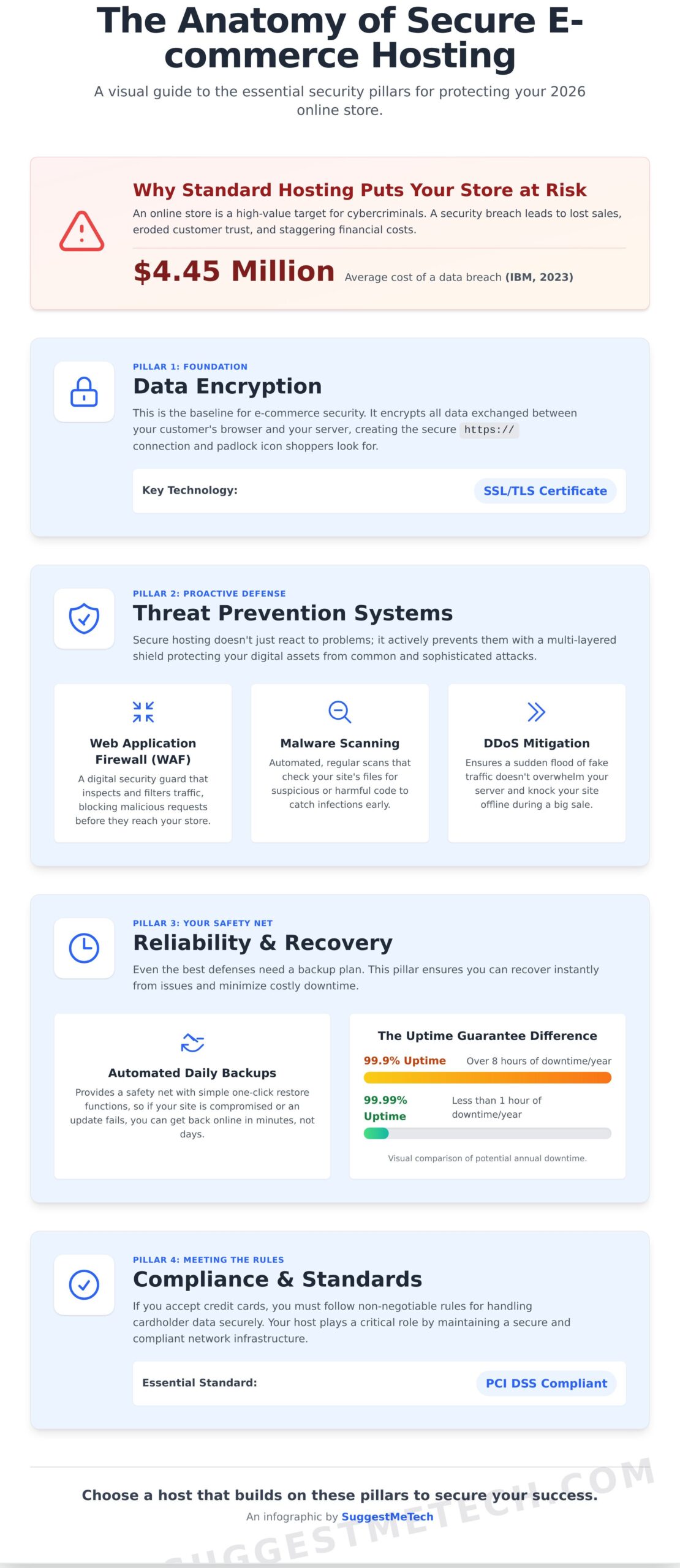
The consequences of a security breach extend far beyond a temporary website outage. According to IBM’s 2023 Cost of a Data Breach Report, the average financial impact reached $4.45 million. Beyond the staggering costs, you face a catastrophic loss of customer trust that can take years, if ever, to rebuild. Furthermore, failing to protect user data can lead to severe fines under regulations like GDPR and CCPA. Proper secure web hosting for online stores acts as your first and most crucial line of defense against these devastating outcomes.
The Core Pillars of Secure E-commerce Hosting
Choosing secure web hosting for online stores isn’t about a single feature; it’s about a foundation built on several core pillars. Each pillar addresses a different type of threat, and together they create a robust defense for your business and customer data. Understanding these essentials will empower you to ask the right questions and select a host that truly prioritizes your store’s safety.
Data Encryption: Your Digital Armor
This is the absolute baseline for e-commerce security. An SSL/TLS certificate encrypts data exchanged between your customer’s browser and your server, creating the secure “https://” connection and padlock icon shoppers trust. While free certificates (like Let’s Encrypt) are good, paid options offer higher levels of business validation, boosting credibility. Without encryption, you cannot safely process payments or protect sensitive customer information.
Threat Prevention: Proactive Defense Systems
Great hosting doesn’t just react to problems; it prevents them. Think of a Web Application Firewall (WAF) as a digital security guard, inspecting traffic and blocking malicious requests before they reach your store. This is complemented by automated malware scanning that regularly checks for harmful code. Finally, DDoS mitigation ensures a sudden flood of fake traffic doesn’t knock your site offline during a big sale. These tools form a proactive shield, aligning with principles found in the FTC cybersecurity framework for protecting your digital assets.
Reliability and Recovery: Your Safety Net
Even with the best defenses, things can go wrong. Look for providers that offer automated, daily backups and a simple one-click restore function. This means if your site is compromised or an update fails, you can get back online in minutes, not days. Also, pay close attention to uptime guarantees. A 99.99% uptime means less than an hour of downtime per year, while 99.9% means over eight hours-a significant difference in potential lost sales.
Compliance and Standards: Meeting Industry Rules
If you accept credit cards, you must adhere to the Payment Card Industry Data Security Standard (PCI DSS). These are the non-negotiable rules for handling cardholder data securely. While you are ultimately responsible for your store’s compliance, your hosting provider plays a critical role by maintaining a secure network. Always look for a provider that is explicitly PCI compliant, as this gives you a secure foundation to build upon.
A Practical Checklist for Choosing Your Secure Host
Navigating the technical jargon of hosting providers can be overwhelming. This practical checklist is designed to cut through the noise, translating essential security and performance pillars into clear, actionable questions. While this guide focuses on the host, remember that your own security habits, like using the best vpn to manage your store, are just as important. Use this framework to compare providers and ensure you’re choosing truly secure web hosting for online stores, not just a standard plan with a higher price tag.
Security Features to Verify
Your store’s security is non-negotiable. Before committing to a provider, get direct answers to these questions. If a feature isn’t included, ask about the cost to add it.
- Does the plan include a free, auto-renewing SSL certificate? An SSL is the baseline for security, encrypting customer data. It should be included and managed for you at no extra cost.
- Is a Web Application Firewall (WAF) part of the package? A WAF is your frontline defense, filtering out malicious traffic and blocking common attacks before they reach your site.
- Are automated daily backups with easy restores standard? Your safety net in case of an error or breach. Confirm you can restore your site with a single click.
- Do they offer proactive malware scanning and removal? Don’t settle for a host that only reacts. Proactive scanning finds and eliminates threats before they can do damage.
Performance and Support Evaluation
A secure site is useless if it’s slow or you can’t get help when it’s down. Your hosting performance directly impacts sales and customer trust.
- What is their server uptime guarantee? Look for a service level agreement (SLA) that guarantees 99.9% uptime or higher.
- Are servers optimized for platforms like WooCommerce or Magento? Generic hosting isn’t enough. Optimized servers offer better speed and stability for e-commerce functions.
- Is 24/7 expert support available via live chat or phone? When your store is down, you need immediate access to someone who can actually fix the problem, not just create a ticket.
- Check reviews specifically mentioning support quality. How does the host perform during a real crisis? Past customer experiences are your best indicator.
E-commerce Specific Questions
Finally, a few critical questions separate generic hosting from a solution built for commerce. These are essential for any serious online retailer.
- Is the hosting environment PCI compliant? This is crucial for securely processing credit card payments. Adhering to PCI standards is a cornerstone of secure e-commerce platform best practices and protects you from liability.
- Do they offer scalable plans to handle traffic spikes? Your hosting should be able to grow with you, especially during a successful marketing campaign or holiday sale.
- Is there built-in server-level caching? Caching dramatically speeds up your product pages, which leads to a better customer experience and higher conversion rates.
Our Top Picks: Best Secure Web Hosting for Online Stores (2026)
After carefully evaluating performance, support, and critical security layers, we’ve identified the top hosting providers that excel at protecting e-commerce businesses. Choosing the right secure web hosting for online stores depends on your budget, technical skill, and specific needs. Below are our editor’s picks, each offering a unique combination of security, features, and value.
Budget-Friendly Secure Hosting: Excellent Value for Startups
Ideal for startups and small e-commerce stores, some providers deliver robust security features without the high price tag. They prove that affordable hosting doesn’t mean you have to compromise on safety. These platforms are often highly optimized for performance, with specific tools to accelerate e-commerce sites, ensuring a fast and secure shopping experience for your customers.
- Key Security Features: Includes a built-in Web Application Firewall (WAF), an automatic malware scanner, advanced DNS protection, and automated backups.
- Price: E-commerce plans typically start around $3.99/month, offering excellent value.
- Pros: Excellent value for money, strong foundational security suite, good performance.
- Cons: More advanced features like daily backups and priority support may be reserved for higher-tier plans.
Explore Budget-Friendly Secure Plans at SuggestMeTech
Premium Managed Hosting: Best for Hands-Off Security & Performance
For store owners who prefer a hands-off, fully managed approach, certain premium providers are top contenders. They go beyond standard security with custom-built infrastructures designed to proactively protect e-commerce sites. Expert customer support, often specializing in popular e-commerce platforms like WordPress and WooCommerce, is a major advantage, offering specialized assistance for security issues and giving you peace of mind.
- Key Security Features: Custom Web Application Firewalls (WAF), AI-powered anti-bot systems that block millions of threats daily, and free daily backups with easy one-click restores.
- Price: Managed e-commerce plans typically start around $3.99/month for introductory rates.
- Pros: Advanced, proactive security; top-rated, expert support; excellent uptime.
- Cons: Renewal prices are often significantly higher than introductory rates.
Discover Premium Managed E-commerce Hosting at SuggestMeTech
Beginner-Friendly Secure Hosting: Integrated E-commerce Solutions
For entrepreneurs launching their first online store, certain beginner-friendly providers offer an excellent choice. Their platforms simplify the entire process with integrated online store builders and user-friendly dashboards. While some providers may offer more advanced security out of the box, these options provide a solid, all-in-one foundation that’s easy to set up and manage.
- Key Security Features: Free SSL certificates for all plans, basic malware scanning, and the option to purchase a dedicated IP address for enhanced security.
- Price: Online store plans generally start around $9.95/month.
- Pros: Extremely beginner-friendly, seamless integration with popular e-commerce tools, includes essential tools to start selling.
- Cons: More advanced security features often come as paid add-ons.
View Beginner E-commerce Hosting Options at SuggestMeTech
The Bottom Line: Protecting Your Online Store
In the world of e-commerce, your web host is more than a platform; it’s a fortress. As we’ve explored, standard hosting simply can’t provide the specialized protection your business and customers deserve. A truly secure foundation is built on non-negotiable pillars like robust SSL certification, proactive DDoS mitigation, and strict PCI compliance. Choosing the right secure web hosting for online stores is a critical business decision that directly impacts your revenue, reputation, and the trust you build with every sale.
Navigating the options can be complex, but our work is designed to give you clarity and confidence. We’ve done the heavy lifting with our in-depth analysis of security features and expert-vetted recommendations, all focused on one goal: helping you protect what you’ve built. Ready to build a secure store? Compare our top-rated hosting providers.
By making a smart, security-first choice today, you’re setting your e-commerce business up for safe, sustainable growth for years to come.
Frequently Asked Questions
What is PCI compliance and do I really need it for my small store?
PCI compliance is a set of security standards for businesses that handle credit card information. And yes, you absolutely need it, no matter your store’s size. If you process payments directly, you are responsible for protecting that data. The easiest way to manage this is by using a payment processor like Stripe or PayPal, as they handle the most sensitive parts of the transaction, greatly simplifying your own compliance requirements.
Can I just use a cheap shared hosting plan for my online store?
We strongly advise against it. Cheap shared hosting plans often lack the dedicated resources and robust security needed to protect customer data and handle traffic spikes. A security breach on another website sharing your server could potentially put your store at risk. Investing in a hosting plan built for e-commerce provides the performance, security, and peace of mind that are essential for building customer trust and protecting your business.
Do I need secure hosting if I use a platform like Shopify?
No, you do not need to purchase separate hosting. Platforms like Shopify, BigCommerce, or Squarespace are “hosted” solutions, which means their monthly fee includes secure hosting, an SSL certificate, and PCI compliance. They manage all the server-side security for you. This is a major benefit of using an all-in-one e-commerce platform, as it lets you focus on your products instead of technical server management.
How much more does secure e-commerce hosting cost than regular hosting?
The cost for secure web hosting for online stores is typically higher than basic shared hosting, but the price is justified. Expect to pay anywhere from $20 to $100+ per month, compared to just $3 to $15 for a standard plan. This premium covers crucial features like dedicated IP addresses, advanced firewalls, malware scanning, and the performance needed to handle transactions smoothly. It’s an investment in your store’s reputation and security.
What’s the difference between a free SSL and a paid one?
Both free and paid SSL certificates provide the same level of encryption, securing the connection between your customer’s browser and your store. The primary differences are validation and warranty. Paid SSLs often involve a deeper business verification process (OV or EV), displaying your company name to build more trust. They also typically include a financial warranty against data breaches caused by a certificate failure. For most new or small stores, a free SSL is perfectly sufficient.
My store got hacked. What are the first steps I should take?
First, contact your hosting provider’s support team immediately. They can help isolate your site to prevent further damage and begin investigating the breach. While they work, change all your critical passwords-for your hosting account, e-commerce admin panel, payment gateways, and FTP. If you have clean, recent backups, be prepared to restore your site. A quality host with 24/7 expert support is invaluable in this situation.
While secure hosting is the foundation, enhancing customer interaction is key for growth. Integrating tools like automated customer service chatbots can significantly improve user experience and build trust. Web development firms can build these solutions; for instance, xelltechnology.com offers examples of WhatsApp chatbots designed to provide instant support and drive sales.