

Thinking about making your website more eco-friendly, but worried it means sacrificing speed, uptime, or your budget? You’re right to be cautious. With so many companies claiming to be “green,” it’s tough to tell which green web hosting providers are truly committed to sustainability versus just “greenwashing.” The great news is that you don’t have to choose between a high-performing website and a healthy planet. In fact, many of the industry’s most innovative hosts are leading the charge in sustainability.
That’s why we’ve done the deep-dive for you. In this guide, we’ll cut through the marketing noise to compare the top contenders of 2024. We’ll break down what makes a host genuinely eco-friendly, from renewable energy matching to energy-efficient data centers. You’ll discover fast, reliable, and affordable hosts that make a real positive impact, and gain the confidence to choose the perfect one for your project. Let’s find a home for your website you can feel good about.
Key Takeaways
- Understand what “green hosting” truly means and why it’s a critical choice for reducing your website’s carbon footprint.
- Discover our top-rated green web hosting providers that prove you don’t have to sacrifice speed or uptime for sustainability.
- Learn the key factors to evaluate beyond eco-friendly claims, ensuring you choose a host that meets your specific budget and technical needs.
- Follow our simple guide to make migrating your website to a green host a smooth and hassle-free process.
What is Green Web Hosting (and Why Does It Matter)?
Every click, search, and stream on the internet requires energy. Powering the vast network of data centers that make the digital world possible consumes an enormous amount of electricity, creating a significant environmental footprint. This is where the concept of sustainable hosting comes in. But what is green web hosting, exactly? It’s a service where a provider takes active, measurable steps to mitigate the environmental impact of its operations. Choosing from the best green web hosting providers is one of the most direct ways you can reduce your own website’s carbon footprint.
The Internet’s Hidden Environmental Impact
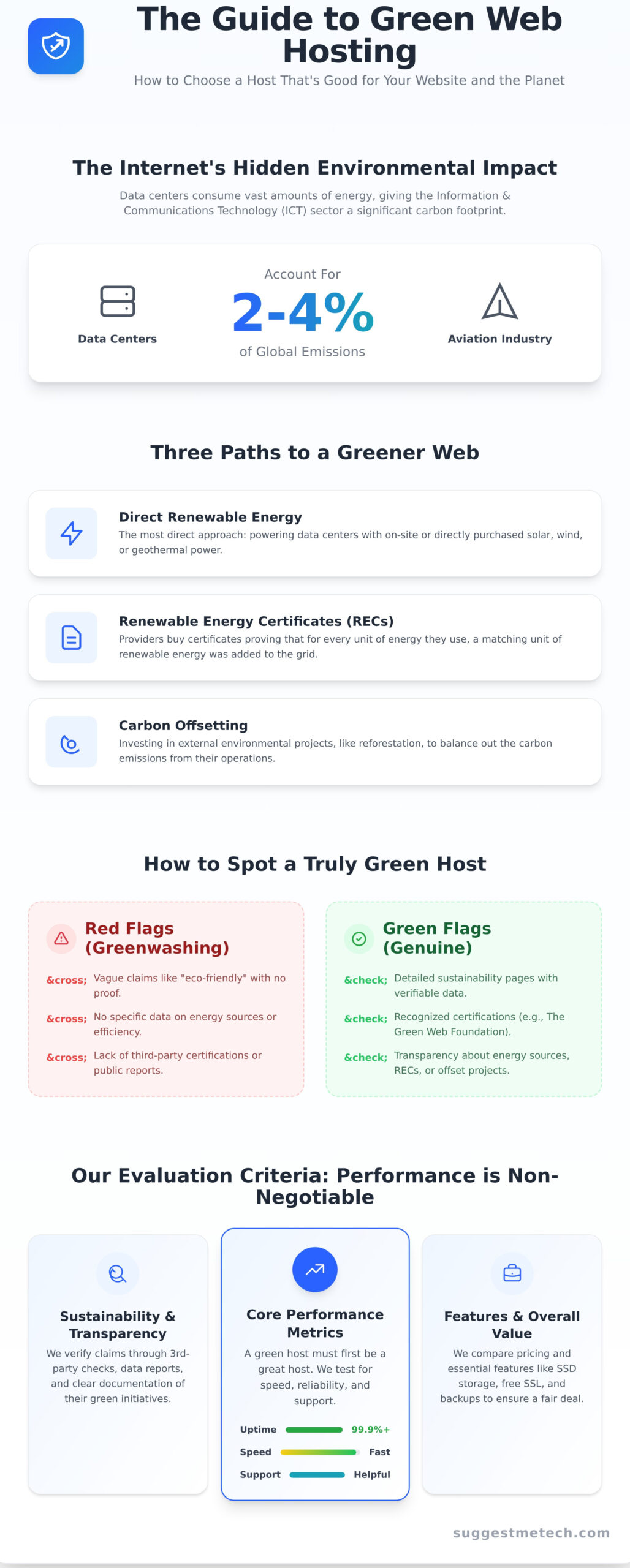
It’s easy to forget that the internet has a physical foundation. The global network of data centers-filled with power-hungry servers, cooling systems, and network infrastructure-consumes a staggering amount of energy. In fact, the information and communications technology (ICT) sector has a carbon footprint often compared to the entire aviation industry, accounting for an estimated 2-4% of global greenhouse gas emissions. Every website is part of this equation, contributing to the demand that fuels these facilities 24/7.
How Green Hosting Works: Three Main Approaches
Green hosts tackle their environmental impact using several key strategies. While methods vary, they typically fall into one of three categories:
- Direct Renewable Energy: The most direct approach involves powering data centers with on-site or directly purchased renewable energy sources like solar, wind, or geothermal power.
- Renewable Energy Certificates (RECs): Many hosts purchase RECs. For every unit of electricity they consume from the grid, they buy a certificate that proves a corresponding unit of renewable energy was generated and added to the grid elsewhere.
- Carbon Offsetting: Providers also invest in external projects that reduce carbon dioxide in the atmosphere, such as reforestation or methane capture initiatives, to balance out their own emissions.
Beyond the Hype: How to Spot Greenwashing
As sustainability becomes a key selling point, some companies engage in “greenwashing” by making misleading claims about their environmental practices. Be wary of vague terms like “eco-friendly” without any data to back them up. A truly green host is transparent. Look for detailed sustainability pages, public reports, and recognized third-party certifications that verify their claims. The most credible green web hosting providers are proud to show you exactly how they are making a difference.
Our Evaluation Criteria: How We Chose the Best Eco-Friendly Hosts
Choosing the right eco-friendly host goes beyond a green badge on a website. At SuggestMeTech, we dig deeper. Our evaluation process is designed to verify sustainability claims while ensuring you get the rock-solid performance your website deserves. We believe the best green web hosting providers don’t force you to choose between your values and your website’s speed or reliability. Our goal is to identify providers who prove that top-tier performance and genuine sustainability can go hand-in-hand.
Sustainability and Transparency
A provider’s commitment to the planet is our first checkpoint. We look for concrete evidence, not just vague promises. This means verifying their use of renewable energy, either directly from sources like wind and solar or through certified Renewable Energy Certificates (RECs). We also check for verification from reputable third parties like The Green Web Foundation, which maintains a public directory of hosts running on green energy. Transparency is key; we favor hosts that openly publish their energy efficiency data and details about their carbon offsetting projects.
Core Performance Metrics
An eco-friendly host is still a web host, and performance is non-negotiable. Our hands-on tests measure the three pillars of quality hosting:
- Uptime: We monitor our test sites continuously, looking for providers who meet or exceed the industry standard of a 99.9% uptime guarantee. Anything less can mean lost visitors and revenue.
- Speed: Using tools like GTmetrix and Pingdom, we measure server response times and full page load speeds. A fast site is crucial for both user experience and SEO rankings.
- Customer Support: We test each host’s support team with real-world questions to assess their response times, technical knowledge, and overall helpfulness. When you need help, you need it fast.
Features and Overall Value
Finally, we assess the overall value for your money. Being green shouldn’t mean compromising on features or paying an unfair premium. We look for a comprehensive package that includes modern essentials like SSD storage for speed, free SSL certificates for security, and automated backups for peace of mind. We compare their pricing against top non-green competitors to ensure you’re getting a fair deal. A clear and affordable upgrade path is also crucial for supporting your website as it grows.
The 5 Best Green Web Hosting Providers of 2024
After comparing performance, features, and environmental commitments, we’ve identified the top green web hosting providers that deliver excellent service without compromising on sustainability. Each host on this list takes a unique approach to eco-friendly operations, from matching energy consumption with renewable energy credits to innovating data center cooling. Here’s our breakdown of the best options available today.
GreenGeeks: Best Overall for Its 300% Energy Match
Best For: Users who want to make a climate-positive impact.
GreenGeeks stands out with an unmatched commitment to renewable energy. For every unit of energy they consume, they purchase three times that amount in Renewable Energy Certificates (RECs) and put it back into the grid. This 300% energy match makes your website “carbon-reducing.” As a recognized EPA Green Power Partner, they also provide excellent performance with LiteSpeed servers optimized for WordPress, making them a powerful and responsible choice.
Visit GreenGeeks to Learn More
InMotion Hosting: Best for Green Data Centers
Best For: Businesses needing reliable performance from eco-conscious infrastructure.
InMotion Hosting tackles energy consumption at the source: its data centers. They were one of the first to implement advanced Outside Air Cooling technology, which dramatically reduces their cooling energy needs by nearly 70%. Beyond their hardware, InMotion invests in community green initiatives, including reforestation projects. This focus on infrastructure and community makes them a top pick for businesses that value stability and sustainability.
See InMotion Hosting’s Green Initiatives
HostPapa: Best for Small Businesses
Best For: Small businesses and beginners looking for an affordable, user-friendly green host.
HostPapa makes going green simple and accessible. They commit to purchasing 100% renewable energy to power their entire operation, from servers to office spaces. Their platform is designed for ease of use, offering a user-friendly control panel, a free domain name, and a robust set of features tailored to small businesses. With affordable plans and reliable support, HostPapa is one of the best green web hosting providers for getting a new venture online.
A2 Hosting: Best for Speed and Carbon Neutrality
Best For: Developers and site owners who prioritize performance and speed.
A2 Hosting proves that you don’t have to sacrifice speed for sustainability. Through their “FutureServe Green Hosting” initiative, they partner with Carbonfund.org to offset all their server emissions, achieving full carbon neutrality. They are famous for their optional Turbo servers, which promise up to 20x faster page loads. Combined with their efforts in reforestation and running energy-efficient hardware, A2 Hosting is the ideal choice for performance-driven, eco-conscious users.
Explore A2 Hosting’s Turbo Plans
DreamHost: Best for Carbon Neutral Operations and WordPress
Best For: WordPress users seeking a host with a long-standing green record.
DreamHost has been a leader in green hosting for years, achieving carbon neutrality back in 2007. Their data centers are powered by renewable sources and hold LEED Platinum and Energy Star certifications. They also implement high-efficiency cooling and processors. As an officially recommended WordPress host, DreamHost offers optimized performance, a 100% uptime guarantee, and a strong commitment to open-source technology, all while maintaining their eco-friendly pledge.
Discover DreamHost’s Green Hosting
Key Factors to Compare When Choosing Your Green Host
Selecting a host based on its eco-friendly claims is a great start, but it’s only half the battle. The best green web hosting providers deliver on sustainability without forcing you to compromise on the speed, security, and reliability your website needs to succeed. This guide will help you look beyond the green label and choose a provider that aligns with both your values and your technical requirements.
Energy Source vs. Offsets: What’s the Difference?
Not all “green” claims are equal. The most impactful approach is when a host powers its data centers directly with renewable energy, like solar or wind. A more common and still excellent method is purchasing Renewable Energy Certificates (RECs), which match the host’s energy consumption with green energy fed into the grid. Carbon offsets, which fund environmental projects like reforestation, are a valid way to achieve neutrality but are different from directly addressing energy use.
Essential Hosting Features
Your eco-friendly host must also be a high-performance host. Here are the non-negotiable features to look for in any plan you consider:
- SSD Storage: Solid-State Drives (SSDs) are significantly faster than traditional hard drives, directly impacting your site’s loading speed and user experience. This is a modern standard.
- Free SSL Certificate: An SSL certificate encrypts data between your site and its visitors, which is crucial for security, trust, and SEO rankings. Most reputable hosts include this for free.
- Automatic Backups: A reliable backup system is your ultimate safety net. Look for hosts that offer free, automated daily or weekly backups to protect you from data loss.
- Uptime Guarantee: Your website needs to be accessible. A 99.9% uptime guarantee is the industry benchmark, ensuring your site experiences minimal downtime.
Verifying Green Credentials
Don’t just take a company’s word for it-do a quick check. You can verify if a website is running on sustainable energy using The Green Web Foundation’s free checker tool. Also, look for official certifications on the host’s website, like the EPA Green Power Partner seal in the United States. Finally, a truly committed provider will have a detailed “About Us” or “Green Initiatives” page explaining exactly how they achieve their environmental goals. Armed with this knowledge, you can confidently choose a host that truly makes a difference.
How to Switch to a Green Web Host
Thinking about making the switch but worried about the technical hassle of moving your website? You’re not alone. The good news is that migrating your site to a new host is more straightforward than ever. The best green web hosting providers understand that a difficult migration is a major barrier, so they have streamlined the process to be as painless as possible.
In fact, most reputable hosts offer free or low-cost migration services handled entirely by their expert support teams. By following a few simple steps, you can move your site with minimal to zero downtime.
Step 1: Choose Your New Green Host and Plan
Your first move is to select a provider that aligns with your performance needs and sustainability goals. Use our detailed comparison above as your starting point. The most important rule here is to sign up for your new hosting plan before cancelling your old one. This ensures your site stays live throughout the entire process. Ready to choose? See our top green hosting picks.
Step 2: Back Up Your Website and Request Migration
Before you do anything else, perform a full and recent backup of your website files and databases. While your new host will handle the transfer, having your own backup is a critical safety net. Once you have your backup secured, contact your new host’s support team to initiate the migration. They will typically ask for your previous host’s login credentials, such as your cPanel username and password, to begin the transfer.
Step 3: Test and Update Your DNS
After the migration is complete, your new host will provide a temporary URL or a way to preview your site on their servers. Review it carefully to ensure everything-from images and links to contact forms-is working correctly. Once you confirm it’s a perfect copy, you’ll take the final step: updating your domain’s nameservers (DNS) to point to your new host. This change can take a few hours to propagate globally, but your site will remain online during the transition.
Your Smooth Migration Checklist:
- Select and purchase your new green hosting plan.
- Create a complete, independent backup of your current website.
- Provide your new host with the necessary credentials to begin migration.
- Use the temporary URL to test the migrated site for any issues.
- Update your domain’s DNS to point to the new server.
- Once you confirm everything is stable, you can cancel your old hosting service.
Make the Switch to a Greener Web
Choosing an eco-friendly host is one of the most impactful decisions you can make for your online presence and the planet. As we’ve explored, you don’t have to compromise on speed, reliability, or support to make a sustainable choice. The best green web hosting providers seamlessly blend top-tier performance with a genuine commitment to renewable energy and environmental responsibility.
This principle of using technology for sustainability extends beyond the web. In the physical world, for example, automation specialists like Rocatech help homes and businesses reduce their energy consumption through smart systems.
Finding the perfect host goes beyond just being green. Your budget, traffic, and technical needs all play a crucial role. To help you make a fully informed decision, we invite you to explore all of our expert web hosting recommendations. Our practical guides and unbiased, expert-led reviews are based on real-world performance tests, ensuring you can choose your next host with total confidence.
By making a thoughtful choice, you’re not just building a website; you’re helping to build a more sustainable internet for everyone.
Frequently Asked Questions
Is green web hosting more expensive than regular hosting?
Not necessarily. While this was true in the past, the market has become very competitive. Many top green web hosting providers now offer plans at prices comparable to, or even cheaper than, traditional hosts, especially for shared hosting. For high-performance plans like VPS or dedicated servers, you might see a small premium, but this often comes with better hardware and support. It’s always best to compare features and pricing directly to find a plan that fits your budget.
What is the difference between ‘carbon neutral’ and ‘300% green’ hosting?
‘Carbon neutral’ hosting means the provider balances its carbon footprint, usually by purchasing carbon offsets to fund environmental projects. ‘300% green’ is a more direct approach where the host purchases Renewable Energy Certificates (RECs) equivalent to 300% of their energy usage. This means for every unit of energy they consume, they invest in putting three units of renewable energy back into the grid. This makes them ‘climate positive’ by actively supporting the growth of green energy infrastructure.
How can I check if any website is hosted on a green server?
The easiest way is to use the online directory from The Green Web Foundation. You can enter a website’s URL, and their tool will check its database to see if the hosting provider is recognized for its green credentials. If you want to dig deeper, you can also visit the hosting provider’s website directly. Look for a dedicated page on their environmental policy, which should detail their use of renewable energy, RECs, or other green initiatives.
Will choosing a green web host affect my website’s SEO?
No, choosing a green web host will not negatively affect your SEO-and it can sometimes help. Core SEO factors like site speed, uptime, and server location are what matter to search engines. Many top-tier green hosts invest in modern, energy-efficient servers that deliver excellent performance. While there’s no direct ranking boost for being green, displaying a green hosting badge can improve user trust and brand perception, which are positive signals for your overall online presence.
Can I get green hosting for my WordPress website?
Absolutely. Green hosting is compatible with virtually all website platforms, including WordPress. The ‘green’ aspect refers to how the hosting company powers its servers, not the software you can run on them. Nearly all green web hosting providers offer plans that fully support WordPress, and many even provide specialized managed WordPress hosting. You can build your WordPress site with confidence, knowing its carbon footprint is being addressed by your chosen eco-friendly provider.
What are Renewable Energy Certificates (RECs)?
Renewable Energy Certificates (RECs) are a key tool for green hosting. Each REC is a tradable certificate proving that one megawatt-hour (MWh) of electricity was generated from a renewable source, like wind or solar, and sent to the power grid. Hosting companies purchase RECs to match their energy consumption. This doesn’t mean green power flows directly to their servers, but it guarantees they are financially supporting the generation of an equivalent amount of clean energy elsewhere.