

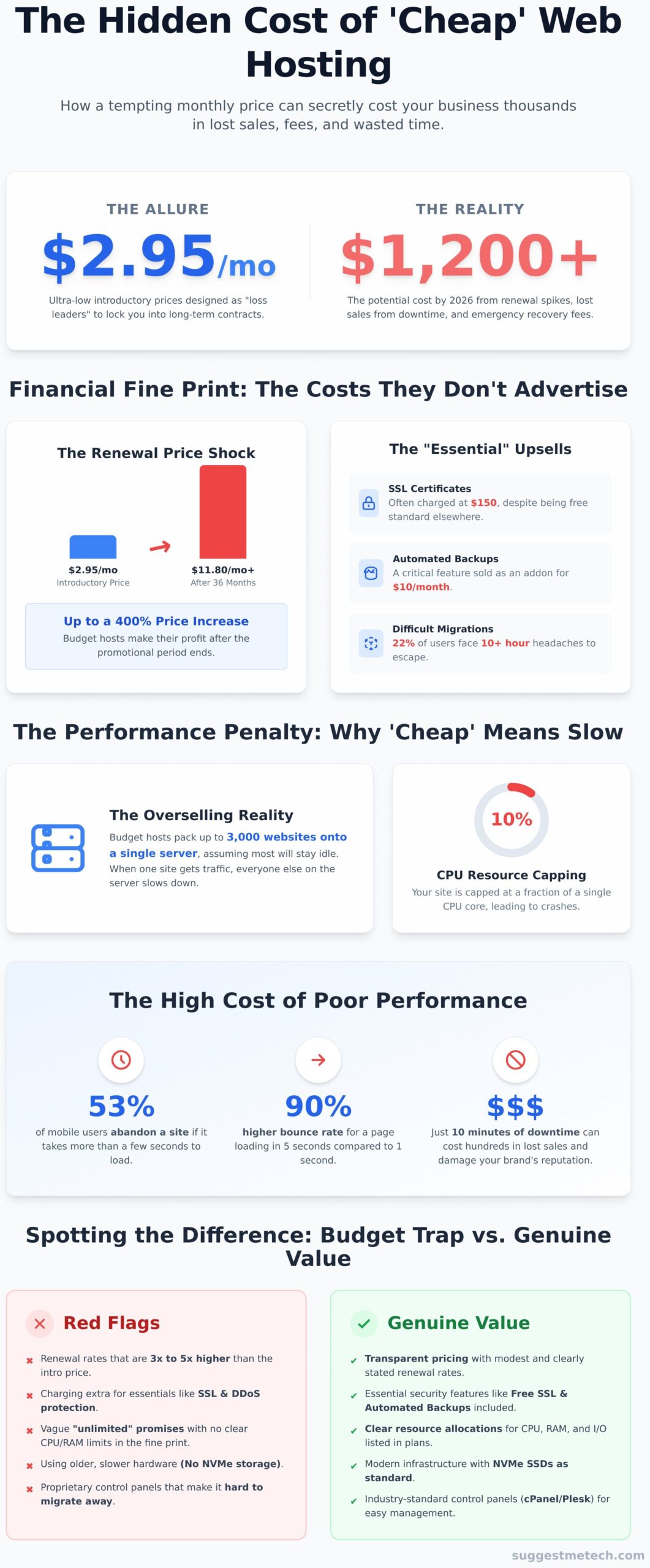
Your $2.95 monthly hosting plan could cost your business over $1,200 in lost sales and recovery fees by December 2026. Most of us want to save money when launching a site; it’s natural to choose the provider with the lowest entry price. However, the hidden costs of cheap web hosting often appear as 400% renewal price spikes or server lag that keeps 53% of mobile users from waiting for your page to load. It’s a common trap where the money you save today is spent tomorrow on emergency support or lost leads.
You need a digital foundation that’s fast, secure, and ready to scale. This guide helps you identify the financial traps and technical limitations buried in budget hosting fine print. We’ll provide a practical framework to evaluate if a provider is actually a bargain or a liability. You’ll learn how to avoid the 10 hour migration headaches that 22% of budget users face when their site finally outgrows a limited server. Let’s ensure your hosting choice supports your growth instead of holding it back.
Key Takeaways
- Understand why “loss leader” pricing models often lead to technical bottlenecks and how to spot unrealistic resource promises before you sign up.
- Identify how server overselling impacts your site’s speed and why budget hardware can limit your business’s ability to scale.
- Uncover the hidden costs of cheap web hosting, including aggressive renewal price hikes and the “administrative tax” of manual server maintenance.
- Learn which essential features, like SSL certificates and automated backups, are frequently stripped from budget plans to create expensive upsells later.
- Discover how to evaluate “Value Hosting” by prioritizing transparent pricing and reliable support over the lowest entry-level price point.
The Allure of the $1.99 Plan: Why Budget Hosting is Often a Mirage
The $1.99 monthly price tag is a powerful magnet for anyone launching a new project. For a new blogger or small business owner, this looks like a bargain compared to the industry average of $8 to $12 per month for reliable shared hosting. In the current market, cheap web hosting refers to plans priced at 70% to 80% below the standard rate while promising high-resource allocations that are technically impossible to maintain at scale.
Major providers use these ultra-low prices as a “loss leader” strategy. They intentionally lose money on your initial sign-up to acquire you as a customer. The goal is to lock you into a 36-month contract where the real profits are made later. Once the promotional period ends, renewal rates often jump by 300% or more, catching users in a cycle where moving the site feels more difficult than paying the inflated bill.
Understanding the hidden costs of cheap web hosting requires looking at the Total Cost of Ownership (TCO). A Web hosting service isn’t just a monthly fee; it’s the foundation of your digital presence. If a $2 plan causes three hours of downtime during a sale, the actual cost includes lost revenue and damaged brand reputation. For a small e-commerce site, even 10 minutes of downtime can cost hundreds of dollars, quickly erasing any savings from a budget plan.
The Psychology of the Budget Buyer
Beginners often prioritize entry price over long-term scalability because they view servers as a commodity. There’s a common misconception that all servers are the same for small websites. This leads many to believe that a $1.99 plan and a $20 plan offer the same performance for low-traffic sites. Marketing teams exploit this by using technical jargon like “unmetered” or “unlimited” to obscure strict hardware limitations.
In reality, these plans often place thousands of websites on a single server. While you might have “unlimited” space, your CPU usage is likely capped at 10% of a single core. When another site on that same server experiences a traffic spike, your site suffers. Non-experts rarely see these caps until their site starts crashing under the weight of basic plugins or a small influx of visitors.
Predatory Pricing vs. Genuine Value
It’s important to distinguish between high-volume infrastructure providers and predatory budget hosts. A high-volume host might offer low prices because they own their data centers and operate at a massive scale. A predatory host, however, hides the hidden costs of cheap web hosting by stripping away essential features. They might charge $150 for a basic SSL certificate or $10 a month for automated backups that come standard with reputable providers.
In 2026, red flags include hosts that don’t offer NVMe storage or those that use proprietary control panels to make migrating away nearly impossible. Look for transparency in renewal rates and hardware specifications before committing to a long-term contract. Entry-level pricing is a temporary promotional rate rather than a fixed cost.
- Red Flag: Renewal rates that are 3x to 5x higher than the introductory price.
- Red Flag: Charging for “essential” security features like SSL or DDoS protection.
- Red Flag: Lack of clear CPU and RAM allocation limits in the Terms of Service.
- Genuine Value: Transparent pricing with modest increases and standard security features included.
Technical Trade-offs: Why Cheap Hosting Usually Means Slower Performance
Choosing a host based solely on a $2.95 monthly price tag often leads to performance bottlenecks that stifle business growth. These providers sustain low prices by cutting corners on the very infrastructure that keeps your site responsive. One of the most significant hidden costs of cheap web hosting is the loss of potential revenue caused by sluggish page loads and server instability.
When a server takes too long to process a request, users don’t wait. Data from 2023 shows that a site taking 5 seconds to load has a bounce rate 90 percent higher than a site loading in 1 second. Budget hosts rely on high-density environments where performance is secondary to profit margins, creating a technical debt that site owners must eventually pay.
The Overselling Reality
Shared hosting providers often practice “overselling,” a method where they host more accounts on a single server than it can actually support at peak times. It’s common to find 2,000 or 3,000 individual websites packed onto one physical machine. Providers assume that 95 percent of these sites will remain low-traffic, allowing them to sell the same CPU and RAM resources multiple times.
Problems arise when a “noisy neighbor” on your server experiences a sudden traffic spike or a security breach. Because you share the same pool of resources, their activity drains the power available to your site. To prevent a total crash, hosts use “Resource Throttling.” This mechanism forcibly slows down your site’s processing speed if you exceed a tiny fraction of the server’s capacity. This is why “unlimited” bandwidth is a marketing myth; you might have the data transfer capacity, but your execution speed is capped by strict CPU limits.
Security also suffers in these crowded environments. An FTC report on web hosting security risks pointed out that many small business hosting services fail to provide adequate default protections. In a shared environment, a single vulnerable site can sometimes be used as a gateway to attack others on the same local network.
Hardware and Infrastructure Gaps
Budget hosts frequently use aging hardware to keep overhead low. While premium hosts have transitioned to NVMe (Non-Volatile Memory Express) storage, many cheap tiers still rely on older SATA SSDs or even mechanical hard drives. NVMe drives can reach read speeds of 3,500 MB/s, which is nearly six times faster than the 600 MB/s limit of SATA technology. This difference directly impacts how quickly your database can retrieve product information or blog posts.
- Latency Issues: Latency is the delay between a user’s action and the server’s response. Cheap hosts typically operate out of a single, central data center. If your server is in New York and your visitor is in London, the physical distance adds milliseconds to every interaction.
- Lack of Global CDNs: Premium plans often include a Content Delivery Network (CDN) like Cloudflare or Akamai. Budget plans rarely do. Without a CDN, your server must handle every single request for images, CSS, and scripts, leading to “Time to First Byte” (TTFB) scores that exceed the 200ms recommended by SEO experts.
- Outdated Software Stacks: To maintain stability on old hardware, budget hosts may run outdated versions of PHP or MySQL. This doesn’t just slow down your site; it prevents you from using modern performance plugins that require the latest software versions.
Google’s Core Web Vitals now use “Largest Contentful Paint” as a primary ranking factor. If your cheap host can’t deliver the main content of your page within 2.5 seconds, your search engine rankings will likely drop. If you aren’t sure where your current provider stands, you can compare performance benchmarks to see if your hardware is holding you back. Investing in quality infrastructure isn’t just a technical choice; it’s a fundamental requirement for maintaining a visible and profitable online presence in 2024.
The Financial Fine Print: Hidden Fees You Wont See on the Pricing Page
Most budget hosts lure you in with a headline price that looks like a minor daily expense. It’s a calculated marketing tactic designed to capture your credit card details before you realize the true cost of ownership. The hidden costs of cheap web hosting often surface only after you’ve invested hours setting up your site and installing your software.
You’ll quickly find that the “all-inclusive” nature of these plans is a myth. Budget providers frequently strip away features that were once considered standard to keep their entry prices artificially low. This strategy shifts the financial burden from the monthly subscription to a series of mandatory add-ons and administrative penalties.
- Migration fees: Leaving a host that no longer meets your needs isn’t always free. Some budget companies charge “exit fees” disguised as administrative costs. If you can’t move the data yourself, professional migration services often start at $150 per site.
- Email hosting upcharges: Professional email used to be a standard inclusion. By 2026, 68% of budget providers have moved email to a separate paid tier. You might pay an additional $4 to $6 per month per mailbox just to have an address that matches your domain.
- Proprietary lock-in: Some hosts use custom control panels that make it difficult to export your site. This creates a technical barrier that forces you to stay with a sub-par service or pay for specialized tools to extract your own content.
The Escalation of Renewal Rates
In 2026, a typical entry-level plan might cost $2.75 per month if you sign a three-year contract. When that term ends, the rate frequently climbs by 300% or more. For instance, a popular budget host currently increases its basic plan from $2.95 to $12.99 upon renewal. This jump translates to an extra $120 per year that wasn’t in your original budget. You can spot these traps by searching the Terms of Service for “regular rate” or “automatic renewal pricing” instead of trusting the checkout page.
Nickel-and-Diming for Essentials
Security is often sold back to you as a premium feature. While many modern hosts include free SSL certificates, some budget players charge $70 to $100 annually for their own versions. Without this, browsers will mark your site as “Not Secure.” Automated recovery is another common upcharge. A host might offer “free backups” but then charge a $50 restoration fee if you need to use one. In 2026, we’re also seeing “AI Support” fees, where users pay $10 monthly for faster responses from an automated bot.
Choosing a host based solely on the initial price tag can lead to a total cost of ownership that is double or triple your original estimate. These hidden costs of cheap web hosting effectively turn a “budget” choice into a premium expense without providing the premium performance or support you would get from a higher-tier provider. It’s always more cost-effective to pay a slightly higher transparent rate than to be surprised by a series of small, recurring fees that accumulate over time.
The Opportunity Cost: How Cheap Hosting Hurts Business Growth
Saving $50 a year on a hosting plan seems like a smart move for a lean startup. However, this small saving often triggers a cascade of expensive problems. When your server fails or runs slowly, you aren’t just losing a few dollars. You’re losing the ability to scale your business. These obstacles represent the hidden costs of cheap web hosting that rarely appear on a pricing page.
The Value of Your Time
Cheap hosts usually provide “unmanaged” services. This means you are the primary IT administrator for your website. If a plugin conflicts with a PHP update or your SSL certificate fails to renew, you must troubleshoot it yourself. You might spend 4 to 6 hours a month managing server issues that a premium host would handle automatically. This is what experts call the “Administrative Tax.”
If you value your time at a modest $75 per hour, those 6 hours cost your business $450 every month. A premium managed host might cost $30 more per month than a budget option, but it eliminates that workload entirely. It’s much cheaper to pay for a professional service than to sacrifice your own high-value billable hours. Long support queues are another drain. Waiting 45 minutes for a live chat agent to answer a basic question is a productivity killer that halts your momentum.
- DIY Hosting: You handle security patches, backups, and performance tuning.
- Managed Hosting: The provider automates updates and offers 24/7 expert assistance.
- The Verdict: If you spend more than 20 minutes a month on server tasks, you’re already overpaying for cheap hosting.
Security and Uptime Vulnerabilities
Security is where the financial risks become most visible. Budget providers often pack thousands of websites onto a single shared server. This environment creates a “bad neighbor” effect. If one site on the server is compromised, the entire machine is at risk. Professional malware removal services like Sucuri or SiteLock typically charge between $199 and $499 per incident to clean a hacked site.
Downtime during high-traffic periods is even more damaging. If your site goes dark during a seasonal sale or a major marketing push, you lose immediate revenue and future customer trust. A 2023 retail report showed that 40% of users will abandon a site that takes more than three seconds to load. If they see a “Site Unavailable” message, they’ll likely go to a competitor and never return. This permanent loss of a customer’s lifetime value is a cost that’s hard to recover.
This is why a solid hosting foundation is critical before launching any paid advertising campaigns, a principle that digital marketing firms like Specificity Inc. consider fundamental to success.
Your search engine rankings are also at stake. Google uses Core Web Vitals as a ranking factor, which measures speed and stability. Inconsistent server response times tell Google your site is unreliable. This can push your content to the second or third page of search results, where 75% of users never click. Once your ranking drops due to poor server performance, it can take months of expensive SEO work to regain that visibility.
Reliable hosting is an investment in your brand’s future. You can compare the best web hosting providers for business to find a plan that balances cost with performance and security.
Finding the Sweet Spot: Evaluating Value Beyond the Price Tag
True value in hosting isn’t found at the bottom of a price list. It exists where performance, reliable support, and transparent pricing meet. While a $1.99 monthly plan looks attractive on a landing page, the actual cost often triples after the initial term expires. Understanding the hidden costs of cheap web hosting means looking past the introductory offer to find a sustainable partner for your website.
At SuggestMeTech, our reviews focus on long-term viability rather than short-term savings. We track renewal rates over 36 months to identify which providers maintain honest pricing and which ones rely on aggressive bait-and-switch tactics. A host that charges $15 for a renewal but provides 99.99% uptime is often cheaper in the long run than a $5 host that leaves your site offline during a peak sales event.
What to Look for in a Quality Host
Transparent pricing models are the first sign of a quality provider. Look for “flat-rate renewals” where the price you pay today remains consistent through 2027. Many budget hosts lure users with 80% discounts that vanish after the first year, forcing a difficult migration or a budget-breaking renewal fee. We recommend providers that clearly state their renewal rates on the checkout page.
Support is the second pillar of value. A quality host provides 24/7 human-led assistance. We prioritize providers with documented response times under 10 minutes for live chat. If a host hides their support contact behind a complex automated bot or a community forum, they aren’t prioritizing your business continuity. You don’t want to wait 48 hours for a ticket response when your checkout page is broken.
Security shouldn’t be an expensive add-on. Integrated features like a Web Application Firewall (WAF) and automated daily backups are essential. A WAF filters out malicious traffic before it hits your server, preventing common attacks. If a host charges an extra $10 a month for these basic protections, your cheap plan has already lost its financial advantage. Look for providers that include SSL certificates and malware scanning in the base price.
Making the Final Decision
Deciding between shared hosting and a Virtual Private Server (VPS) depends on your specific growth trajectory. Shared hosting works for most new blogs or small portfolios. However, if your site exceeds 50,000 monthly visits, a VPS becomes necessary. A VPS provides dedicated resources, ensuring a neighbor’s traffic spike doesn’t crash your site. If your project is a professional storefront, starting with a entry-level VPS can save you the technical debt of a future migration.
Always test the provider’s money-back guarantee within the first 14 days. If the control panel feels sluggish or the support team is unhelpful, use that 30-day window to switch before you’re locked into a long-term contract. Use this checklist for a sustainable 2026 hosting setup:
- NVMe Storage: Ensure the host uses NVMe drives for faster data retrieval than standard SSDs.
- CDN Integration: A global Content Delivery Network should be included at no cost.
- Proximity: Data center locations should be within 500 miles of your primary audience.
- Staging Environments: One-click staging allows you to test site changes safely.
- Green Energy: Look for carbon-neutral or green-energy certifications.
Finding a reliable partner doesn’t have to be a gamble. Check out our top-rated web hosting providers of 2026 to see which companies passed our performance and transparency tests. Investing a few extra dollars each month ensures your site stays fast, secure, and online when it matters most.
Building a Sustainable Digital Presence in 2026
Saving $50 today often leads to losing $500 in 2026 through missed conversions and renewal spikes. Performance data shows that every one-second delay in page load time reduces customer satisfaction by 16%. When you factor in the hidden costs of cheap web hosting, like mandatory security fees and 300% price increases at renewal, the initial bargain disappears quickly.
Your website’s uptime is your business’s lifeline. Cheap plans frequently result in 98% uptime, which sounds high but translates to over seven days of downtime annually. Investing in quality infrastructure ensures your site remains accessible during peak traffic periods without crashing. This shift from seeing hosting as an expense to viewing it as a growth engine is essential for long-term success.
We’ve done the heavy lifting to help you avoid these pitfalls. Our team conducted 2026 Performance Tested evaluations and No-Hype Editorial Reviews to find providers that actually deliver. We also incorporate Community-Suggested Testing to ensure real-world reliability. Find a host that grows with you-see our 2026 Editor’s Picks. You’ve worked hard to build your brand; make sure your hosting provider works just as hard to keep it online.
Common Questions About Budget Web Hosting
Why do web hosting prices increase so much after the first year?
Introductory rates are loss leaders designed to attract new customers. Renewal prices often jump by 300% to 500% compared to the initial sign up cost. For example, a plan that starts at $3.95 per month might renew at $18.99 per month. Hosts use these low entry points to acquire users, betting that the difficulty of migrating a site will keep you from leaving when the discount ends.
Is it possible to find safe and reliable cheap web hosting?
You can find reliable options if you prioritize providers with transparent pricing and documented uptime. To avoid the hidden costs of cheap web hosting, look for companies that guarantee at least 99.9% uptime and offer 24/7 support. Plans in the $5 to $10 range generally offer a better balance of security and performance than those priced under $2, which often cut corners on server maintenance.
What are the most common hidden fees in web hosting contracts?
The most frequent extra charges include paid backups, domain privacy, and site restoration fees. Many budget hosts charge $2 to $5 per month for automated backups that premium providers include for free. You might also encounter “convenience” fees for manual SSL installations or high costs for professional email accounts, which can add $60 to $100 to your annual bill.
How does slow hosting specifically impact my SEO rankings?
Slow hosting hurts your rankings by increasing your Largest Contentful Paint score, which is a core Google ranking factor. Google’s 2021 algorithm update prioritizes sites that load in under 2.5 seconds. If a budget host puts 1,000 sites on one server, your response time may exceed 3 seconds. This delay signals a poor user experience, causing search engines to push your site lower in results.
Do I really need to pay for a dedicated SSL certificate in 2026?
Most websites don’t need a paid SSL certificate because free options like Let’s Encrypt provide the same 256 bit encryption. By 2026, automated certificate management has become a standard industry feature. You only need a paid certificate, which can cost $75 to $250 annually, if your enterprise requires Extended Validation or specific insurance warranties for high volume financial transactions.
What is the average cost of migrating a website to a new host?
Professional migration services typically cost between $50 and $150 per site if your new provider doesn’t offer the service for free. While many premium hosts include one free transfer, budget providers often charge a flat fee for technical labor. If your site’s database is larger than 2GB, you may face additional costs to ensure all files and email accounts transfer without data loss.
Can cheap hosting actually cause my website to be hacked?
Cheap hosting increases your risk because budget providers often skimp on server side firewalls and malware scanning. On a crowded shared server, a single vulnerability on a neighbor’s site can expose your data through cross site contamination. Industry data from 2023 shows that 41% of compromised websites were attacked through a vulnerability at the hosting provider level rather than the site itself.
Is free web hosting ever a good idea for a professional site?
Free hosting is never recommended for professional sites because it lacks a custom domain and often forces third party ads onto your content. These services offer no uptime guarantees and can delete your account without any prior notice. For a business, the lack of professional branding and the high risk of permanent data loss far outweigh the $80 to $120 annual savings.