

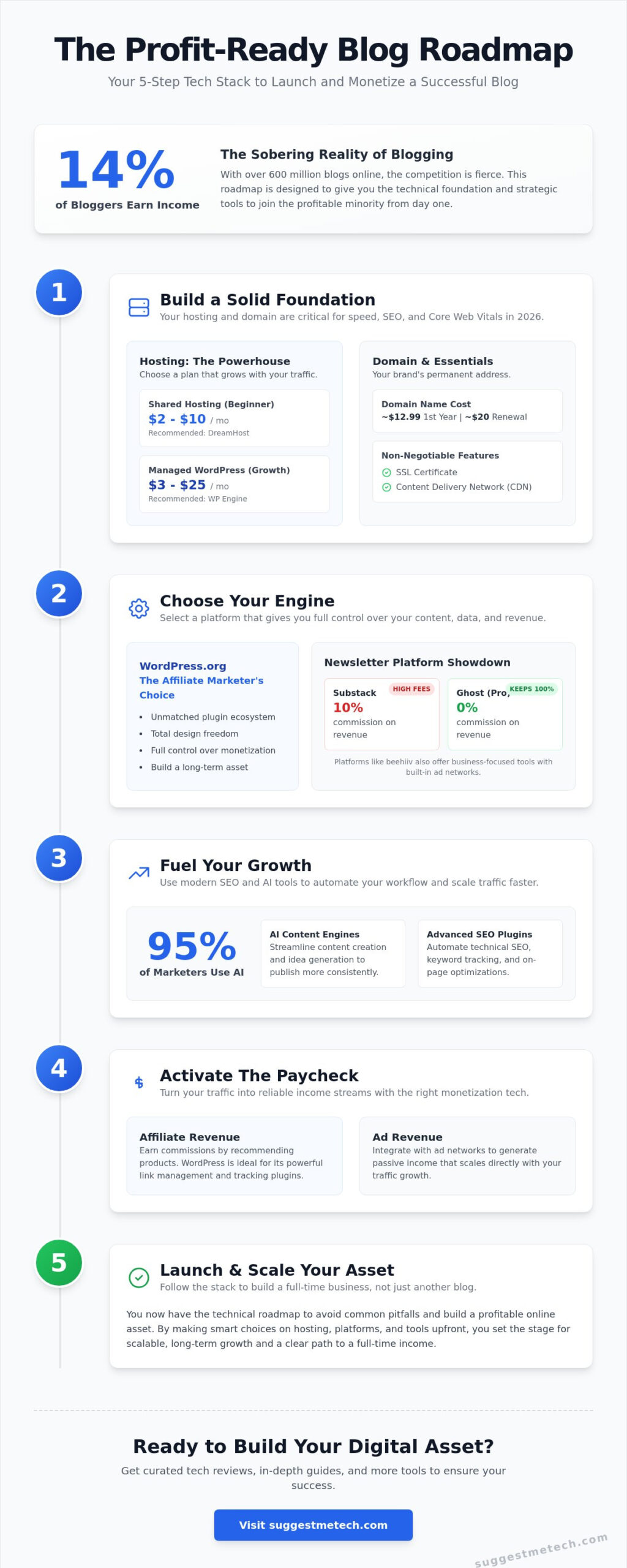
With over 600 million blogs active globally, it’s a sobering reality that only 14% of creators actually earn any income. You’ve likely felt the weight of that competition while searching for the best tech tools to start a blog and make money. It’s easy to feel overwhelmed by technical choices or the fear of sinking money into hosting and plugins that won’t pay for themselves. You want a clear path to profitability, not a list of hidden subscription fees.
I’ve vetted the essential tech stack you need to launch a professional, scalable platform from scratch without wasting your budget. Whether you’re looking for introductory hosting rates as low as $2.95 per month or want to join the 95% of marketers using AI to streamline their workflow, this guide provides the answers. We’ll walk through a roadmap for affiliate and ad revenue, ensuring your tech choices grow as your traffic does.
Key Takeaways
- Learn why your choice of hosting is the most critical factor for Core Web Vitals and search rankings in 2026.
- Compare the long-term control of WordPress against the streamlined revenue models of modern newsletter platforms like beehiiv and Substack.
- Identify the best tech tools to start a blog and make money, from AI content engines to advanced SEO plugins that automate growth.
- Discover the specific affiliate management tools and ad networks required to scale your blog into a full-time income stream.
- Follow a vetted five-step roadmap to launch a professional, profit-ready site without the usual technical overwhelm.
The Essential Foundation: Hosting and Domains for 2026
Your digital infrastructure is the most significant factor in determining your site’s visibility and speed. When people search for the best tech tools to start a blog and make money, they often focus on design, but your hosting environment is what actually powers your Core Web Vitals. In 2026, search engine algorithms strictly penalize sites that fail to meet Largest Contentful Paint (LCP) and Interaction to Next Paint (INP) standards. If your server is slow, your content won’t rank, regardless of its quality. High-performance hosting isn’t just a luxury; it’s a technical requirement for any profitable venture.
To understand why this infrastructure is so vital, it’s helpful to define the basics. What is a blog? Simply put, it’s a database of content that requires a reliable server to deliver files to users globally. For most beginners, shared hosting is the standard entry point, with costs ranging from $2 to $10 per month. However, as your traffic grows, managed WordPress hosting becomes necessary. These plans, typically priced between $3 and $25 per month, offer server-side caching and automated security updates. By 2026 standards, your hosting must include SSL encryption and Content Delivery Network (CDN) integration as standard features to protect user data and ensure fast loading times across different regions.
Choosing a Domain Name with Purpose
Your domain name is your brand’s permanent address on the web. Aim for a name that’s short, memorable, and ends in .com, as this remains the most trusted extension for users. A new registration for the first year typically costs between $6.79 and $12.99, but remember that renewal prices usually rise to around $18.48 to $20 annually. Avoid the temptation of “free” domains offered by locked-in builders, as these often lack privacy protection and make it difficult to transfer your site later. If you’re still choosing your name, read our guide on what is a domain name to understand the technical nuances before you buy.
Vetted Hosting Providers for Profitability
We’ve analyzed several providers to see which ones deliver the best return on investment for new creators. DreamHost is an excellent starting point, offering a balance of affordability and official WordPress recommendations. For those who prioritize speed and have a slightly larger budget, WP Engine provides a premium managed environment that handles all the technical heavy lifting for you. Both options ensure your site stays online and fast during traffic spikes. For a more detailed comparison of uptime and server response times, see our best web hosting review.
The Engine: Top Blogging Platforms for Earning Potential
Choosing your Content Management System (CMS) is a decision about who owns your business. While many beginners start on social platforms, the best tech tools to start a blog and make money are those that give you full control over your data and your income streams. Your platform acts as the central hub for your content, your email list, and your tracking code. If you choose a platform that limits your monetization options, you’ll eventually hit a ceiling that requires a painful and expensive migration.
WordPress.org remains the industry standard for creators who want to build a long-term asset. It’s an open-source system that allows you to install any plugin or theme you need. If you prefer a more streamlined experience, Ghost is a powerful alternative. The Ghost (Pro) “Starter” plan costs $15 per month when billed annually, and it doesn’t take a cut of your subscription revenue. This is a significant advantage over “free” platforms like Medium, which often restrict how you can use affiliate links or display ads.
WordPress.org: The Affiliate Marketer’s Choice
Affiliate marketing requires a robust infrastructure to manage links and track conversions. WordPress is the preferred choice for this because its plugin ecosystem is unmatched. You can easily add specialized tools for SEO and link management that aren’t available on closed platforms. If you’re ready to get started, our how to start a blog guide walks you through the entire installation process. For ongoing advice on which plugins to choose, SuggestMeTech provides curated reviews to help you avoid technical bloat.
The Newsletter Pivot: beehiiv and Substack
Newsletters have changed the blogging landscape by allowing creators to reach their audience directly without relying on search algorithms. Substack is easy to use, but it takes a 10% commission from your paid subscription revenue, which can be a massive cost as you scale. Platforms like beehiiv offer a more business-focused approach with built-in ad networks and growth tools. Combining a traditional site with a newsletter is one of the best tech tools to start a blog and make money because it diversifies your traffic and protects your revenue from sudden search engine updates.
Growth Tools: SEO and AI Content Engines
Once your foundation is set, your focus must shift to visibility. Finding the best tech tools to start a blog and make money involves more than just picking a theme; it requires a data-driven strategy for visibility. In 2026, search engines are more sophisticated, and competition is higher than ever. You don’t need the most expensive software to compete. While tools like Semrush or Ahrefs are powerful, their costs can be prohibitive for beginners, with Ahrefs Lite starting at $129 per month. Instead, start with a lean, effective stack that prioritizes performance and accuracy.
For WordPress users, the choice between Rank Math and Yoast is a common hurdle. Yoast is a classic, but Rank Math has become the preferred choice for modern creators because it offers advanced schema markup and built-in redirection for free. These features are vital for helping AI search engines understand the context of your articles. Pair your SEO plugin with Google Search Console and AnswerThePublic. These tools provide direct insight into what people are actually searching for without the triple-digit monthly price tag.
Optimizing for Search in 2026
Modern SEO is less about keyword density and more about authority. Rank Math helps you implement complex schema types that make your content “readable” for AI overviews. Google Search Console remains your most valuable free asset, as it shows you the exact queries driving traffic to your site. Search intent is the most critical SEO factor in 2026, as it aligns your content directly with the specific problem a user is trying to solve.
Leveraging AI for Content Velocity
AI adoption is no longer optional; roughly 95% of content marketers now use AI in their workflow. Tools like Claude and ChatGPT are excellent for research and outlining, but they shouldn’t replace your unique voice. Use Jasper AI, which starts at $49 per month for the Creator plan, to help draft sections while you focus on adding E-E-A-T (Experience, Expertise, Authoritativeness, and Trustworthiness). For visuals, Midjourney provides high-end unique imagery, while Canva remains the best choice for quick, professional blog graphics. This hybrid approach ensures you produce content faster without sacrificing quality.
As you optimize for traffic, don’t forget that transparency is a legal requirement. Following the FTC endorsement guidelines ensures your monetization stays compliant while you build trust with your audience. High-ranking content is useless if it doesn’t lead to a credible relationship with your readers.
The Paycheck: Monetization Tech and Affiliate Tools
Revenue doesn’t just happen by accident; it requires a deliberate choice of the best tech tools to start a blog and make money. While competitors often treat monetization as an afterthought, your choice of affiliate management and ad networks should be integrated from day one. This integration allows you to scale from a hobbyist to a professional publisher without rebuilding your entire site later. Using the best tech tools to start a blog and make money means choosing software that works together to maximize every visitor’s value.
Affiliate marketing is often the fastest way to see a return on your investment. Tools like Lasso or ThirstyAffiliates are essential for keeping your links organized and your data clean. These plugins allow you to manage thousands of links from a single dashboard, ensuring that a dead link on one page doesn’t cost you commissions across your entire site. If you’re looking for more ways to optimize your revenue streams, check out our latest tech reviews for the most up-to-date recommendations. For those ready to sell their own guides or courses, platforms like Gumroad or LemonSqueezy handle the technical heavy lifting, from payment processing to file delivery.
Display advertising provides a more passive income stream, but the barrier to entry varies. Google AdSense is the starting point for many, though it has a $100 payout threshold that can take time to reach for new sites. As your traffic grows, moving to premium networks like Ezoic or Mediavine is necessary for higher earnings. These networks use sophisticated AI to place ads where they perform best, often doubling or tripling the revenue you’d see from basic setups without increasing your ad density.
Mastering Affiliate Marketing Tech
Success in affiliate marketing depends on how you present products to your audience. High-converting product boxes and comparison tables help readers make decisions quickly, which directly impacts your bottom line. Link cloaking is equally important, as it turns long, ugly affiliate URLs into clean, branded links that build trust. Deep linking increases conversion rates by sending your readers directly to a specific product page rather than a generic homepage.
Scaling with Display Ads and Newsletters
Premium ad networks in 2026 typically require at least 50,000 monthly sessions for entry. To reach this level, you need to drive repeat traffic through automated email sequences. ConvertKit, now known as Kit, is the industry leader for bloggers because it simplifies complex automations. By setting up a welcome series, you can introduce new readers to your best content and affiliate offers automatically. Tracking these earnings across multiple platforms is easier when you use a centralized dashboard, allowing you to see which articles are your true profit engines.
The SuggestMeTech Profit Stack: 5 Steps to Launch
Identifying the best tech tools to start a blog and make money is just the beginning; the real challenge is executing the setup in the correct order. Most new bloggers fail because they spend weeks obsessing over design instead of building their revenue infrastructure. To avoid this trap, you need to follow a logical sequence that prioritizes site performance and monetization from the very first day. By following this SuggestMeTech Profit Stack, you’re using the best tech tools to start a blog and make money while avoiding the technical debt that slows down most new creators.
- Step 1: Secure your domain and hosting. Start with a .com domain and a reliable host like DreamHost. As discussed earlier, these foundational choices determine your Core Web Vitals and your ability to scale.
- Step 2: Install WordPress and a lightweight theme. Once your hosting is live, install a theme like Kadence or Astra. These themes are built for speed, ensuring your site loads quickly for both readers and search engine crawlers.
- Step 3: Configure your SEO and AI workflow. Install Rank Math to handle your technical schema and meta data. Integrate an AI assistant like Claude or Jasper into your research process to maintain the content velocity needed to stay competitive.
- Step 4: Apply for affiliate programs and set up tracking. Join Amazon Associates or specialized networks. Use Lasso to organize your links and ensure you’re following the FTC guidelines we covered in the growth section.
- Step 5: Launch your first 10 ‘Pillar’ articles. Focus on long-form content that solves specific user problems. These initial posts establish your E-E-A-T and provide the data Google needs to understand your niche.
Your MVP (Minimum Viable Product) Tech Stack
You don’t need a complex setup to start earning. A professional MVP stack consists of DreamHost for hosting, Kadence for your site’s structure, Rank Math for SEO, and Kit for your email marketing. This combination offers the best balance of speed and cost, allowing you to launch a high-performance site for a relatively small initial investment. On your first day, prioritize getting your SSL active and your basic legal disclosures in place before you move on to advanced design features.
Next Steps: From Hobby to Business
Once your site reaches traffic milestones, like 10,000 or 50,000 monthly sessions, your tech needs will evolve. You’ll eventually want to upgrade to premium managed hosting like WP Engine to handle increased load and move to advanced ad networks. The key is to reinvest your early profits into better tech that automates your growth. Join our newsletter for weekly tech recommendations and deeper guides to help you navigate these transitions as your business grows.
Build Your Digital Asset Today
Starting a blog in 2026 is about more than just writing; it’s about building a scalable business ecosystem. Success depends on owning your platform through self-hosted options like WordPress or Ghost for total control. By integrating AI into your research workflow and using advanced SEO plugins, you can compete with established creators without needing a massive budget. These strategic choices are what separate hobbyists from professional publishers.
Choosing the best tech tools to start a blog and make money ensures that your site is fast, compliant with current FTC regulations, and optimized for high-paying affiliate commissions. Your choice of hosting remains the single most important factor for Core Web Vitals and long-term ranking success. Every tool in your stack should work together to provide a seamless experience for your readers while maximizing your revenue potential.
Ready to launch? Start your blog today with our recommended hosting partner to ensure your site is built on a foundation vetted for budget-friendly scalability and updated for 2026 SEO standards. You have the roadmap and the vetted tools; now it’s time to take the first step toward building your own profitable digital property.
Frequently Asked Questions
How much does it cost to start a blog in 2026?
Starting a professional blog in 2026 costs between $50 and $150 for the first year. You’ll spend approximately $2.95 per month on basic shared hosting and roughly $12 for a new .com domain registration. While prices increase during your second year due to higher renewal rates, this initial investment covers the essential infrastructure needed to launch a profit-ready site.
Can I make money blogging for free without buying tools?
You can start for free, but it’s much harder to build a sustainable business without owning your platform. Free services like Substack take a 10% commission on your earnings, which adds up quickly as your audience grows. Investing in the best tech tools to start a blog and make money allows you to keep your revenue and maintain full control over your advertising and affiliate links.
Is WordPress still the best platform for making money?
WordPress.org remains the premier choice for creators who want maximum monetization potential and technical control. It provides access to thousands of specialized plugins for SEO, affiliate management, and speed optimization that other platforms lack. While newsletter tools like Ghost or beehiiv are rising in popularity, the flexibility of a self-hosted WordPress site remains unmatched for building a valuable digital asset.
How many blog posts do I need before I can start making money?
Most bloggers need at least 10 to 15 high-quality pillar articles before they see significant traction or get accepted into premium affiliate networks. These posts should be in-depth, often exceeding 2,000 words, to demonstrate authority to both readers and search engines. Focus on solving specific problems for your audience to build the trust necessary for high conversion rates and newsletter signups.
Do I need to be a developer to use these tech tools?
You don’t need to be a developer or have coding knowledge to use modern blogging software. Most hosting providers offer one-click WordPress installations, and visual editors make designing pages as simple as dragging and dropping elements. The best tech tools to start a blog and make money are designed for user-friendliness, allowing you to focus on content strategy rather than technical troubleshooting.
What are the best affiliate programs for beginner bloggers?
Amazon Associates is the most accessible program for beginners, though commission rates vary from 1% to 20% depending on the product category. Once you have steady traffic, look into specialized networks like Impact, ShareASale, or CJ Affiliate. These platforms connect you with brands that often offer higher fixed commissions and better tracking windows than generic retail programs.
How long does it take for a new blog to rank on Google?
A new blog typically takes three to six months to start ranking for competitive keywords on Google. This timeline depends on your content quality, site speed, and how well you’ve optimized for search intent. Research shows that content exceeding 3,000 words often gets more traffic and backlinks, which helps speed up the process of building authority in your chosen niche.
Should I use AI to write my blog posts?
You should use AI to enhance your workflow, but not to replace your unique perspective or personal experience. With 95% of content marketers adopting AI by 2026, using it for research, outlining, and ideation is now a standard practice. However, you must add your own expertise to meet search engine requirements. Purely AI-generated content often lacks the depth needed to rank well or convert readers into customers.