

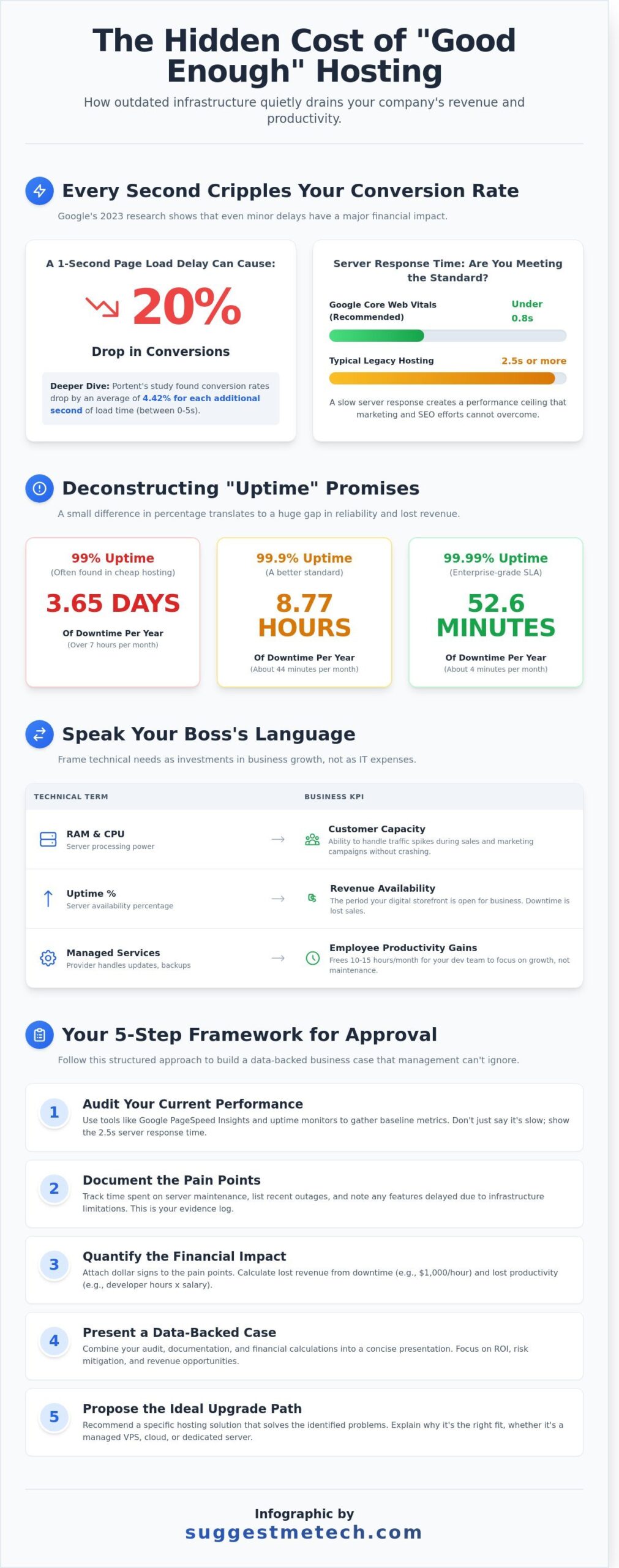
According to Google’s 2023 performance research, a 1 second delay in mobile page load times can slash conversion rates by up to 20%. If your site is currently crawling under the weight of outdated infrastructure, you’re likely searching for how to convince my boss we need better hosting before the next traffic surge hits. It’s frustrating to watch your maintenance workload grow while your current provider fails to deliver the security and speed your business deserves. You know that a 15 minute outage during peak hours is more than a technical glitch; it’s a direct hit to revenue and brand reputation.
The good news is that you don’t have to fight for a budget increase with technical jargon alone. We will show you how to translate hosting frustrations into a high impact business case that secures management approval for an upgrade. This guide provides a clear roadmap for your pitch, including the specific data points needed to prove ROI and handle pushback from the finance department. You’ll gain the confidence to show leadership exactly how a faster server will pay for itself within the first 6 months.
Key Takeaways
- Shift your mindset from “it’s working” to “it’s costing us” by identifying how legacy technical debt drains your company’s budget.
- Master the art of translating technical jargon into business KPIs, turning abstract metrics like RAM and uptime into customer capacity and revenue availability.
- Learn exactly how to convince my boss we need better hosting by countering common objections about cost and migration risk with data-backed business logic.
- Follow a structured 5-step pitch framework to audit your current performance and present existing pain points with clear dollar signs attached.
- Identify the ideal upgrade path for your business goals, including when to prioritize managed services to reclaim valuable internal time.
Why the ‘If It Ain’t Broke’ Mentality is Costing Your Company Money
It’s easy for a manager to look at a website that loads and assume everything is fine. However, this ‘if it ain’t broke’ approach ignores the invisible accumulation of technical debt that drags down your bottom line. Just because a site functions doesn’t mean it’s performing for your business. Legacy hosting is often a bottleneck that limits your team’s ability to deploy new features or handle traffic spikes. You aren’t just paying for a server; you’re paying for the foundation of your digital storefront. If that foundation is shaky, your entire marketing budget is at risk. When you start researching how to convince my boss we need better hosting, you have to frame it as a financial recovery mission rather than a technical upgrade.
A website that ‘works’ by 2015 standards is no longer the benchmark for success. Optimization is the new standard. If your current host takes 2.5 seconds just to respond to a server request, your site is already failing the 0.8-second response time recommended by Google’s Core Web Vitals. This lag creates a ceiling for your SEO efforts that no amount of keyword research can fix. You can’t build a high-performance sales machine on a budget engine. Developer frustration is another hidden cost that rarely shows up on a balance sheet. When your team spends 12 hours a month troubleshooting server configuration errors instead of building new product pages, you’re losing high-value labor. Modern hosting environments provide staging areas and automated backups that reduce this friction. By upgrading, you’re buying back your team’s time and redirecting it toward growth-focused tasks.
The True Cost of a 1-Second Delay
A 2019 study by Portent showed that the first five seconds of page-load time have the highest impact on conversion rates. In fact, website conversion rates drop by an average of 4.42% for every additional second of load time between seconds 0 and 5. This isn’t just a minor inconvenience. It’s a direct leak in your revenue stream. When a user clicks your link in search results and then immediately hits the back button because the page is sluggish, Google notices. This ‘pogo-sticking’ tells search engines your site isn’t a quality result, leading to a steady decline in your organic rankings over time. Fast server response times act as a silent signal of professional reliability that builds immediate user trust.
Downtime: More Than Just a Temporary Glitch
Downtime is expensive and public. If your average lead value is $250 and your site generates four leads per hour, a single hour of downtime costs you $1,000 in immediate potential revenue. That doesn’t account for the 88% of users who are less likely to return to a website after a poor experience. Cheap hosting providers often promise 99% uptime, which sounds good until you realize that allows for over 7 hours of downtime every month. In contrast, enterprise-grade SLAs often guarantee 99.99% uptime, limiting total annual downtime to just 52 minutes. Understanding how to convince my boss we need better hosting requires highlighting these massive gaps in reliability and their long-term impact on brand reputation.
- 99% Uptime: 3.65 days of downtime per year.
- 99.9% Uptime: 8.77 hours of downtime per year.
- 99.99% Uptime: 52.6 minutes of downtime per year.
Translating Technical Metrics into Business KPIs
To effectively learn how to convince my boss we need better hosting, I need to swap technical jargon for financial outcomes. Decision-makers prioritize growth and risk management over server specs. If I tell them we need more RAM, they see an expense. If I tell them we need to increase our “Customer Capacity” to handle 20% more traffic during the Q4 peak, they see an investment in scale. High-performance CPU and RAM aren’t just hardware; they’re the engine that prevents the site from crashing when a marketing campaign actually succeeds.
Uptime isn’t just a percentage; it’s “Revenue Availability.” A site with 99.5% uptime sounds reliable, but it actually stays offline for 3.6 hours every month. For an e-commerce brand doing $5,000 in daily sales, that’s $750 in monthly revenue simply vanishing. Managed services should be framed as “Employee Productivity Gains.” When a host handles updates and backups, it returns about 4 to 6 hours of high-value work time to the internal team every week. Finally, think of SSL and firewalls as “Insurance and Risk Mitigation.” They’re the digital equivalent of a building’s sprinkler system, protecting the company’s brand equity from total destruction.
Speed is a Sales Feature, Not a Tech Spec
Page speed directly dictates the bottom line. Google uses Core Web Vitals to determine search rankings, but it also impacts Google Ads. A slow site lowers the Quality Score, which forces the company to pay a higher Cost Per Acquisition (CPA) for every click. Research shows that a 1-second delay in mobile load times can decrease conversion rates by up to 20%. With Google’s mobile-first indexing requirement for 2026, a fast host is no longer optional for staying visible in search results. You can find the best hosting for speed to ensure your marketing budget isn’t being wasted on bounces.
Security as a Compliance and Trust Asset
The financial impact of a security failure is staggering. According to the 2023 IBM Cost of a Data Breach Report, the average cost of a breach is now $4.45 million. Investing in secure hosting is a fraction of that price. Modern hosting providers simplify GDPR and CCPA compliance by offering localized data centers and automated encryption. The Cybersecurity and Infrastructure Security Agency (CISA) emphasizes that website security is a fundamental part of organizational risk management. Before diving deeper, it’s helpful to review our guide on What is Web Hosting? to establish a baseline for these security features. This helps when explaining how to convince my boss we need better hosting by showing that security is a prerequisite for customer trust, not a luxury add-on.
Overcoming the 3 Biggest Management Objections
Decision makers often resist technical upgrades because of loss aversion. They worry more about the potential chaos of a failed migration than the benefits of a faster site. To understand how to convince my boss we need better hosting, you must address the psychological fear of change with cold, hard data. Management isn’t trying to be difficult; they are simply balancing risk against the bottom line. You can win the argument by reframing every technical “feature” as a business “safeguard.”
The ‘Expense’ vs. ‘Investment’ Argument
The most common hurdle is the price tag. A budget host costs about $60 per year, while a premium business host might start at $300 or more. On paper, that looks like a 400% increase in spending. However, this narrow view ignores the Total Cost of Ownership (TCO). When a site is slow, you pay for it through lost sales, higher bounce rates, and expensive developer “workarounds” to fix performance issues. If your site generates $5,000 a month, a single extra sale pays for the entire yearly hosting upgrade.
When evaluating the business value of a website, you have to look at how infrastructure supports conversion. Use this simple ROI formula to make your case: (Expected Revenue Gain – Hosting Increase) / Hosting Increase. If better hosting improves your conversion rate by just 0.5%, the return is often 10 times the initial cost. High-performance hosting isn’t a bill; it’s a revenue driver that reduces the need for constant technical troubleshooting.
De-risking the Migration Process
Management often fears that moving the site will lead to downtime or lost data. You can eliminate this fear by highlighting “White Glove” migration services. Many top-tier providers now offer professional migrations for free, handled by specialists who move hundreds of sites a week. This removes the burden from your internal team and ensures the transition is seamless. You should also emphasize the use of staging environments. These allow you to build and test the site on the new server in a private “sandbox” before any traffic sees it. This ensures that 100% of bugs are squashed before the site goes live.
If your leadership is still hesitant, show them user-friendly options from our guide on the Best Web Hosting for Small Business. These providers specialize in making the transition painless for non-technical teams. By presenting a clear, step-by-step plan that includes a rollback strategy, you prove that the move is a calculated improvement rather than a reckless gamble.
The ‘Extra Features’ Myth
When a boss says, “We don’t need these extra features,” they usually mean they don’t want to pay for things they don’t understand. Reframe “features” as “Future-Proofing.” Automated daily backups aren’t just a perk; they are an insurance policy against a $10,000 recovery bill. Advanced security layers aren’t optional; they protect the company from a data breach that could destroy its reputation in 24 hours. Scalability is another critical point. If a marketing campaign goes viral, a budget host will crash under the pressure. High-quality hosting allows the site to scale instantly, ensuring that you don’t waste your marketing budget on a site that nobody can access. This is how to convince my boss we need better hosting: by showing that “extra” features are actually essential safety nets for a growing company.
The 5-Step Pitch Framework: Building Your Business Case
Winning approval for a technical upgrade requires more than just a complaint about slow speeds. It requires a structured argument that speaks the language of leadership: ROI and risk mitigation. If you’re struggling with how to convince my boss we need better hosting, follow this five-step process to turn technical needs into a compelling business case.
Gathering the Evidence
Data is your strongest ally. Start by running your website through various testing platforms to create a baseline report. A 2023 study by Portent showed that sites loading in 1 second have conversion rates 3x higher than those loading in 5 seconds. If your Largest Contentful Paint (LCP) exceeds 2.5 seconds, you have a concrete performance gap to highlight. Key tools for your report include:
- Google PageSpeed Insights: Focus on mobile performance and Core Web Vitals.
- Internal Feedback: Ask the sales team if they’ve lost leads due to site timeouts.
- Competitor Benchmarking: Test your top three rivals; showing the boss that a competitor loads 45% faster often triggers immediate action.
Step 2: Identify ‘Pain Points’ with dollar signs attached. You must translate technical lag into lost revenue. If your site generates $15,000 monthly and has a 25% bounce rate linked to speed, a 1-second improvement could recover thousands in lost opportunities. Bosses care about the bottom line, so present the hosting cost as an investment in revenue retention rather than a recurring expense.
Presenting the Solution
When you present your findings, avoid the trap of offering a single choice. This forces a simple yes or no decision. Instead, offer three tiered options to give the boss a sense of control over the budget. A “Good” option might be a basic plan upgrade, while “Best” represents a fully managed cloud solution with 99.99% uptime. To remain objective, use an unbiased third-party resource like the Best Web Hosting Providers of 2026 from SuggestMeTech. This shifts the conversation from your personal preference to industry-standard recommendations.
Step 4: Highlight the ‘Risk of Inaction’. Explain the consequences of staying on the current server. Mention that 40% of users abandon a website that takes more than 3 seconds to load, based on Akamai’s latest performance data. Beyond speed, emphasize security. If an outdated server leads to a data breach, the average cost for a small business can exceed $100,000 in recovery and legal fees. This makes the upgrade feel like a necessary insurance policy.
Step 5: The ‘Ask’ – A clear, low-friction next step. End your pitch with a specific request that doesn’t feel overwhelming. Instead of asking to migrate the whole site immediately, ask for permission to start a 14-day trial or a “sandbox” migration for a single landing page. This low-friction approach is the most effective way regarding how to convince my boss we need better hosting without causing budget panic.
Your Executive Summary should be a 30-second elevator pitch: “Our current site loads in 7 seconds, which is costing us approximately 18% in mobile conversions. By moving to a provider from the latest hosting performance reviews, we can cut load times in half and secure our customer data for an extra $50 per month.”
Selecting the Right Upgrade Path for Your Team
Selecting the right path means looking directly at your 2026 growth targets. If you expect a 20% increase in traffic over the next twelve months, shared hosting won’t cut it. Shared hosting is like living in a crowded apartment building where a neighbor’s party can ruin your quiet night. VPS (Virtual Private Server) provides isolated resources, ensuring a neighbor’s traffic spike doesn’t crash your checkout page. Cloud hosting offers the highest redundancy, often boasting 99.99% uptime by spreading data across multiple server clusters. This ensures your site stays live even if a single hardware node fails.
Choosing managed hosting is a strategic move to reclaim internal time. While unmanaged plans look cheaper on paper, they require your team to handle security patches, server updates, and manual backups. If your lead developer earns $120 per hour, spending five hours a month on server maintenance costs the company $600. A managed plan often covers these tasks for an extra $30 or $50 monthly, allowing your team to focus on revenue-generating features instead. It’s a simple calculation of opportunity cost that any manager will understand.
Expert support acts as a force multiplier for small teams. When a critical database error occurs at 3 AM on a holiday, having 24/7 access to a Tier 3 technician prevents thousands in lost revenue. It’s the difference between a ten minute fix and a twelve hour outage that burns through your marketing budget. When you’re researching how to convince my boss we need better hosting, emphasize that support isn’t just a help desk; it’s an insurance policy for the company’s digital storefront.
Final Checklist for your 2026 Hosting Contract:
- Automatic daily backups with one-click restore functionality.
- Free SSL certificates and proactive malware scanning included.
- Global Content Delivery Network (CDN) integration for fast international loading.
- Transparent renewal pricing that avoids 300% price hikes after the first year.
- Dedicated IP addresses to improve email deliverability and security.
Finding the Sweet Spot: Budget vs. Performance
The cheapest hosting plans, often priced under $5, usually share a single server with up to 1,000 other websites. This congestion leads to slow load times, and a one-second delay can drop conversion rates by 7% according to industry benchmarks. You’ll also encounter renewal traps where the price jumps from $3.99 to $18.99 after the initial term ends. Always check the “long-term” cost before signing any contract. Unlimited hosting is a marketing myth because every physical server has fixed hardware limits on CPU and memory that will inevitably throttle your site’s performance regardless of what the sales page claims.
Next Steps: Starting the Conversation
Knowing how to convince my boss we need better hosting starts with a clear, data-backed proposal. Use this template to kickstart the process:
“Hi [Boss Name], our current site takes 4.5 seconds to load, which is 2.5 seconds slower than the industry average for 2024. I’ve identified an upgrade path that would improve our speed by 40% for an additional $25 per month. This change will protect our ad spend and improve our SEO rankings. Can we discuss the transition plan on Tuesday?”
If they say no, don’t get discouraged. Document every instance of downtime or slow performance over the next 30 days. Presenting a log of lost opportunities makes the “yes” much easier during the next budget review. For specific performance data to back your claim, research industry benchmarks and compare them against your current provider’s metrics, or explore our detailed hosting comparisons at SuggestMeTech to find suitable alternatives.
Take the Lead on Your Infrastructure Upgrade
Moving beyond the “if it ain’t broke” mentality is the first step toward protecting your company’s revenue. By translating technical latency into lost conversions and using our 5-step pitch framework, you turn a technical request into a strategic business move. You now have the tools to handle the 3 biggest management objections with data-backed confidence. Understanding how to convince my boss we need better hosting isn’t just about server speed; it’s about proving ROI through stable uptime and scalable performance that supports growth.
Don’t walk into that meeting empty-handed. We’ve utilized our 10+ years of IT experience to run independent speed tests on every major provider to ensure our recommendations are bulletproof. Our detailed comparison tables break down budget versus performance specifically for 2026 requirements so you can present a clear, vetted choice. Ready to find the right partner for your team? Compare the top-rated business hosting providers of 2026 here and bring the data that makes a “yes” inevitable. Your infrastructure is the backbone of your digital presence; it’s time to give it the support it deserves.
Frequently Asked Questions
How do I calculate the ROI of better web hosting?
You calculate ROI by comparing the cost of site downtime against the monthly subscription price of a premium host. If your website generates $1,000 every hour and experiences 5 hours of annual downtime on a budget plan, your company loses $5,000. Upgrading to a $50 monthly managed host typically reduces downtime to 0.01%, which saves you $4,400 per year in recovered revenue.
Is it really that hard to migrate a website to a new host?
Website migration is actually quite simple if you choose a provider that offers dedicated white-glove migration services. Leading hosts like WP Engine or SiteGround now provide free migrations for 100% of their new business accounts. This transition usually takes less than 24 hours to complete and involves zero downtime for your visitors. Your team won’t need to write any code during the entire transfer process.
What is the most important hosting feature for a non-tech boss?
Reliability, measured by a 99.99% uptime guarantee, is the most critical feature for any business leader. A boss cares most about the site being accessible to customers 24/7 without interruptions. When learning how to convince my boss we need better hosting, focus on how a reliable host prevents the 40% bounce rate associated with pages that take longer than 3 seconds to load.
How much should a business realistically spend on hosting in 2026?
A small to medium business should budget between $30 and $150 per month for quality hosting in 2026. While $5 plans exist, they lack the security and speed required for professional operations. Investing $100 monthly ensures you get dedicated resources, automated daily backups, and 24/7 priority support. This small increase represents less than 1% of most small business marketing budgets for the year.
Can better hosting actually improve my Google rankings?
Better hosting directly improves Google rankings by increasing your Core Web Vitals scores, specifically the Largest Contentful Paint (LCP) metric. Google confirmed in 2021 that page speed is a key ranking factor for both desktop and mobile searches. Moving from a shared server to a VPS can reduce server response times by 200ms or more, which helps your pages climb higher in search results.
What happens if my boss says we don’t have the budget right now?
Present a “cost of inaction” report that shows exactly how much money the business is currently losing due to poor performance. If your site takes 5 seconds to load, you’re likely losing 25% of your potential conversions according to Portent’s 2022 research. Knowing how to convince my boss we need better hosting often requires showing that the “cheap” plan is actually the most expensive option.
Is managed hosting worth the extra cost for a small team?
Managed hosting is worth the investment because it offloads 10 to 15 hours of technical maintenance per month from your internal team. The host handles security patches, software updates, and server optimizations automatically. For a team of three people, this reclaimed time is worth thousands of dollars in productivity. You get to focus on growing the business while the experts handle the technical backend.
How do I explain ‘server uptime’ to someone who isn’t tech-savvy?
Explain server uptime as the “open for business” hours of your digital storefront. A 99% uptime sounds good, but it actually means your site is closed for 3.65 days every year. A professional host offering 99.99% uptime reduces that “closed” time to just 52 minutes annually. It’s the difference between a shop that stays open all year and one that shuts down for an entire long weekend.