

Your web host should be your most profitable silent partner, not a constant source of unbillable maintenance hours. You likely entered this industry to build high-impact digital experiences, not to spend your Friday nights troubleshooting server updates or manual backups. Finding the best web hosting for agencies in 2026 is no longer just about uptime; it is about choosing an ecosystem that functions as a force multiplier for your team’s productivity.
We understand the frustration of losing billable time to complex site handoffs or the lack of white-labeling tools that build your brand authority. This guide reveals the top-rated hosting platforms designed to streamline client management and maximize your recurring revenue through 2026. We will compare the industry leaders on their ability to provide single-dashboard control, automated staging environments, and profitable reselling structures so you can scale your portfolio with confidence.
Key Takeaways
- Understand why a multi-tenant management platform is essential for professional client work compared to traditional shared hosting.
- Discover the five essential features, such as white-labeling and staging sites, that define the best web hosting for agencies in 2026.
- Evaluate top-tier providers based on their ability to handle cloud flexibility or premium WordPress-specific management.
- Learn how to build a profitable recurring revenue stream by reselling hosting and automating the client billing transfer process.
- Match your hosting choice to your agency’s specific growth stage to ensure your infrastructure scales alongside your client portfolio.
Beyond Speed: Why Agencies Need Specialized Hosting in 2026
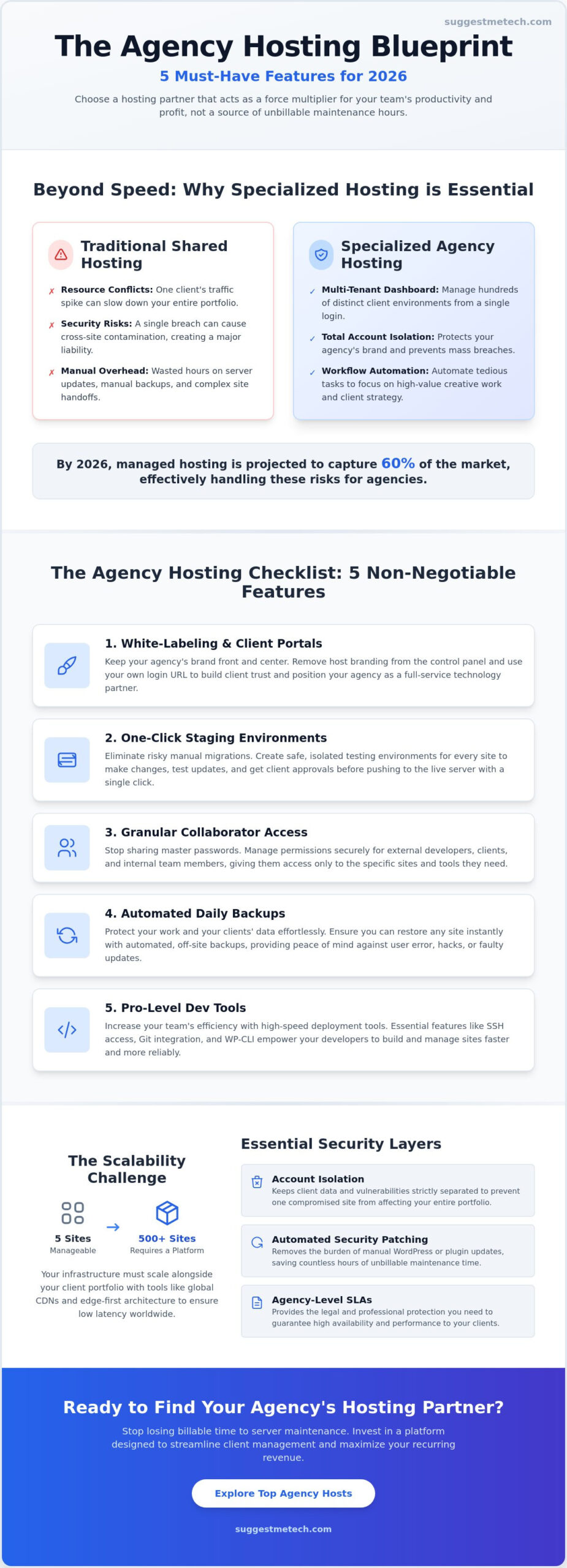
Agencies often treat hosting as an afterthought, but in 2026, your infrastructure is a direct reflection of your professional reputation. Choosing the best web hosting for agencies requires looking past basic uptime and focusing on multi-tenant management. You aren’t just buying a web hosting service; you are investing in a platform that allows you to manage hundreds of distinct environments from a single login. Standard shared hosting might look cheap on paper, but the hidden costs in manual updates and resource conflicts can quickly erode your profit margins.
Performance standards have shifted. With Core Web Vitals now the absolute baseline for search visibility, a slow server doesn’t just hurt the client; it damages your agency’s credibility. Modern providers have evolved from simple vendors into infrastructure partners. They offer tools that automate the tedious parts of your job so you can focus on high-value creative work and client strategy.
The Scalability Challenge: From 5 to 500 Sites
Managing five sites is easy. Managing 500 is a different game entirely. For a growing agency, vertical scaling is more critical than individual site performance. You need the ability to increase resources instantly when a client’s campaign goes viral without affecting the other sites in your portfolio. Using global CDNs with “edge-first” architecture is now a standard requirement to ensure low latency for international audiences. This ensures that a traffic spike in London won’t slow down a client site in New York.
Security and Liability: Protecting Your Agency Brand
Security is a major liability for any agency. If one client site on a shared server is compromised, cross-site contamination can take down your entire portfolio. Specialized agency hosting ensures total isolation between client accounts. This structure protects your brand and provides a clear value-add you can sell to clients. Consider these essential security layers:
- Account Isolation: Keeps client data and vulnerabilities strictly separated to prevent mass breaches.
- Automated Security Patching: Removes the burden of manual WordPress or plugin updates, saving hours of unbillable time.
- Agency-Level SLAs: Provides the legal and professional protection you need to guarantee high availability to your stakeholders.
By 2026, managed hosting is projected to capture 60% of the market because it effectively handles these risks. Selecting the best web hosting for agencies means choosing a partner that prioritizes these operational efficiencies over raw server specs.
The Agency Hosting Checklist: 5 Non-Negotiable Features
Choosing a server is easy. Finding a partner that supports your specific agency workflow is where most firms struggle. As the industry evolves, staying aligned with industry standards for web hosting helps ensure you provide a secure and transparent service to your clients. The best web hosting for agencies should act as an extension of your own brand, offering tools that eliminate manual labor and reduce technical debt.
Don’t settle for a generic plan. You need an environment that prioritizes your team’s efficiency just as much as site performance. Look for these five core features to protect your time and profit:
- White-labeling: Keep your agency’s brand front and center in the client dashboard.
- One-Click Staging: Create safe testing environments for every site in your portfolio.
- Granular Collaborator Access: Manage permissions for external developers and internal team members without sharing master passwords.
- Automated Daily Backups: Ensure you can restore any site instantly if a client makes a mistake.
- Pro-Level Dev Tools: Access via SSH, Git integration, and WP-CLI for efficient, high-speed deployments.
White-Labeling and Client Portals
Your clients don’t need to know who provides your hardware. They only need to know that your agency provides a seamless, professional experience. Top-tier providers allow you to remove their branding entirely from the control panel. You can provide a branded login URL and even customize support links to point directly to your internal ticketing system. This builds trust and positions your agency as a full-service technology partner rather than just a middleman.
Workflow Automation: Staging to Production
Manual migrations are a relic of the past. Modern agencies rely on one-click staging environments to get client approvals without risking the live site’s integrity. The best web hosting platforms now include advanced database syncing. This allows you to push design changes from staging to production without overwriting new content or orders that happened on the live site while you were working. Beyond staging, your team needs Git integration to maintain version control across multiple developers. Access via SSH and WP-CLI is equally vital for running bulk updates or managing files without the lag of a standard FTP client. If you are currently vetting new partners, our latest technology reviews offer a deeper dive into which dashboards provide the most intuitive developer experience.
The Top 5 Web Hosting Providers for Agencies (Ranked)
Ranking the best web hosting for agencies requires looking at more than just raw uptime. In 2026, these five providers dominate the market by adhering to core web standards while offering distinct advantages for different agency business models. Whether you prioritize designer-friendly workflows or high-performance cloud infrastructure, your choice should align with your team’s technical strengths.
- WP Engine: This remains the premium choice for agencies focusing exclusively on WordPress. Their infrastructure is optimized for the CMS, and their scale plans handle high-traffic portfolios with ease.
- Cloudways: If your team needs flexibility among providers like DigitalOcean, Vultr, or AWS, Cloudways is the winner. It offers a pay-as-you-go model that is ideal for agencies with fluctuating client traffic.
- Kinsta: Utilizing Google Cloud’s Premium Tier network, Kinsta provides top-tier performance. Their MyKinsta dashboard is widely considered the most intuitive for managing complex, multi-site client environments.
- SiteGround: For smaller boutique agencies or freelancers, SiteGround’s GoGeek plan offers the best value. It includes essential white-label tools and collaborator access at a lower entry price.
- Flywheel: Now part of the WP Engine family, Flywheel focuses on the creative workflow. Their “Blueprints” feature allows you to save theme and plugin configurations to launch new client sites in seconds.
Managed WordPress vs. Managed Cloud: Which is Better?
Choosing the best web hosting for agencies often comes down to a choice between simplicity and control. Managed WordPress hosts like WP Engine or Kinsta handle the technical heavy lifting, from core updates to security patching. Managed cloud providers like Cloudways give you more granular control over server resources and specific cloud providers. If your agency wants a “hands-off” experience where the host manages the server, stick with managed WP. If you have developers who want to tweak server settings or optimize resource allocation site-by-site, managed cloud is the better fit.
Support Response Times: A Critical Agency Metric
When a client’s site goes down, every minute of latency costs you money and professional trust. Support quality is a mission-critical metric for any agency partner. Providers that offer 24/7 expert access ensure that your how to start a blog clients receive the same level of care as your enterprise-level accounts. High-end plans often include dedicated account managers; this personalized service can be the difference between a quick fix and a day-long outage that damages your brand.
Maximizing Profit: How to Resell Hosting and Manage Client Handoffs
Hosting shouldn’t just be an expense on your balance sheet. It is a recurring revenue engine. When you choose the best web hosting for agencies, you gain the infrastructure to act as a direct provider for your clients. This reseller model allows you to purchase resources at a wholesale rate and bill your clients at a premium, covering your management time and technical oversight. Selecting the best web hosting for agencies in 2026 provides the automation tools needed to scale this revenue without increasing your manual workload.
Transferring billing is a common friction point that can lead to missed payments or service interruptions. The top providers in 2026 allow you to move the financial responsibility to the client while retaining your administrative access. This ensures you can still perform updates and troubleshoot issues without being on the hook for the monthly bill if a client’s credit card expires. For agencies managing dozens of sites, using billing automation tools like WHMCS or the host’s native client management portal is essential to keep your cash flow consistent.
To maximize your margins, don’t just sell space on a server. Sell a managed care package. A typical high-margin bundle includes:
- Managed Hosting: Secure, high-performance environments tailored to the client’s CMS.
- Maintenance: Weekly plugin, theme, and core updates with compatibility testing.
- Security: Proactive monitoring, malware removal, and automated daily backups.
- Reporting: Monthly performance and health reports that prove your ongoing value.
Pricing Strategies for Agency Hosting
The “Value-Added” approach is often the most profitable. Instead of showing the hosting cost as a line item, wrap it into a broader maintenance retainer or an SEO package. This makes the price less about the server specs and more about the peace of mind you provide. If you are struggling to decide which billing model fits your workflow, you can find detailed comparisons in our technology reviews and guides.
The Legal Side: Terms of Service and SLAs
Your client agreements need to be airtight to protect your agency from liability. Include specific clauses regarding uptime expectations and support boundaries. Clearly define what constitutes a “billable fix” versus “included maintenance.” For example, if a client breaks their own site by installing an incompatible plugin, your agreement should specify a restoration fee. This protects your time and ensures your hosting business remains a profit center rather than a support burden. Managing these expectations early prevents scope creep and keeps your client relationships healthy as you scale.
Choosing Your Partner: Matching Hosting to Your Agency’s Growth Stage
A solo freelancer managing three local business sites has vastly different needs than a global agency juggling 500 enterprise accounts. The best web hosting for agencies is the one that fits your current operational scale while offering a clear path for expansion. As you grow, your hosting requirements will shift from basic affordability to sophisticated workflow automation and high-availability architecture.
- The Freelancer Phase: At this stage, you need to prioritize low entry costs and easy ownership transfers. Providers like SiteGround or Hostinger are ideal because they offer promotional entry rates and simple “ship-to-client” features that let you hand off billing quickly.
- The Boutique Agency: Once you manage 10 to 50 sites, time is your most valuable asset. Focus on platforms like Flywheel or Cloudways. These offer the staging environments and site cloning tools discussed in our earlier sections to help your team deploy new projects faster.
- The Enterprise Shop: For those managing high-traffic portfolios, custom architecture and 24/7 phone support are non-negotiable. WP Engine and Kinsta provide the Google Cloud infrastructure and dedicated account management required for mission-critical client work.
When to Migrate Your Entire Portfolio
You’ll know it’s time to move when you spend more time on server maintenance than on client strategy. If your current host throttles performance during traffic spikes or lacks a centralized dashboard for bulk updates, you are losing money. Many top-tier providers now offer free white-glove migration services for agencies moving 10 or more sites. The ROI of switching is usually found in the hours saved through a more efficient management interface. Moving your entire portfolio to the best web hosting for agencies can consolidate your billing and reduce the mental load of managing multiple different environments.
Next Steps: Setting Up Your Agency Account
Before you commit, perform a thorough audit of your current client sites to ensure they are migration-ready. Check for outdated PHP versions or heavy plugin configurations that might require specific server optimizations. Most providers offer trial periods or demo accounts. Use this time to test the collaborator interface with your team to see if the permissions settings match your internal workflow. Don’t forget to claim agency-exclusive perks. Programs like Kinsta’s agency plan offer free hosting for your own agency site and up to $10,000 in hosting credits for eligible partners. These incentives can significantly lower your overhead during the transition period.
Final Verdict for 2026: For most growing firms, Kinsta is our top recommendation. Their MyKinsta dashboard remains the gold standard for multi-site management, and their use of the Google Cloud Platform ensures the performance your clients demand. If you need more provider-specific details, our latest technology reviews offer a deeper dive into the technical benchmarks of each platform.
Future-Proof Your Agency Infrastructure
Successful agencies in 2026 treat their hosting as a core profit center rather than a simple overhead cost. You’ve seen how specialized features like white-labeling and automated staging protect your billable hours and build your brand authority. By selecting a partner that aligns with your specific growth stage, you can eliminate technical bottlenecks and focus on high-value client strategy. Whether you are a solo freelancer or an enterprise shop, your server choice acts as the foundation for every digital experience you deliver.
Finding the best web hosting for agencies is the first step toward a more predictable and profitable business model. It’s about more than just speed; it’s about building a recurring revenue stream that scales with your ambition. Find the perfect hosting partner for your agency with our top-rated reviews. Our guides provide a deep-dive comparison of 15+ agency-specific features and real-world performance testing data for 2026 to ensure you get the best ROI possible.
Your infrastructure should empower your growth, not hold it back. Take the lead today and start building a more resilient, high-performance client portfolio that stands out in a competitive market.
Frequently Asked Questions
What is the best web hosting for agencies in 2026?
Kinsta is our top recommendation for most agencies due to its intuitive MyKinsta dashboard and high-performance Google Cloud infrastructure. WP Engine remains the premium choice for WordPress-centric firms, while Cloudways offers the best flexibility for those needing cloud-native options. Your choice should depend on whether you prioritize a hands-off managed experience or granular server control.
Can I white-label my hosting dashboard for my clients?
Yes, white-labeling is a standard feature for agency-focused providers like SiteGround, Kinsta, and Hostinger. These tools allow you to remove the host’s branding and replace it with your agency’s logo and color scheme. This creates a professional, branded login experience that reinforces your authority as a full-service technology partner.
How do I charge my clients for web hosting?
Most agencies use a “Value-Added” model by bundling hosting into a monthly maintenance package that includes security and updates. You can bill clients through a recurring retainer using automation tools like WHMCS or the host’s native billing transfer features. This strategy ensures you cover your wholesale costs while generating a profitable recurring revenue stream for your management time.
Is managed WordPress hosting better for agencies than VPS?
Managed hosting is almost always better for agencies because it automates server maintenance, security patching, and core updates. While a VPS might offer more granular control, it requires significant manual oversight and technical expertise that can eat into your profit margins. Managed platforms let your team focus on billable creative work rather than troubleshooting server configurations.
How does collaborator access work in agency hosting?
Collaborator access allows you to invite team members or external contractors to specific sites without sharing master passwords. You can set granular permissions to limit access to billing details or staging environments. This is a vital security feature in the best web hosting for agencies, ensuring your portfolio remains protected as your team scales and project requirements change.
What happens to the hosting if a client leaves my agency?
You should choose a provider that supports seamless site ownership and billing transfers. Most agency-focused hosts allow you to “ship” a site to a client’s individual account while you retain administrative access if needed. This process ensures a clean financial break without the risk of site downtime or data loss during the transition period.
Do these providers offer free migrations for my existing client sites?
Yes, most premium agency hosting plans include free white-glove migrations for your entire portfolio. Providers like Kinsta and WP Engine frequently handle the technical heavy lifting to move 10 or more sites simultaneously. This service reduces the risk of errors and saves your team dozens of unbillable hours during the onboarding process.
Which hosting provider has the best agency partner program?
Kinsta and WP Engine offer the most robust agency partner programs in 2026. These programs often include free hosting for your agency’s own site, priority support, and a listing in their official partner directories. Utilizing the best web hosting for agencies through these programs helps you reduce operational overhead while gaining a credible seal of approval for your brand.