

In 2026, your affiliate site isn’t just a collection of links; it’s a trust engine that converts readers into buyers through speed and transparency. You likely feel the frustration of platforms that are either too technical to manage or too restrictive to rank on Google. It’s exhausting to deal with hidden costs when you’re just trying to earn your first commission. Finding the best website builder for affiliate marketing shouldn’t feel like a compromise between ease of use and powerful SEO.
I’ve tested these platforms so you don’t have to waste time on trial and error. This guide will help you find the perfect platform to build your recommendation engine and teach you the technical steps to launch a profitable site this year. We’ll compare the leading website builders on the market; we’ll also provide a clear roadmap from initial setup to your first commission check. Whether you’re worried about page speed or managing complex disclosure requirements, you’ll find the practical answers you need right here.
Key Takeaways
- Understand how the 2026 shift toward value-driven content has replaced traditional banner ads as the primary driver of affiliate success.
- Gain a clear technical blueprint for tracking and attribution so that your traffic converts into verified commissions.
- Evaluate the best website builder for affiliate marketing to find a platform that balances ease of use with the SEO power needed to rank.
- Explore different revenue models like Pay Per Sale and Pay Per Lead to choose a niche with the highest profit potential.
- Learn how ethical link disclosure and genuine expertise help you navigate Google’s Helpful Content requirements for long-term growth.
Defining Affiliate Marketing: Why Your Website Builder Choice Matters
Affiliate marketing is the digital version of a trusted friend’s recommendation. It’s a performance-based system where brands pay you a commission for every successful referral you generate. While the core concept remains simple, the execution has evolved significantly. In 2026, success is driven by value-driven content integration rather than flashy banner ads. Users want genuine help, not a sales pitch. They look for detailed comparisons and hands-on testing before they ever click a link.
Choosing the best website builder for affiliate marketing is the most critical technical decision you’ll make. This choice dictates your SEO ceiling; some platforms make it easy to rank for competitive reviews, while others act like a lead weight on your visibility. It also establishes your conversion floor. If your site loads slowly or looks unprofessional, you’ll lose the trust required to earn a commission. To understand the foundations of this industry, you can explore the history and methods behind What is Affiliate Marketing? to see how these compensation models have matured into a multi-billion dollar industry.
The Four Key Players in the Affiliate Ecosystem
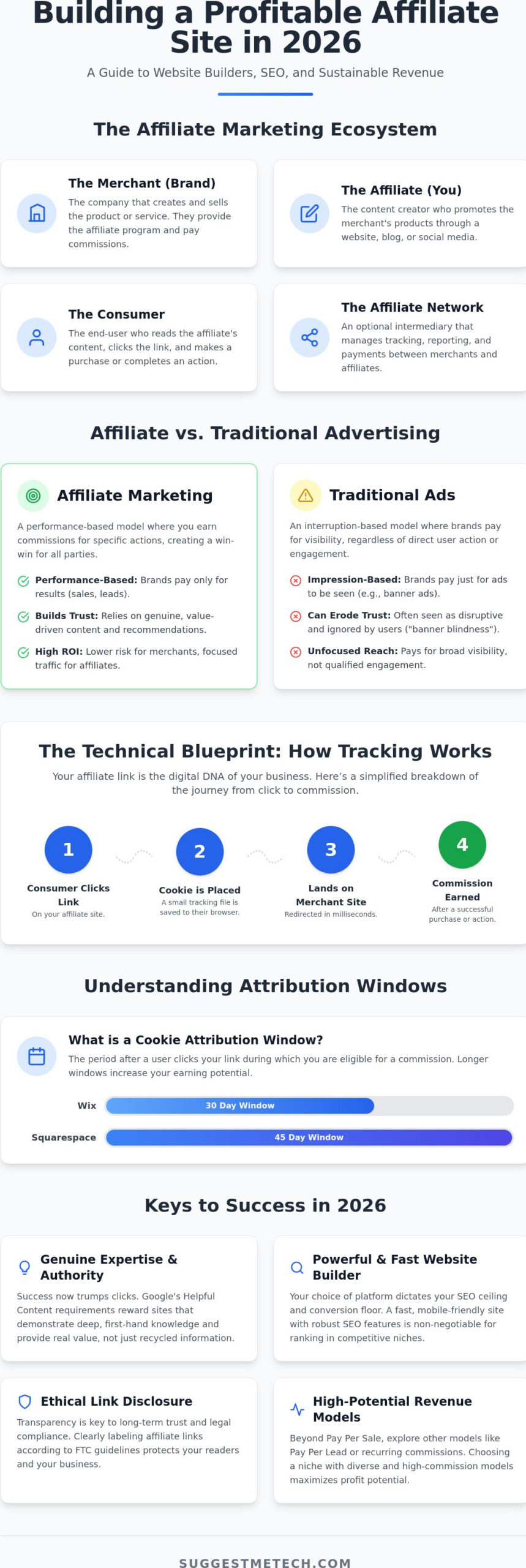
Success requires understanding how different roles interact within the market. The Merchant is the brand providing the product or service. You, the Affiliate, are the content creator providing the recommendation. The Consumer is the user seeking a solution to a specific problem. Finally, the Affiliate Network acts as the hub that connects brands with creators and tracks every click and sale to ensure you get paid accurately. When these four players align, the user gets a solution, the brand gets a sale, and you earn a profit.
Affiliate Marketing vs. Traditional Advertising
Traditional advertising often relies on “pay-per-impression” models where brands pay just to be seen. Affiliate marketing is far more efficient because it’s performance-based; brands only pay when a specific action, like a sale or sign-up, occurs. This model creates a healthier ecosystem for everyone involved. As an affiliate, you act as a vital middleman. You provide unbiased comparisons that help consumers cut through marketing noise. By focusing on helpful reviews rather than broad ads, you maintain your independence while earning a sustainable income. Your website builder must support this by allowing for clean link management and high-speed performance. If the platform feels restrictive for SEO, your growth will stall before you even reach your first payout threshold.
The Technical Blueprint: Tracking, Attribution, and Builder Compatibility
Your affiliate link is the digital DNA of your business. It is a unique URL that identifies your specific traffic and ensures the merchant knows exactly who sent the customer. When a reader clicks a link in your blog post, they’re redirected through a tracking server before landing on the merchant’s checkout page. This process happens in milliseconds, but it’s the foundation of your revenue. Tracking ensures you get credit for the sale even if the user doesn’t buy immediately. Choosing the best website builder for affiliate marketing means finding a platform that handles these technical handshakes without breaking the user experience.
Behind the scenes, when a user makes a purchase, the merchant’s system looks for a tracking code associated with that session. If it finds your ID, the commission is logged in your affiliate dashboard. However, this process requires your website to be technically sound. If your builder adds messy redirects or slows down the page, you might lose the click before the tracking even initializes. Following FTC disclosure guidelines is also a technical requirement; you must ensure your site clearly labels these links to maintain trust and legal compliance. If you’re feeling overwhelmed by these technicalities, you can find simplified guides at SuggestMeTech to help you get started.
The Role of Cookies and Attribution Windows
A cookie is a small file placed on the user’s browser that remembers your referral. The duration of this file, known as the attribution window, is vital to your earnings. For example, Wix typically offers a 30 day cookie, while Squarespace provides a 45 day window. If a user clicks your link but waits 20 days to buy, you still get paid. Most builders today use “last-click” attribution, meaning the final affiliate link clicked gets the credit, but modern platforms are starting to support more complex multi-touch models.
Cross-Device Tracking in 2026
Tracking has become more sophisticated to match how people shop. It’s common for a user to click your link on a phone while commuting but finish the purchase on a laptop at home. In 2026, tracking systems use digital fingerprinting and logged-in user data to bridge this gap. This ensures you don’t lose commissions just because a customer switched devices. You need a website builder that integrates seamlessly with these robust tracking technologies to maximize your ROI. Without reliable attribution, you’re essentially leaving money on the table every time a user switches from mobile to desktop.
Revenue Models and Choosing a High-Commission Niche
Your niche choice determines your earning potential just as much as your traffic does. Selecting the best website builder for affiliate marketing allows you to showcase different affiliate revenue models effectively, whether you’re focusing on one-off sales or long-term growth. As a living case study of a successful affiliate site, SuggestMeTech demonstrates how to balance these models to fund high-quality, free tech guides.
Pay Per Sale (PPS) remains the gold standard for most creators. You earn a percentage of the purchase price or a flat fee for every customer you refer. For instance, Wix pays a flat $100 per referral, while Shopify offers $150. Pay Per Lead (PPL) is another path; it pays you for actions like free trial sign-ups or consultation requests. This is often easier to convert but usually pays less per action. If you’re looking for stability, recurring commissions are the holy grail. Common in software and subscription services, these programs pay you as long as the customer remains a subscriber, creating a compounding income stream over time.
Strategy often comes down to high-ticket items versus volume. Selling a few expensive items like enterprise software requires deep trust-building content. Mass-market products, however, rely on high traffic volumes. While the median commission for e-commerce is around 8.4%, SaaS and tech niches often jump to 22.5%, making them highly lucrative for those with the right platform.
Understanding Commission Structures
- Flat Rate vs. Percentage: Some programs pay a set dollar amount regardless of the sale price, while others scale with the customer’s spend.
- Tiered Commissions: Many brands reward high performers by increasing their commission percentage as they drive more monthly volume.
- High-Value Niches: Tech services, particularly best web hosting providers, provide some of the most competitive rates because the customer lifetime value is so high.
Payment Thresholds and Schedules
Getting clicks is only half the battle; you also need to understand the payout terms. Most networks operate on Net-30 or Net-60 schedules, meaning you receive funds 30 or 60 days after a sale is verified. This delay accounts for potential customer refunds. You’ll also encounter minimum thresholds. You might need to earn $300 before Wix issues a payout, or reach a specific limit on platforms like Shopify or Squarespace. Common payment methods include PayPal, wire transfers, and direct deposit. Using the best website builder for affiliate marketing ensures your site remains professional and fast, helping you reach these thresholds much faster by maintaining user trust.
The Best Website Builders for Affiliate Marketing: A 5-Step Launch Guide
Launching a site is easier than ever, but building one that actually pays requires a strategic approach. You don’t need a computer science degree to start, but you do need to follow a proven sequence. Here is the five-step roadmap to get your site from zero to your first commission.
- 1. Choose Your Niche: Focus on a specific category you understand; for example, Parasta Tallinnassa succeeds by dominating a specific geographic niche with expert local knowledge. Don’t try to cover everything; pick a sub-niche where you have genuine interest and expertise.
- 2. Build Your Platform: This is where you select the best website builder for affiliate marketing. Your choice here determines how easily you’ll manage links and rank in search results.
- 3. Select Quality Products: Only promote items you would recommend to a friend. Your reputation is your most valuable asset. If a product is bad, say so clearly to maintain trust.
- 4. Create High-Value Content: Move beyond generic Top 10 lists. Deep comparisons and hands-on testing are what readers actually want to see in 2026.
- 5. Drive Targeted Traffic: Use SEO to find people searching for solutions. Supplement this with social media and a newsletter to build a community that doesn’t rely solely on search algorithms.
Top 5 Builders for 2026 Compared
Every platform has strengths depending on your specific goals. Here is how the top contenders stack up for affiliate needs:
- WordPress.org: The ultimate choice for flexibility. It offers the best SEO control for serious marketers who want to own every aspect of their site.
- Wix: Best for speed-to-market. It features built-in affiliate apps that help you get a professional site live in hours rather than days.
- Ghost: The top choice if you want a newsletter-first model. It’s clean, fast, and built specifically for creators who focus on long-form writing.
- Shopify: Best for hybrid sites. Use this if you plan to sell your own digital products alongside your affiliate recommendations.
- Squarespace: Ideal for high-design niches. It’s perfect for visually driven categories like headphones where aesthetic appeal builds trust.
The Foundation: Hosting and Domains
You must own your platform. Relying solely on social media is a risk because algorithms can change overnight. A self-hosted site gives you total control over your business. Start by choosing a domain name that allows for future growth; don’t pick something so narrow that you can’t expand later. For a full technical walkthrough, follow our guide on How to Start a Blog in 2026. If you need help choosing the right tools for your specific niche, visit SuggestMeTech for our latest tested recommendations.
Success in 2026: Why Authority Trumps Clicks
In 2026, the “trust gap” is the biggest hurdle for any new marketer. Users are increasingly wary of biased reviews and AI-generated spam that offers no real value. This is the era of Helpful Content, where Google rewards genuine expertise and hands-on testing over keyword stuffing. If you want to build a sustainable business, your site must function as a trust engine. Selecting the best website builder for affiliate marketing is just the first step; your success depends on how you use that platform to demonstrate authority.
Transparency is your most powerful tool for building long-term trust. Clearly disclosing your affiliate relationships isn’t just a legal requirement; it’s an opportunity to show your audience that you value honesty. At SuggestMeTech, we prioritize user intent over high-commission products. We often recommend a budget-friendly hosting plan or a free tool if it’s the right fit for the reader’s specific problem. This approach might mean a smaller commission today, but it ensures the reader returns to us for their next tech purchase. Diversifying your income across multiple programs and platforms protects you from sudden algorithm changes that can wipe out a single-source revenue stream overnight.
Building a Recommendation Engine, Not a Sales Pitch
Diversification and Long-Term Growth
As your authority grows, you can move from a narrow niche into related categories. This expansion allows you to capture a wider audience without losing your core identity. Building an email list is essential for this growth; it gives you a direct line to your audience that you own regardless of social media or search engine changes. You can also attract new visitors by creating utility content. For example, a guide on how to clear cache on iPhone brings in top-of-funnel traffic that might later look for your hardware recommendations. By combining helpful tools with expert reviews, you create a comprehensive resource that readers will bookmark and share. Success in this industry is a marathon, and authority is the only way to stay in the race.
Build Your Affiliate Trust Engine
Choosing the best website builder for affiliate marketing is the technical foundation of your business, but your commitment to helpful, honest content is what will keep you profitable. You’ve learned that reliable tracking and attribution are the keys to getting paid; owning your platform is the only way to protect yourself from algorithm shifts. SuggestMeTech is built on these exact principles. We only recommend products we’ve tested ourselves. Join 50,000+ monthly readers who trust our tech guides to navigate their own digital journeys.
Start your own affiliate blog today with our 2026 step-by-step guide. The affiliate landscape is evolving, but there’s never been a better time to turn your expertise into a recommendation engine that works for you. You have the tools and the roadmap. Now it’s time to take the first step toward your first commission.
Frequently Asked Questions
Is affiliate marketing still worth it in 2026?
Yes, affiliate marketing remains highly profitable in 2026 with the global industry valued at over $18.5 billion. Success today requires moving away from thin content toward becoming a trusted resource for your audience. While competition is higher, brands still spend billions because performance-based referrals are more efficient than traditional ads. You’ll succeed by focusing on high-value niches like SaaS or tech where commission rates often reach 22.5%.
Which website builder is best for SEO in affiliate marketing?
WordPress.org remains the best website builder for affiliate marketing for those seeking total SEO control and deep customization. It allows you to optimize every technical detail from schema markup to specific page speed parameters. However, if you prefer a managed solution, platforms like Wix and Squarespace now offer robust SEO tools that are sufficient for most niche sites. Your choice should balance your technical comfort with your need for search visibility.
Do I need a website to start affiliate marketing?
You don’t strictly need a website to start, but owning one is the only way to build a sustainable business. While you can promote links on social media or YouTube, those platforms own your audience and can change their rules at any time. A dedicated site allows you to capture organic search traffic and build an email list. It’s your central hub for establishing authority and providing the deep comparisons that drive conversions.
How much does it cost to start an affiliate marketing website?
Starting an affiliate site is relatively inexpensive, typically requiring less than $100 to get your first pages live. You’ll need a domain name for about $15 per year and a monthly hosting plan or builder subscription. Wix starts at $17 per month for their Light plan, and many budget hosting providers offer similar entry-level pricing. These small upfront costs are minimal compared to the potential recurring revenue a successful site can generate.
How do I disclose affiliate links to my audience legally?
You must clearly and conspicuously disclose your affiliate relationships to comply with FTC regulations. Place your disclosure near the endorsement or link where users can easily see it without scrolling. Avoid vague language; use direct statements like “I earn a commission if you click this link.” Failing to do so can lead to legal liability and fines of over $51,000 per violation. Transparency doesn’t just keep you legal; it builds long-term trust.
What is the difference between affiliate marketing and influencer marketing?
Affiliate marketing is a performance-based model where you only get paid when a specific action, like a sale, occurs. Influencer marketing often involves a flat fee paid upfront for brand awareness or social reach. While many creators now combine both strategies, the affiliate model is generally more accessible for beginners. You don’t need a massive following to start earning; you just need to provide helpful advice that leads to a purchase.
Can I use a free website builder for affiliate marketing?
You can technically use a free builder, but it’s rarely a good idea for a serious business. Free plans often restrict your ability to use affiliate links and force you to use a subdomain, which is very difficult to rank on Google. They may also display their own ads on your content, distracting your visitors. Investing in a paid plan ensures you own your brand and have the professional tools needed to scale your income.
How do I find out if a company has an affiliate program?
The easiest way to find a program is to scroll to the footer of a company’s website and look for an “Affiliates” or “Partners” link. You can also search for the brand name followed by the phrase “affiliate program” in any search engine. Many companies host their programs on large networks like Impact or CJ. Joining these networks gives you access to thousands of potential products to promote from a single dashboard.