

That $4.99 domain deal you just found might actually be the most expensive mistake you make this year. While GoDaddy often wins the race for the lowest introductory price, the long-term math tells a very different story for your wallet. If you’re tired of aggressive upselling during checkout and skyrocketing renewal prices that double after the first year, you aren’t alone. Choosing between namecheap vs godaddy isn’t just about the first twelve months; it’s about finding a stable foundation that won’t slow down your website or drain your budget.
We understand how frustrating it is to deal with slow loading speeds and hidden fees for basic features like WHOIS privacy. This guide provides a transparent, expert comparison of pricing, performance, and user experience to help you choose the right partner. We’ll break down why a .com domain can cost $96.95 over five years at one provider while staying under $66 at the other. We’ll also compare real-world performance data and evaluate which dashboard actually saves you time. By the end, you’ll know exactly which giant deserves your business in 2026.
Key Takeaways
- Calculate the true five year cost of your domain to avoid the common trap of low introductory rates followed by expensive renewals.
- Navigate the namecheap vs godaddy comparison by identifying which provider offers essential security features like WHOIS privacy for free.
- Evaluate hosting performance beyond simple uptime by looking at the impact of modern NVMe storage on your website loading speeds.
- Learn how to bypass aggressive upselling during the checkout process to keep your initial setup costs as low as possible.
- Determine which provider fits your specific business scale, from minimalist setups for freelancers to complex ecosystems for larger teams.
The 2026 Landscape: Why Namecheap and GoDaddy Still Matter
For over two decades, these two companies have acted as the primary gateways to the internet. Whether you’re launching a personal blog or a high-traffic corporate storefront, your journey into the digital space likely starts with one of these two giants. Understanding GoDaddy’s history and market position helps explain why they remain such a dominant force. They’ve evolved far beyond simple domain registration, transforming into massive ecosystems that offer everything from basic web hosting to sophisticated AI-driven marketing suites.
By 2026, the industry has undergone a significant shift. We’ve moved past basic keyword searches into an era of AI-assisted domain discovery and instant site generation. Both providers now use machine learning to suggest creative alternatives when your first choice is taken, often building a functional landing page before you’ve even finished the checkout process. This evolution makes the namecheap vs godaddy choice more complex because their feature lists look increasingly similar on the surface. However, the core dilemma for users remains the same: do you prioritize the massive brand recognition and integrated tools of GoDaddy, or the pricing transparency and privacy-first culture of Namecheap?
The primary services have also expanded. While domains and shared hosting remain the bread and butter, both companies now compete heavily in professional email services and managed security. The decision often comes down to how much you value a “one-stop-shop” experience versus a provider that sticks to the basics and does them exceptionally well for a lower price.
Who is Namecheap for in 2026?
Namecheap remains the top recommendation for the budget-conscious builder who values upfront honesty. It’s the go-to platform for users who want to avoid the “upsell trap” during checkout. It’s best for:
- Privacy seekers: Users who believe WHOIS protection should be a standard right, not a paid add-on.
- Minimalists: Creators who prefer a clean, straightforward dashboard that doesn’t feel like a digital billboard.
- Tech-savvy individuals: Professionals who want reliable performance without paying a premium for brand name recognition.
Who is GoDaddy for in 2026?
GoDaddy is designed for the entrepreneur who values convenience and comprehensive support. It functions as a complete business infrastructure. It’s best for:
- Small business owners: Teams that need their marketing, email, and website tools tightly integrated under a single login.
- Support-reliant users: People who feel more confident knowing they can access 24/7 phone support if something goes wrong.
- Domain investors: Professionals who want to leverage the world’s largest domain auction house to buy and flip valuable assets.
Domain Registration: Transparency vs. Brand Power
Every domain registrar operates under the oversight of the global domain name system coordinator, yet the way they bill you for those addresses varies wildly. When comparing namecheap vs godaddy, the initial price you see on the search results page is rarely the price you’ll pay over the life of your website. In 2026, the gap between “introductory” and “renewal” rates has become the most critical metric for any buyer.
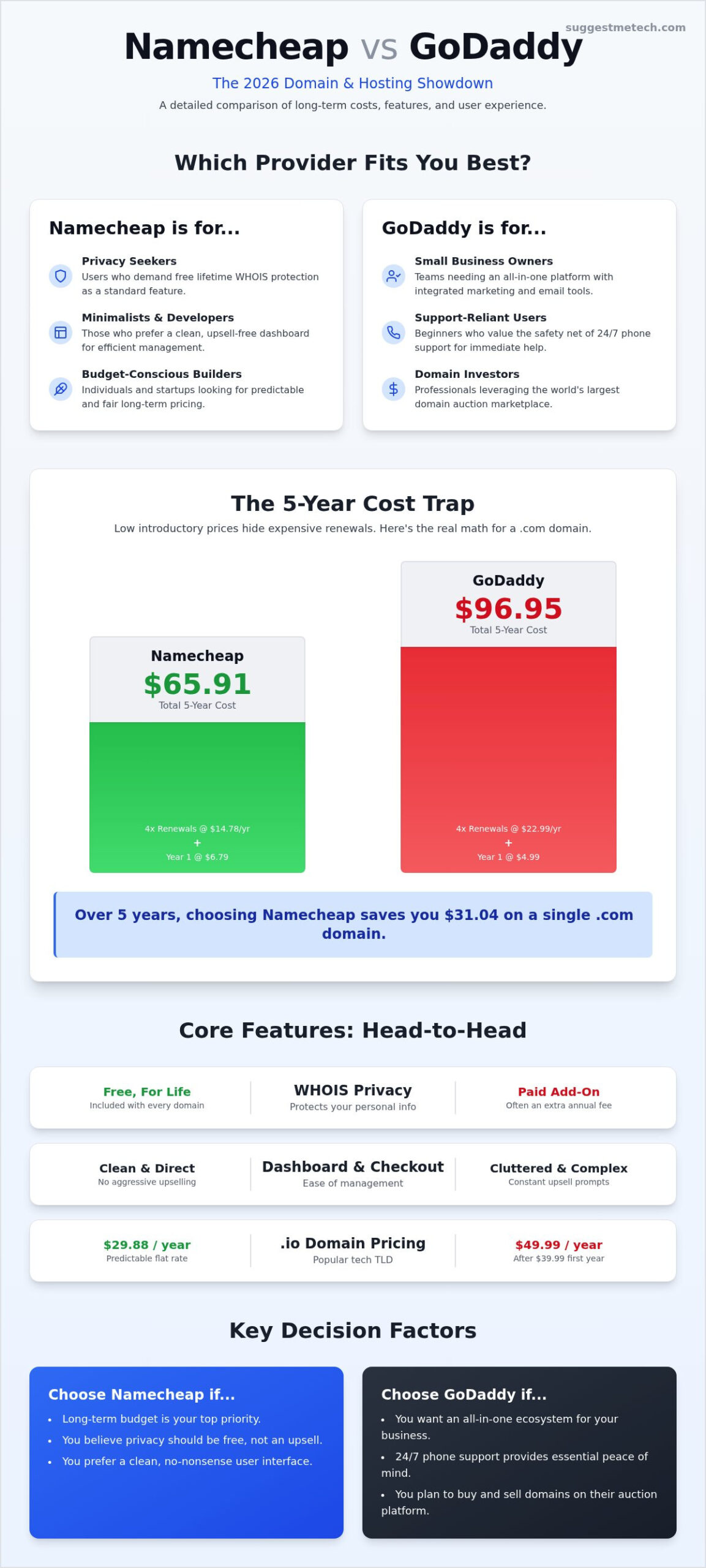
For a standard .com registration, GoDaddy often leads with an aggressive $4.99 entry price using a promo code. Namecheap sits slightly higher at $6.79 for the first year. However, the script flips entirely at renewal. Namecheap maintains a predictable $14.78 annual fee, while GoDaddy’s renewal price jumps to $22.99. For specialized extensions like .io, Namecheap offers a flat $29.88 per year, whereas GoDaddy starts at $39.99 and renews at $49.99. These differences might seem small today, but they lead to a significant total cost of ownership gap over time.
Domain management also differs in its complexity. Namecheap provides a streamlined dashboard that makes updating DNS records or initiating transfers a three click process. GoDaddy’s interface is more robust but also more cluttered, often requiring you to navigate past multiple upsell prompts just to change a name server. If you are just starting out, you might find it helpful to read our guide on What is a Domain Name? A Simple Guide for Beginners before making your final choice.
The “Introductory Price” Trap
GoDaddy frequently markets domains for as low as $0.01, but these offers almost always require a two year commitment. You pay pennies for year one and then face a massive price hike for year two. Namecheap avoids these extreme fluctuations, opting for a model that prioritizes long-term retention over flash sales. In 2026, a cheap domain is only a bargain if the renewal price doesn’t triple in year two. If you want to avoid hidden fees, you can find more honest comparisons at suggestmetech.com.
Security and Privacy Features
Privacy is where the namecheap vs godaddy debate becomes most one-sided. Namecheap includes free WHOIS privacy on all eligible domains forever. This service hides your home address and phone number from the public database. GoDaddy, conversely, often treats privacy as a tiered add-on, charging extra for basic protection. Namecheap also offers “Domain Vault” for high-security needs, providing machine-learning based monitoring and manual approval for changes. While GoDaddy offers similar tiered security packages, many of their essential features are locked behind monthly subscriptions that quickly exceed the cost of the domain itself.
Hosting Performance: Speed, Uptime, and AI Integration
Performance in 2026 isn’t just about keeping your site online; it’s about how effectively your host uses modern hardware and artificial intelligence to serve content. In the namecheap vs godaddy comparison, the hardware gap has widened. Namecheap now uses NVMe storage as a standard for its shared hosting plans, which provides significantly faster data transfer than traditional SSDs. GoDaddy, by contrast, uses tiered speed levels, often reserving its fastest server resources for premium customers while entry-level plans use standard SSD configurations.
The rise of AI has also changed the hosting landscape. GoDaddy’s “Airo” platform is a comprehensive suite that uses AI to generate logos, social media copy, and even basic website structures in minutes. Namecheap’s Site Maker offers a similar automated experience but focuses more on layout simplicity and rapid deployment. While GoDaddy provides a more robust brand-building toolkit, Namecheap’s focus on raw hardware performance often results in a snappier user experience for the visitor. Following the FTC guidance on choosing a web host is a smart first step to ensure your provider meets modern security and reliability standards.
Speed Test Results: GTmetrix and Beyond
Real-world testing reveals a clear performance leader. In recent GTmetrix benchmarks, Namecheap achieved an average mobile load time of 809ms, earning a 100% performance grade. GoDaddy trailed behind with a 1.5s load time and an 83% grade. This difference matters because a one-second delay can significantly increase your bounce rate and hurt your SEO rankings. Server location plays a vital role here too. Namecheap allows you to choose between US, UK, and Amsterdam data centers, while GoDaddy’s massive global network includes Singapore to better serve Asian audiences. For a broader look at how these stack up against other providers, see The Best Web Hosting Services of 2024: Tested and Reviewed.
WordPress Optimization in 2026
Both giants have moved toward specialized environments for WordPress users. Namecheap’s EasyWP is a proprietary cloud-based solution that operates independently of traditional cPanel hosting, offering faster speeds and easier backups. GoDaddy’s WordPress hosting is more traditional but includes a highly polished staging environment where you can test changes before they go live. Managed WordPress Hosting is a specialized, hands-off solution where the provider handles server-level optimizations, security patches, and backups so you can focus on content. Both offer one-click installs, but Namecheap’s cloud architecture typically provides a more consistent uptime experience compared to GoDaddy’s shared server clusters.
User Experience: Navigating the “Upsell Fatigue”
The user experience starts long before you reach the dashboard. It begins the moment you click “Add to Cart.” In the 2026 comparison of namecheap vs godaddy, the checkout process reveals a stark difference in business philosophy. Buying a domain on Namecheap is a high-speed experience; it typically takes about four clicks to move from search to purchase without any extra baggage. GoDaddy’s process is significantly more involved, often requiring you to decline four or five separate offers for email, security, and website builders before you can actually pay.
Once you’re past the payment screen, the dashboard experience continues this theme. Namecheap uses a minimalist design that prioritizes your active services. It’s easy to find your DNS settings or renewal dates without getting lost. GoDaddy’s dashboard is a massive, complex ecosystem. While it’s more cluttered, it’s also more powerful if you use their entire suite of marketing tools. It acts as a central hub for your business, but the learning curve is steeper for those who just want a simple site.
The Psychological Cost of Upselling
GoDaddy is frequently criticized for using “dark patterns” during checkout. These are design choices, like pre-checked boxes for “Full Domain Protection,” that assume you want a service unless you specifically opt out. This creates a high mental load for beginners who might not know which features are essential. Namecheap maintains a much cleaner cart experience, showing you exactly what you asked for and nothing else. Actionable tip: Always double-check your cart for “Email Essentials” or “Security Starter” add-ons before clicking buy. These small monthly fees can quickly bloat your initial budget. For a deeper look at avoiding these traps while setting up your first site, check out our guide on How to Start a Blog in 2026: A Step-by-Step Guide for Beginners.
Support Channels and Response Times
Support is where GoDaddy often justifies its higher price point. They offer 24/7 phone and WhatsApp support, which is a vital lifeline for non-technical users who need to hear a human voice to solve a problem. Namecheap relies on a ticket system and live chat. Their chat is fast, but it requires a level of technical literacy to describe your issue in writing. If you prefer self-service and quick text-based fixes, Namecheap is excellent. If you want someone to walk you through a setup over the phone, GoDaddy wins.
Choosing between these two depends on how much guidance you want versus how much independence you value. If you want to avoid the noise and manage your own foundation, you can explore our other hosting reviews to see how these giants compare to leaner, more specialized alternatives.
The Verdict: Choosing Your Infrastructure for 2026
Your choice of digital infrastructure in 2026 determines whether your website is a streamlined asset or a growing liability. When we look at the three year outlook for a single .com domain, the namecheap vs godaddy comparison reveals a clear financial winner. Namecheap will cost you approximately $36.35 over that period, while GoDaddy reaches $50.97. If you manage a portfolio of ten domains, you are looking at a $140 difference. This isn’t just pocket change; it’s the cost of an entire year of premium hosting. The decision isn’t purely about the lowest price, but about where that money is being spent. If you are launching a site for a high-performance niche, you can visit S5 Tech to see how they guide beginners through complex hardware specs.
For bloggers and independent freelancers, the lean approach is almost always the right move. You need a fast, secure foundation without the distractions of a complex marketing suite. Namecheap’s inclusion of NVMe storage and free privacy protection as standard features makes it the logical choice for those who value performance and data security. However, established small businesses with multiple team members often find value in the GoDaddy ecosystem. If your staff needs 24/7 phone support and integrated email marketing tools to save time, the higher annual cost acts as a convenience fee that many are willing to pay.
- You prioritize long-term savings: You want a predictable billing cycle with renewal rates that stay consistent year after year.
- You value a clean interface: You prefer a dashboard that focuses on domain management rather than constant cross-selling and advertisements.
- You are tech-independent: You are comfortable using live chat or tickets for support and don’t need to be walked through setups over the phone.
GoDaddy Wins If…
- You need a unified business hub: You want your website, social media scheduling, and professional email managed through a single login.
- You rely on verbal support: You prefer having a 24/7 phone line available to resolve technical issues through a direct conversation.
- You are a domain professional: You need access to a massive secondary market for buying, selling, and auctioning premium domain names.
While these two giants dominate the entry-level market, they aren’t the only options. If your project grows to require enterprise-grade managed WordPress environments or specialized security configurations, you may eventually look toward high-end boutique providers. For the vast majority of users in 2026, however, the choice between these two will define their early success. You can find more deep dives and performance benchmarks on SuggestMeTech to ensure your next tech investment is the right one. Choose the partner that matches your current budget and your future goals.
Build Your Digital Foundation with Confidence
Choosing between namecheap vs godaddy comes down to your specific growth stage and technical needs. For most freelancers and bloggers, Namecheap offers the best long-term value. With a GTmetrix verified speed of 809ms and free WHOIS privacy included automatically, it provides a fast and secure start without the headache of aggressive checkout upsells. You get exactly what you pay for without the hidden renewal spikes that often surprise GoDaddy users.
If you need a complete business suite with 24/7 phone support, GoDaddy remains a viable option. However, if performance and pricing transparency are your top priorities, the choice is clear. Your website deserves a foundation that supports your vision rather than draining your budget. It’s about finding a partner that helps you grow without adding unnecessary friction to your workflow.
Ready to lock in your savings? Check Namecheap’s Latest Hosting Deals and get your project live with a provider that respects your budget. We’re here to help you navigate every technical hurdle as you build your digital future.
Frequently Asked Questions
Is Namecheap really cheaper than GoDaddy in the long run?
Yes, Namecheap is significantly more affordable over a multi-year period because their renewal rates are lower and they include free WHOIS privacy. While GoDaddy often wins on the first-year promo price, their renewal fees for a .com can jump to $22.99 compared to Namecheap’s $14.78. Over five years, you’ll likely save about $30 per domain. This makes a major difference if you manage multiple websites.
Can I buy a domain on Namecheap and host it on GoDaddy?
You can absolutely buy your domain from one provider and use another for hosting. This process involves pointing your Namecheap domain’s nameservers to GoDaddy’s hosting account. Many professionals prefer this decoupled approach because it prevents a single company from having total control over all your digital assets. It also makes it much easier to migrate your hosting later without moving your entire domain registration.
Does GoDaddy include free SSL certificates in 2026?
GoDaddy’s policy on SSL certificates varies by plan, but they frequently charge extra for them on basic shared hosting tiers. Many competitors now offer AutoSSL or Let’s Encrypt for free as a standard feature. If you’re comparing namecheap vs godaddy, remember that Namecheap includes free SSL certificates for the first year on many plans. Always check your specific cart items to ensure you aren’t paying a high annual fee for basic security.
Which platform is better for WordPress beginners?
Namecheap’s EasyWP is often the better choice for beginners who want a simplified, managed experience. It removes the technical complexity of cPanel and focuses on a streamlined dashboard. GoDaddy is also beginner-friendly, but their interface is much more cluttered with marketing tools and upsell prompts. If you want to get your site live quickly without distractions, Namecheap’s cloud-based WordPress environment is usually the more productive path for new users.
Is Namecheap customer support available 24/7?
Namecheap provides 24/7 support through live chat and a help desk ticket system. They don’t offer phone support, which is a key distinction for some users. Their chat agents are generally fast and technically proficient, but you’ll need to be comfortable communicating your issues through text. For those who prefer immediate verbal assistance, GoDaddy’s 24/7 phone and WhatsApp lines provide a more traditional support experience that some find more reassuring.
What happens to my domain if I want to switch from GoDaddy to Namecheap?
Switching your domain is a standard process called a domain transfer. You’ll need to unlock your domain at GoDaddy, get an authorization code, and then purchase a transfer at Namecheap. This usually adds an extra year to your current registration period automatically. The process takes about five to seven days to complete. It’s a smart move if you want to lower your annual renewal costs and secure free privacy protection permanently.
Does Namecheap offer a website builder similar to GoDaddy?
Namecheap offers a tool called Site Maker, which is designed for rapid, simple website creation. It’s a great alternative to GoDaddy’s Airo AI builder if you want a clean landing page or personal site. While GoDaddy’s builder is more feature-rich for marketing and social media integration, Namecheap’s version is often easier to manage for those who don’t need a complex business ecosystem. Both allow you to go from zero to live very quickly, especially when paired with automated tools like Monster Maps to instantly populate your site with an interactive project map.
Namecheap is generally very transparent, but you should watch for promotional rate endings. Like most hosts, the lowest monthly price is an introductory offer that increases upon renewal. However, they don’t hide essential costs like domain privacy or basic security. Unlike some competitors, they don’t sneak extra services into your cart as pre-checked boxes. This transparency is a major factor in the namecheap vs godaddy debate for budget-conscious users who hate checkout surprises.