

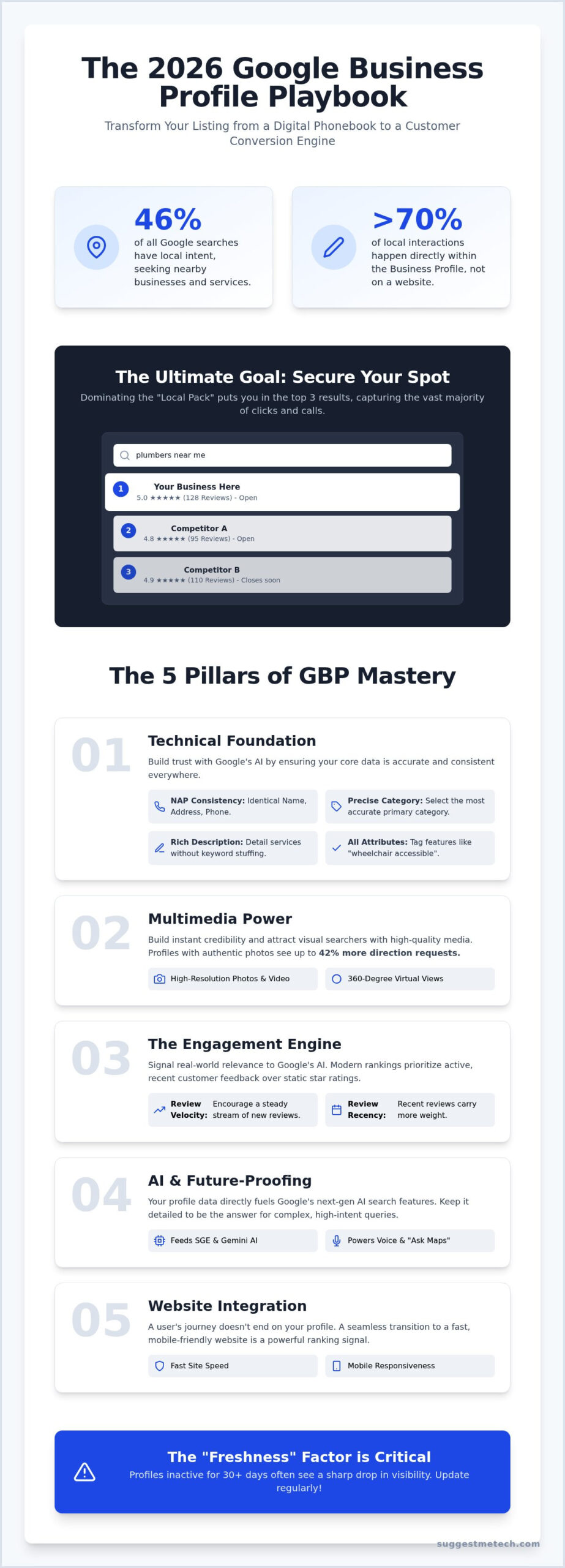
Did you know that 46% of all Google searches now have local intent, yet over 70% of those interactions happen entirely within a Google Business Profile? If you’re still treating your listing like a static phone book entry, you’re missing the primary way customers find you in 2026. Optimizing your google business profile isn’t just a “set it and forget it” task anymore. It’s now a dynamic, AI-driven dashboard where your responsiveness and “freshness” determine whether you land in the coveted top 3 Local Pack or vanish into page two.
It’s frustrating to watch your visibility drop while you’re busy managing your actual business, especially with Google’s stricter video verification requirements and the new “Ask Maps” AI features. We understand that dealing with fake reviews or a confusing dashboard is the last thing you want to do after a long day. This guide will show you how to master the latest local SEO techniques to dominate the map and turn casual searchers into loyal customers. You’ll learn how to navigate the 2026 review policies, leverage generative AI for your descriptions, and build a streamlined maintenance process that saves you hours every week.
Key Takeaways
- Master the shift from static listings to interactive conversion hubs to secure your spot in the high-value Local Pack top 3.
- Streamline your technical foundation by optimizing your google business profile through precise category selection and cross-web NAP consistency.
- Build instant credibility using 2026 multimedia strategies like 360-degree views and high-resolution video to drive immediate customer action.
- Boost your authority by prioritizing review velocity and recency over a simple star rating to signal real-world relevance to Google’s AI.
- Align your digital infrastructure by integrating your website speed and mobile responsiveness directly with your local SEO strategy for maximum impact.
Why Optimizing Your Google Business Profile is Non-Negotiable in 2026
The days of “Google My Business” are long gone. Since late 2021, the platform has evolved into the Google Business Profile, a shift that moved management away from a standalone app and directly into Search and Maps. In 2026, this isn’t just a directory; it’s the primary engine behind Google’s Search Generative Experience (SGE). When users ask complex questions, Google’s Gemini AI and the “Ask Maps” feature scan your profile attributes, services, and reviews to provide instant, summarized answers. If your data is missing or outdated, your business effectively doesn’t exist for these high-intent AI-driven queries. Your local SEO success is often tethered to your underlying tech stack; having the right web hosting and domain infrastructure ensures that when a user clicks from your profile to your site, they experience the speed and reliability that Google’s algorithm rewards.
Securing a spot in the “Local Pack” is the ultimate goal for local visibility. These top three listings capture the majority of clicks and calls. Research shows that over 70% of local searches result in direct interactions with a profile rather than a traditional website link. This makes optimizing your google business profile a survival requirement for any business that relies on local foot traffic or service calls. There is a direct correlation between profile completeness and consumer trust. Listings with high-quality, authentic photos receive up to 42% more requests for directions and calls compared to incomplete or generic profiles.
The Shift from Static Listing to Interactive Dashboard
Managing your presence is now faster because you do it where your customers are. You handle everything directly through the search results page. This real-time capability is critical because Google now prioritizes “freshness” as a ranking signal. Profiles that remain inactive for 30 days often see a drop in visibility. Local SEO in 2026 is about maintaining a living digital storefront that reflects your current service availability and professional standards.
Local Search Trends: Voice and Visual Search
Search behavior has moved beyond typing. Voice assistants rely on your profile’s structured data to answer “near me” requests. Similarly, “search by photo” features use your imagery to match user needs with your offerings. High-resolution, authentic photos are essential for this visual discovery. Local Authority is defined as a combination of proximity, relevance, and prominence. Consistent optimizing your google business profile ensures Google’s AI recognizes you as the most authoritative solution. We’re interested to hear how your local rankings have shifted recently; share your results in the comments below so we can discuss these trends together.
The Technical Foundation: Data Points That Drive Rankings
Foundational accuracy is the bedrock of local search visibility. While we’ve discussed the shift toward AI-driven results, the algorithms still rely on traditional signals to verify your identity. The most critical of these is NAP consistency. Your business Name, Address, and Phone number must be identical across your website, social media, and third-party directories. Even small variations, like “Street” versus “St.”, can create data fragments that weaken your authority. Google’s algorithm rewards certainty; when it sees matching data everywhere, it gains the confidence to rank you higher. Pairing this with a clear, keyword-rich business description is essential. Focus on what you do and where you do it, but avoid “keyword stuffing.” A natural description that highlights your specific services helps Google’s Gemini AI categorize your business for complex user queries.
Attributes are another high-value data point. These are specific tags like “locally owned,” “wheelchair accessible,” or “LGBTQ+ friendly” that appear on your profile. In 2026, these aren’t just for show. They serve as direct filters for users and data points for AI Overviews. If a user asks for a “locally owned coffee shop with a ramp,” Google uses these attributes to filter the results. Take the time to select every relevant attribute to ensure you appear in these highly specific, high-conversion searches.
Strategic Category Selection
Your primary category is perhaps the single most important ranking factor you control. It tells Google exactly what your business is. Many owners make the mistake of “category dilution” by adding too many secondary categories that aren’t strictly relevant. This confuses the algorithm and can actually lower your rankings for your main service. Use technical tools to see which categories your top-ranking competitors use. If your business is seasonal, such as a landscaping company that offers snow removal in winter, update your primary category to reflect these shifts. This ensures you remain relevant for current search intent year-round.
Service Areas and Location Settings
Service Area Businesses (SABs) face unique challenges. If you don’t have a physical storefront, you must define your service boundaries precisely. Don’t simply select a massive radius; this often leads to lower rankings because you’re spread too thin. Instead, list specific towns or zip codes where you actually operate. To further boost your local relevance, link your profile to a high-performance domain. A fast, well-structured website acts as a secondary verification source for Google. If you’re looking to refine your digital setup, you can compare the best tech tools to find the right infrastructure for your local SEO needs. Optimizing your google business profile becomes much easier when your website and profile work in perfect sync.
Beyond the Basics: Leveraging Multimedia and Interactive Features
Immersive content is no longer optional for businesses that want to stand out. In 2026, optimizing your google business profile requires moving beyond a few static storefront shots. High-resolution 360-degree views and 4K video tours are now the gold standard for building “virtual trust.” Customers want to see the interior of your shop or the quality of your equipment before they ever leave their house. For businesses in technical or creative niches, such as classic car modification, you can click here to see how detailed visual demonstrations build immediate authority with potential clients. Statistics from The Dietz Group show that listings with high-quality photos receive up to 42% more requests for directions and calls. Don’t rely on stock photography; Google’s AI can now detect non-authentic imagery and may penalize your visibility for it. Instead, focus on “freshness” by uploading new, real-world photos at least once a month to signal that your business is active and thriving.
Friction is the enemy of conversion. By enabling the “Messaging” and “Booking” features directly within your profile, you allow customers to take action without ever leaving the search results. This is a massive competitive advantage. While many businesses still force users to find a contact page on their website, you can offer instant gratification. If you’re a service-based business, integrated booking tools can turn a casual searcher into a scheduled appointment in seconds. This streamlined approach aligns with the 2026 trend of “zero-click searches,” where the user’s needs are met entirely within the Google ecosystem.
Visual Storytelling for Local SEO
Technical precision matters when you upload media. For 2026, keep your photos in JPEG or PNG format and ensure file sizes stay under 5MB to prevent slow loading times on mobile devices. Videos should be high-resolution but concise, ideally under 30 seconds and in MP4 format. Geotagging photos helps Google verify your physical location by embedding GPS coordinates directly into the image metadata. Additionally, encourage your customers to upload their own photos. User-generated content (UGC) acts as a powerful ranking signal because it provides unbiased proof of your business’s real-world presence.
Converting Searchers with Google Posts
Google Posts allow you to treat your profile like a localized social media feed. Use “What’s New” posts for general updates, “Events” for upcoming workshops, and “Offers” for time-sensitive discounts. A weekly posting schedule ensures your profile stays relevant and provides “ready-to-buy” users with a reason to choose you over a competitor. Optimizing your google business profile through offer posts is particularly effective because it allows you to track conversions directly within your dashboard. Always include a clear Call to Action (CTA) like “Book Now,” “Call Today,” or “Claim Offer” to guide the user toward the next step. If you’ve seen a specific type of post drive more traffic, let us know in the comments so we can compare strategies.
Finally, remember that the manual “Questions & Answers” section has evolved into the AI-powered “Ask Maps.” While you can no longer seed manual FAQs in the same way, the AI scans your posts, reviews, and descriptions to answer user queries. This makes the accuracy and depth of your interactive content more important than ever. Every post you write and every photo you tag is now data that helps Google’s Gemini AI recommend your business to the right people.
The Engagement Engine: Managing Reviews and Social Proof
A perfect 5.0 rating is no longer the primary goal for local search dominance. In 2026, Google prioritizes review velocity and recency over a static high score. A steady stream of fresh feedback signals to the algorithm that your business is currently active and reliable. With 87% of consumers reading online reviews before visiting a local business, your reputation is your most powerful conversion tool. Beyond just social proof, these reviews provide a massive SEO boost. When customers include specific service names or keywords in their feedback, they help Google’s AI understand exactly what you offer. This organic semantic data is a critical component of optimizing your google business profile for long-tail search queries.
Speed is the new standard for customer service. The “24-Hour Rule” is essential because 75.5% of customer reviews now receive a response from the business. Failing to respond quickly doesn’t just look bad to potential customers; it tells Google you aren’t engaged with your community. You must also stay vigilant against review spam. Fraudulent listings and fake negative reviews can tank your rankings. Use the reporting tools within your dashboard to flag suspicious activity immediately. Maintaining a clean, authentic profile is a non-negotiable part of your daily maintenance routine. If you’re looking for more ways to enhance your digital presence, explore our latest tech reviews and guides for expert recommendations on the best business tools.
A Proactive Review Acquisition Strategy
Generating consistent feedback requires a system. Use QR codes at your checkout or include automated email follow-ups after a service is completed. However, you must stay within the legal and ethical boundaries set by Google’s April 2026 policy updates. You cannot offer incentives like discounts or gifts for reviews, and “review gating”—the practice of pre-screening for only positive feedback—is strictly prohibited. Additionally, you can’t pressure customers to leave reviews while they’re still on your premises using kiosks or shared tablets. When you receive negative feedback, respond professionally and offer a solution. This transparency often builds more trust than a sea of perfect ratings.
The Q&A Section: Your Secret SEO Weapon
The traditional Q&A section has evolved into the AI-powered “Ask Maps” feature. Google’s Gemini AI now scans your entire profile, including your posts and website, to provide instant answers to user questions. While the manual Q&A interface has changed, the strategy remains the same: you must provide the data the AI needs. You can still influence these answers by highlighting services in your business description and posts that aren’t explicitly listed in your primary categories. Monitor the “Ask Maps” summaries for accuracy. If the AI is pulling incorrect information, it’s a sign that you need to refine the clarity of your profile data. Optimizing your google business profile means ensuring that every piece of text you provide is clear, accurate, and helpful for the AI to interpret.
Scaling Your Local Presence: Tools and Website Integration
Your website is the silent partner in your local SEO strategy. While the profile captures initial attention, Google’s algorithm evaluates your website’s speed and mobile responsiveness to determine your ranking authority. A slow site or a broken mobile experience signals unreliability to the algorithm. Embedding your map correctly is another technical detail that matters. While a simple iframe is easy to implement, using a Google Maps API integration provides a more professional, interactive experience that Google prefers. This technical alignment ensures that optimizing your google business profile isn’t undermined by a poor user experience once a customer clicks through to your site.
Authority also comes from the broader web. Local citations, which are mentions of your business on other directories, and high-quality backlinks from local organizations act as votes of confidence. If you manage multiple locations, use professional dashboard tools to sync updates across all profiles simultaneously. This prevents data fragmentation and ensures every branch remains visible in its respective territory. Tracking these moving parts is easier when you have a centralized tech stack that monitors your local rankings in real time.
The Website-GBP Synergy
Success starts with a reliable foundation. Choosing the best web hosting ensures your site loads instantly, which is a direct ranking factor for local search in 2026. You should also implement Local Schema Markup to provide Google with structured data about your physical address, opening hours, and service menus. Finally, ensure your website’s footer matches your profile information exactly. This consistency reinforces your legitimacy to both users and AI crawlers, preventing the “data conflicts” that often drop businesses out of the top 3 Local Pack.
Tracking Success in 2026
Stop obsessing over “Views” and start tracking “Interactions.” In the GA4 era, you need to focus on phone calls, direction requests, and website clicks. Use UTM parameters in your profile’s website link to track traffic accurately. This allows you to see exactly how many leads your profile generates versus your organic search results. Optimizing your google business profile is a continuous process that requires a disciplined routine. Follow this 10-minute weekly checklist to stay ahead:
- Respond to all new reviews within 24 hours to maintain your engagement score.
- Upload at least two fresh, authentic photos of your team or recent work.
- Publish one “What’s New” or “Offer” post to keep your profile “fresh” in Google’s eyes.
- Check the “Ask Maps” AI summaries to ensure Google is presenting your data accurately.
We’re interested in hearing which tracking tools you find most helpful for your local campaigns. Share your results or ask a question in the comments below so we can help you refine your 2026 strategy.
Take Control of Your Local Search Dominance
Consistently optimizing your google business profile is the difference between being a local leader or a digital ghost. You’ve learned how to leverage AI-driven “Ask Maps” features, maintain strict NAP consistency, and use review velocity to signal real-world relevance. These aren’t just minor tweaks; they’re foundational shifts in how local SEO operates in 2026. By integrating these strategies with a high-performance website and reliable hosting, you create a seamless journey for every customer who finds you on Maps.
Join 50,000+ readers who rely on SuggestMeTech for practical business advice and expertly tested strategies for local SEO growth. Ready to build a professional home for your local business? Check out our guide on how to start a blog and website in 2026.
The local market moves fast, but with these tools, you’re ready to stay ahead. Share your latest ranking wins in the comments below; we’re excited to see your business at the top of the Local Pack.
Frequently Asked Questions
How long does it take to see results after optimizing my Google Business Profile?
You should expect to see measurable results within 4 to 8 weeks after making significant updates. While changes to your hours or photos appear almost instantly, ranking shifts require the algorithm to re-evaluate your authority. Consistently optimizing your google business profile by adding fresh content and responding to reviews helps speed up this process. Google needs time to verify that your engagement signals are authentic and sustained before rewarding you with a top spot.
Can I optimize my Google Business Profile if I don’t have a physical office?
You can absolutely rank without a physical storefront by setting your profile as a Service Area Business (SAB). During setup, you simply leave the address field blank and define the specific towns or zip codes you serve. This allows you to appear in local searches for your target areas while keeping your home address private. It’s a perfect solution for mobile professionals like plumbers, cleaners, or consultants who meet customers at their locations.
Does having more reviews automatically mean I will rank higher than my competitors?
Review volume is important, but velocity and recency are more critical ranking factors in 2026. A business with 20 new, detailed reviews from the last month will often outrank a competitor with 200 reviews from three years ago. Google’s AI also looks for “keyword-rich” reviews where customers mention specific services. This provides the semantic proof that your business is currently active and delivering exactly what searchers are looking for right now.
Is it worth paying for local SEO tools to manage my Google Business Profile?
Paying for local SEO tools is highly beneficial if you’re managing several locations or need to track neighborhood-level rankings accurately. These platforms automate tasks like syncing data across directories and monitoring review sentiment across the web. For a single-location business, you might find the free Google dashboard sufficient. However, if you want to perform deep comparative analysis against aggressive competitors, professional tools provide the data-driven edge you’ll need to stay ahead. For niche markets, specialized solutions like Helpful.vet offer veterinary professionals the interactive workflow tools and clinic benchmarks necessary to optimize their operations alongside their digital presence.
What is the most important ranking factor for Google Maps in 2026?
Proximity remains a dominant factor, but relevance has significantly increased in importance due to AI integration. Google’s “Ask Maps” feature relies on the depth of your profile data to answer specific user questions instantly. This makes the process of optimizing your google business profile with detailed attributes and services essential. If your profile provides the most relevant answer to a complex query, Google may prioritize you even if a competitor is physically closer to the searcher.
How do I handle a Google Business Profile suspension or ‘soft’ disabled status?
You should first check for any policy violations, such as an inconsistent business name or a suspicious address change. Once you’ve corrected the issue, use the formal reinstatement form to explain your case clearly. You’ll likely need to provide evidence of your business’s existence, such as a tax ID or a photo of your branded vehicle and tools. Avoid creating a new profile while one is suspended, as this can lead to a permanent ban.
Should I include keywords in my business name to rank better in local search?
You should never add extra keywords to your business name unless they are part of your legal, registered identity. Google’s automated systems are very efficient at catching “keyword stuffing,” and it’s a leading cause of immediate profile suspensions. Instead, weave your target keywords into your business description, services list, and Google Posts. This builds your relevance safely without risking a penalty that could remove your business from the map results entirely.
How often should I post updates to my Google Business Profile?
We recommend posting at least one update every seven days to maintain a strong “freshness” signal. Regular activity tells Google that your business is operational and actively engaged with its customers. Profiles that remain inactive for more than 30 days often experience a noticeable decline in their Local Pack visibility. Use a mix of “What’s New” updates, event announcements, and special offers to keep your audience interested and the algorithm happy.