
You’re currently a renter on the internet, and big tech companies are your landlords. Every photo you post, every message you send, and every bit of data you generate sits on someone else’s server. It’s completely natural to feel overwhelmed by technical jargon like blockchain, DAOs, or gas fees. You might even worry that the whole thing is just a complex marketing buzzword for crypto scams.
This guide provides what is web3 explained simply, stripping away the noise to show you how this technology actually works for you. At SuggestMeTech, we believe in practical advice over hype. We promise to show you exactly how the internet is shifting from a “read-write” platform into a “read-write-own” ecosystem where you finally control your digital footprint. You’ll learn the core differences between the web you use today and the future of the internet, including why your privacy might finally be protected by code instead of corporate promises. With the Web3 market projected to grow to $12.61 billion in 2026, we will help you decide if you need to act now or if you can afford to wait and see.
Key Takeaways
- Understand how the internet is evolving from static pages to user-owned platforms with this guide on what is web3 explained simply.
- Learn why decentralization and blockchain technology mean you no longer have to rely on a single company to store your personal data.
- See the practical shift from using email passwords to digital wallets, giving you total control over your digital identity.
- Explore real-world examples like DeFi and DAOs to see how banking and business work when the community is in charge.
- Get actionable steps on setting up a digital wallet and mastering seed phrases to navigate this new landscape safely.
The Evolution of the Internet: From Web 1.0 to Web3
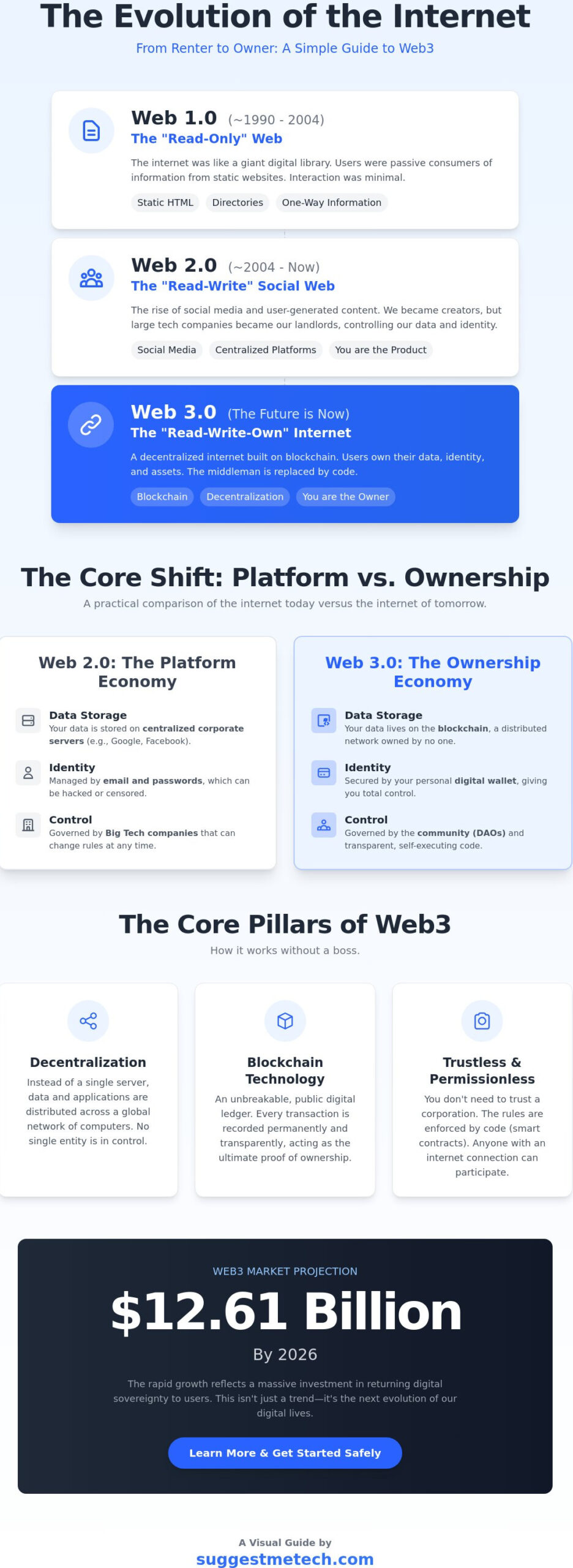
To understand the future, we have to look at where we started. The internet didn’t just appear as the social media giant it is today; it went through distinct phases of growth. When looking for what is web3 explained simply, it helps to view the timeline as a shift in power. We’ve moved from being observers to creators, and we’re now becoming owners. Web3 is a decentralized internet built on distributed ledgers that returns data control to users.
Web 1.0: When the Internet Was a Digital Encyclopedia
Think of Web 1.0 as a massive, digital library. Between roughly 1990 and 2004, the internet consisted mostly of static HTML pages. You could read information, but you couldn’t really interact with it. Personal homepages on GeoCities or directories like the early version of Yahoo! were the standard. Users were passive consumers. You went online to find a specific fact or read a document, much like browsing an encyclopedia. There were no “likes,” no comments, and certainly no video streaming. It was a one way street of information.
Web 2.0: The Rise of Big Tech and Social Media
The mid-2000s brought a seismic shift. This was the “Read-Write” era, often called the social web. Platforms like Facebook, YouTube, and Twitter allowed anyone to become a creator. It became incredibly easy to how to start a blog in 2026 or share a video with the world. However, this convenience came with a hidden cost. While we gained interactive tools, we handed over our personal data to a handful of massive corporations. These “Big Tech” landlords provide free services in exchange for tracking your behavior and selling your privacy to advertisers. Power became centralized in giant data centers owned by a few companies. You don’t own your profile; the platform does.
We are now entering the third phase. If Web 1.0 was a library and Web 2.0 was a town square, Web3 is a marketplace where you actually own your stall. This “Read-Write-Own” era uses blockchain technology to remove the middleman. Instead of your data living on a corporate server, it lives on a shared network that no single entity controls. This isn’t just a theoretical change. By 2026, the total market value of Web3 is approximately $10.2 billion. This reflects a massive investment in returning digital sovereignty to the people. This shift ensures that your digital identity belongs to you, not a corporation. This guide on what is web3 explained simply highlights why this transition is the most significant change to our digital lives since the invention of the browser.
The Core Pillars of Web3: How It Works Without a Boss
Web3 isn’t just one app or a single website. It’s a fundamental change in how the internet’s plumbing works. To understand what is web3 explained simply, you have to look at who is in charge. In the current web, companies like Google or Amazon act as the “boss” of your data. In Web3, the boss is replaced by a set of shared rules that everyone follows. This shift relies on a few key concepts that ensure no single person or company can pull the plug on your digital life.
The core pillars of Web3 are built around the idea of giving power back to the individual. First, there is decentralization. Instead of all your photos and messages sitting on one company’s server, they are distributed across a global network of computers. This makes the system much harder to hack or shut down. Then, we have trustlessness and permissionless access. Trustlessness doesn’t mean you can’t trust people; it means you don’t have to trust them because the code verifies everything for you. Permissionless means that as long as you have an internet connection, you can use these tools. There’s no CEO to ban your account or Terms of Service that change overnight without your consent.
Blockchain: The Unbreakable Digital Receipt
Think of a blockchain as a public spreadsheet that everyone can see but no one can edit or delete. When you buy something or send data in Web3, that action is recorded in a “block.” Once that block is full, it’s chained to the previous one, creating a permanent history. This is far more secure than a private database. If a company’s database gets hacked or an employee makes a mistake, your data can vanish. On a blockchain, thousands of computers are constantly checking each other’s work to make sure the records are accurate. It’s the ultimate digital receipt that proves you own what you say you own. This transparency is a key part of what is web3 explained simply, as it removes the mystery from digital transactions.
Smart Contracts: Rules That Execute Themselves
Smart contracts are the engines that make Web3 run. Imagine a vending machine. You don’t need a cashier to sell you a soda; you just need to meet the machine’s conditions, like inserting the right amount of money. A smart contract does the same for digital agreements. It’s a piece of code that automatically triggers an action when certain conditions are met. This eliminates the need for expensive middlemen like lawyers or bank administrators. Whether you’re trading digital art or taking out a loan, the smart contract handles the details instantly and fairly. If you’re overwhelmed by the options, checking out our tech reviews and guides can help you find the most reliable platforms using this technology today.
Web 2.0 vs. Web3: A Practical Comparison
Understanding the jump from the current internet to the next generation is easier when you look at your daily habits. When we look at what is web3 explained simply, the biggest change isn’t the code; it’s the relationship between you and the apps you use. In Web 2.0, you are essentially a guest in someone else’s digital house. In Web3, you are the homeowner. This shift changes everything from how you sign in to who profits from your data.
The differences are practical and immediate:
- Login Methods: Web2 uses fragmented email and password combinations. Web3 uses a single digital wallet.
- Data Storage: Web2 relies on centralized company servers. Web3 uses a network of decentralized nodes.
- Governance: Decisions are made by corporate boards in Web2. In Web3, community voting and DAOs lead the way.
- Censorship: Centralized platforms can ban your account at will. Web3 is built to resist central authority.
The ‘Login with Wallet’ Revolution
Imagine never having to click a “Forgot Password” link again. In the Web3 world, your digital wallet acts as your universal passport. Instead of sharing your name, birthdate, and email with every new app, you simply connect your wallet. This provides a massive privacy benefit. You don’t have to surrender your personal identity just to use a service. This is a sharp contrast to traditional domain registration, which often requires you to provide verifiable contact information to a central registrar. With a Web3 login, you prove you own the account through cryptography, not by handing over your data.
Who Owns the Content?
The current web has a “renter” problem. If you post a photo on Instagram or a video on YouTube, those companies ultimately control that content. They can delete it, change the rules on how it’s shared, or even use it for their own AI training without your direct consent. Web3 flips this script. By using tokens and NFTs on a blockchain, you hold the actual deed to your digital assets. This authoritative overview of Web3 highlights how these technologies ensure your digital life is portable. If you don’t like one app, you can take your data and your assets to another platform seamlessly.
This portability is a core reason why what is web3 explained simply is about freedom. You aren’t locked into a single ecosystem. As we move through 2026, more users are realizing that their digital footprint has value. Web3 is the infrastructure that lets you reclaim that value. It’s about moving from being a product for advertisers to being the owner of your own digital space.
Real-World Examples: What Can You Actually Do in Web3?
Most people get stuck on the theory, but the practical side is where things get interesting. When looking for what is web3 explained simply, the best answer is found in the apps that allow you to bypass traditional gatekeepers. Whether you’re managing money or joining a global project, the goal is to cut out the person taking a cut of your transaction. By 2026, the Web3 market has reached a value of approximately $10.2 billion, reflecting how these applications are moving from niche experiments into the mainstream.
DeFi: Managing Money Without a Middleman
Decentralized Finance (DeFi) is essentially banking without the bank. Instead of waiting for a branch to open on Monday morning, you can lend or borrow assets at 3 AM on a Sunday. You use your digital wallet to interact with a protocol that manages the math. It’s a global, borderless market that never sleeps. However, this financial frontier comes with risks. The market is volatile, and because there’s no “customer service” to call if you lose your keys, you must be your own security guard. By March 2, 2026, new enforcement rules under PSD2 are bringing more oversight to custody services, which adds a layer of structure to the industry, but caution is still your best tool.
DAOs: The Future of Community Projects
DAOs (Decentralized Autonomous Organizations) are the “no-boss” version of a company. Imagine a group of 5,000 people from 40 different countries who want to fund a new tech product. Instead of forming a traditional corporation, they form a DAO. Every member holds a “governance token” that acts like a voting ballot. If the group wants to spend money or change a rule, the community votes on the blockchain. The code then executes the decision automatically. There are over 17,000 companies and 3,200 startups operating in the Web3 space as of 2026, many of which use this collaborative model to build products faster than traditional hierarchies.
There’s also a significant shift in how we store files and spend time online. Decentralized storage splits your files into tiny pieces and spreads them across a network. This makes them far more secure than traditional cloud storage because there is no single point of failure. In the metaverse, Web3 ensures that if you buy a digital item or virtual land, it’s yours to keep or sell as an NFT. You aren’t just renting space in a game; you’re building actual equity in a digital world. This ownership is the heart of what is web3 explained simply.
Ready to explore the tools that make this possible? Check out our tech reviews and guides to find the best platforms for your digital journey.
How to Get Started with Web3 Safely in 2026
You don’t need to be a software engineer to begin your journey into the decentralized web. While the underlying technology is complex, using it is becoming more intuitive every day. If you want what is web3 explained simply, think of it as learning a few new digital habits. By following a clear, step-by-step path, you can explore this new frontier while keeping your data and assets secure. The transition to a “read-write-own” internet starts with taking control of your own digital entry point.
Choosing Your First Digital Wallet
Your first step is setting up a non-custodial digital wallet. This is the “passport” that allows you to move between different decentralized applications (dApps). Unlike a traditional bank account, a Web3 wallet doesn’t actually store your money inside it. Instead, it holds the private keys that prove you own your assets on the blockchain. It’s more like a specialized browser that verifies your identity without needing a central authority.
There are two main types of storage to consider. “Hot” wallets are apps or browser extensions connected to the internet, making them convenient for daily transactions. “Cold” wallets are physical devices that stay offline, providing maximum security for long term holdings. When you set up any wallet, you’ll receive a seed phrase. You must never share your 12-word seed phrase with anyone, as it acts like a master key to your entire digital identity. If you lose this phrase, you lose access to your assets forever.
Safety First: Avoiding Scams and Pitfalls
The freedom of Web3 comes with a higher level of personal responsibility. Because there’s no “Undo” button on the blockchain, every transaction you sign is permanent. Scammers often use “phishing” sites that look identical to real platforms to trick you into connecting your wallet. Always verify the URL before clicking “Connect.” It’s helpful to think of this as basic digital hygiene. Just as you might learn how to clear cache on iphone to keep your device running at peak performance, you need to maintain your digital security habits to stay safe in Web3.
Once you have your wallet and security basics down, you can start exploring. Use a Web3-enabled browser like Brave or Opera to find dApps that interest you. You might join a DAO to see how community voting works or try a decentralized social media platform where you own your content. This hands-on experience is the best way to truly grasp what is web3 explained simply. The future of the internet is about moving from being a passive user to an active owner, and that journey starts with your first secure transaction.
Follow these four steps to begin:
- Step 1: Download a reputable non-custodial wallet like MetaMask or Coinbase Wallet.
- Step 2: Write down your seed phrase on physical paper and store it in a safe place.
- Step 3: Connect to a well-known dApp, such as a decentralized exchange, to see how the interface works.
- Step 4: Research a DAO or community project that aligns with your interests to see decentralization in action.
Ready to Own Your Digital Future?
The shift from the centralized web to a decentralized ecosystem is the most significant change in how we interact online since the birth of the browser. We’ve explored what is web3 explained simply to show that this era is defined by your ability to own your data, your identity, and your assets. By moving away from corporate landlords and adopting tools like digital wallets and smart contracts, you gain a level of privacy and control that simply didn’t exist in the previous decade. Whether you’re exploring DeFi or joining your first DAO, you’re no longer just a passive consumer; you’re a participant with real equity.
Technology moves fast in 2026, but you don’t have to navigate these changes alone. At SuggestMeTech, we provide simplified guides for complex technology alongside expert editor’s picks for all tech categories. We also pride ourselves on being community-focused, regularly testing user-driven review suggestions to ensure our advice remains practical and relevant for your everyday life. Explore our top-rated tech guides and reviews to stay ahead of the curve. The internet is changing, and with the right knowledge, you’re in the perfect position to make the most of it.
Frequently Asked Questions
Is Web3 the same thing as Cryptocurrency?
No, cryptocurrency is just one tool within the broader Web3 ecosystem. While crypto provides the financial incentive and payment system, Web3 refers to the entire infrastructure of a decentralized internet. It includes decentralized file storage, social networks, and identity systems that don’t necessarily require you to trade or hold coins to participate.
Do I need to buy Bitcoin to use Web3?
You don’t need Bitcoin to browse Web3 apps, but you might need specific network tokens to interact with certain features. For example, many decentralized apps run on the Ethereum network and require small “gas fees” paid in Ether to process transactions. However, simply viewing content or joining some communities often requires nothing more than a compatible digital wallet.
Is Web3 actually safe for beginners?
Web3 is safe if you follow strict security protocols, but it carries more personal responsibility than the current internet. Because there’s no central help desk to reset a password, losing your seed phrase means losing your assets forever. Beginners should start with small amounts of capital and use reputable wallets to ensure their journey remains secure and productive.
What is the difference between Web3 and the Metaverse?
Web3 is the underlying technology, while the Metaverse is the visual and social experience. Think of Web3 as the engine and the Metaverse as the virtual world you explore. Web3 provides the blockchain based ownership of digital items, like virtual clothes or land, which makes a truly open and persistent Metaverse possible for users.
Can Web3 be hacked if it’s decentralized?
Individual blockchains are extremely difficult to hack, but the apps and “bridges” built on top of them can have vulnerabilities. While the core ledger is secure, hackers often target poorly written smart contracts or use phishing to trick users. This is why what is web3 explained simply often focuses on individual security habits rather than network failures.
Will Web3 replace the current internet entirely?
It’s more likely that Web3 will coexist with Web 2.0 rather than replace it. Centralized services are often faster and cheaper for tasks that don’t require high security or ownership. You’ll likely use Web3 for banking, identity, and high value content, while still using traditional platforms for basic information and streaming services.
How do I make money in Web3?
Most people earn in Web3 through DeFi lending, trading digital assets, or participating in “Play to Earn” ecosystems. Professional opportunities are also growing rapidly. As of March 2026, AI skills are mentioned in 53.1% of Web3 job postings, showing that managing AI agents within decentralized networks is becoming a primary way for experts to generate income.
Do I need a special computer or phone to access Web3?
No, you can access the decentralized web using any modern smartphone or computer with a standard internet connection. You simply need to install a Web3 enabled browser or a wallet extension to act as your gateway. This high level of accessibility is a core part of what is web3 explained simply for people who want to start exploring today.