
Over-ear, in-ear, ANC, Bluetooth codecs… is it any wonder that buying new headphones in 2025 feels completely overwhelming? You’re navigating a sea of technical specs and marketing buzzwords, all while the fear of spending your hard-earned money on the wrong pair looms large. You just want a great listening experience, whether you’re on a crowded commute, deep in a gaming session, or crushing a workout at the gym.
That’s exactly why we created this guide. We’re cutting through the noise to deliver clear, practical advice on choosing your perfect audio companion. We will break down everything you need to know, from the core differences between over-ear, on-ear, and in-ear models to which features are actually worth paying for. By the end, you’ll have the confidence to select a pair that perfectly fits your ears, your lifestyle, and your budget.
Decoding the Designs: Over-Ear, On-Ear, & In-Ear Headphones
Before diving into features like noise-cancellation or wireless technology, your first major decision is choosing the physical style, or ‘form factor’. This choice is critical because each design offers a distinct trade-off between comfort, portability, and sound quality. While the core technology has evolved, the three main styles have been constants throughout the history and types of headphones. Your ideal match will ultimately depend on where and how you plan to listen, whether you’re at your desk, on a crowded train, or at the gym. Let’s break down the pros and cons of each.
Over-Ear (Circumaural): For Maximum Immersion
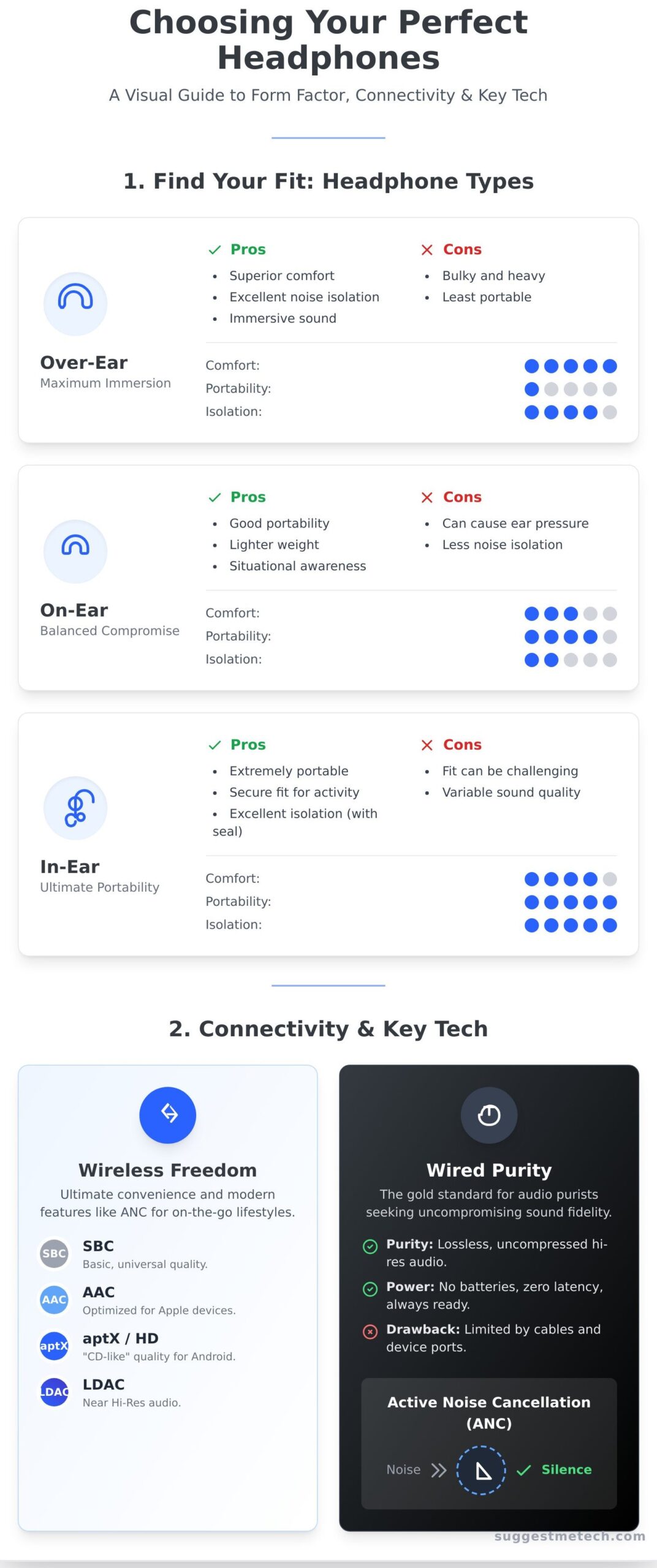
As the name suggests, over-ear headphones feature large earcups with pads that fully enclose your ears. This creates a natural seal that physically blocks out external noise, a feature known as passive noise isolation. The large drivers and sealed design often produce the most expansive and immersive soundstage, making them a favorite for critical listening at home or in the office. They are generally considered the most comfortable for long sessions.
- Pros: Superior comfort, excellent passive noise isolation, and immersive sound quality.
- Cons: Bulky and heavy, making them the least portable option and less than ideal for travel.
On-Ear (Supra-aural): The Balanced Compromise
On-ear models offer a middle ground, with pads that rest directly on your ears instead of around them. This design makes them significantly more compact and lighter than their over-ear counterparts, offering a solid blend of performance and portability. Because they don’t create a complete seal, they allow more ambient sound to filter in. This can be a safety advantage for city commuters but a drawback in noisy environments.
- Pros: Good portability, lighter weight, and allows for some situational awareness.
- Cons: Can exert pressure on the ears, causing discomfort for some users after extended wear.
In-Ear (Earbuds & IEMs): For Ultimate Portability
In-ear headphones, which include everything from standard earbuds to high-fidelity in-ear monitors (IEMs), are designed to fit inside your ear canal. Their incredibly small and lightweight form factor makes them the undisputed champion of portability. They are the perfect companion for sports, commuting, and any active lifestyle where size and discretion are key. A proper seal is crucial, as it directly impacts both bass response and noise isolation.
- Pros: Extremely portable and lightweight, secure fit for activity, and excellent noise isolation with the right eartips.
- Cons: Sound quality varies widely, and finding a comfortable, secure fit can be a challenge for some users.
The Great Debate: Wired vs. Wireless Headphones
Once you’ve settled on a form factor, the next critical choice is connectivity. The decision between wired and wireless headphones boils down to a fundamental trade-off: ultimate convenience versus uncompromising audio fidelity. While Bluetooth technology has made incredible strides, shrinking the performance gap, key differences remain that will steer your decision. Your choice will depend on your primary listening device, your tolerance for charging batteries, and how much you prioritize pure sound quality.
The Case for Wireless: Freedom and Features
Wireless freedom is the primary draw for most users. Connecting via Bluetooth eliminates the frustration of tangled cables, making them perfect for commutes, workouts, and general daily use. For anyone with a modern smartphone, most of which have ditched the traditional headphone jack, wireless is less a choice than a necessity. This category is also where you’ll find the most innovation, with features like Active Noise-Cancellation (ANC) and multi-device pairing becoming standard. The only catch? They need power, so battery life is a crucial specification to check before you buy.
The Enduring Appeal of Wired: Purity and Power
For the audio purist, wired connections remain the gold standard. They offer a stable, interference-free signal with zero latency-no batteries to charge and no signal dropouts. A direct physical connection allows for uncompressed, high-resolution audio transmission, delivering sound exactly as the artist intended. For audiophiles with dedicated amplifiers, wired is the only choice to properly power high-end headphones. This powerful hardware requires responsible use, so it’s always wise to practice safe listening habits. The main challenge today is device compatibility, as the reliable 3.5mm jack is becoming increasingly rare.
Understanding Bluetooth Codecs (SBC, AAC, aptX, LDAC)
Not all wireless audio is created equal. The quality of your connection depends on Bluetooth codecs-the digital language your source device and headphones use to compress and transmit audio. Here’s a quick guide:
- SBC: The universal, mandatory codec. It gets the job done but offers the most basic audio quality.
- AAC: The standard for Apple devices. It provides better sound quality than SBC and is optimized for iPhones, iPads, and Macs.
- aptX / aptX HD: Common on Android devices and Windows PCs, offering higher fidelity, “CD-like” quality that’s a noticeable step up from SBC.
- LDAC: Sony’s high-resolution codec, capable of transmitting near-lossless audio on compatible Android devices.
For the best results, ensure both your audio source (like your phone) and your headphones support the same high-quality codec.
Key Features Explained: From Noise Cancellation to Microphones
Today’s headphones are powerful gadgets packed with technology that goes far beyond just playing music. Understanding these key features helps you cut through the marketing noise and decide what’s a genuine upgrade versus a gimmick. The best approach is to focus on technology that solves a specific problem for you, whether it’s silencing a noisy commute or ensuring crystal-clear work calls. Let’s demystify the most important tech you’ll find.
Active Noise Cancellation (ANC): Your Cone of Silence
Often hailed as a must-have for frequent flyers and commuters, ANC uses tiny, outward-facing microphones to detect ambient noise and generate an opposing sound wave to cancel it out. This creates a “cone of silence” that’s perfect for focusing in loud open offices or enjoying your audio on a plane. The trade-off is slightly increased battery drain and, in some models, a subtle change in sound signature. For the best of both worlds, look for models with a “Transparency Mode,” which uses the mics to let you hear your surroundings when you need to.
Drivers and Soundstage: The Heart of the Sound
At the core of any pair of headphones are the drivers-the miniature speakers responsible for converting an electrical signal into audible sound. While manufacturers often tout driver size, bigger doesn’t automatically mean better; driver quality and tuning are far more critical. For a deeper dive into the science of how headphones create sound, this guide is an excellent resource. Closely related is the “soundstage,” which describes how spacious and three-dimensional the audio feels. For the most immersive, concert-like experience, open-back headphones typically offer the widest and most natural soundstage.
Microphone Quality and Controls
If you plan on taking calls or joining virtual meetings, microphone quality is non-negotiable. A single, poorly placed mic will leave you sounding distant and muffled. Instead, look for models that feature:
- Multiple Microphones: Beamforming arrays help isolate your voice from background noise.
- Noise-Reduction Technology: AI-powered software that actively filters out wind, traffic, and chatter.
- Intuitive Controls: Decide between the tactile feedback of physical buttons and the sleek convenience of touch panels for managing calls and playback.
Clear communication can make all the difference in a professional setting. See our top-rated headphones for calls and meetings.
How to Choose Headphones for Your Lifestyle
The “best” headphones aren’t just about sound quality; they’re about how seamlessly they fit into your daily life. A pair designed for critical audio analysis at home will be a frustrating choice for a sweaty gym session. Matching key features to your primary activities ensures you get the most value from your purchase. Let’s break down the ideal type of headphones for some of the most common scenarios.
For Travel and Commuting
When you’re on the move, blocking out the world is paramount. Look for features that make your journey smoother and more enjoyable.
- Active Noise Cancellation (ANC): This is your top priority for silencing airplane engines, train rumbles, and public chatter.
- Portability: Choose models with a folding design or a compact, sturdy case that fits easily into a bag.
- Battery Life: Aim for 20+ hours of playback with ANC on to last through long-haul flights and potential delays.
For Sports and Fitness
Your workout audio gear needs to be tough, secure, and unobtrusive. The right pair will motivate you without getting in the way.
- Sweat and Water Resistance: An IP rating (like IPX4 or higher) is non-negotiable for durability against sweat and rain.
- Secure Fit: Earbuds with wingtips or over-ear hooks prevent them from falling out during intense activity.
- Situational Awareness: For outdoor runners and cyclists, bone conduction models are a great choice for hearing traffic.
For Gaming and Home Entertainment
Immersion and communication are key for a great gaming experience. These features provide a competitive edge and a cinematic feel.
- Soundstage & Directional Audio: A wide soundstage helps you pinpoint enemy footsteps and other in-game cues.
- Low-Latency Connection: A wired or 2.4GHz wireless connection is a must to eliminate audio lag.
- Clear Microphone: Your teammates will thank you for a high-quality mic that ensures clear communication.
For the Office and Working from Home
In a professional setting, clarity and focus are the goals. Your work headphones should be a tool for productivity.
- Excellent Microphone Quality: A noise-isolating microphone makes your voice sound crisp and clear on video calls.
- Multi-device Pairing: Seamlessly switch your audio source between your computer and your smartphone.
- All-Day Comfort: Lightweight, over-ear designs with soft padding are ideal for wearing through a full workday.
Have a specific use case we didn’t cover? Let us know and we might feature it in a future test.
Your Perfect Pair Awaits
Navigating the world of audio gear can feel complex, but choosing the right pair doesn’t have to be. As we’ve covered, the best decision starts with understanding your own needs-whether that means prioritizing the immersive seal of over-ear models, the portability of in-ears, or the freedom of a wireless connection. By matching key features like active noise cancellation and microphone quality to your specific lifestyle, you can confidently select the perfect headphones that enhance your daily listening.
Now that you’re armed with the knowledge, the next step is finding the specific models that deliver. That’s where our practical advice comes in. We cut through the marketing noise with unbiased, hands-on testing to provide recommendations tailored directly to your budget and needs.
Ready for our top picks? Explore our ‘Best Of’ headphone guides now!
The ideal audio experience is out there, and you now have the map to find it. Happy listening!
Frequently Asked Questions
What’s the difference between active noise cancellation (ANC) and noise isolation?
Noise isolation is a passive feature that physically blocks sound using a tight seal, much like earplugs. Over-ear headphones with thick, dense earcups are great examples. Active Noise Cancellation (ANC) is an electronic process. Microphones listen for external sounds, and the headphones generate an opposite sound wave to cancel it out. ANC is most effective against low-frequency, constant noises like an airplane engine or an air conditioner, while isolation works on a broader range of sounds.
How long should the battery last on wireless headphones?
For over-ear wireless headphones, a good benchmark is 20-30 hours of playback with ANC turned on. For wireless earbuds, expect 5-8 hours from the buds themselves, with an additional 15-24 hours provided by the charging case. Many models also feature a quick-charge function, where just 10-15 minutes of charging can provide over an hour of listening time, which is a practical feature for users on the go. Look for these figures when comparing your options.
Are more expensive headphones always better?
Not necessarily. Higher prices often correlate with premium materials, more advanced features like superior ANC or multi-device connectivity, and better overall build quality. However, sound quality is subjective. A mid-range model might suit your audio preferences better than a pricier one tuned for a different sound profile. The best headphones for you balance audio performance, features, and comfort within your specific budget, so it’s wise to focus on reviews and personal needs rather than just the price tag.
Do I need a headphone amplifier (amp) or digital-to-analog converter (DAC)?
For the vast majority of users, the answer is no. Most modern smartphones, laptops, and wireless headphones have high-quality, built-in DACs and amps that are perfectly sufficient for everyday listening. You should only consider an external DAC/amp if you are an audiophile using high-impedance, wired headphones. For these specific models, an external unit can provide the extra power and audio clarity needed to drive them properly and unlock their full potential.
Are gaming headsets good for listening to music?
While you can certainly use a gaming headset for music, it may not be the ideal experience. Gaming headsets are typically tuned to emphasize sounds that are important for gaming, such as footsteps and explosions, often resulting in boosted bass and treble. This can make music sound less balanced or natural compared to headphones designed specifically for audio fidelity. However, some higher-end gaming headsets offer a more balanced profile that performs well for both media and gaming.
How do I properly clean and maintain my headphones?
To clean over-ear headphones, wipe the earpads and headband with a soft, slightly damp cloth. For earbuds, remove the silicone tips and wash them with mild soap and water, ensuring they are completely dry before reattaching. Use a soft, dry brush or a toothpick to gently clear debris from the speaker grilles. Never use harsh chemicals or submerge the electronics in liquid. Regular cleaning not only maintains hygiene but also helps preserve the audio quality and longevity of your headphones.
What does IPX4 or other water-resistance ratings mean?
The “IP” rating stands for Ingress Protection, which measures an electronic device’s resistance to solids and liquids. The first number refers to dust protection (an ‘X’ means it wasn’t tested for dust), while the second number indicates water resistance. An IPX4 rating, common for workout earbuds, means the device is resistant to water splashes from any direction. A higher rating like IPX7 means the device can be submerged in up to 1 meter of water for 30 minutes.