

The promise of launching a website for zero cost is tempting, but the phrase “free web hosting” often comes with a healthy dose of skepticism. Are you trading a price tag for painfully slow performance, unprofessional ads plastered all over your project, or a surprise bill the moment you get a little traffic? It’s a common fear, and a valid one. Sorting through the offers to find a genuinely good deal without getting trapped by hidden limitations can feel overwhelming, especially if you’re just starting out.
That’s where we come in. We’ve cut through the marketing noise and put the most popular providers to the test to find the best truly free options for 2025. In this practical guide, you won’t just get a list. You’ll discover the critical catches and limitations of each service, understand exactly what you’re giving up for that zero-dollar price tag, and learn the clear signs that tell you it’s time to upgrade. Let’s find the right starting point for your website, risk-free.
The Uncomfortable Truth About ‘Free’ Web Hosting
The promise of launching a website at zero cost is incredibly tempting. But before you jump in, it’s crucial to understand a fundamental reality: hosting costs money. Servers, electricity, maintenance, and support staff all have a price tag. So, how can companies offer a service for free? The short answer is that it’s a marketing strategy, not a charity. With free web hosting, you always pay with something other than money.
What’s the Catch? The Business Models of Free Hosting
A free Web hosting service almost always operates on a "freemium" business model, designed to lead you toward a paid product. Their survival depends on converting a percentage of free users into paying customers. Here’s how they create that path:
-
Aggressive Upselling: The entire free experience is a funnel. You’ll constantly be prompted to upgrade for more features, better performance, or to remove frustrating limitations.
-
Forced Advertising: The host will place their own branding or third-party ads on your website. You have no control over what appears or how it affects your brand’s image.
-
Severe Resource Caps: They intentionally provide minimal storage, bandwidth, and processing power, ensuring that any meaningful project will quickly hit a wall and require an upgrade.
-
Data Collection: Some providers may leverage your personal information for marketing. Always read the terms of service to understand how your data is being used.
Key Limitations to Expect with Any Free Plan
Beyond the business model, every free plan comes with significant technical and practical trade-offs. For zero cost, you should expect to encounter:
-
Performance: Your site will be slow. It will share server resources with hundreds of other free sites, leading to poor loading times and low uptime guarantees (if any).
-
Resources: Storage space is often less than 1GB, and bandwidth is capped, meaning your site could go offline after a small spike in traffic.
-
Branding: You won’t get a professional domain name. Instead, you’ll be stuck with a subdomain like yourblog.freehost.com and the provider’s ads.
-
Support: Don’t expect to talk to a human. Support is typically limited to community forums or a knowledge base, leaving you to solve problems on your own.
Who Should (and Shouldn’t) Use Free Hosting?
Despite the drawbacks, free plans have their place. They are a great fit for students learning to code, hobbyists building a personal portfolio, or developers who need a temporary space to test a project. However, they are a poor choice for any serious business, e-commerce store, or website where performance and credibility are important. If your reputation or revenue is on the line, the small cost of paid hosting is a necessary and worthwhile investment.
Top 3 Free Hosting Providers for Traditional Websites
While website builders offer an all-in-one solution, sometimes you need the flexibility of traditional hosting. The following providers offer a classic cPanel-style experience at no cost, but it’s crucial to understand the trade-offs. Performance, reliability, and support are severely limited, which is a key part of the downsides of free web hosting that users must accept. These services are best used as learning tools or for temporary projects, not for serious business websites.
InfinityFree: Best for Generous Features and No Ads
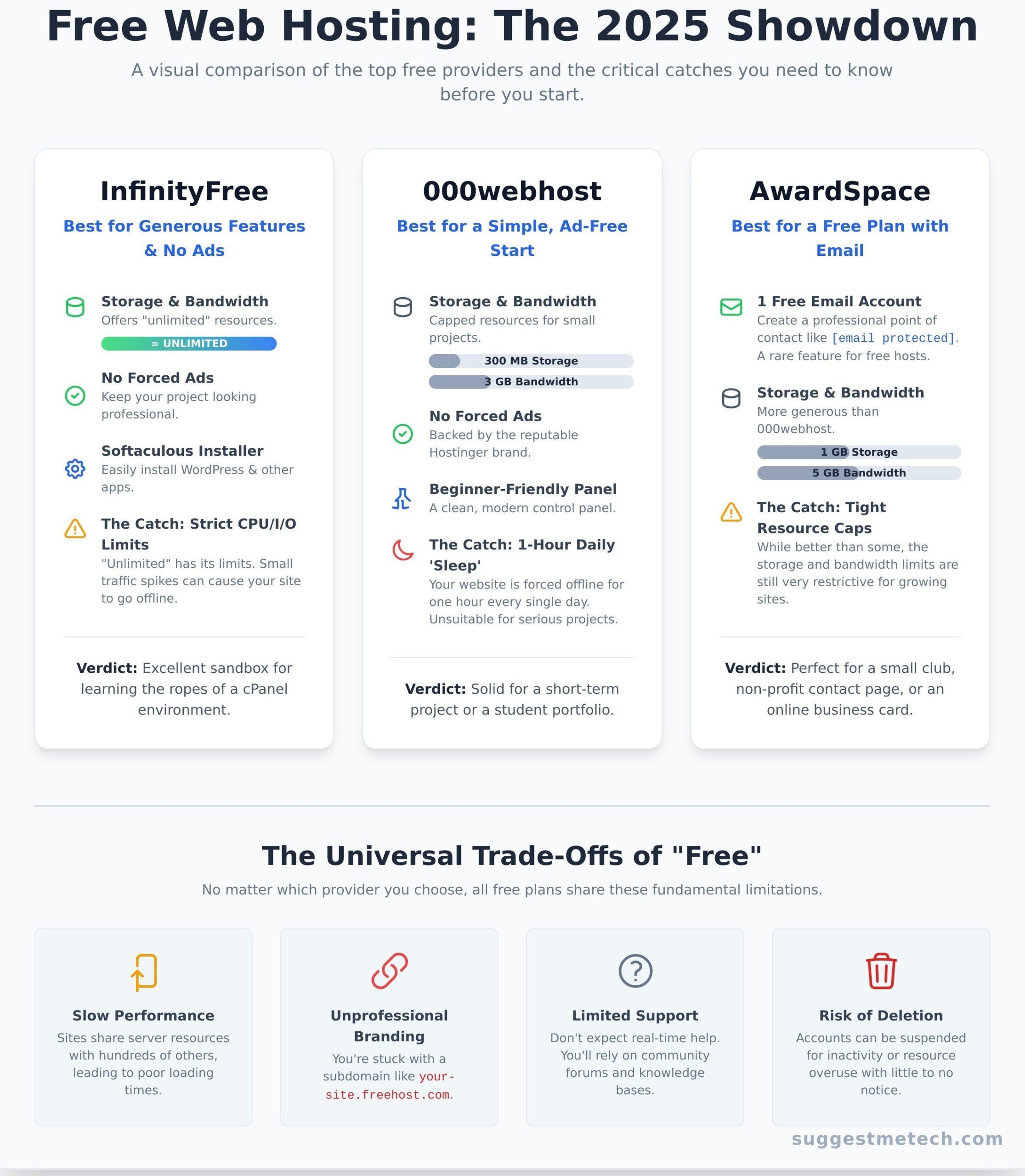
InfinityFree makes a bold claim with its offer of unlimited storage and bandwidth. While you won’t be charged for overages, your site’s performance is governed by strict server resource limits (CPU and I/O) that can cause it to go offline if you get a small traffic spike. The major benefit is the inclusion of the Softaculous script installer, making it incredibly easy to set up WordPress or hundreds of other applications with one click. There are also no forced ads on your site, which is a significant plus.
Verdict: InfinityFree is an excellent sandbox for learning the ropes of a cPanel environment or for testing a complex script without committing to a paid plan.
000webhost (by Hostinger): Best for a Simple, Ad-Free Start
Backed by the well-known provider Hostinger, 000webhost offers a degree of credibility that many free hosts lack. Instead of cPanel, it uses a custom control panel that is clean, modern, and very beginner-friendly. The limitations, however, are strict: you get just 300 MB of storage and 3 GB of bandwidth. Most notably, your site will be forced to "sleep" for one hour every day, making it unsuitable for anything that requires constant uptime. Like InfinityFree, it is ad-free.
Verdict: A solid, reliable choice for a short-term project, a student portfolio, or as a simple platform to learn the basics of website management.
AwardSpace: Best for a Free Plan with Email Hosting
AwardSpace stands out by offering a feature that is almost unheard of in the free web hosting space: a free email account (e.g., you@yourdomain.com). This makes it a unique choice for anyone wanting to create a professional point of contact. The trade-off is the very tight resource caps, including 1 GB of storage and 5 GB of monthly bandwidth. The platform is straightforward and provides a good entry point for understanding how web hosting and email hosting work together.
Verdict: Perfect for a small club, a non-profit’s contact page, or a personal online business card where a custom email address is more important than site performance.
A final word of caution: all free providers reserve the right to suspend or delete your account with little notice for inactivity or overuse of server resources. Always keep a local backup of your website files and database, as relying on these services for critical data is a significant risk.
Top 2 Free Hosting Options from Website Builders
If traditional hosting feels too technical, website builders offer a popular entry point into the world of free web hosting. These platforms operate on a ‘freemium’ model: they provide a free, feature-limited plan in the hope that you’ll eventually upgrade to a paid subscription. The trade-off is clear: you get an incredibly simple, visual way to build a site, but you sacrifice control, are forced to display their branding, and are locked into their platform. While these curated environments are generally safer than many traditional free hosts, it’s important to be aware of the broader security risks of free web hosting, as documented in large-scale studies. This path is best for users who prioritize design and speed over technical customization.
Wix: Best for Creative Freedom and Beautiful Templates
Wix is renowned for its powerful drag-and-drop editor and a massive library of professionally designed templates. It gives you immense creative freedom to place elements anywhere on the page, making it a favorite for visually-driven projects. However, the free plan comes with significant limitations:
-
Prominent Wix Ads: A non-removable Wix banner is displayed at the top of your site.
-
Forced Subdomain: Your URL will be in the format username.wixsite.com/sitename.
-
Limited Features: Key functions like e-commerce, connecting a custom domain, and advanced analytics require a paid subscription.
Verdict: Perfect for online portfolios, event websites, and personal projects where professional branding isn’t the top priority.
Weebly (by Square): Best for Simple Small Business Sites
Weebly offers a more structured and streamlined editing experience than Wix, which can be less overwhelming for beginners. Its standout feature on the free plan is its integration with Square, allowing you to test out basic e-commerce functionality by selling a few items. Like other builders, the free version includes mandatory Weebly branding in the site’s footer and assigns you a yourname.weebly.com subdomain. It’s a practical tool for getting a simple presence online quickly.
Verdict: An excellent choice for a local business needing a simple ‘online brochure’ or a service provider wanting to test the waters with online payments.
A critical point to remember with both platforms is vendor lock-in. You cannot simply download your site files and move to another hosting provider. If you decide to leave, you have to rebuild your website from scratch. This is a fundamental limitation of the convenience they offer.
Free Static Site Hosting: The Developer’s Choice
While many traditional free hosting plans come with significant trade-offs, a modern alternative has emerged that’s perfect for developers and tech-savvy creators: static site hosting. Unlike a dynamic site (like WordPress) that builds pages on-demand, a static site consists of pre-built HTML, CSS, and JavaScript files. This simple architecture delivers key advantages:
-
Incredible Speed: Sites load almost instantly because there is no server-side processing or database to query.
-
Enhanced Security: With no database or complex backend, the most common web attack vectors are eliminated.
-
Effortless Scalability: Static files can be served to millions of users from a global network without performance degradation.
This approach is ideal if you’re comfortable with basic code or using a static site generator like Hugo or Jekyll. For many projects-from personal portfolios to product landing pages-this is the best kind of free web hosting available today, offering professional-grade results without the cost.
GitHub Pages: Best for Project Documentation & Portfolios
Directly integrated into the world’s largest code repository, GitHub Pages is the simplest way to launch a site from your code. Just push your HTML, CSS, and JavaScript files to a specific branch in your GitHub repository, and your site is live. It’s the go-to solution for developers looking to showcase project documentation, create a professional portfolio, or launch a simple blog. You can even connect your own custom domain at no extra cost.
Netlify: Best for Powerful Features and Automation
Netlify is more than just hosting; it’s a complete development platform built for automation. Its generous free tier includes continuous deployment directly from Git, serverless functions for dynamic tasks, and built-in form handling. This powerful combination allows you to build sophisticated, modern web projects without managing servers. For those looking beyond basic static sites, Netlify offers a clear upgrade path. Explore advanced hosting options for your next big idea.
Cloudflare Pages: Best for Unmatched Speed and Performance
When raw speed is your top priority, Cloudflare Pages is the undisputed champion. It leverages Cloudflare’s massive global Content Delivery Network (CDN), deploying your site to data centers worldwide. This ensures lightning-fast load times for every visitor, no matter their location. The setup is just as simple as its competitors-connect a Git repository and you’re done. With enterprise-grade security built-in, it’s the top choice for performance-critical projects.
When to Upgrade to Paid Hosting (And Why It’s Worth It)
While a free web hosting plan is an excellent launchpad for a new project or hobby site, there comes a point when its limitations can hold you back. Viewing the move to paid hosting isn’t an expense-it’s a crucial investment in your website’s growth, credibility, and long-term success. If your project is getting serious, the platform it runs on should be serious, too.
5 Telltale Signs You’ve Outgrown Your Free Plan
How do you know it’s time to make the switch? Watch for these clear indicators that your website’s needs have surpassed what a free service can offer.
-
Performance Issues: Your site is frequently slow, or worse, unavailable. Visitors have little patience for a lagging page and will quickly move on.
-
You Need Professionalism: You want a custom email address like contact@yourdomain.com and need to remove the provider’s mandatory ads and branding from your site.
-
You’re Hitting Resource Caps: You are constantly running into strict storage or bandwidth limits, which stops you from adding new content or handling more traffic.
-
Security and Features are Lacking: You need essential features like automatic backups, stronger security measures, and the ability to install specific software that your free plan doesn’t support.
-
You Need Reliable Support: You’ve run into a technical problem, but with no dedicated support team available, you’re left to solve it on your own.
The Core Benefits of Paid Hosting
Moving to a paid plan unlocks a suite of essential tools and guarantees. You’re not just paying for server space; you’re investing in performance, reliability, and peace of mind. Key benefits include your own domain name, faster servers with uptime guarantees, 24/7 customer support, and critical features like email hosting and enhanced security.
Our Top Picks for Affordable Paid Hosting
Making the leap from free web hosting doesn’t have to be expensive. Many top-tier providers offer powerful shared hosting for just a few dollars per month-a small price for a massive upgrade in performance and features.
For those ready to upgrade, we recommend starting with providers known for their value and reliability:
-
Hostinger: Often leads the pack with incredibly low introductory prices, fast server performance, and an easy-to-use control panel, making it a perfect first upgrade.
-
Bluehost: A top recommendation for WordPress users, offering a free domain name for the first year, a free SSL certificate, and seamless one-click WordPress installation.
These are just a couple of the excellent, budget-friendly options available. To find the perfect fit for your specific needs, be sure to see our full comparison of the Best Web Hosting Providers.
Choosing Your Path: From Free Hosting to Professional Growth
As we’ve explored, free hosting can be an excellent launchpad for personal projects, learning to code, or testing a new idea without any upfront financial commitment. It provides a valuable, risk-free environment to get started. However, it’s crucial to be aware of the inherent trade-offs-from limited resources and provider ads to slower speeds and minimal support. The best free web hosting services serve a specific purpose, but they are a stepping stone, not a final destination for a serious business or a website poised for growth.
When you’re ready to move beyond these limitations and build a professional online presence, investing in a quality paid provider is the most critical next step. To help you make that leap with confidence, our guides are built on in-depth testing and analysis. We provide unbiased, user-focused reviews and Editor’s Pick recommendations to ensure you find the perfect fit for your budget and goals. Ready for a professional website? See our expert picks for the Best Web Hosting Providers.
Your website has incredible potential. Choose the right foundation that will allow it to thrive.
Frequently Asked Questions About Free Web Hosting
Can I get a free domain name with free web hosting?
It’s highly unlikely. Most free hosting providers give you a subdomain, like yourname.freehost.com, not a custom domain like yourname.com. While a few services might bundle a free domain, it’s a rare offer that often comes with significant restrictions or is tied to an eventual upgrade. A custom domain name almost always requires a separate purchase, even if a provider allows you to connect it to their free plan.
Is free web hosting safe enough for a personal website?
For a simple hobby site or a temporary project, it can be adequate. However, free hosts often lack essential security features like free SSL certificates, automated backups, and proactive malware scanning. This makes them a poor choice for any website that might collect user information or aims to build credibility. The lack of robust security protocols puts your site and your visitors at a higher risk compared to paid hosting solutions.
Will my website have forced ads if I use a free host?
Most likely, yes. Placing advertisements on your website is one of the primary ways free hosting companies cover their operational costs. These ads can appear as banners, pop-ups, or text links that you have no control over, which can look unprofessional and detract from your user experience. Always read the provider’s terms of service carefully to understand their advertising policy before you commit to their platform.
Can I install WordPress on a free hosting plan?
Yes, many free hosts offer a one-click WordPress installer, but it comes with major trade-offs. The server resources-like CPU and RAM-are extremely limited, leading to very slow loading times and poor performance. You will also face strict limitations on which plugins you can install and how much storage you can use. This makes it challenging to build a functional or scalable WordPress site on a free plan.
What’s the difference between free hosting and a ‘free trial’ from a paid host?
A ‘free trial’ gives you temporary access to a premium, full-featured hosting service. It’s a marketing tool to let you test the provider’s speed, support, and tools before you buy. In contrast, free web hosting is a permanently free but severely stripped-down service. It offers minimal resources, poor performance, and no support. A free trial is a preview of a quality product, while free hosting is a limited product itself.
How much traffic can a free website actually handle?
Very little. Free hosting plans are designed for extremely low traffic, typically just a few hundred visitors per month. They impose strict limits on bandwidth and processing power. A small, unexpected surge in visitors-from a social media share, for example-can easily exceed these limits. This can cause your site to slow down, display errors, or even be taken offline entirely by the provider.
Can I use my own domain with a free hosting provider?
Some providers allow this, but many do not. The standard practice for free hosting is to assign you a subdomain, such as yoursite.provider.com. If a provider does allow you to connect a custom domain you already own, the process can be technically complex, and they may not offer support to help you. This feature varies widely between services, so it’s a critical point to verify before signing up.