

Why are you paying for a three-year commitment for a website that might only need to live for three months? Most providers lure you in with low prices that require a 36-month lock-in, leaving you stuck with high upfront costs and frustrating renewal price shocks later. It’s a common trap, but you shouldn’t have to choose between a fair price and your professional freedom. Choosing month-to-month web hosting plans is a strategic risk-management move that keeps you in the driver’s seat of your own project.
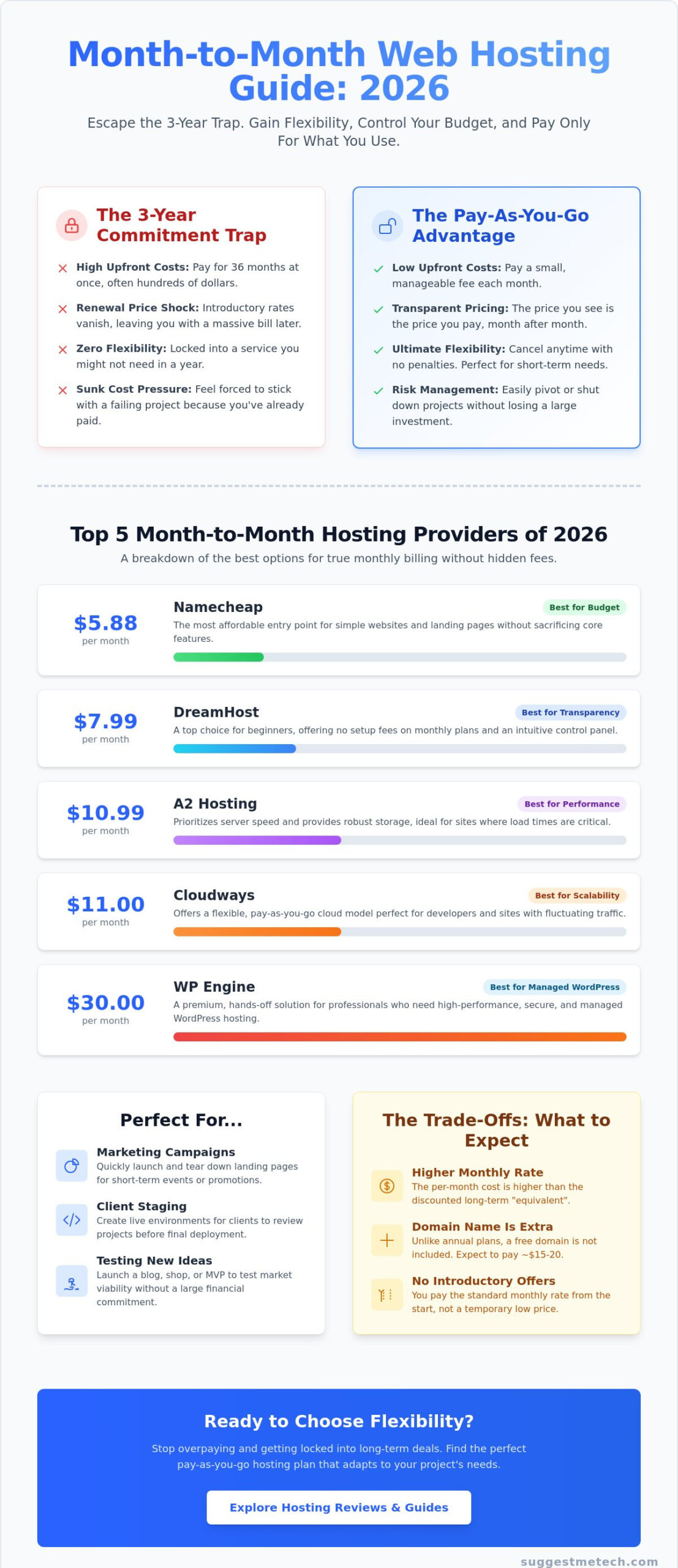
We’ve researched the top providers to help you find genuine flexibility without the long-term handcuffs. This guide highlights the best month-to-month web hosting plans available in 2026, focusing on those that offer true monthly billing without hidden setup fees. You’ll learn which hosts, like Namecheap at $5.88 per month or DreamHost at $7.99, provide the best balance of performance and price. We’ll break down the latest renewal rates and feature sets so you can cancel at any time and maintain total control over your hosting budget.
Key Takeaways
- Learn why the pay-as-you-go model is a vital risk-management tool for new websites and experimental projects.
- Compare the top month-to-month web hosting plans of 2026 to find providers that offer true flexibility without hidden setup fees.
- Uncover the “hidden costs” of monthly billing, such as domain registration fees and one-time activation charges.
- Discover which specific hosting providers earned our top recommendations for transparency, beginner-friendliness, and high-speed performance.
What is Month-to-Month Web Hosting and Why Should You Care?
A web hosting service that bills monthly is essentially a pay-as-you-go agreement. Instead of signing a multi-year contract, you pay for thirty days of server space at a time. If the service doesn’t meet your standards or your project ends early, you simply stop paying. There are no cancellation fees or legal ties to worry about. This setup provides a massive psychological advantage. You don’t have to feel the “sunk cost” pressure of a failing project just because you already paid for three years of hosting upfront.
Choosing month-to-month web hosting plans is a calculated decision for those who value agility over the lowest possible price. It is the gold standard for developers who need temporary environments, seasonal businesses that only operate a few months a year, and entrepreneurs testing a “Minimum Viable Product” (MVP). You get to keep your capital in your pocket rather than handing it to a hosting giant for a service you might not use in 2027 or 2028.
The Difference Between Monthly Billing and Annual Discounts
Hosting companies are famous for highlighting “introductory rates” that look incredibly cheap. You might see a price like $2.99 per month, but that rate almost always requires a 36-month commitment paid in full. When you switch to a monthly cycle, that price often jumps to $10 or $15. You also lose out on “Free Domain” offers. Most hosts charge an extra $15 to $20 for a domain name if you aren’t signing a long-term contract. While the per-month cost is higher, the impact on your immediate cash flow is much lower. You avoid a $300 upfront bill in favor of a small, manageable monthly expense.
Top Use Cases for Short-Term Hosting Plans
Not every website is meant to last forever. Many professionals use monthly plans for specific, time-sensitive tasks:
- Marketing Campaigns: Creating a temporary landing page for a specific event or a 30-day social media blitz.
- Client Staging: Setting up a live environment where a client can review and approve a website before it moves to its permanent home.
- Niche Testing: Launching a new blog or shop to see if it gains traction before committing to a long-term contract.
This flexibility ensures you never pay for “ghost” hosting. If a project pivots or fails, you can shut it down instantly. You stay in control of your budget and your tech stack without being locked into outdated hardware or poor support for years on end.
Top 5 Month-to-Month Web Hosting Providers of 2026
Finding the right provider requires looking past the big-font promotional prices that dominate search results. In 2026, a few names stand out for offering honest month-to-month web hosting plans without forcing you into a multi-year trap. These providers understand that agility is a priority for modern developers and small business owners who need to keep their overhead low while testing new ideas.
- DreamHost: Best for transparency. At $7.99 per month for their Shared Starter plan, they are one of the few hosts that don’t charge a predatory “monthly penalty” or setup fee.
- Namecheap: Best for budget projects. Their Stellar plan sits at a highly competitive $5.88 per month, making it the most affordable entry point for simple websites and landing pages.
- A2 Hosting: Best for performance. Their Startup plan lands at $10.99 per month, but they prioritize server-side speed optimizations for those who can’t afford slow load times.
- Cloudways: Best for scalability. Starting at $11 per month on DigitalOcean infrastructure, they offer an hourly billing model that is perfect for sites with fluctuating traffic.
- WP Engine: Best for Managed WordPress. At $30 per month, it’s a premium choice, but it removes the technical burden of maintenance for professional creators.
If you aren’t sure which of these fits your technical stack, our Technology Reviews and Guides provide deeper data on server response times and uptime reliability.
DreamHost vs. A2 Hosting: Balancing Cost and Speed
Comparing these two industry leaders reveals a clear split in philosophy. DreamHost is the king of “no-contract” hosting because they keep the barriers to entry low. You won’t find a setup fee on their monthly shared plans, and they include a free SSL certificate. A2 Hosting’s monthly rate is higher at $10.99, but they provide more robust storage limits and specialized caching. If you’re a beginner, DreamHost’s dashboard is slightly more intuitive, but A2 Hosting offers a wider range of integrated tools for developers who need to squeeze every millisecond of performance out of their site.
Cloud Hosting: The Hourly Alternative
Cloud infrastructure like Cloudways or DigitalOcean offers a different kind of freedom. Instead of a flat monthly fee, you often pay for exactly what you use. This “pay-as-you-go” model is the ultimate version of month-to-month web hosting plans. It’s ideal for high-traffic spikes, but there is a slight technical barrier. You won’t find a standard cPanel here; instead, you’ll manage your server through more advanced interfaces. It’s a powerful choice if you’ve outgrown basic shared hosting but still refuse to sign a 36-month contract.
The Hidden Costs: Is Monthly Hosting Actually Worth It?
While the flexibility of month-to-month web hosting plans is attractive, it often comes with a “monthly penalty” that isn’t always obvious at checkout. Some providers charge a one-time setup fee, which can range from $15 to $30, just to activate your account on a monthly cycle. This fee essentially erases the savings of not paying for a full year upfront. You also need to watch for renewal hikes. For instance, a basic plan might jump from an introductory $3.75 to a standard monthly rate of $17.59 after the first 30 days. This means your bill could increase by nearly five times without any change in service level.
Add-on inflation is another area where costs spiral. Features like automated backups, SSL certificates, or security scanning are often bundled for free with annual plans. On a monthly cycle, these “extras” can cost $2 to $5 each per month. By the time you add basic security and daily backups, your $10 monthly plan has quietly doubled in price. Before you commit, check the fine print for these recurring add-on charges. They can turn a cheap monthly trial into an expensive ongoing liability.
Calculating Your Total Cost of Ownership (TCO)
Total Cost of Ownership (TCO) represents the complete financial burden of your hosting, including the base rate, setup fees, and domain costs, measured over a six-month window. If you only need a site for three months, a monthly plan is a clear winner. However, the “break-even point” usually happens around month seven or eight. If you plan to keep your site live for more than half a year, paying for a 12-month annual plan is almost always cheaper than paying six individual monthly bills at the higher “penalty” rate.
The Domain Dilemma
Most monthly plans don’t include a free domain name, which adds an immediate $15 to $20 to your first bill. We recommend buying your domain from a separate registrar rather than your hosting provider. Keeping your domain and hosting in separate “buckets” makes it significantly easier to hop between different month-to-month web hosting plans if you’re unhappy with your service. You won’t have to deal with the technical headache or the transfer fees associated with moving a domain away from a host you’ve just cancelled. It gives you the ultimate freedom to walk away whenever you want.
How to Choose the Right Plan for Your Specific Needs
Selecting a host shouldn’t feel like a guessing game. To find the right fit for your project, you need a systematic approach that prioritizes performance over marketing promises. While month-to-month web hosting plans provide an easy exit, you still want to pick a winner on the first try to avoid the hassle of migrating your files later. Follow this five-step checklist to evaluate any potential host before you hand over your credit card details.
- Step 1: Estimate your resource needs. If you’re launching a simple landing page, shared hosting is sufficient. If you expect more than 10,000 monthly visitors or need custom software, look for a VPS (Virtual Private Server).
- Step 2: Check the money-back guarantee. Most reputable hosts offer a 30-day window. Verify that this applies to monthly billing cycles, as some companies restrict refunds to annual plans only.
- Step 3: Confirm SSL inclusion. Security is non-negotiable in 2026. If a host tries to charge you $50 for a basic SSL certificate, walk away. It should be free and automated.
- Step 4: Verify 24/7 support. When you’re testing a new setup, you can’t wait until Monday morning for a response. Test their live chat with a technical question before signing up.
- Step 5: Test site speed immediately. Use a tool like GTmetrix or PageSpeed Insights as soon as your site is live. If the “Time to First Byte” (TTFB) is over 500ms, use that money-back guarantee.
If you aren’t sure which provider fits your specific technical requirements, check our latest Technology Reviews and Guides for a deeper dive into server performance metrics.
When to Upgrade to an Annual Plan
We recommend the “Three-Month Rule” for every new project. If your website is still active and growing after 90 days, it has moved past the experimental phase. This is the ideal time to commit to a longer term. You can often negotiate a loyalty discount by contacting support and asking for the annual rate without paying the full “new customer” price again. Once your project proves its viability, it may be time to transition to the best web hosting services that offer deeper discounts for multi-year commitments.
Essential Features You Should Never Sacrifice
Don’t settle for “bare bones” hosting just because you’re paying monthly. Automated backups are actually more critical on short-term plans because you’re more likely to be making frequent, rapid changes to a new site. Ensure your host uses NVMe storage, which has become the industry standard for fast data retrieval in 2026. Finally, look for one-click installers that simplify your blog setup, allowing you to go from zero to live in under ten minutes.
Final Verdict: Which Monthly Plan Wins in 2026?
Deciding on the best host depends entirely on your project’s current stage and your technical comfort level. In 2026, the market for month-to-month web hosting plans has matured, offering high-quality options that don’t require a multi-year commitment. By staying agile and avoiding long-term contracts, you protect your budget while maintaining the freedom to switch if your needs evolve. Our evaluation points to three specific winners for different types of users.
- Best for Beginners: DreamHost. With a monthly price of $7.99 and zero setup fees, it is the most transparent option for anyone starting their first site. You get a solid feature set without the “renewal shock” common with other providers.
- Best for Performance: A2 Hosting. If your site relies on fast load times to convert visitors, their $10.99 monthly plan offers superior server-side optimizations and NVMe storage. It is worth the slight price premium for the speed boost.
- Best for Techies: Cloudways. For those who need total control, Cloudways provides an hourly billing model starting at roughly $11 per month. It is the ultimate choice for developers who want to scale resources up or down instantly.
Keep your project lean. Start with the smallest plan that meets your needs and only upgrade when your traffic data proves it is necessary. This “lean” approach prevents overspending on resources you don’t use and ensures you aren’t paying for “ghost” features that your site doesn’t actually require yet.
Our SuggestMeTech Recommendation
After comparing the top contenders, DreamHost and A2 Hosting emerge as the strongest choices for most users. DreamHost wins on pure value and ease of use, making it our top pick for personal blogs and small business landing pages. A2 Hosting is the better choice for e-commerce or data-heavy sites where every millisecond counts. When you are testing your new site’s performance on mobile, remember to clear cache on iPhone to ensure you are seeing the live, uncached version of your pages. This step is essential for accurate speed assessments.
We want to hear about your experience. Which monthly host have you tried lately? Did you run into hidden fees, or did you find a provider that truly respects your flexibility? Join the conversation below and share your findings with the SuggestMeTech community. Your input helps us refine our Technology Reviews and Guides to serve you better.
Take Control of Your Hosting Strategy
You now have the tools to avoid the 36-month contract trap and keep your digital projects agile. By prioritizing transparency and performance over flashy introductory rates, you protect your budget from unexpected spikes. The best month-to-month web hosting plans are those that balance fair renewal rates with zero hidden setup fees, allowing you to scale or pivot without financial penalty. Stick to the three-month rule; if your site is still growing after 90 days, you’ve moved past the experimental phase and can confidently consider a longer commitment.
Our team at SuggestMeTech provides no-nonsense technical analysis based on independent testing of over 50 hosting providers. We’ve updated our evaluations for 2026 market standards to ensure you get the most reliable data for your decision-making process. Your project deserves a host that works as hard as you do without holding your budget hostage. Take the next step in your journey with confidence.
Check out our curated list of the best web hosting services to find your perfect match.
Frequently Asked Questions
Do month-to-month hosting plans have setup fees?
Setup fees are common but not universal. Some providers charge between $15 and $30 to cover the administrative costs of setting up a short-term account. These fees are often hidden until you reach the final checkout screen. To avoid this extra cost, look for hosts like DreamHost that offer transparent monthly billing without any one-time activation charges or hidden penalties for choosing a shorter cycle.
Can I get a free domain name with a monthly hosting plan?
You typically won’t get a free domain name when paying monthly. Free domain registration is almost always a gift used to entice customers into 12-month or 36-month contracts. If you choose a monthly plan, be prepared to pay the standard registration fee of $15 to $20. This is another reason why we recommend keeping your domain at a separate registrar to maintain your project’s total flexibility.
Is monthly hosting more expensive than annual hosting in the long run?
Monthly billing is significantly more expensive if you stay long-term. You’re paying a premium for the ability to walk away at any time. For example, a plan that costs $3 per month on a three-year contract might cost $15 per month on a monthly basis. If your project is still live after seven months, you have likely already spent more than the cost of a full year of discounted hosting.
Can I switch from a monthly plan to an annual plan later?
Switching to an annual plan is a simple process that most hosts encourage. You can usually find a Manage Subscription or Upgrade button within your account’s billing area. If you’ve been a loyal monthly customer for a few months, it doesn’t hurt to ask support for a special promotional rate when you finally decide to commit to a longer-term annual contract for your website.
Do monthly plans include the same features as annual plans?
Most monthly plans offer the same core server resources as their annual counterparts. You’ll typically get the same amount of SSD storage, bandwidth, and CPU power. However, you might miss out on specific value-add features. Annual plans often bundle in free professional email addresses, premium security software, or advanced backup tools that are sold as paid add-ons for customers who prefer the flexibility of monthly billing.
What is the best month-to-month host for WordPress?
DreamHost is the best choice for WordPress users who want a monthly cycle without the contract. They are officially recommended by the WordPress team and provide a user-friendly installer. For more demanding projects, managed providers like WP Engine or Kinsta offer specialized WordPress environments for $30 to $35 per month. These premium options provide better performance and expert support for those who don’t want to manage server updates themselves.
Is there a money-back guarantee on monthly hosting plans?
Most month-to-month web hosting plans include a 30-day money-back guarantee. This ensures you can test the server’s performance and the responsiveness of the support team before fully committing. DreamHost even offers an industry-leading 97-day guarantee. Just keep in mind that domain registration fees and certain third-party add-ons are almost never refundable, even if you cancel your hosting service within the first few days of signing up.
How do I cancel my month-to-month hosting subscription?
You can cancel your subscription through your provider’s online billing portal or by contacting their support team. To successfully terminate month-to-month web hosting plans, you should disable the auto-renew feature at least 48 hours before your next scheduled payment. This prevents any automatic charges from hitting your credit card. Always verify that you’ve received a cancellation confirmation email to ensure your account is fully closed and no further billing will occur.