

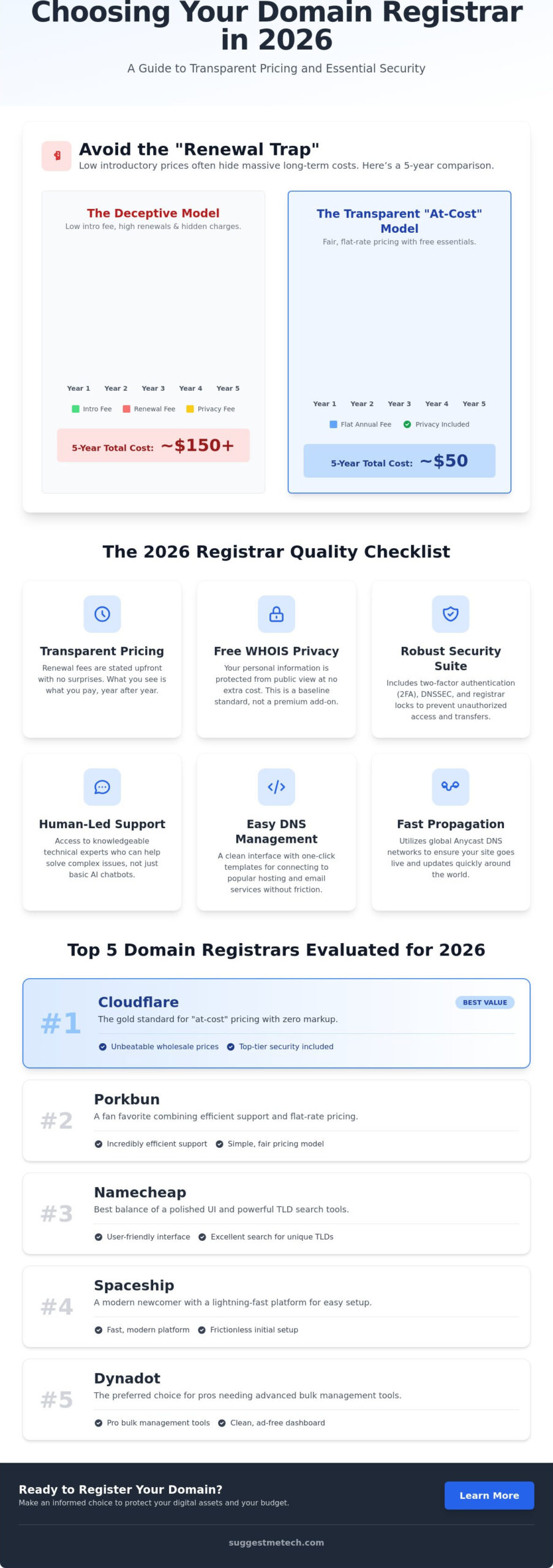
What if that $0.99 domain name you just bought actually costs you $150 over the next five years? It’s a common frustration to sign up for a bargain only to see renewal rates spike to $23 or more while being charged for privacy features that should be free. You’ve likely dealt with cluttered dashboards and difficult transfer processes that make managing your online identity a chore.
Finding the best domain registrars 2026 requires looking past flashy introductory rates to find partners that offer fixed pricing and “at-cost” models. You need a reliable home for your URL that includes free WHOIS protection and robust security like 2FA and DNSSEC as standard features. This article provides a transparent comparison of the most cost-effective and secure options on the market.
We’ll break down the top picks based on long-term value, interface clarity, and the absence of hidden fees. By the end of this guide, you’ll know exactly which registrars respect your budget and provide the professional tools necessary to keep your domains secure.
Key Takeaways
- Identify the best domain registrars 2026 by prioritizing long-term price transparency over deceptive, low-cost introductory offers.
- Understand why free WHOIS privacy and advanced security protocols like DNSSEC are now the essential baseline for any professional domain.
- Compare top-tier registrars like Cloudflare and Porkbun to find the perfect balance between at-cost pricing and user-friendly interfaces.
- Learn how to navigate the “renewal trap” to ensure your annual ownership costs remain predictable and affordable.
- Follow a streamlined, step-by-step roadmap for registering your next domain while avoiding hidden fees and aggressive upselling.
What Makes a Great Domain Registrar in 2026?
A Domain name registrar acts as the bridge between you and the central registry database. These companies are ICANN-accredited to manage your unique web address and ensure it points to the correct server. In the past, registrars could get away with bare-bones service and hidden fees. However, finding the best domain registrars 2026 requires looking for providers that treat security and privacy as standard features rather than expensive add-ons. You’re no longer just buying a name; you’re choosing a security partner for your digital assets.
The industry has shifted significantly over the last few years. By 2026, free WHOIS privacy protection isn’t a “bonus” feature; it’s the absolute baseline. Any company still charging you to hide your personal phone number and home address from public records isn’t worth your time. Privacy is a right, not a revenue stream. Beyond privacy, your registrar must provide robust security tools like mandatory two-factor authentication (2FA), DNSSEC support to prevent spoofing, and registrar locks that stop unauthorized transfers. Interoperability is also a major factor. You need a registrar that makes it easy to point your domain to third-party hosting, email, or CDN services without jumping through hoops.
The 2026 Quality Checklist
- Transparent renewal pricing: The best domain registrars 2026 clearly state their renewal fees upfront. You should never deal with a 300% price jump after your first year. If a .com costs $10 today, it shouldn’t cost $40 next year.
- One-click DNS templates: Setting up your site shouldn’t be a technical headache. Look for registrars that offer pre-configured templates for major hosting providers and email services. This allows you to connect your domain in seconds.
- Prompt, human-led technical support: AI bots have their place for simple questions, but when your site is down, you need a knowledgeable human expert to help you troubleshoot complex DNS issues. Reliability depends on who answers the phone or chat.
Why Your Choice Impacts SEO and Security
Your choice of registrar directly influences how quickly your site goes live and stays online. DNS propagation speed, the time it takes for servers worldwide to recognize your new address, can vary between providers. High-quality registrars use global Anycast DNS networks to ensure your records update almost instantly. Slow propagation delays your launch and can complicate early SEO efforts when search bots attempt to crawl a site that isn’t fully “visible” yet.
Security is equally vital for your brand’s reputation. Low-quality providers often leave you vulnerable to “domain slamming,” where deceptive companies try to trick you into transferring your domain through official-looking mail or emails. A high-quality registrar uses active monitoring and strict transfer protocols to prevent these scams. If you’re still learning the basics of how these addresses work, check out our guide on what is a domain name for foundational context.
Top 5 Domain Registrars for 2026: Evaluated and Ranked
Choosing a registrar in 2026 isn’t just about finding the lowest price for the first twelve months. It’s about avoiding “ecosystem lock-in,” where a provider makes it intentionally difficult to use external hosting or third-party email services. The best domain registrars 2026 prioritize interoperability, allowing you to manage your DNS records without being forced into a proprietary software stack. Before you commit, it’s helpful to review the Registrants’ Benefits and Responsibilities to understand your rights regarding data accuracy and transferability.
Our evaluation focuses on long-term ownership costs and security. We’ve identified five standout providers that lead the market in transparency and performance:
- Cloudflare: The gold standard for “at-cost” pricing. They pass the registry fee and the $0.18 ICANN fee directly to you with zero markup.
- Porkbun: A fan favorite that combines quirky branding with incredibly efficient support and flat-rate pricing.
- Namecheap: Offers the best balance of a polished user interface and powerful search tools for finding unique TLDs.
- Spaceship: A modern newcomer built on a lightning-fast platform designed to reduce the friction of initial setup.
- Dynadot: The preferred choice for pro investors who need advanced bulk management tools and a clean, ad-free dashboard.
Cloudflare vs. Porkbun: The Battle for Best Value
Cloudflare’s wholesale model is unbeatable for those who want the absolute lowest price for .com or .org renewals. However, their interface is built for developers and can feel overwhelming for a first-time user. Porkbun offers a more approachable experience with prices that are only a few cents higher. Both providers include WHOIS privacy and SSL certificates for free, but Porkbun’s human-led support team often responds faster to basic configuration questions. If you’re looking for more in-depth analysis, our latest technology reviews can help you decide which technical path fits your skill level.
Namecheap and Spaceship: Modern Management
Namecheap remains a top contender because of “Beast Mode,” a search tool that lets you filter through 5,000 domains at once based on price or niche. While their renewal rates for .com domains typically land between $13.98 and $18.48, their frequent promotions provide great entry value. Spaceship, on the other hand, uses a feature called “Unbox” to automate the connection between your domain and your chosen services. It’s a “no-click” philosophy that saves significant time during a site launch. Both companies are highly transparent about renewal costs, ensuring you don’t face the $20+ surprises common with legacy providers like GoDaddy.
Best Registrars for Specific Needs and TLDs
The right choice depends entirely on what you’re building. A small business owner prioritizes brand protection and simplicity; a developer requires granular control over technical records. The infrastructure supporting these addresses is a critical component of the global internet, as detailed by the National Telecommunications and Information Administration. To find the best domain registrars 2026, you must match your specific project requirements with a provider’s specialized toolset.
For those sticking to the classics, .com and .net remain the most stable options. These extensions benefit from predictable registry fees and universal recognition. However, if you’re venturing into niche extensions like .ai, .io, or .tech, the stakes are higher. These “modern” TLDs often carry significant registry price hikes. The best domain registrars 2026 for these extensions are those that pass through the costs with minimal markups, saving you $10 to $30 per year on a single address.
- Best for Small Business: Look for providers that offer integrated professional email and “Domain Protection” features to prevent accidental expiration.
- Best for Developers: Prioritize registrars with robust API access and support for advanced DNS record types like CAA and TLSA for security certificates.
- Best for .com and .net: Choose a registrar with a long history of stable renewal rates and zero hidden “privacy” fees.
- Best for New TLDs: Focus on companies that specialize in a wide variety of extensions without adding excessive retail margins.
The Small Business Advantage
Business owners should prioritize “Domain Protection” features that add an extra layer of verification before any critical changes occur. This prevents unauthorized transfers and keeps your digital identity secure. Efficiency is also vital. You’ll want a registrar that allows you to seamlessly sync your domain with the best web hosting services through pre-configured DNS templates. Finally, look for team access settings. This allows you to grant specific permissions to employees or contractors without sharing your master account password.
Managing Modern TLDs in 2026
The cost of .io and .ai domains has risen sharply due to high demand in the tech and artificial intelligence sectors. Some registrars capitalize on this by adding heavy service fees on top of already expensive registry prices. Always check the renewal rate before you buy. Additionally, certain country code TLDs (ccTLDs) require a “local presence” or a physical address in that nation. Quality registrars often provide proxy services to satisfy these requirements legally. Despite the rise of new extensions, .com remains the gold standard for trust in 2026.
Avoiding the “Renewal Trap” and Hidden Fees
A $0.99 domain looks like a steal until you realize it’s a financial trap. Many legacy providers use these flashy entry prices to lure you in, knowing they’ll charge you $21.99 or more every year after that. To find the best domain registrars 2026, you have to look past the first year and calculate the total cost of ownership over five or ten years. Transparent providers don’t hide their renewal rates in the small print or charge you extra for basic privacy. They understand that a long-term relationship with a customer is more valuable than a one-time bait-and-switch.
In 2026, you should never pay for WHOIS privacy. It has become an industry standard to offer this for free. If a registrar tries to add a $10 or $15 fee to redact your personal info, they’re using an outdated business model that preys on beginners. Additionally, keep an eye on the ICANN fee. Every registrar must pay a mandatory $0.18 annual fee to ICANN for each gTLD like .com or .org. This is a standard pass-through. If your invoice shows a fee significantly higher than this for “administrative costs,” you’re likely being overcharged. Some companies even implement “transfer-out” fees or make the process intentionally confusing to hold your domain hostage when you try to leave.
How to Read a Domain Pricing Table
Don’t just click “Buy” on the lowest number you see. Always look for the “Renewal” column before hitting the checkout button. For example, while a .com might cost $5.98 at Namecheap for the first year, it typically renews between $13.98 and $18.48. Compare this to GoDaddy, where renewal prices for a .com often land between $21.99 and $22.99. Calculating a 5-year Total Cost of Ownership (TCO) reveals the true winner. Also, watch out for pre-checked boxes for email trials or website builders that add recurring costs to your bill without your explicit consent.
The Truth About “Free” Domains
Many hosting providers offer a “free domain for one year” when you sign up for their services. This is often a great deal if you’re learning how to start a blog and want to keep initial costs low. However, be careful with these bundles. If you decide to cancel your hosting, some companies make it difficult or expensive to keep the domain name separately. Always verify that you maintain full ownership and can transfer the domain away if you switch servers. For more help navigating these choices, explore our full technology guides to see which bundles offer the best long-term value.
Final Recommendation: How to Choose Your Registrar
Selecting from the best domain registrars 2026 comes down to your technical comfort level and your long-term budget. At SuggestMeTech, our top recommendation for most users is Cloudflare because of their commitment to at-cost pricing and high-end security features. If you prefer a more approachable interface with fast human support, Porkbun is the clear runner-up. Both companies avoid the deceptive upselling and “renewal traps” that plague legacy providers. You’re choosing a partner to protect your digital identity, so transparency should be your primary metric.
The registration process is straightforward but requires attention to detail. First, use a search tool to verify your name’s availability across multiple TLDs. Once you’ve selected your address, double-check that WHOIS privacy is included for free before you reach the final checkout screen. Complete the registration and immediately check your inbox for the ICANN verification email. Failing to click this link can lead to your domain being suspended within 15 days. After you’ve secured the domain, you must complete a “Day 1” checklist to protect your new asset.
- Enable 2FA immediately: Use an app-based authenticator or a hardware key rather than SMS to prevent SIM-swapping attacks.
- Toggle Auto-Renew: Losing a domain because of an expired credit card is a common disaster. Set a backup payment method if possible.
- Configure DNS Records: Point your A, CNAME, or MX records to your hosting and email providers to take your site live.
Our Decision Framework
We’ve categorized our top picks to help you make a quick, informed choice based on your specific project needs:
- Pick Cloudflare if you prioritize the absolute lowest renewal cost and enterprise-grade security. It’s the best option for users who want zero markup on registry fees.
- Pick Porkbun if you want a friendly customer experience and a simple, honest dashboard. Their flat-rate pricing makes them a favorite for small businesses.
- Pick Namecheap if you want a refined user interface and the ability to find unique extensions through powerful search filters.
Securing Your Digital Identity
Security starts with your account setup. Use a dedicated, secure email address for your domain management that is separate from your public contact email. This reduces the risk of targeted phishing attacks. Always ensure the “Registrar Lock” status is active in your dashboard. This simple toggle acts as a deadbolt against unauthorized transfer requests. If you ever decide to move your domain to a different provider, the process is simple: unlock the domain, request an authorization code, and initiate the transfer at your new registrar.
Ready to start building? Check out the best laptops of 2026 to find the perfect hardware for your next big project.
Secure Your Digital Future Today
Choosing a home for your web address is a decision that impacts your budget and security for years to come. We’ve highlighted that the best domain registrars 2026 are those that provide transparent pricing and free privacy protection as a standard. By focusing on the 5-year Total Cost of Ownership rather than just the first-year discount, you can avoid the common “renewal trap” that catches many beginners off guard. Whether you need the at-cost efficiency of Cloudflare or the approachable support of Porkbun, the right choice depends on your project’s specific technical requirements.
Our team at SuggestMeTech conducted an independent technical evaluation of over 20 registrars to bring you these no-nonsense recommendations. We’ve done the heavy lifting so you don’t have to worry about hidden fees or difficult transfer processes. Ready to make your move? Check out our top-rated domain registrars for 2026 at SuggestMeTech to find the perfect fit for your next big idea. Building a professional online presence is easier when you have the right partners in your corner.
Frequently Asked Questions
What is the cheapest domain registrar in 2026?
Cloudflare is the cheapest for most users because they offer at-cost pricing with no markup. While some registrars offer $0.99 intro rates, their renewal fees often jump to over $20. Cloudflare maintains a consistent price based on the registry cost plus the $0.18 ICANN fee. This makes them a top pick among the best domain registrars 2026 for long-term savings and price predictability.
Do I need to pay for WHOIS privacy protection?
No, you should never pay for WHOIS privacy protection in 2026. Most reputable registrars now include this service for free to comply with global privacy standards like GDPR. If a provider tries to charge you $10 or $15 for this feature, they are using an outdated business model. Always choose a registrar that redacts your personal contact information from public records at no additional cost to you.
Can I change my domain registrar after I buy a domain?
Yes, you can transfer your domain to a different registrar at almost any time. ICANN rules generally require you to wait 60 days after the initial registration or a previous transfer before moving it again. The process involves unlocking the domain in your current dashboard and requesting an authorization code. This flexibility allows you to move to a better provider if your current one raises renewal prices unexpectedly.
Is it better to buy a domain from my hosting provider?
Buying from a hosting provider is convenient for setup but often more expensive in the long run. Many hosts offer a free domain for the first year, but renewal rates are typically higher than dedicated registrars. Keeping your domain and hosting separate also prevents “ecosystem lock-in.” If you decide to switch hosting servers, having your domain at an independent registrar makes the migration process much simpler and less risky.
What happens if I forget to renew my domain name?
Your website and email will stop working immediately after the expiration date. Most registrars offer a “grace period” of about 30 days where you can still renew at the standard price. After that, the domain enters a “redemption period” where recovery fees can cost $100 or more. To avoid this, always enable auto-renew and keep a secondary payment method on file to protect your digital identity from accidental loss.
What is DNSSEC and do I really need it?
DNSSEC is a security extension that adds a digital signature to your DNS records to prevent “spoofing” or cache poisoning. It ensures that visitors are directed to your actual website rather than a malicious lookalike. While not mandatory for every small blog, it is highly recommended for any business handling sensitive data. Many of the best domain registrars 2026 now offer one-click DNSSEC deployment to keep your traffic secure.
How much should a .com domain cost in 2026?
A standard .com domain should cost between $10 and $16 per year for a fair renewal rate. While introductory prices might be lower, any renewal fee over $20 is considered high for the current market. Keep in mind that this total should include the mandatory $0.18 ICANN fee and free WHOIS privacy. If you are paying more, you are likely paying for unnecessary markups or bundled services you don’t use.
Can I buy a domain name forever?
No, you cannot technically own a domain name forever with a one-time payment. Domain names are leased on an annual basis for periods ranging from one to ten years. You must continue to pay the renewal fees to maintain ownership of the address. Some registrars allow you to prepay for a full decade, which protects you from potential price increases, but you will still need to renew it once that term ends.