

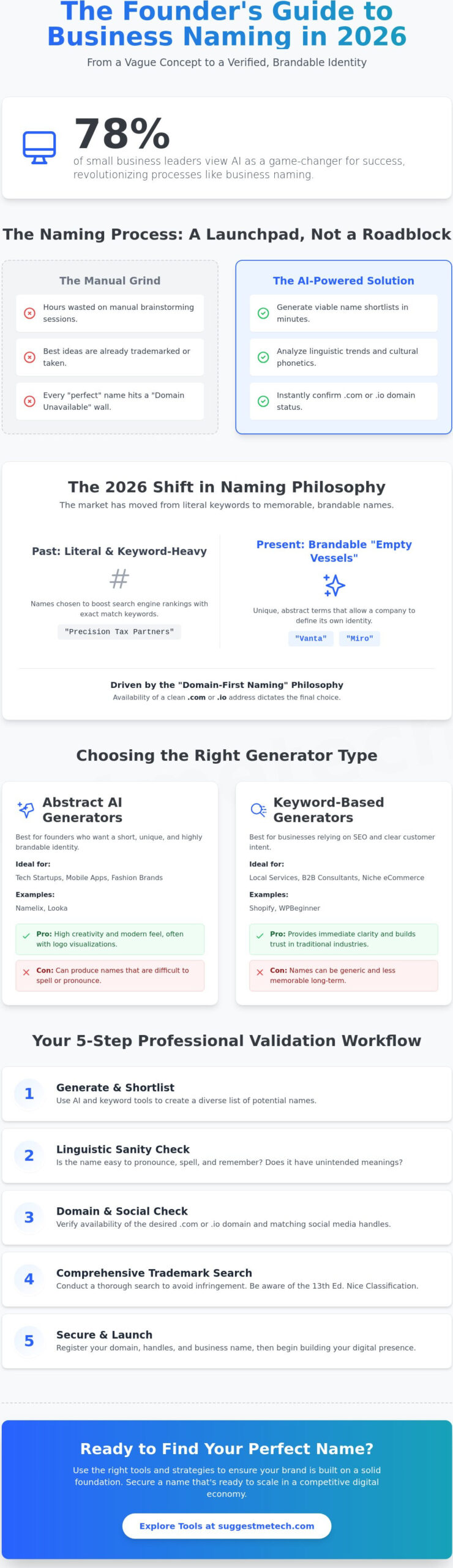
Did you know that 78% of small business leaders now view AI as a fundamental game-changer for their success? Despite this shift, many founders still waste hours on manual brainstorming only to find their best ideas are already trademarked or taken. It’s exhausting to see every “perfect” name hit a “domain unavailable” wall. We believe the naming process should be a launchpad, not a roadblock. By using the right business name generator tools, you can move from a vague concept to a verified, brandable identity in a single afternoon.
We’ve tested the latest platforms to help you find a name that balances creative flair with technical availability. In this guide, you’ll learn how to secure a shortlist of viable names and instantly confirm .com or .io status. We also cover essential 2026 updates, including the 13th edition of the Nice Classification for trademarks and the new ICANN gTLD application window. Whether you’re looking for a free AI suggestion or a premium marketplace domain, these recommendations will ensure your brand is ready to scale in a competitive digital economy.
Key Takeaways
- Learn how to differentiate between abstract AI and literal keyword-based generators to find the best fit for your specific business model.
- Discover the top-rated business name generator tools for 2026, evaluated for their creativity, user experience, and real-time domain availability checks.
- Follow a professional 5-step workflow to validate your name through linguistic sanity checks and comprehensive trademark searches.
- Understand the latest 2026 regulatory changes, including the 13th edition of the Nice Classification and new generic top-level domain (gTLD) opportunities.
- Get actionable advice on transitioning your brand from a name to a functional digital presence with optimized web hosting.
The Evolution of Business Naming in 2026
The traditional whiteboard brainstorming session is no longer enough to launch a brand. In 2026, the digital marketplace is saturated with millions of active trademarks and registered domains, making manual naming a recipe for frustration. Modern business name generator tools have evolved from simple word-mashing scripts into AI-augmented brainstorming partners. These platforms don’t just suggest words; they analyze linguistic trends, check technical availability, and help you build a foundation for a global brand.
A foundational understanding of trade names is vital before you begin your search. In previous years, founders often prioritized literal, keyword-heavy names to boost search engine rankings. However, the market has shifted toward “empty vessel” brandable names. Unique, abstract terms like “Vanta” or “Miro” are now preferred because they allow a company to define its own identity without being limited by a descriptive title. This shift is driven by the “Domain-First Naming” philosophy, where the availability of a clean .com or .io address often dictates the final choice.
Why a Good Name is Your Most Valuable Tech Asset
Your business name is the primary driver of user trust and long-term retention. It’s the core of your digital identity and directly influences your future domain strategy. Getting this right early is a financial necessity. Verified data shows that 31.6% of new businesses in 2026 require over $500,000 in startup capital. With stakes that high, the cost of a mid-stream rebrand is staggering. A name that fails a trademark check or lacks a matching social handle can result in thousands of dollars in lost SEO equity and legal fees. Choosing a scalable name from day one protects your investment.
The Role of Generative AI in 2026 Naming
Generative AI has fundamentally changed how business name generator tools operate. We’ve moved past basic algorithms that simply add suffixes to your keywords. Modern naming engines use contextual AI to understand the “vibe” of an industry. They analyze phonetics to ensure a name is easy to pronounce and remember across different cultures. While general LLMs like ChatGPT can offer creative suggestions, purpose-built naming engines are superior because they integrate real-time database checks. They understand that a fintech startup needs a name that implies stability, while a social commerce app can afford to be more playful and abstract. This specialized focus ensures the suggestions aren’t just creative, but also legally and technically viable.
AI vs. Keyword-Based: Choosing the Right Generator Type
Selecting the right platform depends on whether you want a name that describes what you do or a name that defines who you are. Modern business name generator tools generally fall into three categories: Abstract AI, Literal Keyword, and Industry-Specific engines. Each serves a distinct purpose based on your industry and growth goals. Choosing the wrong type can lead to a brand that feels mismatched with its target audience.
Abstract names are the gold standard for tech startups, mobile apps, and fashion brands. These “empty vessel” names, like Etsy or Hulu, don’t have an inherent meaning, which allows you to build a brand identity from scratch without being boxed in by a specific service. Conversely, literal names are better for local service providers or B2B consultants. If you’re a specialized accounting firm, a name like “Precision Tax Partners” provides immediate clarity for local search results. Before making a final decision, it’s helpful to review the official SBA guidance on how to register and protect your trade name legally.
Abstract AI Generators (Namelix, Looka)
These tools are best for founders who want a short, unique, and highly brandable identity. Platforms like Namelix use machine learning to generate names based on your preferred length and style. They often provide integrated logo visualizations, which helps you see the brand potential immediately. While they offer high creativity and a modern feel, they can sometimes produce nonsensical or “made-up” words that are difficult for customers to pronounce or spell correctly.
Traditional Keyword Generators (Shopify, WPBeginner)
If your strategy relies heavily on SEO and clear intent, traditional keyword-based tools are more effective. These generators take your core service terms and add prefixes or suffixes to create familiar combinations. They’re excellent for traditional industries where trust is built on immediate understanding. However, because these tools rely on common words, they often suggest long, clunky names where the matching .com domains are already taken. For more advice on building your digital foundation, you can explore our latest technology reviews and guides.
The most successful founders often use a hybrid approach. They start with literal keywords to “seed” an AI generator, then filter the results for abstract variations. This method balances the clarity of your industry with the creative edge needed to stand out. Since 75% of small businesses are now investing in AI, leveraging these business name generator tools effectively is no longer optional; it’s a competitive requirement for 2026.
The Top Business Name Generator Tools Reviewed
Choosing the right tool requires a clear understanding of your brand’s technical and creative needs. We evaluate business name generator tools based on four critical metrics: creativity, domain integration, user experience, and cost. An academic perspective on business naming highlights that a name must be distinctive and avoid linguistic traps to be effective. These platforms help you bypass those pitfalls by using data-driven algorithms instead of guesswork.
Namelix: Best for Tech Startups
Namelix is the gold standard for founders seeking short, brandable identities. It uses a sophisticated machine learning algorithm that actually improves as you save your favorite results. You can use specific filters like “Rhyming” or “Compound” to narrow down the style. While the core naming service is free, Namelix offers tiered branding packages. You can purchase a basic logo file for $25 or a full designer package with brand guidelines for $65. The platform’s seamless integration with domain registrars makes it easy to see which names are ready for immediate registration.
Shopify Generator: Best for E-commerce
The Shopify Business Name Generator is built for speed and SEO. It’s the ideal choice for entrepreneurs who want to move quickly from a name to starting a blog or an online store. This tool excels at creating literal keyword combinations that are easy for customers to find in search results. Its “available” domain indicators are highly reliable, ensuring you don’t fall in love with a name that’s already taken. It’s a practical, no-nonsense tool for businesses where clarity is more important than abstract branding.
Canva Magic Write: Best for Creative Brainstorming
Canva Magic Write allows you to use prompt engineering to generate name lists directly within your design workflow. This is a massive advantage because you can instantly see how a potential name looks on marketing materials or social media templates. While it’s a general-purpose AI, its collaborative features make it perfect for team sessions. You’ll get the best results by providing specific context about your target audience and brand values. It’s a flexible option for those who want to visualize the brand reality alongside the name.
For founders with a larger budget, BrandBucket offers a premium “ready-to-go” experience. Unlike AI generators that create names from scratch, BrandBucket is a curated marketplace of pre-vetted, high-quality domains. These names often come with a premium price tag, but they provide an instant sense of authority and established presence. Whether you choose a free AI tool or a premium marketplace, the goal is to find a name that scales with your future ambition.
The 5-Step Workflow for Validating Your Generated Name
Finding a catchy suggestion through business name generator tools is only the first half of the process. In a saturated 2026 market, a name that sounds perfect might already be a legal or digital minefield. You need a rigorous validation workflow to ensure your chosen brand can actually exist in the real world. Follow these five steps to move from a raw idea to a secure business asset.
- Step 1: The Linguistic Sanity Check. Say the name out loud and write it down. Check for unintended meanings in other languages or slang. In 2026, global commerce is the standard, and a name that sounds professional in English might be offensive elsewhere.
- Step 2: The Domain Deep-Dive. Don’t stop at the .com. With the 2026 ICANN application window opening for new generic top-level domains (gTLDs), you have more options than ever. Verify if your name works with .brand, .tech, or other specialized endings.
- Step 3: Social Media Handle Audit. Consistency is vital for social commerce. Since 77% of small businesses now rely on social media to reach customers, check TikTok, Instagram, and X immediately. If the handles are taken by inactive accounts, you may need to reconsider.
- Step 4: Preliminary Trademark Search. Use the USPTO Class ACT AI tool launched in March 2026 to automate your classification tasks. This helps you navigate the 13th edition of the Nice Classification system, which updated how goods like eyewear and heated garments are categorized.
- Step 5: The Bar Test. Imagine telling a friend your business name in a noisy room. If you have to spell it out or repeat it three times, it’s too complex. Verbal clarity is essential for word-of-mouth growth.
Handling the “Taken Domain” Crisis
It’s common to find that your ideal .com is parked or priced at a premium. If the price exceeds your budget, consider using .io, .co, or .app extensions effectively. Many successful tech startups now launch on these TLDs without any loss in credibility. Another strategy is to add a functional verb to your URL. Secure a domain like “Get[Name].com” or “Use[Name].com” to keep the core brand name while staying within a reasonable budget. For more advice on building your digital foundation, check our comprehensive technology reviews.
Avoiding Legal Pitfalls Early
A basic search on the Trademark Electronic Search System (TESS) is mandatory. Legal trouble often comes from names that are “confusingly similar” rather than exact matches. If your name sounds too close to an established competitor in the same industry class, you’re at risk for a cease-and-desist letter. As of January 1, 2026, the updated Nice Classification rules are in effect, so ensure your search covers the correct modernized categories for your products. If you plan to scale, checking global registries is no longer optional; it’s a requirement to protect your intellectual property.
Beyond the Name: Launching Your Digital Presence
After you’ve utilized business name generator tools to secure a winning brand, the focus shifts from ideation to execution. A great name provides the spark, but your technical infrastructure provides the fuel. Transitioning from a creative concept to a functional website requires a strategic approach to hosting, security, and visual identity. In 2026, where 77% of small businesses depend on social media as a direct revenue driver, your digital launch must be cohesive across every touchpoint.
The first step is securing your digital real estate. Once you’ve confirmed your domain’s availability, you need a reliable platform to house your content. Selecting the right web hosting service is a foundational decision that affects your site’s speed and reliability. Since 66% of SMBs are increasing their investment in data management, choosing a host that offers robust security features and automated backups is essential for protecting your new brand asset from day one.
Connecting Your Name to Hosting
For most beginners, simplicity is the best strategy. Purchasing your domain and hosting from the same provider often eliminates technical headaches during the DNS configuration phase. This setup allows for a smoother integration of your SSL certificate. An SSL certificate is no longer optional; it’s a vital trust signal that tells visitors their data is secure on your branded domain. As you manage these digital assets, ensuring you have the right hardware is equally important. We’ve evaluated the best laptops for managing a growing digital business to help you stay productive while you build your online presence. High-performance hardware ensures you can handle design software and data management tools without lag.
Building Your Brand Voice
The name you chose through business name generator tools naturally dictates your visual and verbal identity. If you selected an abstract, modern name like “Aura,” your logo’s font should likely be a clean, sans-serif style with a vibrant color palette. Conversely, a literal name like “Heritage Consulting” often benefits from traditional serif fonts and muted, professional tones. This consistency must extend to your brand voice. Creating a style guide ensures that the “personality” of your generated name remains uniform across your professional email, website copy, and social profiles. This guide should outline your preferred tone, whether it’s authoritative and helpful or playful and community-focused.
We’re interested in your journey. Selecting a name is a collaborative process, and we’d love to hear what you’ve discovered. What name did you land on? Share your top choices in the comments below for community feedback. Let’s work together to turn your brand ideas into a successful digital reality.
Launch Your Brand with Confidence
Securing a memorable identity in 2026 requires more than a lucky guess. By leveraging modern business name generator tools, you’ve moved past the frustration of taken domains and robotic suggestions. You now have the framework to validate your choice through our comprehensive validation checklists, ensuring your brand survives linguistic hurdles and the latest trademark classifications. Your name is the foundation for your entire digital presence, from your visual style guide to your technical hosting strategy.
Our expert tech reviews and 2026 market-ready advice are designed to help you navigate these complex choices with ease. Don’t let a great idea stall at the naming phase. Take the next step in your entrepreneurial journey by establishing a professional home for your new brand. Find your perfect brand name and start your blog today! We’re excited to see the unique brands you create and scale in this competitive landscape.
Frequently Asked Questions
Are business name generators truly free to use?
Most business name generator tools offer their core naming algorithms for free. You typically only pay if you choose to purchase additional assets like logo files or brand identity kits. For example, Namelix generates names at no cost, but their basic branding package starts at $25. This model allows you to brainstorm hundreds of ideas without any initial financial commitment.
Can I trademark a name suggested by an AI generator?
You can trademark an AI-generated name as long as it isn’t already registered in your specific industry class. It’s essential to conduct a thorough search using the USPTO Class ACT AI tool launched in early 2026. This tool helps you navigate the updated 13th edition of the Nice Classification, which now includes specific categories for modern tech and reclassified goods like eyewear.
What is the best business name generator for a small local business?
For local service providers, keyword-based generators like the one offered by Shopify are usually the best choice. These tools focus on literal combinations that include your service and location, which is vital for local search engine visibility. While abstract AI tools are great for tech startups, a local plumber or accountant benefits more from a name that provides immediate clarity to customers.
Do I have to buy a domain through the naming tool?
You aren’t required to purchase your domain through the naming tool’s suggested registrar. Most generators use affiliate links to registrars like Namecheap or GoDaddy to earn a commission. You can simply copy your favorite name and register it through your preferred hosting provider or registrar instead. This flexibility allows you to consolidate your digital assets wherever you feel most comfortable.
What should I do if my perfect business name is taken on social media?
If your name is taken on social media, you can use creative modifiers to secure a similar handle. Adding words like “get,” “hq,” or “official” to your brand name is a standard practice for many successful startups. Since social commerce is a primary revenue driver for 41% of small businesses, having a consistent handle is important; however, a small variation won’t hurt your brand’s long-term recognition.
How many words should a modern business name be?
Modern business names should ideally be one or two words long. Short names are easier to remember, simpler to type into mobile browsers, and fit better on social media profiles. In the 2026 digital market, brevity is a competitive advantage. If your name is too long, it risks being truncated on search results or becoming difficult for customers to recall during word-of-mouth recommendations.
Can I use ChatGPT as a business name generator?
You can use ChatGPT for brainstorming, but it lacks the real-time database integration found in specialized business name generator tools. While ChatGPT is excellent for creative wordplay, it won’t tell you if a domain is available or if a trademark is already registered. Use it to generate a list of seeds, then move to a dedicated naming engine to verify technical and legal viability.
What are the most popular domain extensions for startups in 2026?
The .com extension remains the most popular choice, but .io, .ai, and .co are widely accepted for startups. In 2026, the new ICANN application window has also introduced a variety of new generic top-level domains (gTLDs). These specialized endings allow organizations to apply for their own domain endings, such as .brand or .city, providing more creative freedom when the primary .com is unavailable.