

If you spent three hours this morning troubleshooting a server crash instead of growing your business, your “cheap” hosting plan just cost you more than a premium subscription. It’s a common trap; you choose an entry-level plan to save money, only to find yourself acting as an unpaid IT intern. You’re likely wondering, is managed hosting worth the extra cost when you could just do it yourself?
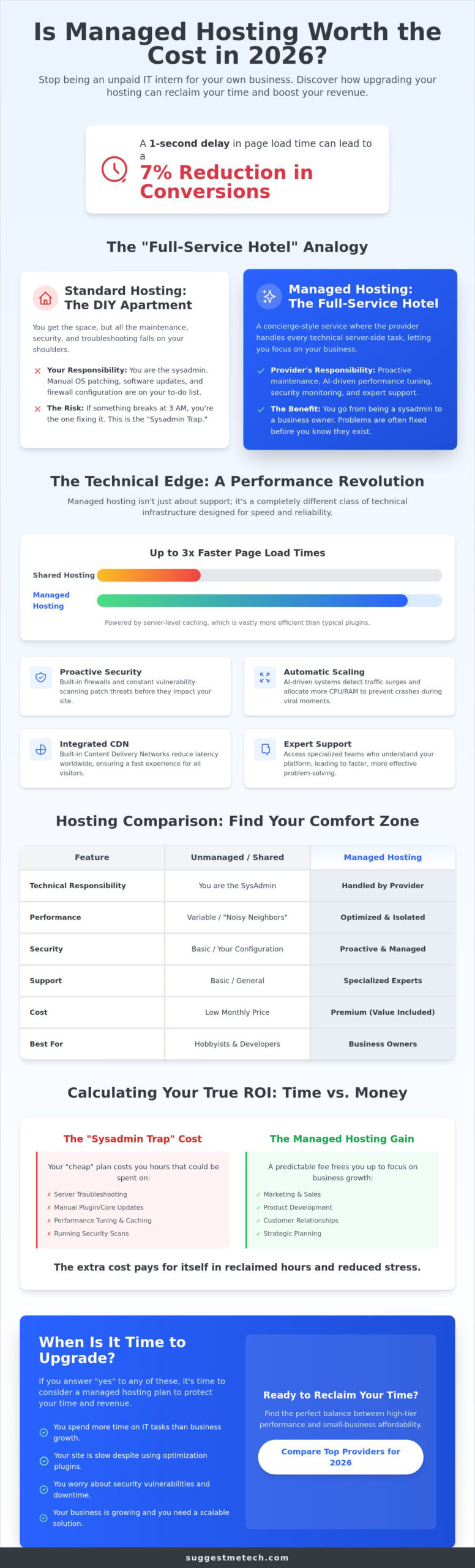
We understand the hesitation because every dollar counts in your budget. It’s frustrating to watch your site lag despite following every speed tip you find online. However, research shows that a single one-second delay in page load time can lead to a 7% reduction in conversions. This guide breaks down the 2026 ROI of managed hosting, showing you how to reclaim your time and protect your site from the plugin vulnerabilities that cause most WordPress hacks. We’ll provide a clear decision framework to help you know exactly when to upgrade and a shortlist of reliable providers that actually deliver on their performance promises.
Key Takeaways
- Learn the “full-service hotel” analogy to understand why managed hosting provides more value than just a place to store your files.
- Discover how server-level caching and built-in security firewalls can make your site up to three times faster without manual configuration.
- Use our maintenance audit to decide is managed hosting worth the extra cost by comparing the price of premium plugins against all-in-one plans.
- Identify the exact moment your business should transition from a DIY setup to a professional platform to avoid the “sysadmin trap.”
- Compare the top-rated providers for 2026 to find the perfect balance between high-tier performance and small-business affordability.
What Exactly is Managed Hosting and Why Does it Cost More?
Think of a standard web hosting service as a DIY apartment rental. You get the space, but you’re responsible for the cleaning, the plumbing, and the security. Managed hosting flips this model into a full-service hotel experience. It is a concierge-style service where the provider handles every technical server-side task, from software updates to performance tuning. When you ask, is managed hosting worth the extra cost, you have to look past the server hardware and evaluate the value of the expert labor included in your monthly bill.
The price premium exists because you’re paying for specialized server configurations and human expertise. In 2026, this value proposition has evolved with AI-driven management. Modern managed hosts use machine learning to predict traffic surges and automatically scale resources before your site even slows down. They don’t just provide a “room” for your files; they provide an optimized environment designed to keep your business online and profitable without your constant intervention.
Managed vs. Unmanaged: The Concierge Difference
The primary divider between these two tiers is technical responsibility. In an unmanaged setup, you are the systems administrator. You must manually patch the operating system, update PHP versions, and configure firewalls. If something breaks, you’re the one fixing it at 3:00 AM.
Managed hosting offers a “white glove” experience. You gain direct access to specialized support teams who understand your specific platform. This leads to proactive maintenance rather than reactive troubleshooting. Managed providers often identify and patch security vulnerabilities or fix database errors before you even realize a problem existed. It’s the difference between being a sysadmin and being a business owner.
Common Types of Managed Hosting in 2026
While many people associate this service only with one platform, the 2026 landscape is much broader. Choosing the right type is critical for determining if is managed hosting worth the extra cost for your specific project.
- Managed WordPress Hosting: This remains the industry standard. These environments are tuned specifically for WordPress, featuring built-in caching and automatic plugin updates.
- Managed Cloud/VPS: This offers scalable power for growing applications. It combines the flexibility of the cloud with a dedicated team to manage the infrastructure.
- Managed WooCommerce: These are specialized environments built for high-traffic e-commerce. They prioritize database performance and checkout speed to prevent lost sales during peak shopping hours.
By moving technical tasks to the host, you free up your schedule for high-level growth. Whether you’re running a simple blog or a complex store, the “extra” cost usually pays for itself in reclaimed hours and reduced stress.
The Technical Edge: Why Managed Sites Outperform Shared Plans
When evaluating is managed hosting worth the extra cost, the technical infrastructure is where the value becomes undeniable. Shared hosting is often compared to a crowded apartment building where one neighbor’s burst pipe ruins your floor. Managed hosting provides true resource isolation. This means even if another site on the same network experiences a massive traffic spike, your site remains stable and fast. In 2026, premium providers have moved beyond simple space rental to integrated platforms. Wix explains managed hosting as a comprehensive service that optimizes everything from the server hardware to the software layer.
The most immediate difference you’ll notice is speed. Managed hosts utilize server-level caching, which is significantly more efficient than using a standard WordPress plugin. By handling the heavy lifting at the server level, these hosts can deliver pages two to three times faster than entry-level plans. They also include automatic scaling as a standard feature. If your content goes viral, the system detects the load and automatically allocates more CPU and RAM to keep your site online without any manual intervention on your part.
Speed and Performance Optimization
Performance isn’t just about bragging rights; it’s a core business metric. Managed plans typically include built-in Content Delivery Networks (CDNs) and object caching to drastically reduce your Time to First Byte (TTFB). This is vital because 53% of mobile users will abandon a website if it takes longer than three seconds to load. Every 100ms of latency can cost you 1% in sales conversions. If you want to dive deeper into optimizing your digital tools, our technology reviews and guides offer practical advice for maximizing your tech stack’s efficiency.
Advanced Security and Disaster Recovery
Determining is managed hosting worth the extra cost often comes down to how much you value your site’s uptime during a crisis. Managed providers include Web Application Firewalls (WAF) and automatic malware removal as standard features. You also get the “peace of mind” factor through daily off-site backups and one-click restores.
Most premium hosts provide staging environments where you can test new plugins or theme changes before pushing them live. This prevents the “white screen of death” that often occurs during routine updates. When you are testing these changes on mobile, remember that local browser data can skew your results; knowing the steps for clearing cache on iPhone is essential for seeing your site’s true, updated performance. By combining these security layers with high-end speed, managed hosting functions as a proactive insurance policy for your online presence.
Managed vs. Unmanaged vs. Shared: Finding Your Comfort Zone
Deciding which hosting tier fits your needs requires looking past the monthly sticker price. While shared hosting remains the most affordable entry point, it often creates a “technical debt” that you’ll have to pay off later with your own time. When you ask if is managed hosting worth the extra cost, you’re really asking about the total cost of ownership. This includes the price of the server, the cost of specialized software, and the value of the hours you spend maintaining it all.
Reliability is another major differentiator. Shared hosting plans rarely offer robust Service Level Agreements (SLAs). If the server goes down because another user is running a poorly coded script, your site goes down with it. Managed providers offer much higher uptime guarantees. They also provide clear scalability paths. Many “unlimited” shared plans actually start throttling your CPU and memory the moment your traffic begins to grow. Managed hosting, by contrast, is designed to expand alongside your business without those invisible ceilings.
The Hidden Costs of ‘Cheap’ Hosting
Entry-level plans look attractive until you realize what’s missing. To get a shared site up to professional standards, you often need to pay for third-party security suites like Wordfence or Sucuri. You might also need a premium backup service. These individual subscriptions can easily add $20 to $30 to your monthly expenses. If you are just starting a blog, these extra costs and the time spent troubleshooting them can be a major distraction from creating content. Every hour you spend fixing a database connection is an hour you aren’t growing your brand.
Who Each Type is Best For
Choosing the right path depends on your goals and your technical comfort level. There is no one-size-fits-all answer, but these general categories can help you decide if is managed hosting worth the extra cost for your specific situation.
- Shared Hosting: This is the right choice for hobbyists, students, or small personal projects with minimal traffic. It is a low-risk way to learn the basics of web management.
- Unmanaged VPS: This tier is built for tech-savvy developers. You get total control over the server environment, but you’re also responsible for every security patch and software update.
- Managed Hosting: This is the gold standard for businesses, high-traffic blogs, and e-commerce stores. If your website generates revenue, the cost of a managed plan is essentially a productivity insurance policy.
By delegating the technical heavy lifting to experts, you ensure your site remains a high-performance asset rather than a time-consuming chore.
The Business Case: Calculating the True ROI of Your Time
Most business owners look at their monthly hosting bill as a line-item expense rather than a strategic investment. However, if you value your time at $50 or $100 per hour, spending five hours a month troubleshooting server errors means you’ve effectively spent hundreds of dollars on “free” maintenance. To determine is managed hosting worth the extra cost, you must perform a rigorous maintenance audit. Consider the time you spend on manual backups, checking plugin compatibility, and monitoring for security threats. When these tasks are offloaded to a managed provider, your “hourly rate” as a business owner is applied to growth rather than chores.
Performance also has a direct impact on your bottom line. Verified data shows that a one-second delay in page load time can lead to a 7% reduction in conversions. For a site generating $2,000 in monthly revenue, that is a $140 loss every single month. In this scenario, the question of is managed hosting worth the extra cost is answered by the revenue you reclaim through faster load times. You’re also paying for risk mitigation. Having access to expert support during a site crisis prevents the reputational damage and lost sales that occur during prolonged downtime.
The 5-Point ‘Time to Switch’ Checklist
You don’t always need premium hosting on day one. However, specific milestones indicate that your current setup is holding you back. If you meet these criteria, it’s time to upgrade:
- Traffic Milestone: Your site consistently reaches 10,000 or more monthly visitors.
- Revenue Milestone: Your website generates enough income to cover its own operating costs.
- Complexity Milestone: You rely on resource-heavy themes or essential e-commerce plugins.
- Support Milestone: You need technical answers in five minutes rather than waiting 24 hours for a ticket response.
- Security Milestone: You have experienced a hack or a malware scare in the last twelve months.
Opportunity Cost: What Could You Build Instead?
Reclaiming five hours a month is about more than just numbers; it’s about what you can build with that time. Those hours could be used for content creation, product development, or networking with potential clients. There is also a significant mental health benefit. Removing “site anxiety” from your daily routine allows you to focus on high-level strategy without the fear that an automated update will crash your business. By outsourcing your technical foundation, you scale faster. For more insights on optimizing your business tools, explore our technology reviews and guides to find the best fit for your workflow.
Choosing the Best Managed Hosting Providers for 2026
Selecting a provider is the final step in your ROI analysis. By now, you’ve calculated the value of your time and the cost of potential downtime. The market in 2026 offers several distinct paths depending on your specific business goals. For those who prioritize raw performance and AI-driven optimization, WP Engine and Kinsta remain the industry leaders. These platforms have integrated advanced machine learning to handle traffic surges automatically. This ensures your site stays online during viral moments without manual intervention.
If you’re still questioning is managed hosting worth the extra cost because of a tighter budget, Flywheel provides an excellent alternative for creatives and small agencies. It offers a streamlined workflow and high-end features like staging environments at a more accessible price point. For developers who need granular control over their infrastructure, Cloudways and Pantheon offer scalable cloud environments that grow with your application’s complexity. These tools allow you to focus on code rather than server maintenance.
SuggestMeTech’s Top Picks for Managed Hosting
- WP Engine: This is our top choice for high-performance WordPress sites. Their platform is built for speed and security, featuring automated updates and a robust global CDN as standard.
- Flywheel: We recommend this for those transitioning from shared hosting who want a simple, visual interface. It offers exceptional ease of use and solid support without an enterprise price tag.
Check out our full guide on the best web hosting services for a deeper dive into our testing methodology and performance data.
How to Transition Without Downtime
The fear of a messy migration often keeps people on slow, unreliable hosts. Most premium providers now offer free, professional migration services to handle the move for you. Before you start, ensure your domain name settings and DNS records are accessible. This ensures a smooth handoff between your old server and the new one. Once the migration is complete, use speed testing tools to verify that your Time to First Byte (TTFB) has improved as expected.
Final Verdict: Is it worth it for you? If your website is a revenue-generating asset, the answer is a definitive yes. The “extra” cost is actually a productivity insurance policy. It protects your time, secures your data, and ensures your customers have a fast, reliable experience. For hobbyists, staying on shared hosting might make sense for now. However, the moment you value your time more than the cost of a few cups of coffee, it is time to upgrade. Managed hosting isn’t just a service; it is the foundation for your business growth.
Scale Your Business With Confidence
Deciding is managed hosting worth the extra cost depends on whether you view your website as a hobby or a professional asset. We’ve shown that the technical edge in speed and security pays for itself by reclaiming your maintenance hours and preventing lost sales from high latency. By choosing a managed environment, you trade technical headaches for a high-performance foundation that scales automatically. It’s a strategic shift from being a part-time sysadmin to being a full-time business owner.
At SuggestMeTech, we provide simplified tech advice for growing businesses. Our recommendations are based on independent reviews with no brand bias. To find the right fit for your specific workflow, compare our top-rated managed hosting providers for 2026. Every platform on our shortlist has been expertly tested for speed and uptime to ensure you get the best value for your investment.
You don’t have to be a systems administrator to run a successful site; you just need the right partners in your corner. Take the next step toward a faster, more secure digital future today.
Frequently Asked Questions
Is managed WordPress hosting significantly faster than shared hosting?
Yes, managed WordPress hosting is generally two to three times faster than shared hosting because of specialized server-level caching. Unlike shared plans where you compete for CPU and RAM with hundreds of other sites, managed environments isolate your resources. This specific optimization drastically reduces the Time to First Byte. It ensures your site stays responsive even when traffic surges, which is a critical factor for maintaining high SEO rankings in 2026.
Can I manage my own server to save on the managed hosting cost?
You can manage your own server using an unmanaged VPS, but you’ll need advanced systems administration skills to do it safely. You’re responsible for patching the operating system, configuring firewalls, and updating PHP versions manually. While the monthly hosting bill might be lower, the hours you spend on maintenance usually cost more than a managed plan. Most business owners find that outsourcing these technical tasks is a more efficient use of their budget.
Does managed hosting include a free domain name?
Most premium managed hosts do not include a free domain name because they focus their resources on high-end infrastructure. While entry-level shared hosts often use free domains as an introductory hook, managed providers expect you to maintain your domain separately. This approach allows you to keep your digital assets independent from your hosting service. It provides a cleaner setup if you ever decide to move your site or change your provider in the future.
What happens if my managed site gets hacked?
If your managed site is compromised, your provider usually handles the malware removal and site restoration at no extra charge. They use proactive monitoring to detect intrusions and vulnerabilities, often fixing the issue before you even realize it happened. Since these hosts take responsibility for the server’s security layer, they provide expert hack recovery. This level of protection is one of the primary reasons businesses choose to invest in managed services.
Is managed hosting worth it for a small personal blog with low traffic?
Managed hosting is usually not a requirement for a low-traffic personal blog where downtime has no financial impact. If you’re a hobbyist with more time than money, a standard shared plan is a practical starting point. You should only ask is managed hosting worth the extra cost once your site begins to generate revenue or the manual updates become a burden. At that stage, the time you reclaim is worth the investment.
How difficult is it to migrate from shared to managed hosting?
Migrating is very easy because most managed providers include free, professional migration services or dedicated transfer plugins. Their technical experts handle the movement of your files and databases to ensure a smooth transition without data loss. You won’t have to worry about the technical details of the move. Once the migration is complete, you simply update your DNS settings to point to the new, faster server.
Does managed hosting limit which plugins I can use?
Yes, managed hosts often restrict specific plugins that are known to cause security vulnerabilities or performance lag. These usually include duplicate caching tools or resource-heavy backup scripts that are already handled at the server level. By limiting these plugins, the host ensures your site remains stable and fast for all visitors. These restrictions actually simplify your site management because you don’t have to research and maintain dozens of different technical plugins yourself.
What is the average price difference between shared and managed plans in 2026?
In 2026, shared hosting starts as low as $2 per month, while managed plans generally range from $15 to $50 or more. This price difference covers the cost of expert support, automated daily backups, and specialized server hardware. When you evaluate is managed hosting worth the extra cost, factor in the price of premium security plugins you would otherwise need to buy. Most growing businesses find the all-in-one managed model provides better long-term value.