By the end of this year, nearly 25% of the global population is expected to spend at least one hour every day in the metaverse for work, shopping, or education. If you feel like you’re already behind, don’t worry. Most people are still trying to figure out what is the metaverse for beginners amidst all the tech hype and expensive hardware announcements. It isn’t just a video game or a fancy headset; it’s the 3D evolution of the internet that’s changing how we handle real-world tasks.
You’ve likely heard that you need to drop thousands of dollars on gear like the $3,499 Apple Vision Pro just to get started, which makes the whole thing feel out of reach. We understand how frustrating the information overload can be, especially when you just want to know if this tech is actually useful for your daily life. This guide cuts through the jargon to show you exactly how the metaverse works in 2026. You’ll learn about the minimum hardware you actually need, including budget-friendly options like the $349.99 Meta Quest 3S, and discover how to start exploring virtual spaces for free today.
Key Takeaways
- Understand the fundamental shift from simply viewing the internet to “inhabiting” it through persistent, interconnected 3D spaces.
- Learn exactly what is the metaverse for beginners by discovering how to access top platforms using your existing smartphone or web browser.
- Explore practical applications that go far beyond gaming, including immersive 3D workspaces and digital-first shopping experiences.
- Get a clear, jargon-free explanation of the “tech stack” and spatial computing that makes virtual objects feel real in your environment.
- Identify the critical privacy safeguards and health considerations necessary for a safe and comfortable experience in virtual reality.
What is the Metaverse? Defining the 3D Internet
To understand what is the metaverse for beginners, think about how you use the internet today. You look at a screen to read an article, watch a video, or scroll through social media. The metaverse changes this by turning the internet into a 3D space you can actually walk through. It’s a persistent, collective virtual space where our digital and physical lives finally merge. Unlike a standard website that feels like a flat page, the metaverse feels like a place you inhabit.
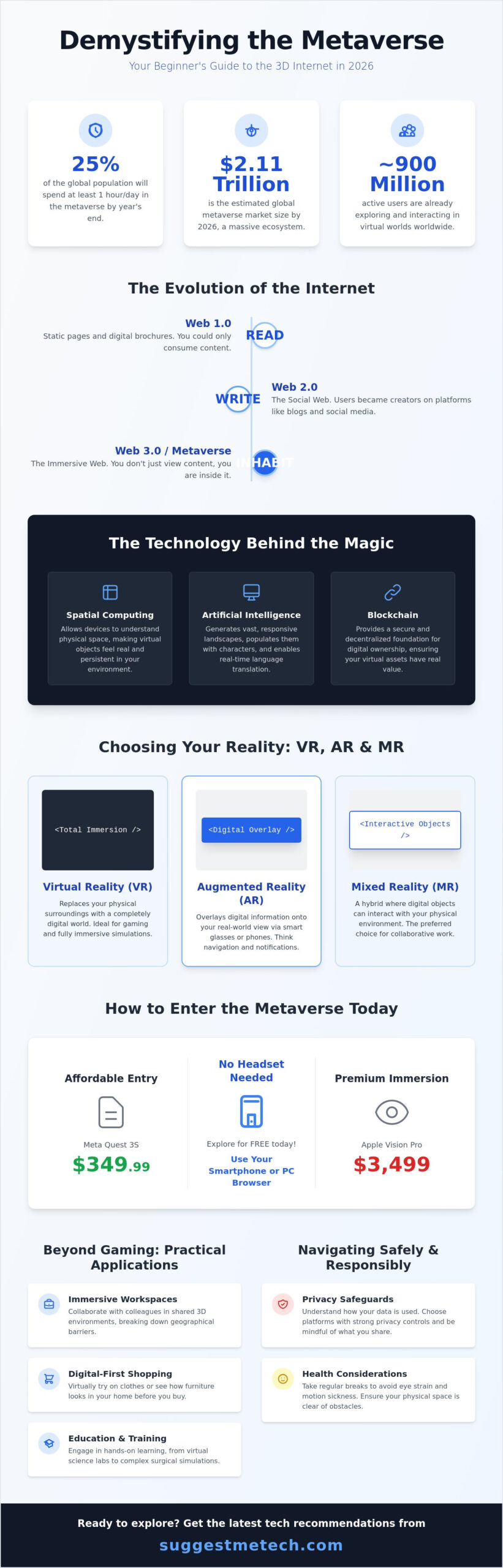
A key part of this definition is “persistence.” If you build a house or leave a digital item in a metaverse space, it stays there even after you log out. Other people can see it and interact with it in real time while you’re away. This creates a functioning economy where digital assets have real value. By 2026, the global metaverse market is estimated to reach $2.11 trillion, proving that this isn’t just a niche hobby for gamers. It has become a massive ecosystem with roughly 900 million active users worldwide. If you’re still looking for a deep dive into the history of the term, checking out the community-vetted definition of what is the metaverse can provide helpful context on its sci-fi origins.
The Evolution: From Web 1.0 to the Metaverse
The internet has gone through three major phases. Web 1.0 was the “Read” era, where you visited static pages like digital brochures. Web 2.0 brought the “Read/Write” era, defined by social media and blogs where everyone could create content. We’ve now entered the “Inhabit” era. In the metaverse, you don’t just view the content; you’re inside it. This transition to Web 3.0 relies on decentralized tech and 3D experiences that make the digital world feel immersive rather than distant. It’s the difference between looking at a photo of a forest and actually walking between the trees.
Is it Just One Giant Virtual World?
Many people confuse “The Metaverse” with Meta, the company that owns Facebook. However, the metaverse is a broad concept, just like “the internet” is a concept. It consists of many different platforms. Some are closed systems like Roblox, where everything stays within their walls. Others are open, interoperable spaces where developers are working to let you move your digital identity from one world to another. Your avatar acts as this identity. It’s your 3D representation that allows you to maintain a consistent look and reputation across various virtual environments, whether you’re attending a work meeting or a digital concert.
How the Metaverse Works: The Technology Behind the Magic
Understanding what is the metaverse for beginners requires a look at the “tech stack” that powers these immersive worlds. It isn’t a single app you download; it’s a complex layer of hardware and software working in sync. At the center of this experience is spatial computing. This technology allows your devices to understand the physical space around you. When you place a virtual screen on your real-world office wall, spatial computing ensures it stays pinned there, even if you walk out of the room and come back later. This makes digital objects feel like they have actual weight and presence in your life.
Artificial Intelligence (AI) plays a massive role in building these environments. Instead of designers hand-coding every blade of grass, AI generates vast, responsive landscapes and populates them with realistic characters. It also handles real-time language translation, allowing users from different continents to converse without barriers. To get a deeper grasp of how the metaverse works, you have to look at the underlying economy. Blockchain technology provides the foundation for digital ownership. It creates a secure record of who owns which virtual assets, ensuring that your digital property can’t be easily duplicated or deleted by a single company. If you’re looking for the right gear to start exploring these features, check out our latest tech reviews and guides for expert recommendations.
Virtual Reality (VR) vs. Augmented Reality (AR)
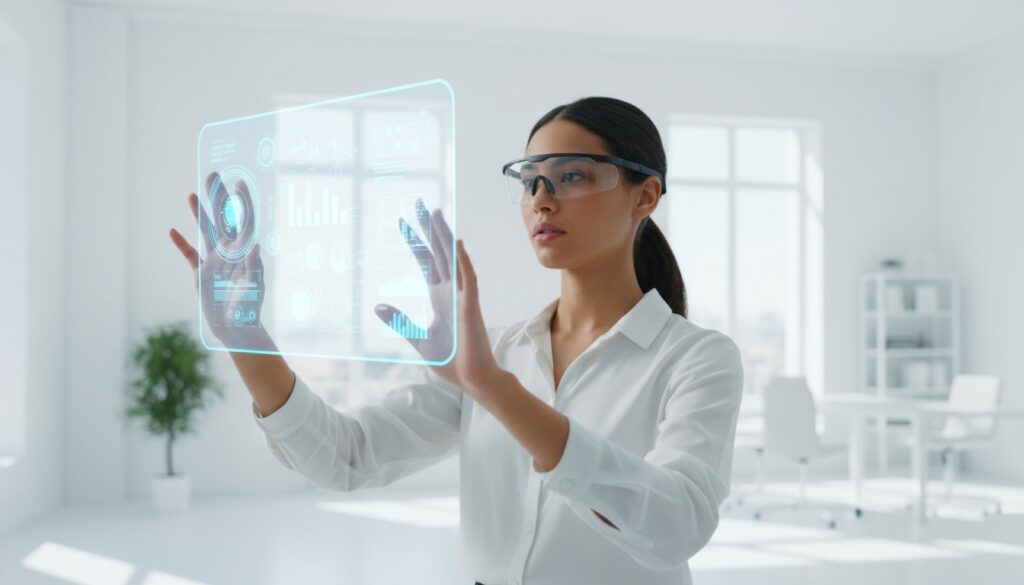
People often use these terms interchangeably, but they offer very different experiences. VR provides total immersion by replacing your physical surroundings with a digital world. AR, like the tech used in smart glasses, overlays digital information onto your real-view. Mixed Reality (MR) is the hybrid where digital and physical objects can actually interact. You might see a virtual ball bounce off your real sofa. While VR is great for gaming, MR is becoming the preferred choice for work because it doesn’t cut you off from your actual environment.
The Engine Room: Servers and Connectivity
Lag is the biggest hurdle for a seamless experience. If there’s a delay between your movement and the visual response, it ruins the immersion and can even cause motion sickness. Edge computing solves this by processing data closer to the user rather than at a distant central server. This keeps interactions fast and fluid. Interoperability is the ability to move digital assets between different virtual worlds. Achieving this is the current goal of groups like the Metaverse Standards Forum, so your avatar can eventually travel between platforms without losing its identity or items.
Practical Uses: What Can You Actually Do in the Metaverse?
While gaming accounts for roughly 23% of the market in 2026, the real story lies in how we spend our daily lives. Approximately 25% of the global population now spends at least an hour every day in virtual spaces for work, shopping, or education. For anyone asking what is the metaverse for beginners, the answer is simple. It’s a place where you can do almost anything you do in the physical world, but without the limits of distance or gravity. You aren’t just looking at a screen; you’re participating in a shared environment with others.
Digital commerce has evolved beyond simple online shopping. Many brands now offer “digital twins” of their products. If you buy a pair of physical sneakers, you might receive a digital version for your avatar to wear in a virtual world. This creates a bridge between our two realities. A recent UK Parliament briefing on the metaverse highlights how these sectors are expanding, offering new benefits for the economy while also presenting unique societal challenges that we’re still learning to manage.
The Future of Work and Collaboration
Virtual workspaces have replaced the standard video call for many teams. Instead of staring at a grid of faces, you sit around a 3D table where you can manipulate digital models of products or buildings. Architects and engineers now collaborate in real-time on life-sized blueprints before a single brick is laid in the real world. This industrial application is saving major corporations hundreds of millions in operational costs. If you want to build a career in this space, establishing your professional presence is just as vital as learning how to start a blog in 2026. It’s all about creating a digital identity that people can find and trust.
Entertainment and Digital Socializing
Social life in the metaverse feels surprisingly natural. You can attend a live concert where the artist performs as a giant avatar, or visit a digital art gallery with friends from three different continents. Virtual tourism is also booming. You can take a guided tour of the Great Wall of China or even explore a high-resolution recreation of the Martian surface from your living room. The education market alone is valued at $21.98 billion this year, as students use these immersive tools to visit historical events or perform complex surgeries in risk-free simulations.
Getting Started: What Hardware and Software Do You Need?
One of the biggest misconceptions about what is the metaverse for beginners is that you need to spend a fortune just to walk through the door. While the $3,499 Apple Vision Pro gets all the headlines, it isn’t the standard entry point. Most major platforms like Roblox, Decentraland, and Horizon Worlds don’t charge any entry fee at all. You can start exploring today using three distinct levels of hardware depending on your budget and how deep you want to go.
Tier 1 involves basic entry via your smartphone or a standard web browser. This is perfect for attending a virtual meeting or exploring a social space without buying extra gear. Tier 2 moves into intermediate territory, using a powerful computer to handle higher-quality 3D graphics and complex avatars. Finally, Tier 3 offers full immersion. This requires VR or AR headsets like the Meta Quest 3S, which starts at $349.99 for the 128GB model as of April 19, 2026. This setup often includes haptic gear that lets you feel physical sensations within the virtual world.
The Essential Gear for Beginners
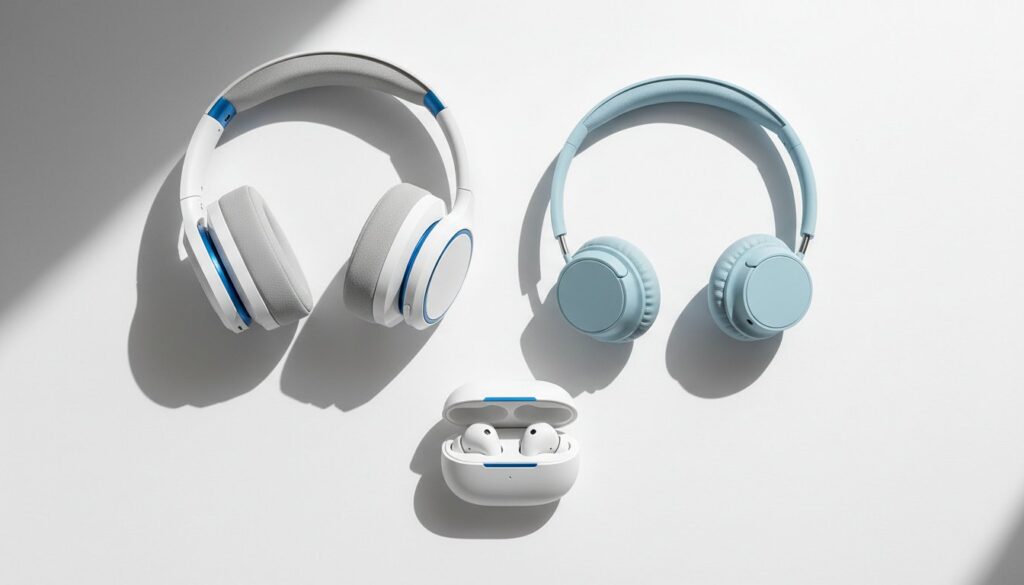
Your audio experience is just as vital as the visuals for feeling “present” in a digital space. Spatial audio helps you hear exactly where people are standing, so check our guide on choosing your perfect pair of headphones to get the best experience. If you prefer the Tier 2 approach, you’ll need a high-performance processor to avoid motion-blur and lag. We’ve rounded up the best laptops of 2026 with VR-ready specs to help you choose. For those ready for a headset, the Meta Quest 3S (256GB) at $449.99 provides a great balance of storage and performance for most new users.
Popular Platforms to Explore First
Roblox and Fortnite serve as the primary gateways for most people. These platforms focus on social gaming and are incredibly easy to navigate without a headset. If you’re more interested in digital real estate or the virtual economy, Decentraland and The Sandbox are the go-to choices. For those who just want to meet new people and visit user-made rooms, Horizon Worlds and VRChat offer the most active social communities. Before you buy any new equipment, read our detailed tech reviews to ensure you’re getting the best value for your specific setup.
Challenges and Reality Checks: Is the Metaverse Safe?
As virtual spaces become more integrated into our daily routines, we have to address the risks that come with them. For anyone exploring what is the metaverse for beginners, safety should be a top priority. Moving your social and professional life into a 3D environment introduces new vulnerabilities that didn’t exist in the flat web. Privacy is no longer just about your email address or credit card number; it’s now about your physical presence and biometric data.
The digital divide also remains a significant concern in 2026. While platforms themselves are often free, the hardware required for a high-quality experience is getting more expensive. The recent price increase for the Meta Quest 3S to $349.99 on April 19, 2026, shows that entry costs are a moving target. This creates a gap between those who can afford the latest immersive gear and those stuck with basic smartphone access. Additionally, long-term immersion can lead to physical discomfort or “VR sickness,” which is why many users are currently shifting toward mixed reality (MR) rather than fully closed virtual reality.
Privacy in a 3D World
In the metaverse, companies can track more than just what you click. High-end headsets now monitor eye movements, heart rates, and even facial expressions. This biometric data is the new frontier of privacy. Since there are no specific, overarching metaverse laws yet, existing regulations like the GDPR are being stretched to cover virtual interactions. To protect yourself, always utilize “safe zones” in social apps to prevent unwanted interactions. Establishing a secure digital identity is also crucial. Just as you need to understand what is a domain name to own a piece of the traditional web, you must learn how to secure your avatar and digital assets using multi-factor authentication and encrypted wallets.
The Road to 2030: What is Next?
The next few years will focus on making virtual worlds feel even more tangible. We’re seeing a massive push toward haptic feedback, which allows you to feel the texture of objects or the pressure of a handshake in a digital space. Smart glasses are also becoming more stylish and functional, aiming to replace the bulky headsets we use today. Ultimately, the metaverse is a tool designed to enhance your real life, not replace it. It allows us to collaborate across oceans and learn in ways that were once impossible. If you stay informed and set healthy boundaries, you can navigate these new worlds with confidence.
Your Future in the 3D Internet Starts Here
You now have a solid grasp of what is the metaverse for beginners and how it’s reshaping our digital lives in 2026. This isn’t a science fiction concept anymore; it’s a practical tool for collaboration, education, and global social connection. As we’ve explored, you don’t need a massive budget to participate. Whether you’re using a standard smartphone or a dedicated headset, the 3D internet offers a new way to experience the world that feels more personal and immersive than the flat web of the past.
Staying safe and choosing the right entry point are the most important steps you’ll take. As technology moves toward haptic feedback and integrated smart glasses, having a knowledgeable guide makes all the difference. Our jargon-free guides and expert-tested reviews are updated for 2026 standards to help you navigate these choices with confidence. Check out our latest tech reviews to find the best gear for your metaverse journey. The virtual landscape is expanding every day, and there’s never been a better time to start your exploration.
Frequently Asked Questions
Do I have to wear a headset to use the metaverse?
No, you don’t need a headset to explore these virtual worlds. Most popular platforms are accessible through standard smartphones, tablets, or web browsers. While headsets offer full immersion, you can still participate in social events, meetings, and shopping using the devices you already own. This makes understanding what is the metaverse for beginners much easier since you don’t have to invest in expensive gear right away.
Is the metaverse free to join?
Joining the metaverse is generally free. Major platforms like Roblox, Horizon Worlds, and Decentraland don’t charge an entry fee for users. These companies generate revenue through in-platform purchases instead. You might spend money on avatar accessories, unique digital items, or virtual real estate, but the initial exploration won’t cost you anything. It’s a low-risk way to see if the technology fits your lifestyle.
What is the difference between the metaverse and Multiversus?
The metaverse is a broad concept representing the 3D evolution of the internet, while Multiversus is a specific video game. Think of the metaverse as the entire ocean and Multiversus as a single boat. Multiversus is a platform-fighter game featuring characters from various Warner Bros. franchises. It’s a fun experience, but it doesn’t represent the persistent, interconnected virtual economy that defines the actual metaverse concept.
Can I make money in the metaverse?
You can definitely earn income in these virtual spaces. Many users make money by creating and selling digital assets like avatar clothing or 3D environments. Others invest in virtual real estate or offer professional services like virtual architecture and event planning. With the global metaverse market estimated at over $2 trillion this year, the opportunities for digital entrepreneurship are growing rapidly for those who learn the basics.
Is the metaverse safe for children?
Safety for children depends entirely on the platform and the parental controls you enable. Many spaces offer “safe zones” and restricted communication settings to protect younger users from unwanted interactions. It’s vital to monitor your child’s activity in social VR just as you would on any other social media site. Understanding what is the metaverse for beginners involves learning how to set these boundaries before letting kids explore.
How much data does the metaverse use?
Immersive 3D environments use a lot of data. You can expect to use between 500MB and 2GB of data per hour depending on the complexity of the world and the number of active users around you. This is significantly higher than standard web browsing or even 4K video streaming. If you have a capped data plan, it’s best to use a stable Wi-Fi connection to avoid unexpected charges.
What happens to my data in the metaverse?
Your data is typically stored by the platform owner to improve your experience and manage your digital assets. However, modern headsets also collect biometric data like eye movements and heart rates. While existing laws like GDPR apply to these spaces, enforcement is still evolving. Always review the privacy settings of any platform you join to understand how your personal information is handled and shared with third parties.
Do I need a special computer to access the metaverse?
You don’t need a specialized computer for basic access, but a powerful machine improves the experience. A standard modern laptop can handle browser-based worlds easily. If you want full immersion with high-resolution graphics, you’ll need a PC with a dedicated graphics card and a fast processor. This prevents the lag and motion blur that can lead to discomfort during longer sessions in virtual reality.