

What if you could land a $100,000 career without spending a single dollar on tuition? It’s easy to feel overwhelmed by the endless sea of bootcamps and the fear that AI might make your new skills obsolete before you even finish your first project. You’ve likely felt stuck in “tutorial hell” at some point, wondering if you’re actually smart enough to master the logic required for professional software development. Learning how to learn coding for free isn’t about finding one magical course; it’s about building a structured “Learning Stack” that works for your specific goals.
This guide provides the exact roadmap you need to go from an absolute beginner to a job-ready developer using only top-rated, zero-cost resources. We’ll break down the best programming languages for beginners, list vetted platforms like The Odin Project and Harvard’s CS50x, and show you how to leverage AI tools as a co-pilot rather than a crutch. You’ll get a clear, step-by-step plan to navigate the 2026 job market with confidence and a portfolio that stands out.
Key Takeaways
- Master the art of AI-assisted programming to stay competitive in the 2026 job market without needing a traditional computer science degree.
- Discover how to learn coding for free by selecting a specialized path like Web Development or Data Science based on your specific career goals.
- Utilize foundational resources like Harvard CS50 and freeCodeCamp to build a “Learning Stack” that combines academic theory with practical application.
- Escape “tutorial hell” by applying the 20/80 rule, ensuring you spend 80% of your time writing original code rather than just watching videos.
- Establish professional credibility by curating a GitHub portfolio featuring three “Hero Projects” that solve real-world problems for potential employers.
The Reality of Learning to Code for Free in 2026
Learning to code doesn’t require a bank loan or a four-year commitment to a university campus anymore. In 2026, the barrier to entry has dropped to its lowest point in history, thanks to a massive surplus of high-quality, open-source curricula. When you explore how to learn coding for free, you aren’t just looking for a list of videos. You’re looking for a structured path that mirrors a professional environment. Modern Computing education has evolved from rigid classroom settings to decentralized, project-based paths that anyone with an internet connection can access.
Free vs. Paid: Is There a Quality Gap?
There is no longer a significant gap in the quality of information available. Open-source curricula, such as the Open Source Society University (OSSU), offer a depth of computer science knowledge that rivals expensive $15,000 bootcamps. The real difference lies in the “cost” of your own discipline. Bootcamps provide a schedule and a coach; free paths require you to be your own project manager. AI tools like ChatGPT and Claude have leveled the playing field by acting as 24/7 personal tutors. They can explain complex bugs or break down difficult concepts instantly, providing the support that used to be exclusive to paid programs.
The 2026 Developer Landscape
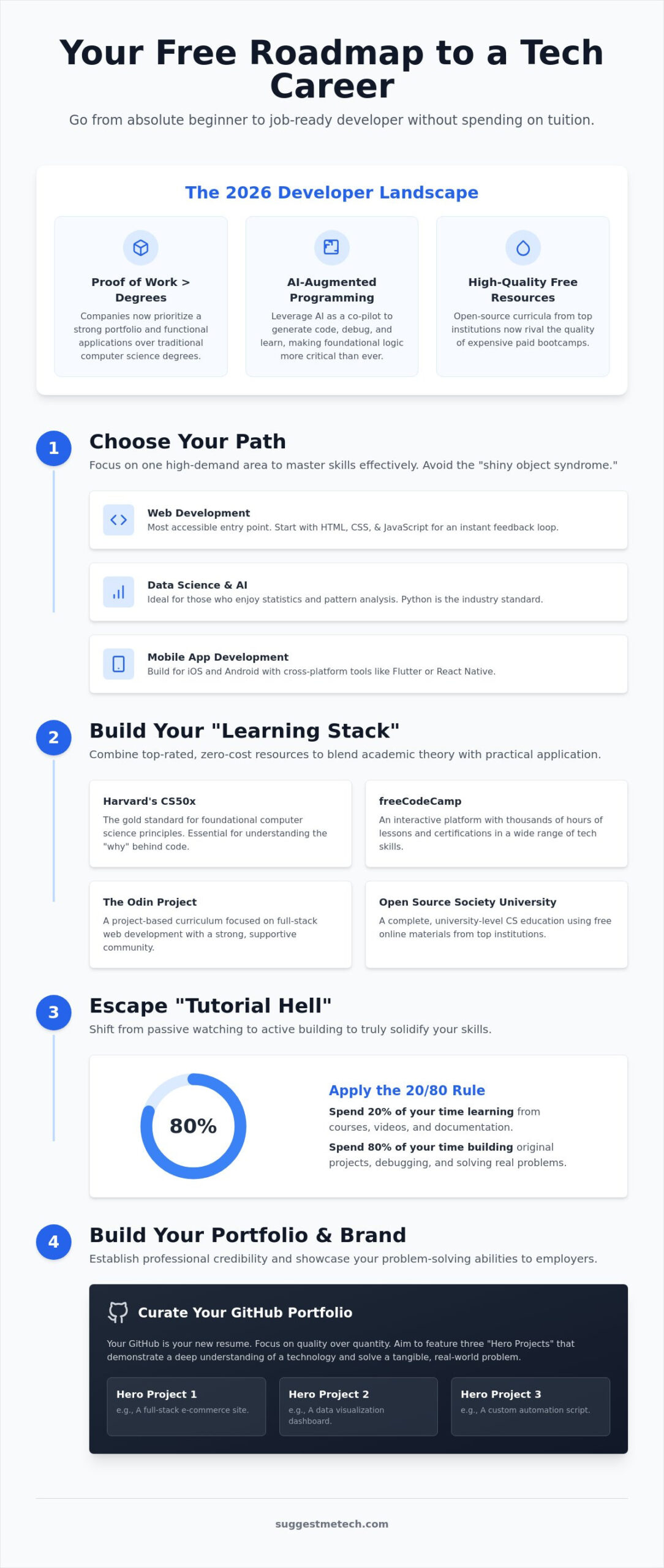
The role of a developer in 2026 is “AI-augmented.” You aren’t just writing every line of code from scratch; you’re directing AI to generate boilerplate and then debugging the output. This shift makes foundational knowledge in logic and data structures more important than ever. You need to know why code works to fix what the AI gets wrong. Full Stack Development is the most versatile path for beginners because it covers both the user-facing interface and the behind-the-scenes logic.
Step 1: Choosing Your Path and Setting Up
Before you dive into the specifics of how to learn coding for free, you need a clear destination. If you don’t pick a specific path, you’ll end up learning a bit of everything and mastering nothing. This is the first hurdle in understanding how to learn coding for free effectively. Most successful self-taught developers focus on one of three high-demand areas. Each path requires a different mindset and a specific starting language.
The ‘Big Three’ Career Paths for Beginners
- Web Development: This remains the most accessible entry point. You’ll start with HTML and CSS before moving into JavaScript. The feedback loop is instant; you write code and see the results in your browser immediately.
- Data Science & AI: If you enjoy statistics and analyzing patterns, this is your route. Python is the industry standard here. To get started with a high-quality curriculum, you can look into Google’s free Python class, which provides an excellent foundation in the language.
- Mobile App Development: For those who want to build for iOS or Android, cross-platform tools like Flutter or React Native are the way to go. This path is slightly more complex but highly rewarding for creators.
Automation is also a vital sub-skill. Even if you don’t become a full-time “Automation Engineer,” learning to write scripts that handle repetitive tasks will make you more valuable in any tech role. Start by picking one path and sticking with it for at least three months to avoid the “shiny object syndrome” that plagues many beginners.
Setting Up Your Coding Environment
You don’t need a $3,000 MacBook to start your journey. Most modern web development and data science tasks can be handled by a mid-range machine. If you’re worried about your current hardware, browse our guide on the best laptops of 2026 to find budget-friendly options that won’t lag while you’re compiling code.
Once your hardware is ready, install Visual Studio Code (VS Code). It’s the industry-standard code editor and it’s completely free. You should also set up a GitHub account on day one. Git is a version control system that tracks your progress, and GitHub is where you’ll host your code for others to see. Learning to push your code to a repository early on builds the professional habits recruiters look for later. If you’re unsure which hardware fits your budget, check out our hardware reviews at SuggestMeTech. Finally, create a distraction-free digital workspace. Turn off social media notifications and set up a dedicated “coding” folder on your desktop to keep your projects organized from the start.
The Best Free Coding Platforms: 2026 Edition
Your success depends on the quality of your curriculum. In 2026, the challenge isn’t finding information; it’s filtering out the noise. If you want to master how to learn coding for free, you must choose platforms that balance theory with hands-on practice. Some sites excel at teaching you how to type, while others teach you how to think like an engineer.
freeCodeCamp remains the gold standard for web development. Their curriculum has transitioned into smaller, 300-hour certifications like Responsive Web Design and JavaScript Algorithms. This modular approach makes it easier to track progress without feeling overwhelmed. If you want a more academic foundation, Harvard’s CS50x is the premier choice. While a verified certificate costs $219 as of July 2026, you can audit the entire course for free. It’s a rigorous introduction to logic and computer science that uses C and Python to build a deep understanding of how software actually works.
Interactive Platforms vs. Project-Based Paths
Interactive platforms like Codecademy are excellent for syntax practice. Their free tier lets you learn the basic rules of a language without any setup. However, syntax is only 10% of the job. To reach “job-ready” status, you must eventually graduate to The Odin Project. This open-source curriculum is considered “hard mode” because it requires you to set up a local development environment on your own machine. While interactive apps provide a safe sandbox for syntax, real-world project paths force you to break and fix things in a professional environment.
University-Grade Courses for Free (MOOCs)
You can access elite education through Massive Open Online Courses (MOOCs) without paying tuition. One of the best ways to understand how to learn coding for free is by auditing university courses on platforms like Coursera and edX. This gives you access to all lectures and readings for $0. For a more community-driven academic experience, Stanford’s Code in Place offers a high-quality introductory programming course based on their popular CS106A curriculum. If you want to go even deeper, MIT OpenCourseWare provides nearly all MIT course content for free, though it requires significant self-discipline to navigate.
Don’t overlook YouTube’s “hidden gems” for specific frameworks. Channels like The Net Ninja and Traversy Media offer project-based tutorials that are often better than paid courses. These creators focus on practical application, showing you exactly how to build and deploy real applications. Remember, the value of these resources lies in the knowledge you gain and the projects you build, not just a digital certificate.
To ensure you can stream these high-definition tutorials without buffering, consider a reliable home network setup. Providers like TekSavvy offer the high-speed data and television bundles that many developers use to balance their intensive study schedules with much-needed downtime.
The Self-Taught Strategy: How to Avoid ‘Tutorial Hell’
Many beginners fall into the trap of “Tutorial Hell,” a state where you can follow a video instructor perfectly but feel paralyzed when faced with a blank text editor. You feel like you’re making progress because you’re finishing courses, but you aren’t actually internalizing the logic. Real learning happens when the training wheels come off. If you want to master how to learn coding for free, you must shift your focus from passive consumption to active production.
The most effective way to learn is the 20/80 Rule. You should spend roughly 20% of your time watching or reading theory and 80% of your time actually writing code. This approach forces your brain to use active recall, a scientifically proven method for moving syntax from short-term memory into long-term retention. You’ll likely hit a “struggle phase” where nothing seems to work. Don’t get discouraged. This friction is exactly where the deepest learning occurs. Getting stuck and finding your way out is the most important part of the journey.
The ‘Deconstruction’ Method
Instead of moving to a new tutorial as soon as you finish one, stay with the project you just built. Break it on purpose. Change a variable, delete a function, or alter the CSS to see exactly how the application reacts. Once you understand the mechanics, add one new feature that wasn’t in the original tutorial. If you built a simple weather app, try adding a “five-day forecast” button. Document every bug you encounter in a simple text file. This log becomes a personal knowledge base that prevents you from making the same mistakes twice.
Finding a Community (For Free)
You don’t have to learn in isolation. Online communities provide the social accountability that bootcamps usually charge thousands for. Join Discord servers dedicated to the languages you’re learning or participate in the #100DaysOfCode challenge on X. These platforms allow you to share your progress and get peer-to-peer code reviews, which can significantly accelerate your growth.
When you get stuck, learn to ask “smart questions” on Stack Overflow or specialized developer forums. Instead of saying “it doesn’t work,” provide a snippet of your code, explain what you expected to happen, and list the steps you’ve already taken to fix it. This professional approach earns respect from senior developers who are often willing to mentor beginners for free. If you’re looking for more ways to optimize your learning environment, check out the guides at SuggestMeTech. Engaging with others not only solves technical hurdles but also builds the networking connections that lead to job referrals later.
Phase 2: Building Your Portfolio and Brand
Knowing the syntax is only half the battle. To actually get hired, you must prove you can deliver value in a professional environment. In 2026, your GitHub profile has officially replaced the traditional resume. Recruiters look for “green squares” that show consistent activity and a commit history that demonstrates how you solve problems over time. When you are figuring out how to learn coding for free, your ultimate goal should be a public record of your progress.
Don’t clutter your profile with generic tutorial clones. Instead, focus on three “Hero Projects” that solve real problems. A project that automates a tedious task or manages data for a specific niche is far more impressive than another basic calculator. These projects prove you can apply logic to unique challenges, which is exactly what hiring managers look for in the competitive 2026 entry-level market. With entry-level salaries in the US ranging from $60,495 to $95,000 per year, a standout portfolio is your best leverage.
Documenting Your Journey via a Blog
Technical writing is a superpower for developers. When you explain a complex concept to someone else, you solidify your own understanding. A developer blog allows you to host your projects and provide a narrative for your code. It shows that you can communicate with both machines and humans. To get started, check out our guide on how to start a blog in 2026. This platform becomes the “hub” for your brand, where you can share the bugs you’ve conquered and the logic behind your most difficult features.
Hosting Your Projects for Free
You shouldn’t have to pay to show off your work. Services like GitHub Pages, Netlify, and Vercel allow you to host your front-end projects for $0. These platforms integrate directly with your GitHub repositories, so your site updates automatically every time you push new code. While free subdomains are fine for starters, a custom domain makes your portfolio look much more professional. If you’re new to the technical side of web addresses, see what is a domain name to understand how they work. A unique domain acts as a digital business card that sets you apart from other self-taught candidates.
Transitioning from a learner to a job seeker requires a shift in mindset. You’re no longer just someone trying to understand how to learn coding for free; you’re a developer with a documented track record. Use the communities you joined in the previous section to get feedback on your portfolio. Refine your projects based on that advice and start applying for roles with the confidence that your “proof of work” speaks louder than any degree.
Your Path to a Developer Career Starts Now
Mastering how to learn coding for free in 2026 is no longer about finding information; it’s about executing a structured plan. You’ve seen that university-grade logic from Harvard CS50 and practical tracks from The Odin Project provide a foundation that rivals any expensive bootcamp. Success comes down to your ability to build real-world project ideas and engage with community-focused learning strategies rather than just watching endless videos.
Your GitHub profile and personal blog are now your most valuable assets. They prove you can solve problems and communicate technical thoughts clearly. We’ve provided expert-vetted resource lists to ensure you’re using the most current tools available. It’s time to stop researching and start creating. Start your journey today by setting up your developer blog and portfolio with our top hosting picks.
The road to becoming a developer is challenging, but the financial and professional rewards are immense. Stick to your roadmap, stay curious, and keep building. You’ve got this.
Frequently Asked Questions
Can I really get a job by learning to code for free?
Yes, you can land a high-paying role without a formal degree. Most tech companies prioritize your GitHub portfolio and the “Hero Projects” we discussed over expensive credentials. With entry-level salaries reaching up to $95,000 in 2026, the market remains open for those who can prove their technical ability. The key is demonstrating that you can solve real-world problems and work effectively within a professional development environment.
Which coding language should I learn first in 2026?
Your choice depends entirely on your specific career path. JavaScript is the best option for web development, while Python is the industry standard for data science and AI. If you’re still unsure how to learn coding for free, start with Python. Its readable syntax makes it the most beginner-friendly entry point for understanding core programming logic before you move into more complex frameworks.
How long does it take to learn coding from scratch for free?
Most dedicated learners reach job-readiness in 6 to 12 months. This timeline requires consistent daily practice and a focus on building projects rather than just watching tutorials. If you follow the 20/80 Rule, spending the majority of your time writing original code, you’ll likely see significant progress much faster than someone who only consumes passive content through videos or books.
Do I need a high-end laptop to start learning to code?
You don’t need expensive hardware to begin your journey. A basic laptop with at least 8GB of RAM can handle most web development and scripting tasks. Modern tools like VS Code are designed to be lightweight and efficient. As you advance into heavy data processing or mobile app compilation, you might eventually need an upgrade, but a budget-friendly machine is perfectly adequate for your first year.
Are free coding certificates worth anything to employers?
Certificates from platforms like freeCodeCamp or Harvard CS50x show discipline, but they aren’t a golden ticket. Employers value the knowledge behind the certificate more than the digital paper itself. Your GitHub repositories and your ability to explain your code during a technical interview are what will ultimately land you the job in the competitive 2026 market. Focus on the skills, not the badges.
What is the best free resource for absolute beginners?
freeCodeCamp is widely considered the best starting point for web development because of its structured, browser-based curriculum. For those who want a deeper academic foundation in computer science, Harvard’s CS50x is the gold standard. Both resources are completely free to audit and provide the high-quality instruction needed to understand how to learn coding for free from absolute scratch without any prior experience.
How do I stay motivated when learning to code alone?
Consistency is much easier when you have social accountability. Join the #100DaysOfCode movement on X or find a dedicated Discord server for your chosen language. Sharing your “struggle phase” with peers makes the process feel less isolating. Building projects that solve your own personal problems also keeps the work interesting and prevents burnout during the long, self-taught journey to professional employment.
Is AI going to replace coding jobs before I can finish learning?
AI tools like GitHub Copilot are augmenting developers, not replacing them. While AI can generate code snippets quickly, it often introduces bugs that only a human with foundational knowledge can fix. Learning the logic behind data structures and algorithms is more important now than ever. You’ll use AI as a high-speed assistant, but your human oversight remains the essential component of professional software engineering.