

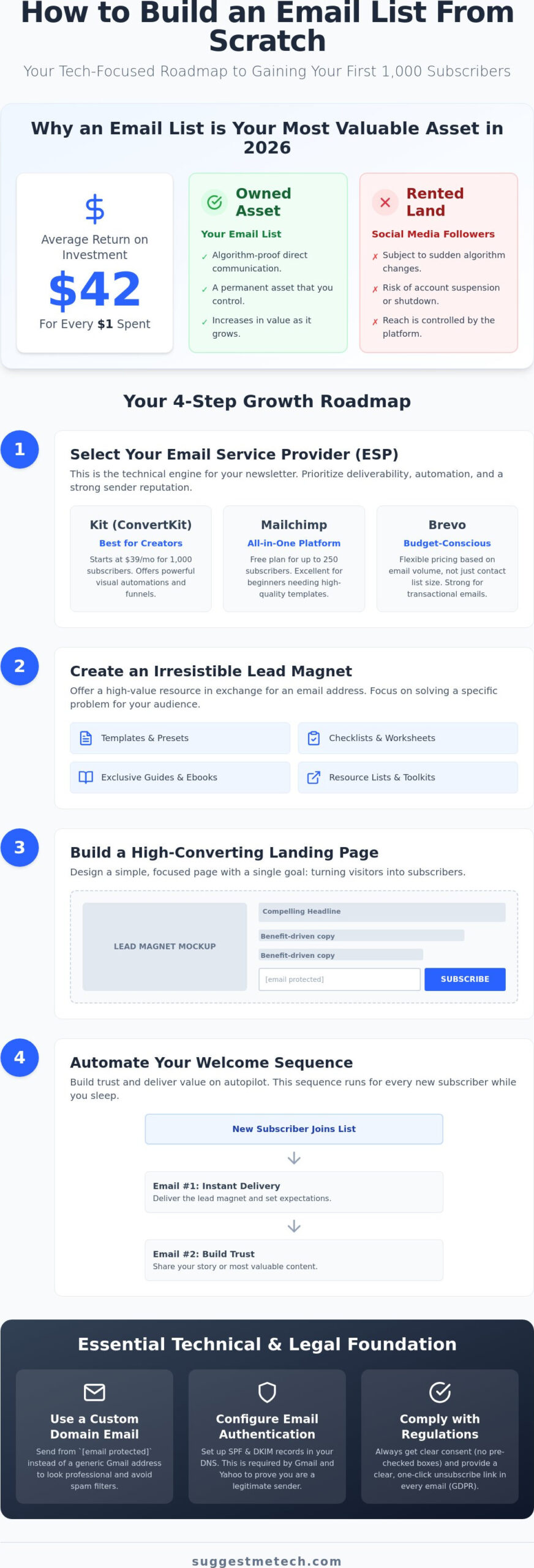
Did you know that email marketing still generates an average return of 42 dollars for every dollar spent in 2026? With global email users reaching 4.73 billion this year, your list is a technical insurance policy against unpredictable social media algorithms. If you’re feeling stuck on how to build an email list from scratch because of technical overwhelm or fear of being spammy, you aren’t alone. Choosing an Email Service Provider or worrying about GDPR compliance can feel like a full-time job.
I understand the frustration of staring at a zero subscriber count while trying to decode industry jargon. This guide simplifies the process by providing a clear tech stack and a repeatable growth strategy. You’ll learn how to grow a high-converting list from zero to your first 1,000 subscribers using tools that actually fit your budget and technical skill level.
We will walk through the best software recommendations for 2026, legal requirements for bulk senders, and the exact steps to build an automated welcome sequence that converts readers into fans while you sleep.
Key Takeaways
- Protect your business from algorithm changes by moving your audience from “rented land” to an owned database.
- Follow our technical roadmap on how to build an email list from scratch, starting with an ESP that prioritizes deliverability.
- Identify which “tech-centric” lead magnets, like templates or checklists, convert best for your specific audience.
- Learn the anatomy of a high-converting landing page to turn casual visitors into loyal subscribers.
- Set up an automated welcome sequence that builds trust and authority with every new signup while you sleep.
Why an Email List is Your Most Valuable Tech Asset in 2026
An email list is an owned database of permission-based contacts that exists independently of social media algorithms. Unlike followers on Instagram or TikTok, these subscribers have given you direct permission to land in their inbox. This is a critical distinction because social platforms are “rented land.” If a platform changes its algorithm or shuts down your account, you lose access to your audience overnight. Learning how to build an email list from scratch is the only way to ensure you maintain a direct line of communication with your community regardless of technical shifts in the social landscape.
When you understand how to build an email list from scratch, you’re investing in a technical insurance policy. You don’t have to worry about a sudden drop in reach or a change in community guidelines that might shadowban your content. Your list is yours. You can move it from one provider to another, and you can reach your subscribers whenever you have something valuable to share. This control is why email remains the foundation of a successful digital strategy in 2026.
The ROI of Email vs. Social Media
Email marketing generates an average return of $36 to $42 for every dollar spent, a figure that continues to outperform every other digital channel. The technical advantage lies in “direct-to-inbox” delivery. While an algorithm-based feed might show your content to only a tiny fraction of your followers, a well-managed email list ensures your message arrives exactly where it’s intended. By focusing on first-party data, you create a permanent asset that increases in value as it grows, rather than relying on the fleeting visibility of a newsfeed.
Email as a Traffic Engine
Once you’ve followed our guide on how to start a blog, your next technical priority is retention. A newsletter acts as a bridge, bringing readers back to your site for new reviews, product comparisons, or tool guides. Most first-time visitors will never return to your website unless you have a way to reach them again. Your email list also serves as a built-in focus group. You can use it to validate new content ideas or survey your audience before investing hours into a new project. It turns a one-off visitor into a recurring traffic source that powers your site’s long-term growth.
Choosing the Right Tech Stack: Email Service Providers (ESPs)
An Email Service Provider (ESP) is the technical engine behind your newsletter. While it’s tempting to use a personal Gmail account, doing so is a major mistake. Personal email providers aren’t built for bulk delivery. They lack the specialized infrastructure, authentication protocols, and one-click unsubscribe mechanisms required by modern regulations. If you want to know how to build an email list from scratch successfully, you must start with a dedicated platform that protects your sender reputation from day one.
Your ESP needs to integrate seamlessly with your best web hosting service to ensure your signup forms load quickly and reliably. Prioritize deliverability and automation over flashy design features. A beautiful email is useless if it never leaves the “Promotions” tab. You can view our comparative tool guides to find the specific software that matches your current site infrastructure.
Top ESP Recommendations for Beginners
- Kit (formerly ConvertKit): This is the premier choice for creators. The “Creator” plan starts at $39 per month for 1,000 subscribers. It offers advanced automation sequences and visual funnels that are easy to manage without technical expertise.
- Mailchimp: This is a robust “all-in-one” platform. It offers a free plan for up to 250 subscribers, with paid tiers starting at $13 per month. It’s excellent for beginners who need high-quality drag-and-drop templates.
- Brevo: Formerly Sendinblue, this platform is ideal for budget-conscious users. It excels at transactional emails and offers a flexible pricing model based on the number of emails sent rather than the size of your contact list.
Technical Integration with Your Domain
Professionalism starts with your email address. Sending from a generic @gmail.com address looks amateur and often triggers aggressive spam filters. You need a custom address linked directly to your domain name. As of February 2024, Gmail and Yahoo require bulk senders to use specific email authentication methods to reach the inbox. You must configure your DNS records to include SPF, DKIM, and DMARC settings. These technical handshakes prove to receiving servers that you’re a legitimate sender. Without these configurations, your efforts to learn how to build an email list from scratch will likely fail as your messages get blocked by major providers.
Creating Your Lead Magnet: The Value Exchange Framework
A lead magnet is a high-value incentive you offer in exchange for an email address. In 2026, people are highly protective of their inboxes. You can no longer rely on a generic “subscribe for updates” call to action. You need to offer something tangible that solves a specific problem. When you are learning how to build an email list from scratch, your lead magnet is the single most important conversion lever you have at your disposal.
The “Quick Win” Rule is the most effective technical strategy for lead magnets. Your incentive must solve a specific problem for the user in under 10 minutes. If you offer a 50-page ebook, your subscriber will likely download it and never open it. Instead, offer a one-page checklist or a specific template. This provides immediate value and establishes you as a helpful expert right away. Crafting a compelling offer is the foundation for how to build an email list from scratch that actually grows month over month.
You also need a reliable place to host your freebie. You can use Google Drive or Dropbox by creating a “view only” link for your file. However, most modern ESPs like Kit or Mailchimp allow you to upload the file directly to their internal storage. This is usually the best technical choice because it keeps the entire process within one platform, which reduces the risk of broken links or permission errors.
Lead Magnet Ideas That Actually Convert
- PDF Resource Guides: These are curated lists of tools or software for specific niches. For example, “The Best Gear for New YouTubers” provides instant value for someone starting a video channel.
- Video Tutorials: Gated content that provides hands-on tech walkthroughs is highly effective. You can host these as unlisted videos on YouTube and share the link in your welcome email.
- Discount Codes: If your site is affiliate-heavy or sells digital products, a simple discount code is often the fastest way to get a signup.
The Delivery Tech: Automating the “First Touch”
Welcome emails have a significantly higher open rate than standard campaigns, averaging 69% according to recent industry data. This is your best opportunity to deliver your lead magnet and build trust. You must set up an automated “Welcome” sequence in your ESP that triggers immediately after someone confirms their subscription. Ensure the download link is prominent and functional. I recommend testing the entire user flow yourself using a secondary email address to make sure the file access is seamless and the formatting looks correct on mobile devices.
Setting Up Your Conversion Engine: Opt-in Forms and Landing Pages
The conversion engine is the technical bridge between a casual visitor and a loyal subscriber. If you’re figuring out how to build an email list from scratch, you don’t need a massive development team to create high-converting assets. Most modern ESPs provide intuitive, drag-and-drop builders that allow you to launch landing pages and forms in minutes. The key is choosing the right tool for the right context. A landing page is a standalone destination designed for one purpose: conversion. It’s perfect for your social media bios or paid ads. Inline forms, on the other hand, sit within your content and capture readers while they’re already engaged with your expertise.
For businesses that want to skip the learning curve and implement a professional conversion strategy, שי דוד משרד פרסום provides expert web design and campaign management services tailored for growth.
Every form you build must be optimized for mobile devices. Since approximately 60% of emails are read on mobile, your opt-in forms must be responsive and easy to navigate on a smartphone. A form that’s too wide or has a tiny close button will frustrate users and hurt your conversion rates. Additionally, compliance is non-negotiable. The penalty for violating the CAN-SPAM Act is up to $53,088 per email as of January 2025. Always include a clear checkbox for GDPR consent and a link to your privacy policy to stay legally protected. This technical diligence is a core part of how to build an email list from scratch that remains sustainable and reputable.
Where to Place Your Forms for Maximum Impact
Strategic placement ensures your offer is seen without being intrusive. Place an opt-in form “above the fold” on your homepage so visitors see it immediately without scrolling. Exit-intent pop-ups are also highly effective, as they trigger just as a user moves their cursor to leave your site. Finally, integrate inline forms naturally within your high-traffic content. For example, if a reader is browsing your headphones guide, they’re likely interested in more tech recommendations. A form offering a “Tech Setup Checklist” fits perfectly here.
Step-by-Step: Building Your First Landing Page
You don’t need to start from a blank canvas. Open your ESP and pick a pre-designed template that matches your brand’s aesthetic. Your headline should focus on the transformation your lead magnet provides. Instead of “Sign up for my newsletter,” try “Get the exact tech stack I used to scale to 10k monthly visitors.” Keep the form simple. Use a single-field for the email address to reduce friction. Every extra field you add, like “First Name” or “Company,” can significantly decrease your signup rate. Once your page is live, browse our software reviews to find the best integration tools to link your landing page to your existing website infrastructure.
Automation and Growth: Scaling Your List from 0 to 1,000
Reaching your first 1,000 subscribers requires moving beyond manual outreach into automated systems that work while you sleep. Once your tech stack is live, your focus shifts to nurturing the leads you’ve captured. Learning how to build an email list from scratch isn’t just about the initial signup; it’s about the long-term relationship you build with your audience. Automated sequences generate over 300% more revenue than standard campaigns, making them the most efficient way to scale your efforts without burning out.
Consistency is your best growth tool. Whether you choose a weekly or bi-weekly schedule, stick to it so your audience knows when to expect your expertise. You should also practice regular email hygiene. It might feel counterintuitive to delete subscribers, but removing inactive accounts actually improves your deliverability. Major providers like Gmail and Yahoo prioritize senders with high engagement rates. A smaller, active list is far more valuable than a large, unresponsive one. Mastering these automation tools is the final step in understanding how to build an email list from scratch that grows sustainably.
The 5-Email Welcome Sequence Template
A well-crafted welcome sequence introduces your brand and sets expectations. Use this template to automate your first interactions:
- Email 1: The Delivery. Send the lead magnet immediately. Don’t make them wait; deliver the value you promised in the signup form.
- Email 2: The “Who am I?” Build authority by sharing your background and why you started your site. Share a personal story that connects with your niche.
- Email 3: The Value Add. Provide a technical tip that solves a common problem. For example, you could share your favorite iPhone cache hacks to help them speed up their devices.
- Email 4: The Question. Ask your subscribers what they’re currently struggling with. Encourage them to reply directly to the email. This boosts your engagement metrics and gives you ideas for future content.
Advanced Growth Strategies
Once your automation is running, use these tactics to accelerate your growth:
- Guest Posting: Write for other tech blogs in your niche. Include a link to your dedicated landing page in your author bio to tap into their established audience.
- Collaborative Giveaways: Partner with non-competing creators to offer a bundle of digital tools or resources. This allows you to cross-pollinate audiences quickly.
- Content Upgrades: Create specific lead magnets for your top-performing articles. If a post about web hosting is getting traffic, offer a “Hosting Migration Checklist” as a specialized opt-in.
Start Your Technical List Building Journey Today
You now have the exact technical roadmap needed to scale from zero to your first 1,000 subscribers. By selecting a reliable ESP and properly configuring your DNS records for maximum deliverability, you’ve already bypassed the most common hurdles that stop most beginners. Remember that your lead magnet should offer a “quick win” that solves a specific problem for your audience in under ten minutes. This initial value exchange is the foundation of a high-converting owned asset that protects your business from unpredictable algorithm changes.
Learning how to build an email list from scratch is a marathon, not a sprint. Focus on maintaining a consistent schedule with your welcome sequence and regularly scrubbing inactive subscribers to keep your engagement rates high. If you want to stay ahead of the latest digital shifts, Join the SuggestMeTech Newsletter for exclusive tech guides and reviews! We’re trusted by thousands of tech enthusiasts who rely on our practical advice delivered weekly. We provide no spam, just pure value to help you navigate complex tech choices with confidence. You’ve got the tools and the strategy; now it’s time to launch your first landing page and start growing.
Frequently Asked Questions
Is it legal to build an email list without a business license?
Yes, you can legally start a list as an individual. While a business license isn’t usually required to gather contacts, you must follow strict regulations like the CAN-SPAM Act. As of January 2025, penalties for violations can reach $53,088 per email. You’ll need to provide a valid physical address in your footer and a clear way for people to unsubscribe to remain compliant with global standards.
Can I build an email list without a website in 2026?
You don’t need a traditional website to start growing your audience. Most modern providers like Kit or MailerLite offer hosted landing pages that act as standalone signup destinations. You can link to these pages from your social media bios, YouTube descriptions, or guest posts. This is a highly effective way to learn how to build an email list from scratch before you’ve even purchased a hosting plan.
How much does it cost to start an email list from scratch?
Starting an email list can cost zero dollars if you use free tiers. AWeber offers a free plan for up to 500 subscribers, and Mailchimp is free for up to 250 contacts. As you grow, expect to pay around $9 to $15 per month for entry-level paid plans. For example, Kit’s Creator plan starts at $39 per month for 1,000 subscribers, providing advanced automation tools for scaling your growth.
What is the best email service provider for absolute beginners?
Mailchimp and Kit are the top choices for beginners. Mailchimp is ideal if you want a visual, drag-and-drop builder with plenty of templates for your first 250 subscribers. Kit is better if you’re a creator who wants to focus on simple, text-based automation and landing pages. Both integrate easily with major platforms, making the technical setup straightforward for anyone starting from zero without a development team.
How often should I send emails to my list so I dont annoy them?
Sending one email per week is the industry standard for maintaining engagement without overwhelming your audience. If you’re just starting, bi-weekly is acceptable, but try not to go longer than a month between updates. Consistency builds trust and ensures your subscribers don’t forget who you are. High engagement rates positively impact your overall deliverability, so focus on providing value in every single message you send to your subscribers.
What is a “Double Opt-In” and do I really need it?
A double opt-in is a process where a user must click a confirmation link in an email before being added to your list. While it adds a step for the user, it’s essential for maintaining a high-quality list and ensuring GDPR compliance. It prevents fake email addresses and bots from inflating your subscriber count. This technical hurdle ensures that every person on your list actually wants to receive your content.
How do I stop my emails from going to the Gmail Promotions tab?
To avoid the Promotions tab, you must prioritize email authentication. As of February 2024, Gmail and Yahoo require bulk senders to use SPF, DKIM, and DMARC records. You should also limit the number of images and links in your messages. Writing like a real person rather than a corporate brand helps your content land in the Primary inbox where it’s more likely to be seen and opened by your readers.