

The biggest finding in a mytecharm.com review may be that the technology blog readers expect is on a different domain. As of September 2026, MyTechArm.com published guides to registering for and using Daman Game, an online gaming and betting platform. The technology reviews and guides are on MyTechArm.org, where the site identifies its team collectively rather than naming individual writers. Reports about Daman Game also include complaints of blocked withdrawals and unresponsive support, so distinguish allegations about the platform from evidence about the website itself.
If you’re unsure whether either site is suitable for research, separate technical safety from editorial credibility. A secure connection doesn’t prove that recommendations are independent, accurate, or based on testing. This review distinguishes what current site information establishes from what remains unclear, including ownership, editorial methods, and disclosures. It also provides a practical checklist for assessing an article’s author, sources, testing details, and update date, so you can decide whether to use it for discovery, comparison, or purchase research.
Key Takeaways
- A mytecharm.com review should distinguish the .com site’s current content from the technology blog hosted at mytecharm.org.
- Security indicators can help assess technical safety, but they don’t establish that a site’s recommendations are accurate or independent.
- Before relying on an article, check for a named author, cited evidence, testing details, an update date, and clear affiliate disclosures.
- Compare recommendations with your needs, budget, and technical requirements, then verify important claims elsewhere.
- The available evidence may help you decide whether a page is useful for discovery or comparison, but may not be enough to support a purchase decision on its own.
MyTechArm.com Review: What Can Be Confirmed About the Site?
Current evidence points to a significant difference between MyTechArm.com and the technology blog readers may expect. As of September 2026, the .com site published guides to registering for and using Daman Game, an online gaming and betting platform. A founder post describes an aim to make practical technology guidance easier to use, but that statement doesn’t establish what the .com site currently publishes or how its content is produced.
For this mytecharm.com review, the distinction is important. A stated mission and an automated safety assessment can provide context, but neither establishes that a particular recommendation is accurate, independent, or based on testing. To assess an article, check its own evidence rather than relying on a description of the site as a whole.
What does the available MyTechArm information say?
In a founder post, the founder describes MyTechArm’s intended purpose as making technology guidance more accessible through simplified explanations, comparisons, reviews, and tutorials. Treat this as the founder’s account of the site’s goals, not independent evidence that the current site delivers those types of content.
Check the live domain before relying on an article. The available information as of September 2026 says MyTechArm.com focused on Daman Game guides, while MyTechArm.org operated as a technology blog. Similar names make it easy to mistake one domain’s content for the other’s, so confirm the address in your browser before evaluating a page.
What does “Likely Safe” establish, and what does it not?
An automated trust assessment can offer a limited technical signal, but it can’t verify who wrote an article or whether its advice is sound. SSL, for example, encrypts the connection between a browser and a website. It doesn’t confirm review accuracy, testing quality, or the reliability of a recommendation.
Automated trust assessments are screening signals, not complete judgments of a website. They may reflect technical checks, such as an SSL certificate or a filtering service’s assessment, but they don’t establish editorial standards, authorship, or factual accuracy. Use them as one part of your review, then inspect the site’s content and verify important claims independently.
A Scamadviser assessment labels MyTechArm “Likely Safe” and cites a valid SSL certificate and a safe DNSFilter assessment. This is a limited signal, not a guarantee about the site’s content or conduct. Check the assessment directly for its current status and date before treating it as up to date.
Keep three questions separate:
- Connection security: Does the browser show an encrypted connection? That helps protect data in transit, but doesn’t validate the page’s advice.
- Transparency: Can you identify the publisher, find contact details, and locate relevant disclosures?
- Editorial reliability: Does the specific article name an author, cite evidence, explain its methods, and show when it was updated?
Some review sites use affiliate marketing, earning a commission when readers follow qualifying links. That possibility alone doesn’t prove bias, but it makes clear disclosures useful. Check the individual page rather than assuming MyTechArm uses this model.
MyTechArm’s Stated Mission Versus Its Published Reviews
The founder’s stated aim is to make practical technology guidance easier to use, but a mission statement doesn’t show how current articles are researched. Available information as of September 2026 says MyTechArm.com publishes Daman Game guides, while MyTechArm.org operates as a technology blog. The distinction matters: the .com content described in the available evidence isn’t a sample of technology product reviews.
For a mytecharm.com review, compare stated goals with evidence on the specific page you’re considering. The available information says the .org site describes its team collectively as tech professionals, writers, and enthusiasts, but doesn’t name individuals. It doesn’t establish the authorship, sourcing, review methods, or update history of specific articles.
| Stated goal | Evidence to look for | What remains unknown |
|---|---|---|
| Make technology guidance accessible | Plain-language explanations that define technical terms and show how a recommendation applies in practice | Whether a specific current article meets this goal |
| Offer comparisons and reviews | Named products, consistent comparison criteria, cited specifications, and relevant limitations | Whether conclusions are based on hands-on tests or research |
| Help readers choose suitable options | Clear use cases, trade-offs, and guidance on who each option suits | How recommendations are selected and maintained over time |
How to assess a MyTechArm article’s evidence
Start with the byline and date. A named author and publication or update date make it easier to assess accountability and whether information may have changed. Then follow the citations. Do they lead to relevant material, such as product documentation, or repeat another unsupported claim? A comparison is more useful when it explains its criteria and trade-offs, not just its winner.
Look for a clear distinction between hands-on testing and a researched summary. If an article says a product was tested, check whether it explains what was tested and how. Without those details, don’t assume the review reflects hands-on experience.
Do the articles explain who each recommendation suits?
A useful recommendation connects its evidence to a reader’s situation. For example, an article comparing devices should explain which needs its criteria prioritize and what trade-offs matter to someone with different requirements. Broad claims without sources, examples, or a stated evaluation method give you less to work with.
Before acting, check whether the article addresses your budget, technical needs, and intended use. Compare its reasoning with other sources, too. For another source of practical technology coverage, explore technology reviews and guides.
Is MyTechArm.com Trustworthy? Separate Safety From Editorial Credibility
A site can have reassuring technical indicators without showing that its articles are accurate or its recommendations well supported. The available Scamadviser assessment labels MyTechArm “Likely Safe” and cites a valid SSL certificate and a safe DNSFilter assessment. Those signals provide limited context, not a complete evaluation of the site or its editorial practices.
Website security protects a connection; review credibility depends on transparent authorship, evidence, and reasoning. For a mytecharm.com review, assess these separately. Don’t treat one automated result as an overall verdict.
Which trust signals are useful, and which are incomplete?
SSL encrypts data sent between your browser and a website. It can help protect information in transit, but it doesn’t establish who operates the site, whether its content is accurate, or whether a product recommendation is suitable. Automated assessments can flag technical indicators, but they aren’t comprehensive audits of ownership or editorial quality.
Check the live site for details that help you understand who is responsible and how its content is produced:
- Ownership and contact details: Can you identify the publisher and find a way to contact them?
- Policies: Are editorial standards and relevant privacy information available and understandable?
- Disclosures: Does an article explain whether commercial relationships may influence its recommendations?
- Article evidence: Are authors, sources, testing methods, and update dates visible where relevant?
The available information doesn’t establish current ownership, contact details, or the site’s full policies and disclosures. Treat those points as unverified unless you can confirm them on the live site. Missing or inaccessible information is a reason to seek more evidence, not proof of misconduct.
How to read affiliate disclosures and recommendations
Affiliate links can generate revenue when readers make qualifying purchases. Their presence alone doesn’t prove a review is biased, and a disclosure alone doesn’t prove editorial independence. Look at how the article explains that relationship and supports its conclusions.
A useful disclosure makes the commercial relationship understandable. The review should also explain why products or services rank as they do, identify meaningful drawbacks, and connect its criteria to readers’ needs. If an article names a “best” option without showing how it was compared or who it suits, treat the ranking as a claim to verify, not a decision made for you.
Evaluate each page on its own evidence. A technical safety signal may help answer whether a connection is encrypted; it can’t tell you whether a recommendation deserves your confidence.
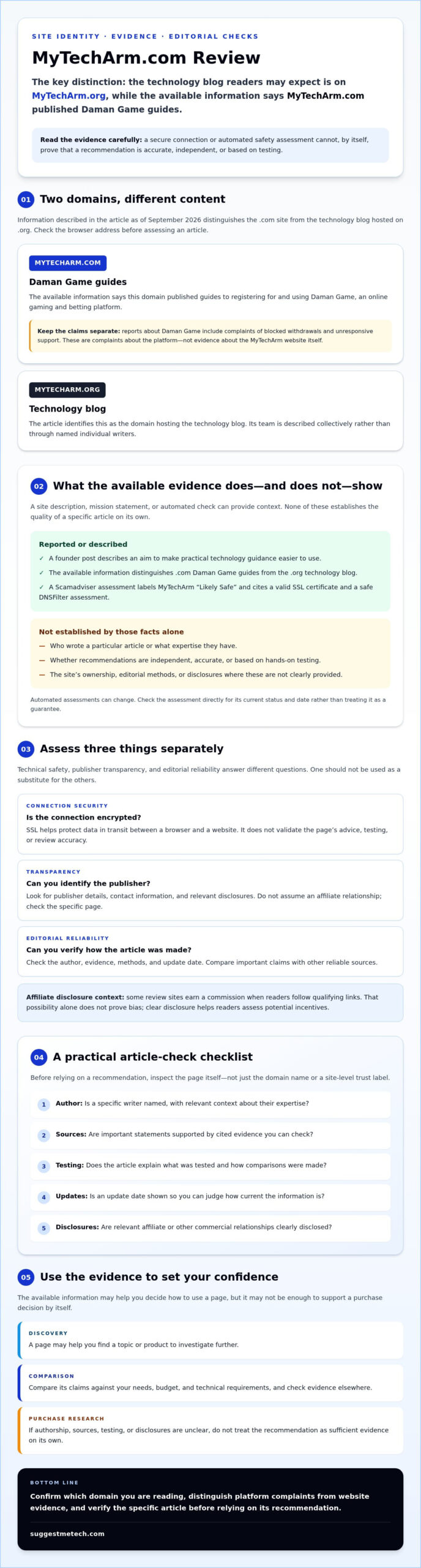
How to Evaluate MyTechArm Before Acting on a Recommendation
Judge a recommendation by the evidence on that specific page, not by the site’s name or a general trust score. A quick check of its date, author, sources, comparison criteria, and limitations can show whether it’s useful for discovery or needs independent verification.
For costly, security-sensitive, or business-critical decisions, corroborate a recommendation with independent sources and the provider’s own documentation before acting.
A quick checklist for checking an individual review
Use this sequence to check an article before relying on its conclusion:
- Check freshness: Find the publication or update date. If the advice depends on changing features or requirements, confirm that the information is still current.
- Identify the author: Look for a named writer, relevant expertise, and clarity about who reviewed or updated the page.
- Trace the evidence: Follow citations and check whether the article explains its comparison criteria, testing methods, and meaningful drawbacks.
- Compare sources: Check at least one independent source and the provider’s own product or service details. Look for agreement on important claims, not just matching rankings.
- Test fit: Compare the recommendation with your needs, budget, and technical requirements. A product suited to a small personal setup may not meet a business’s security or compatibility needs.
For example, if a review recommends a router, first identify your coverage needs, compatible devices, and spending limit. Then verify the specifications with the manufacturer and compare the reasoning with another source. This helps you check whether the recommendation fits without assuming the article tested that router.
When is MyTechArm useful as one source among several?
An article can help with discovery if it explains who its advice is for and shows how it reached its conclusions. If the methodology is unclear, use the page to identify options or questions to investigate, not as the sole basis for a purchase.
Scrutinize decisions involving sensitive data, substantial expense, or systems your work depends on. Compare specific claims with independent coverage and official documentation. If sources conflict or key details are missing, pause and investigate further rather than treating a confident ranking as proof.
Apply the same checks to any technology review. Explore technology reviews and guides as another source for comparisons, and assess each article’s evidence and disclosures on its own.
MyTechArm.com Review: A Practical Verdict and Next Steps
The evidence supports a cautious, specific verdict, not a blanket judgment about every site using the MyTechArm name. As of September 2026, MyTechArm.com’s published content focused on Daman Game guides, while MyTechArm.org operated as a technology blog. A founder’s stated aim and a “Likely Safe” assessment don’t establish that the .com site provides reliable technology reviews.
Use the available information to identify which domain you’re reading and what it currently publishes. It can’t, by itself, establish the quality of an individual review, the methods behind a recommendation, or whether the site is suitable for purchase research.
Who may find MyTechArm useful?
Readers looking for current technology advice should first confirm they’re on the domain that publishes the article they need. MyTechArm.org may be relevant for exploring technology topics, but the available information doesn’t verify the quality of representative current reviews. The .com site’s documented focus is different, so don’t assume it offers the technology content described in the founder’s post.
A specific article may still help you discover products or questions to investigate if it explains its audience and reasoning. For an expensive purchase, a security-sensitive choice, or a business-critical decision, look for stronger article-level evidence and compare independent sources before relying on its conclusion.
What should readers verify before making a decision?
Before acting on a recommendation, check the page itself rather than relying on a site-wide impression. Confirm:
- Date and authorship: Is the article current, and does it identify who wrote or updated it?
- Disclosure and method: Does it explain relevant commercial relationships and how options were evaluated?
- Evidence and limits: Are claims sourced, drawbacks included, and testing distinguished from research?
- Primary details: Do the provider’s own specifications, terms, or documentation support important claims?
- Fit: Does the recommendation meet your actual needs, budget, and technical requirements?
If an article leaves key points unanswered, mark them as unknown and seek confirmation. A missing method or unclear author doesn’t prove the advice is wrong, but it gives you less reason to rely on it without corroboration.
For a broader comparison, explore SuggestMeTech technology guidance as another research source. Review the evidence and disclosures on each article, and make your decision based on what you can verify.
Use the Evidence to Make Your Next Tech Decision
This mytecharm.com review highlights a key distinction: as of September 2026, the .com site published Daman Game guides, while the technology blog operated on .org. A founder’s stated mission and a “Likely Safe” assessment don’t verify the accuracy or independence of a specific review.
Before acting on any recommendation, confirm you’re on the right domain, check the article’s author and date, examine its sources and evaluation method, and verify important details with the provider and independent sources. If those details aren’t clear, treat the article as a starting point rather than a final answer.
SuggestMeTech publishes technology reviews and guides to help readers compare options. Apply the same evidence-based checks to any coverage you read, including ours. Explore practical technology reviews and guides to continue your research, then choose advice that fits your needs and is supported by evidence you can verify.
Frequently Asked Questions
These answers clarify what the available evidence can establish about MyTechArm and how to assess the site’s content before relying on a recommendation.
Is MyTechArm.com safe to use?
The available information doesn’t establish that every aspect of MyTechArm.com is safe or trustworthy. A Scamadviser assessment labeled the domain “Likely Safe” and cited technical indicators, but that isn’t a comprehensive audit or a guarantee about site content. As of September 2026, MyTechArm.com published Daman Game guides. Check the domain and page carefully, avoid sharing sensitive information unless you understand why it’s needed, and verify claims independently.
Is MyTechArm.com a legitimate technology review website?
As of September 2026, MyTechArm.com was not publishing a technology review blog, according to the available site information. Its content focused on guides for registering for and using Daman Game. The technology blog was on the separate MyTechArm.org domain. Because similar domain names can cause confusion, check the address bar and current content before relying on a page as a technology review.
What does Scamadviser say about MyTechArm.com?
A Scamadviser assessment labels MyTechArm.com “Likely Safe” and mentions a valid SSL certificate and a safe DNSFilter assessment. Treat this as a limited technical or automated signal, not a verdict on editorial accuracy, ownership, or business practices. Check the assessment’s live page and date before citing it as current. It doesn’t determine whether a specific review is well researched or suitable for your needs.
Can you trust MyTechArm product reviews?
Don’t rely on a product review solely because it appears on a site with a reassuring safety signal or a clear stated mission. Check the particular article for a named author, publication or update date, cited evidence, comparison criteria, limitations, and any disclosure of commercial relationships. Look for a clear explanation of whether conclusions come from hands-on testing or research. For costly or security-sensitive decisions, compare the advice with independent sources.
Who created MyTechArm and what does the site do?
A founder post describes MyTechArm’s intended aim as making practical technology guidance easier to use through simplified explanations, comparisons, reviews, and tutorials. That account explains the founder’s stated goals, but it doesn’t independently verify current content or establish who owns each similarly named domain. Available information identifies MyTechArm.org as a technology blog and MyTechArm.com as a site publishing Daman Game guides as of September 2026.
How can I tell whether a technology review is reliable?
Check whether the article identifies its author and date, links to credible sources, explains how products were compared, and discusses drawbacks as well as benefits. Look for a stated testing method, and don’t assume hands-on testing unless the article documents it. Confirm important specifications with the manufacturer or service provider, then compare conclusions with at least one independent source. A recommendation should also fit your budget, intended use, and technical requirements.
Does a valid SSL certificate prove that a review website is trustworthy?
No. An SSL certificate supports an encrypted connection between your browser and a website, helping protect information as it travels between them. It doesn’t verify the site’s owner, confirm that a review is accurate, or show that a recommendation is independent. Treat SSL as one technical check. Assess editorial credibility separately by looking for transparent authorship, sources, evaluation methods, update dates, and relevant disclosures.