

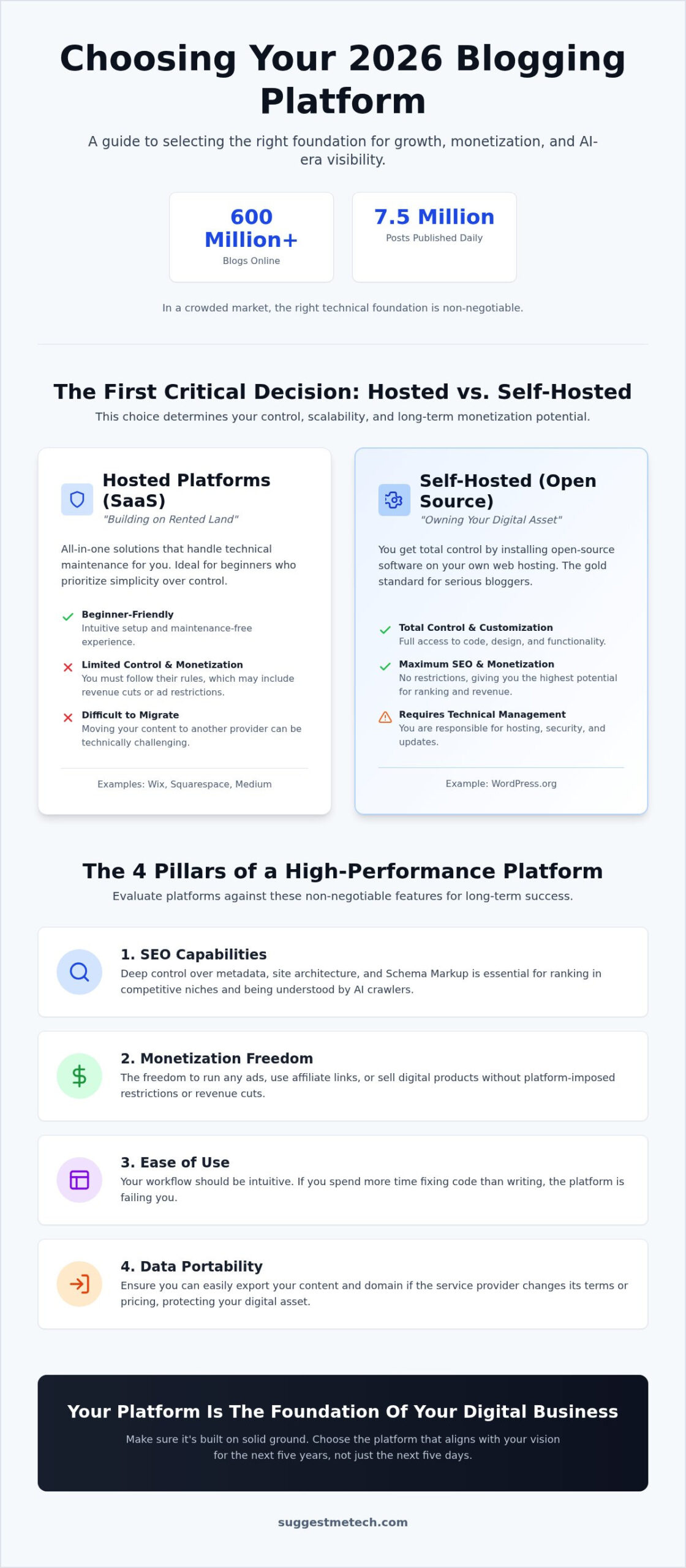
That “free” blogging platform you just signed up for might actually be the most expensive mistake your brand ever makes. When looking for the best blogging platforms among the 600 million blogs already online, most creators prioritize simplicity, but they quickly hit a wall when hidden fees or rigid design tools stall their growth. It’s frustrating to realize the site you’ve spent months building can’t scale with your traffic or rank on the first page of search results. You deserve a setup that lets you focus on your craft rather than technical troubleshooting.
SuggestMeTech has vetted the top contenders to ensure you choose a home that matches your specific goals, from professional monetization to minimalist creative writing. This comparison breaks down the latest AI-driven features in Squarespace and Wix, the gold-standard flexibility of self-hosted WordPress, and the rising popularity of newsletter-first models like Ghost and Substack. You’ll discover exactly how to balance ease of use with the high search engine visibility required to thrive in a market where 7.5 million posts are published every day. By the end of this guide, you’ll have a clear path to owning your audience without outgrowing your technology.
Key Takeaways
- Understand why data ownership and AI-search compatibility are the most critical factors for your blog’s survival in 2026.
- Compare the best blogging platforms for monetization to find the right balance between WordPress’s total control and Ghost’s professional publishing tools.
- Explore how minimalist platforms are helping creative writers avoid burnout by removing complex design tools and focus-killing distractions.
- Identify the essential SEO and monetization pillars you need to scale from a hobbyist to a high-earning digital asset.
- Access a practical decision matrix that matches your unique persona to the ideal tech stack for long-term growth.
What is a Blogging Platform and Why Does Your Choice Matter in 2026?
A blogging platform, technically known as a Content Management System (CMS), is the software or service you use to create, manage, and publish your content online. While the foundational definition of what a blog is remains consistent, the technology driving these sites has undergone a massive shift. In 2026, your choice of platform isn’t just about finding a pretty interface; it’s about selecting a digital engine that can handle the demands of AI-driven search and complex data ownership rules. The best blogging platforms today act as authority-building hubs rather than simple text editors.
The Evolution of Blogging: From Journals to Digital Assets
Blogging has transitioned from personal online diaries into high-value digital assets. In the current landscape, search engines and AI agents like ChatGPT or Gemini prioritize sites with clean code and structured data. If your platform doesn’t allow for deep technical customization, your content might never reach its intended audience. We’ve seen a growing divide between creators who “rent” space on social blogging sites and those who “own” their platform. While free services are tempting, they often carry a high long-term cost in the form of restricted growth and lost revenue potential.
Hosted vs. Self-Hosted: The Great Debate
The distinction between hosted and self-hosted services remains the most important decision for any new or migrating blogger. Your choice here determines your technical freedom and your monetization ceiling.
- Hosted Platforms (SaaS): Services like Wix, Squarespace, or Medium are “all-in-one” solutions. They handle the technical maintenance for you, which is great for beginners. However, you’re building on “rented land.” You must follow their terms of service, and moving your content to a different provider later can be a technical nightmare.
- Self-Hosted Platforms (Open Source): WordPress.org is the gold standard here. It offers total control over every line of code and every pixel of design. To use this, you’ll need to secure your own space through a web hosting provider. This path requires a slightly steeper learning curve but offers the highest potential for SEO and long-term scaling.
Ultimately, the best blogging platforms are those that align with your vision for the next five years, not just the next five days. If you plan to monetize through diverse streams like digital products, private memberships, or advanced affiliate marketing, you need a platform that won’t lock you into a specific ecosystem or take a massive cut of your earnings. Your platform is the foundation of your digital business; make sure it’s built on solid ground.
The 4 Pillars of a High-Performance Blogging Platform
To identify the best blogging platforms, you must look past aesthetic templates and focus on the technical infrastructure that supports your specific goals. Your exit strategy, whether that’s selling a niche site, building a private community, or earning passive ad revenue, dictates which features are non-negotiable. An affiliate marketer needs different tools than a writer building a paid newsletter. Choosing the wrong foundation now creates a friction factor that will eventually stop your progress as a creator.
- SEO Capabilities: Deep control over metadata and site architecture is essential for ranking in competitive niches.
- Monetization: You need the freedom to run ads, use affiliate links, or sell digital products without platform-imposed restrictions or revenue cuts.
- Ease of Use: Your workflow should be intuitive; if you spend more time fixing code than writing, the platform is failing you.
- Portability: Ensure you can easily export your content and your domain if the service provider changes its terms of service or pricing.
SEO and Search Visibility in the AI Era
Search visibility in 2026 requires more than just basic keyword placement. AI crawlers prioritize sites with technical precision, fast loading speeds, and mobile-first architecture. Schema Markup is the language 2026 search engines use to categorize your blog and display your content in rich snippets. If a platform limits your access to these technical settings or bundles them into expensive enterprise plans, your visibility will suffer. You don’t want to realize your site is invisible to AI agents after you’ve already published a hundred articles.
Monetization: Turning Traffic into Revenue
Turning traffic into revenue requires a platform that plays well with external services. The best blogging platforms for monetization don’t restrict your affiliate links or take a percentage of your subscription revenue. Some hosted services actually shadow-ban affiliate-heavy content to protect their own ecosystem, which can kill a business overnight. If you want to scale, look for compatibility with premium ad networks like Mediavine and built-in membership tools for digital storefronts. You can check our deep-dive reviews to see which tools integrate best with these specific revenue streams.
Ownership is the ultimate pillar. If you don’t have the right to move your data or control your monetization, you aren’t building a business; you’re just a glorified tenant. Prioritize platforms that offer a clear path to growth without locking you into a restrictive ecosystem. To see how a professional digital storefront operates, you can explore Digital Ebook Sales and find inspiration for your own future products.
The Top 5 Blogging Platforms for Growth & Monetization
For writers focused on direct-to-inbox content, the choice usually comes down to Ghost or Substack. Ghost is the professional’s choice. It offers a clean UI and, most importantly, takes 0% transaction fees on your subscriptions. Ghost(Pro) starts at $15 per month when billed annually, which is a predictable cost as you grow. Substack is free to start but takes a 10% cut of your revenue plus Stripe fees. Substack’s “Discovery Network” is its biggest advantage, helping new writers find an audience through recommendations. If you have an existing audience, Ghost’s flat fee usually saves you thousands over the long run.
Medium: The “Rent-to-Write” Model
Medium is ideal for writers who want to focus entirely on the craft without touching a single line of code. It provides a built-in readership and a simple editor, but you’re working within a walled garden. You don’t own the relationship with your readers, and if the algorithm changes, your traffic can disappear overnight. Use Medium as a secondary platform to syndicate your work rather than your primary digital home.
Wix and Squarespace: Aesthetic All-in-One Solutions
Simplified Platforms: When Less is More for Your Creative Flow
While heavy hitters like WordPress offer endless power, many professional writers are retreating to simplified environments. In 2026, the noise of complex dashboards and endless plugin notifications has created a demand for no-nonsense tools. Minimalist platforms like Bear and Pika are among the best blogging platforms for creators who prioritize the writing process over site management. These tools strip away the distractions, leaving you with a clean slate and a blinking cursor. They are built for those who find the technical overhead of traditional CMS options a barrier to actual production.
Bear and Pika: The Markdown Revolution
Bear and Pika rely heavily on Markdown. This is a lightweight markup language that allows you to format text using simple symbols, such as hashtags for headings or asterisks for bolding. It keeps your hands on the keyboard and your mind on the narrative. Because these platforms use plain text foundations, your data longevity is high. You aren’t locked into a proprietary database that is difficult to navigate. Most of these services offer simple export tools, ensuring that if you ever need to move to a more robust CMS, your content remains portable. This is a critical exit strategy for any serious writer who wants to avoid platform lock-in.
Microblog and Scribbles: Short-Form Authority
Microblog and Scribbles cater to the resurgence of short-form authority. Instead of competing with the 2,000-word essays that often dominate SEO, these platforms allow for quick, punchy updates that connect directly to the Fediverse. By integrating with Mastodon and Threads, your blog posts act as social media updates that you actually own. This supports the Digital Garden concept. Unlike a chronological feed that buries old content, a digital garden allows you to update and grow ideas over months or years. It turns your blog into a living knowledge base rather than a graveyard of old news. This approach is gaining massive traction among professional researchers and tech-savvy peers who value long-term intellectual growth.
Is a minimalist platform right for you? If your primary goal is to sell complex digital products or run high-volume affiliate sites, these will feel restrictive. However, if you are a thought leader or a creative writer looking for a distraction-free home, the less is more approach is unbeatable. You can read our full reviews of minimalist writing tools to find the one that fits your specific workflow. The best blogging platforms for you are ultimately the ones that you actually enjoy using every day.
Making the Final Call: Your 2026 Blogging Success Plan
Selecting from the best blogging platforms is about matching your current skills with your future ambitions. While technology evolves, the goal remains the same: reaching your audience with as little friction as possible. Don’t let “analysis paralysis” stop you from starting. The best platform is the one you’ll actually use consistently. It’s better to launch on a simple site today than to wait six months for a “perfect” custom build that never materializes.
The SuggestMeTech Recommendation Matrix
We’ve simplified the decision-making process by matching your specific persona to the ideal tech stack for your goals:
- For the Budding Entrepreneur: WordPress.org paired with reliable hosting. This offers the scalability and ownership needed to build a long-term business asset.
- For the Thought Leader or Journalist: Ghost or Substack. These platforms prioritize the reader relationship and offer streamlined newsletter tools to monetize your expertise directly.
- For the Casual Creative: Bear or Medium. Focus on the art of writing without worrying about the technical backend or monetization strategies.
Many successful creators follow what we call the “Golden Path.” They start with a simple, distraction-free setup to build a writing habit. However, as your traffic grows, you must keep an eye on technical performance. Factors like cache and site speed become vital for maintaining high search visibility and a positive user experience. A slow site is the fastest way to lose a reader before they’ve even finished your first paragraph.
Next Steps: Launching Your Blog Today
Once you’ve picked your home, secure your domain name and set up your basic branding. Don’t spend weeks obsessing over your logo or the perfect font. We recommend the “First 10 Posts” rule: focus entirely on producing high-quality content until you have at least ten articles published. Your design should evolve based on how people interact with your writing, not on your initial guesses. Content quality will always outweigh your platform choice, but the right platform makes it significantly easier for that quality to shine. For creators looking to diversify their content strategy with high-quality audio, you can visit Remote Podcast Recording and Production to learn how professional setups can elevate your brand’s voice.
Before you hit “Publish” on that first post, run through this quick checklist:
- Is your domain connected and secure (HTTPS)?
- Have you set up a basic email capture form?
- Does your site load quickly on mobile devices?
- Is your metadata optimized for search and AI crawlers?
We want to hear from you. Which of these best blogging platforms are you leaning toward for your 2026 launch? Share your thoughts in our community or let us know if you need a specific comparison. We’re here to help you navigate these choices and build a digital presence that lasts.
Build Your Digital Future Today
Finding the right home for your content is the most significant technical hurdle you’ll face this year. We’ve established that the best blogging platforms aren’t just about writing; they’re about choosing a scalable asset that you truly own. Whether you opt for the total control of WordPress or the newsletter focus of Ghost, your decision should align with your long-term monetization and SEO goals. Don’t let technical complexity keep you from sharing your voice with the world.
SuggestMeTech has over 100+ platforms reviewed to provide tailored recommendations for every budget. By following our advice, you’re joining a community of 50k+ tech-savvy creators who are building the future of the web. It’s time to stop researching and start publishing. Start your journey with our step-by-step guide on how to start a blog in 2026! The digital landscape is waiting for your unique perspective. Go out there and build something incredible.
Frequently Asked Questions
Which blogging platform is best for SEO in 2026?
Self-hosted WordPress.org remains the leader for SEO because it allows for granular control over technical elements. It supports advanced schema markup and deep metadata customization which AI-driven search engines prioritize. While platforms like Squarespace have improved with tools like Beacon AI, they don’t offer the same level of technical flexibility. If ranking in highly competitive niches is your priority, WordPress provides the most robust foundation for organic growth.
Is WordPress still the best choice for beginners?
WordPress is the best choice if you plan to build a long-term business, but it has a steeper learning curve than all-in-one builders. Beginners today can use managed hosting to eliminate technical headaches like security updates and server maintenance. If you only want to write without managing a site, a hosted platform like Substack might be better. However, starting with WordPress prevents the need for a difficult site migration as your traffic scales.
Can I move my blog from Medium to WordPress later?
Yes, you can move your content, but it is a manual and often tedious process. Medium doesn’t provide a direct “one-click” export that maintains your formatting and SEO metadata perfectly. You will likely need to copy your posts or use third-party import tools. The biggest risk is losing your existing audience and internal links, as Medium is a walled garden. Starting on your own domain avoids these migration headaches entirely.
Is Substack better than a traditional blog for making money?
Substack is superior for direct subscription revenue from a loyal audience, but it lacks the diverse monetization options of a traditional blog. Traditional sites allow you to run high-paying ad networks, sell digital products, and use advanced affiliate marketing strategies. Substack also takes a 10% cut of your earnings. If you want multiple revenue streams, a traditional blog on one of the best blogging platforms like Ghost or WordPress is more profitable.
What are the hidden costs of free blogging platforms?
The primary hidden costs of free platforms are restricted monetization, lack of data ownership, and poor SEO visibility. Many “free” services place their own ads on your site or charge high fees for basic features like using a custom domain. You might also face revenue-sharing requirements that take a percentage of your sales. Ultimately, the cost of being unable to scale or move your content often far outweighs the monthly fee of a professional host.
Do I need a custom domain for my blog?
Yes, a custom domain is essential for professional credibility and search engine ranking. Using a subdomain like “yourname.substack.com” means you are building authority for the platform rather than your own brand. If you ever decide to switch services, you can’t easily take that subdomain authority with you. Investing roughly $15 per year in a unique .com or .net domain ensures you own your digital identity and your search engine results.
How much does it actually cost to run a professional blog?
A professional setup typically costs between $15 and $60 per month. This includes approximately $15 per year for a domain name and $10 to $50 per month for managed hosting or platform fees. While software like WordPress.org is free, you must pay for a server to house it. Premium themes or specific plugins might add one-time costs, but you don’t need a massive budget to launch a high-performing site on the best blogging platforms.
What is the easiest blogging platform for someone with no tech skills?
Substack and Medium are the easiest options because they require zero technical setup. You simply create an account and start typing in a clean editor. If you want a full website with a custom design but no coding, Squarespace is the most intuitive drag-and-drop builder. These platforms handle all the backend maintenance, allowing you to focus entirely on your content. They are perfect for hobbyists or creators who prioritize simplicity over technical control.