

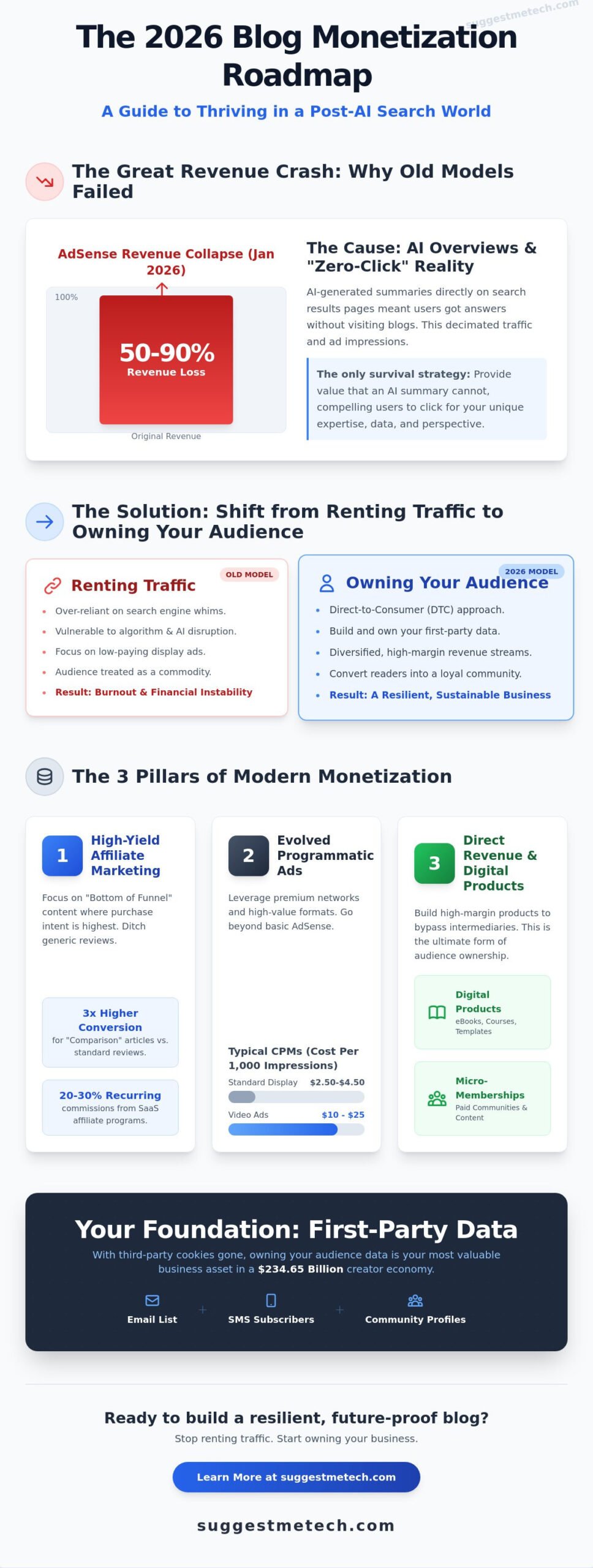
In January 2026, many publishers reported a staggering 50% to 90% drop in Google AdSense revenue due to the expansion of AI Overviews and major technical failures. If you’re struggling with declining clicks or high competition in old affiliate niches, you need a new roadmap. Mastering modern blog monetization strategies for 2026 is no longer optional; it’s the only way to survive. You’ve likely realized that relying on a single search engine for your livelihood is a recipe for burnout and financial instability.
This guide will help you build a resilient business that thrives independently of Google traffic. We’ll show you how to leverage tech-driven revenue models, from high-recurring SaaS commissions to direct-to-consumer digital products. You’ll get a clear preview of the tools needed to tap into the $234.65 billion creator economy while keeping your business compliant with the latest FTC and privacy regulations. Let’s look at how to turn your blog into a sustainable, diversified profit machine that you actually control.
Key Takeaways
- Shift your focus from “renting” search traffic to “owning” your audience to protect your income from AI search disruptions.
- Learn why high-intent affiliate content and recurring SaaS commissions are the most reliable blog monetization strategies for 2026.
- Discover how to launch high-margin digital products and micro-memberships to bypass low-paying display ads.
- Optimize your monetization tech stack to ensure site speed and scalability aren’t holding back your revenue potential.
- Implement a phased roadmap that balances early affiliate cash flow with long-term brand authority and sustainable growth.
The Evolution of Blog Monetization in 2026
The era of simply renting traffic from search engines to fuel your ad revenue is officially over. In 2026, the most successful creators have moved toward a Direct-to-Consumer (DTC) model. This means you aren’t just a content producer; you’re a business owner who owns the relationship with your audience. Effective blog monetization strategies for 2026 prioritize building a revenue moat that protects you from the volatility of external platforms. You can’t rely on the old “publish and pray” method anymore. Today, blogging is about converting casual readers into a loyal community that you can reach directly.
AI Search and the ‘Zero-Click’ Reality
Google’s AI Overviews have turned informational searches into zero-click experiences. If a searcher can get a quick answer in a single paragraph on the results page, they won’t visit your site. This shift was a primary driver behind the 50% to 90% drop in AdSense revenue that many publishers reported in January 2026. To stay profitable, you must provide value that an AI summary cannot. Content marketing now requires a heavy focus on deep Expertise, Authoritativeness, and Trustworthiness (E-A-T). You need to capture users by offering proprietary data, personal case studies, or unique perspectives that compel them to click through for the full experience rather than settling for a generic AI snippet.
Why First-Party Data is Your Biggest Asset
The total disappearance of third-party cookies has fundamentally changed how digital advertising works. Without these tracking tools, standard programmatic ad rates have become less predictable for the average blogger. Your first-party data is now your most valuable currency. This includes your email list, SMS subscribers, and community member profiles. By owning this data, you bypass the gatekeepers and create a direct line to your revenue.
Building this asset starts with your digital foundation. Choosing a domain that represents a long-term brand rather than a narrow keyword is essential for scalability. With the creator economy projected to reach $234.65 billion by the end of 2026, the winners are those who use their blog to collect first-party insights. This data allows you to personalize offers and maintain high conversion rates even when search algorithms shift. It’s about moving away from being a traffic middleman and becoming a destination that people seek out by name.
Modern Affiliate Marketing & Programmatic Advertising
While AI has shifted how people browse, it hasn’t changed how they buy. In fact, affiliate marketing spending in the U.S. is expected to exceed $11.99 billion by the end of 2026. The secret to capturing this revenue lies in moving away from broad, generic reviews toward high-intent content. You’re no longer just providing information; you’re facilitating a specific transaction. Successful blog monetization strategies for 2026 rely on being the final touchpoint before a user makes a purchase. This means focusing your energy where the intent is highest.
High-Yield Affiliate Strategies for 2026
The most profitable bloggers in 2026 have abandoned “top 10” lists in favor of “Bottom of Funnel” keywords. These include specific queries like “Best AI CRM for Small Law Firms” or “Alternative to [Major Competitor].” Comparison articles are currently seeing conversion rates three times higher than standard product reviews. If you’re operating in the technology or B2B space, SaaS affiliate programs are your best bet. These programs typically offer recurring commissions of 20% to 30%, providing a steady income stream that grows as your referred users stay active.
To maximize these conversions, your site must be technically flawless. High-intent users won’t wait for a slow page to load. Building your platform on the best web hosting foundation ensures that your affiliate links and comparison tables load instantly. This technical reliability is a prerequisite for ranking in an era where speed is a direct revenue metric.
Evolved Display Ads: Beyond AdSense
Global programmatic ad spend is forecasted to surpass $200 billion in 2026, accounting for roughly 90% of all digital display ad spending. However, the “set it and forget it” approach to programmatic advertising is no longer enough. Modern networks like Raptive and Mediavine now use AI-driven placement logic to maintain high RPMs even as user behavior changes. Standard display ads currently see CPMs between $2.50 and $4.50, but video ads are the real winners, often reaching $10 to $25 per 1,000 impressions.
To qualify for these premium networks in 2026, you generally need at least 50,000 monthly sessions and a clean, high-viewability layout. Authority blogs are also seeing a resurgence in “Direct Sold” ads. By cutting out the middleman, niche leaders are negotiating custom sponsorship packages that bypass standard ad networks entirely. This approach allows you to maintain a premium user experience while keeping 100% of the revenue. If you’re looking to upgrade your site’s earning potential, you might want to browse our latest tech reviews to find the best tools for ad optimization.
Direct Revenue: Digital Products and Paid Communities
Building direct revenue streams is the most effective way to insulate your business from platform changes. Digital products offer the highest profit margins in blogging because you create the asset once and sell it indefinitely. In 2026, the market has shifted away from passive information toward active implementation. Readers don’t want 100-page ebooks anymore. They want workflows, templates, and “plug-and-play” toolkits that save time. Integrating these assets into your blog monetization strategies for 2026 allows you to capture value from your audience regardless of what happens in search results.
Creating Products That Solve Specific Problems
You can use AI tools to scan your comment sections and community forums to identify the exact technical hurdles your readers face. Instead of broad guides, focus on “Actionable Toolkits” like a 10-step security audit checklist or a budget template for small business owners. Use a “tripwire” pricing model for entry-level products to convert readers into buyers quickly. Once they trust your quality, you can upsell them to premium consulting or high-ticket services. This tiered approach ensures you’re monetizing every segment of your traffic. By selling a solution rather than just information, you position yourself as a practical guide in your niche.
Building a Paid Newsletter or Community
Paid communities and newsletters provide the recurring revenue that traditional ads lack. Choosing the right platform depends on your budget and technical comfort. Substack takes a 10% platform fee on all paid revenue. Patreon offers a “Pro” plan with an 8% fee and a “Premium” plan at 12%, in addition to standard payment processing costs. If you want more control over the user experience, community platforms like Mighty Networks offer plans with transaction fees as low as 2% to 3%. Circle’s Professional plan is another strong contender with a 4% transaction fee. These platforms allow you to offer exclusive “Member-Only” tech reviews and deep-dive insights that aren’t available to the general public.
Transitioning free readers into “Founding Members” requires a clear value proposition. You’re not just selling content; you’re selling access and community. By 2026, micro-memberships and “pay-what-you-want” models have become standard for niche blogs. These models lower the barrier to entry while building a sustainable revenue moat around your brand. It’s the ultimate evolution of the DTC blogging model, where your blog serves as a high-value lead magnet for a deeper, paid relationship. This direct connection ensures your income remains stable even if search algorithms fluctuate.
Building Your 2026 Monetization Tech Stack
Your tech stack is the silent partner in your earnings. In 2026, a one-second delay in mobile load time can slash conversion rates by 20%. High-performance blog monetization strategies for 2026 require an infrastructure that handles traffic spikes and complex tracking without breaking a sweat. You aren’t just running a website; you’re managing a high-speed data funnel. If your site lags, you lose money. It’s that simple.
Infrastructure for High-Traffic Revenue
If you’re still learning how to start a blog, your first investment should be managed WordPress hosting. This foundation is non-negotiable for serious earners because it optimizes Core Web Vitals automatically. Premium ad networks now use these performance metrics as a gatekeeper for entry. Beyond your server, your physical tools define your output. High-output creators are investing in the best laptops available to handle local AI processing and high-resolution video editing for social commerce. Efficiency at your desk translates directly to more content and higher revenue.
The Essential Plugin and Software Suite
Privacy compliance is the biggest technical shift this year. As of January 1, 2026, new comprehensive consumer privacy laws are effective in Indiana, Kentucky, and Rhode Island. Your analytics suite must respect these regulations while still providing the data you need to track affiliate clicks. Many bloggers are moving beyond Google Analytics 4 toward privacy-first platforms that offer cleaner data without relying on third-party cookies.
For revenue optimization, you need Conversion Rate Optimization (CRO) tools that allow for rapid A/B testing of your affiliate links. AI assistants have also evolved from simple drafting tools into sophisticated SEO auditors. These tools fact-check your content and ensure it meets the E-A-T standards required to survive AI search overviews. Finally, your email marketing automation serves as the engine for your direct-to-consumer model. It’s the primary way you deliver digital products and nurture the communities we discussed earlier. Implementing these blog monetization strategies for 2026 requires a stack that prioritizes speed, privacy, and automation. To ensure your business stays ahead of the curve, check out our latest tech recommendations for the best software and hardware combinations.
Creating a Sustainable Monetization Roadmap
Success in blogging is rarely an accident; it’s the result of a disciplined schedule. You can’t implement every revenue stream on day one without diluting your authority. A structured approach ensures you build a solid foundation before asking your audience for their hard-earned money. Your blog monetization strategies for 2026 must balance immediate cash flow with long-term brand equity. This roadmap focuses on a “Sandwich” method, layering authority content between strategic monetization milestones.
- Phase 1: Foundation and Authority (Months 1 to 6): Focus entirely on content that demonstrates deep expertise. Don’t worry about ads yet. Your goal is to satisfy search intent and build an email list.
- Phase 2: The ‘Affiliate First’ Approach: Once you have steady traffic, introduce high-intent affiliate content. Focus on SaaS tools with 20% to 30% recurring commissions or DTC products with high conversion rates.
- Phase 3: Diversification (Months 12+): Apply for premium ad networks like Raptive or Mediavine once you hit session requirements. This is also the time to launch your first micro-membership or digital toolkit.
The golden rule for 2026 is the 70/30 split. Dedicate 70% of your time to creating high-value, non-monetized content that builds trust. Use the remaining 30% for monetization optimization, such as A/B testing affiliate placements or refining your sales funnels. This ratio keeps your audience engaged while ensuring your business remains profitable.
Setting Realistic Revenue Goals
Stop obsessing over total traffic numbers. In 2026, Revenue Per Visitor (RPV) is the metric that actually determines your success. A niche tech blog with 5,000 monthly visitors can easily out-earn a general lifestyle blog with 50,000 visitors if the RPV is optimized through high-ticket affiliates and direct sales. Benchmark your growth against industry standards for your specific niche rather than broad averages. If one income stream underperforms for two consecutive quarters, pivot quickly. Use your first-party data to see which offers your audience actually clicks and adjust your content calendar to match those interests.
The Importance of Maintenance and Auditing
A profitable blog is a well-maintained machine. Technical debt can quietly kill your conversion rates. Regularly learning how to clear cache on iphone and your own site server is essential to maintain the lightning-fast performance users expect. Conduct quarterly link audits to fix broken affiliate links and replace outdated offers. With FTC fines for non-compliance reaching up to $51,744 per violation in 2026, these audits should also include a review of your legal disclosures. Reinvest at least 20% of your monthly profits back into better tech and content scaling. This consistent reinvestment is what separates hobbyists from professional creators in the $234.65 billion creator economy.
Your Path to a Resilient Blog Business
The landscape of the creator economy is shifting, but the opportunity for profit remains massive. By moving away from a reliance on search traffic and focusing on first-party data ownership, you’ve already taken the first step toward a recession-proof business. Remember that the most successful creators in 2026 prioritize deep expertise and direct community engagement over generic content. Success requires balancing your creative output with a disciplined 70/30 approach to monetization and content value.
Implementing these blog monetization strategies for 2026 starts with a foundation that can scale as fast as your ambition. Don’t let technical debt or slow load times hold back your Revenue Per Visitor. You need tools that are as forward-thinking as your business model. Start your profitable blog journey with our 2026 Hosting Guide to access expert-tested recommendations and up-to-date tech analysis. You have the roadmap and the insights to thrive in this new era. It’s time to stop renting your audience and start building your own digital empire.
Frequently Asked Questions
Can I still make money with a small blog in 2026?
Yes, you can earn a full-time income with a small, focused audience. Success in 2026 depends on Revenue Per Visitor (RPV) rather than raw traffic volume. By targeting “Bottom of Funnel” keywords with high purchase intent, small blogs often see conversion rates 3x higher than general information sites. You only need a few thousand loyal readers if you’re offering high-value solutions or specialized SaaS recommendations.
What is the most profitable blog niche for 2026?
B2B Technology, AI implementation, and Finance remain the most lucrative sectors. These niches offer the highest affiliate commissions, often reaching 30% for recurring SaaS subscriptions. They also command premium programmatic ad rates because advertisers are willing to pay more to reach professional decision-makers. If you’re looking for the best blog monetization strategies for 2026, targeting these high-value audiences is a proven path to higher margins.
Is display advertising still worth it with AI search?
It’s still a viable secondary income stream, but it shouldn’t be your only one. Global programmatic spend is expected to exceed $200 billion this year, so the money is there. However, you must qualify for premium networks like Raptive or Mediavine to see significant returns. Use display ads to monetize the traffic that doesn’t convert on your primary affiliate offers or digital products.
How much traffic do I need to start monetizing my blog?
You can start monetizing immediately with high-ticket consulting or specialized digital products. For affiliate marketing, you’ll typically see consistent results once you reach 1,000 targeted monthly sessions. Premium ad networks have higher barriers, usually requiring 50,000 sessions or more. The key is focusing on the quality of your traffic rather than just the total number of hits.
Which is better for 2026: Affiliate marketing or selling my own products?
Selling your own products is better for long-term profit, but affiliate marketing is easier to start. Digital products like templates or workflows offer nearly 100% profit margins, minus small transaction fees from platforms like Circle or Mighty Networks. Affiliate marketing is great for early cash flow because you don’t have to handle customer support or product development. Most successful 2026 blogs use a hybrid model.
Do I need to be a tech expert to monetize a blog?
You don’t need to be a coder, but you do need to be “tech-savvy.” Modern no-code tools and managed WordPress hosting handle the complex backend work for you. Your job is to understand which tools in your stack are driving revenue and which are slowing down your site. Being a knowledgeable guide for your audience is more important than knowing how to write scripts.
What are the hidden costs of starting a monetized blog?
You’ll need to budget for premium hosting, email service providers, and legal compliance. Privacy laws in states like Indiana and Kentucky require specific data handling practices. Additionally, the FTC fine for improper disclosures can reach $51,744 per violation. These “hidden” costs are actually essential investments that protect your business from legal risks and technical failures.
How long does it take to see the first $1,000 in revenue?
Most professional bloggers reach their first $1,000 in monthly revenue within 9 to 12 months. This timeline assumes you spend the first six months building authority and an email list before aggressively pushing products. Speeding up this process is possible if you focus on high-ticket services or consulting from the start, rather than waiting for ad revenue to accumulate.