

The cheapest domain registrar today might be the most expensive one you’ve ever used by year three. That’s the trap hiding inside the Namecheap vs GoDaddy for domains debate, and it catches thousands of site owners every renewal cycle. You register a .com for a promotional price, feel great about the deal, then quietly absorb a renewal rate that’s nearly double what you paid upfront.
You already know the frustration. The checkout process is cluttered with upsells you don’t need, WHOIS privacy that should be free is suddenly a paid add-on, and by the time you’ve clicked through every screen, you’ve spent far more than you planned. It’s a pattern both GoDaddy and, to a lesser extent, Namecheap have built their business models around.
This guide cuts through all of that. Using SuggestMeTech’s 2026 registrar testing data, you’ll get a clear breakdown of first-year versus renewal costs, a straight answer on what’s actually included for free, and a definitive recommendation based on the specific TLD you’re registering. There’s also a 2026 wildcard worth knowing about before you make your final call.
Key Takeaways
- The namecheap vs godaddy for domains debate has a 2026 twist: Google Domains no longer exists as a standalone registrar, making Squarespace the new comparison point you need to understand before registering anything.
- First-year promotional pricing can look dramatically different from Year 2 renewal rates – knowing the true cost of ownership upfront will save you from an expensive surprise at renewal time.
- WHOIS privacy should never cost you extra in 2026 – and which registrar includes it for free versus charging as an add-on is one of the clearest value signals in this comparison.
- The “best” registrar depends entirely on your situation: short-term projects, niche TLDs, and bulk registrations point to a different winner than long-term, single-domain simplicity does.
- SuggestMeTech’s 2026 registrar testing data reveals a definitive recommendation for both beginners and experienced site owners – including one wildcard factor that could change your decision entirely.
Google Domains vs. Namecheap: The 2026 Domain Landscape
A domain registrar is essentially the middleman between you and the global registry that controls a top-level domain. They pay wholesale rates to those registries, mark up the price, and compete for your business. That markup is where the wild pricing variation comes from. A .com registration costs every registrar roughly the same wholesale amount, yet retail prices can differ by several dollars per year depending on who you buy from and whether you’re a new customer or a returning one.
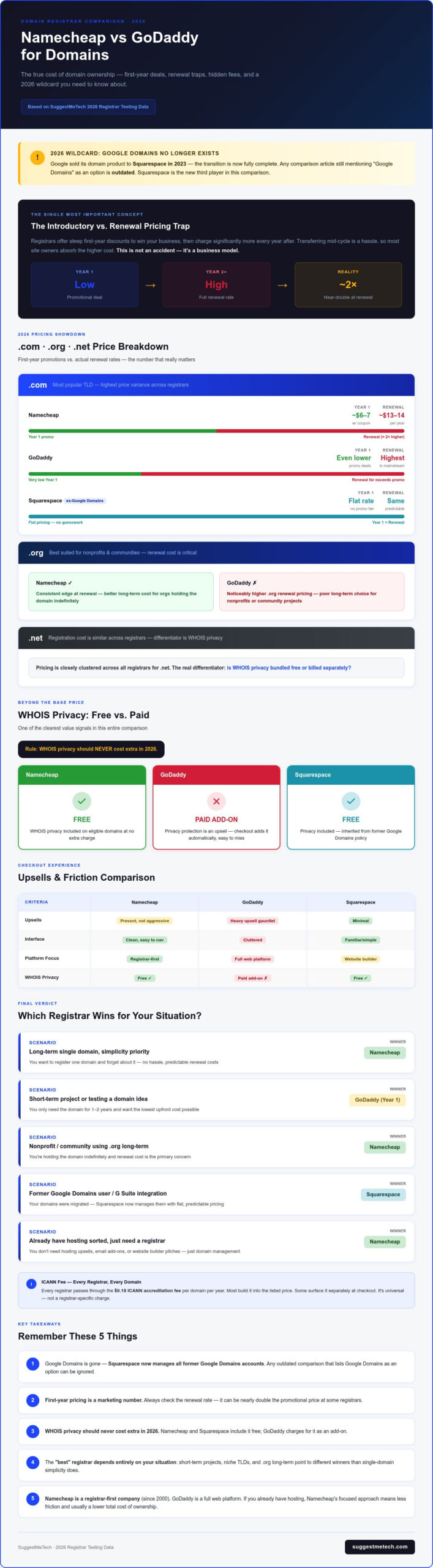
That last distinction matters enormously. The introductory vs. renewal pricing trap is the single most important concept to understand before registering anything. Registrars routinely offer first-year pricing at a steep discount to win your business, then charge a significantly higher rate every year after. You’re essentially locked in by inertia: transferring a domain mid-cycle is a hassle, and many site owners simply absorb the renewal cost rather than deal with it. That’s not an accident. It’s a business model.
What Happened to Google Domains?
Google Domains no longer exists as an independent registrar. Google sold the product to Squarespace in 2023, and by 2026 that transition is fully complete. If you were a Google Domains customer, your domains are now managed through Squarespace’s platform. Billing, DNS management, and renewal notices all route through Squarespace accounts. The seamless Google Workspace integration that made Google Domains attractive to G Suite users still exists, but it’s now Squarespace’s feature to maintain, not Google’s. Some legacy users report the experience is largely unchanged day-to-day; others find the interface less familiar. Either way, if you read a comparison article claiming “Google Domains is the simplest option,” that article is outdated. The product it’s describing doesn’t exist anymore.
Why Namecheap is the Go-To Alternative
Namecheap has operated as a dedicated registrar since 2000, and unlike GoDaddy, it has never tried to become a full-service web platform. That focus shows. The checkout experience is cleaner, upsells are present but not aggressive, and WHOIS privacy protection is included free on eligible domains. In 2026, the “Cheap” in the name still holds up for first-year registrations, though renewal rates have crept upward alongside broader industry pricing trends. The interface has been progressively updated and is genuinely easier to navigate than GoDaddy’s for users who just want to register a domain without clicking through a gauntlet of add-ons.
When you’re evaluating Namecheap vs GoDaddy for domains, Namecheap’s position as a registrar-first company is a meaningful differentiator. GoDaddy wants to sell you hosting, website builders, email, and SSL certificates. Namecheap wants to manage your domains. For buyers who already have hosting sorted, that focused approach translates into less friction and, usually, a lower total cost of ownership.
Direct Pricing Showdown: .com, .org, and .net in 2026
First-year pricing is a marketing number. The real cost of owning a domain is what you pay in year two, year three, and every year after that. That’s the lens you need when comparing Namecheap vs GoDaddy for domains, and it’s where the numbers tell a genuinely different story than most comparison articles show.
Here’s the practical reality for the Big Three TLDs based on SuggestMeTech’s 2026 registrar testing data:
- .com: Namecheap’s first-year promotional price frequently drops to around $6-7 with coupon codes, but renewal rates settle closer to $13-14 per year. Squarespace (the platform now managing former Google Domains customers) charges a flat rate with no promotional tier, which removes the guesswork entirely. GoDaddy’s first-year .com deals can go even lower, but renewal rates are among the highest in the mainstream registrar space.
- .org: Namecheap holds a consistent edge here at renewal. GoDaddy’s .org renewal pricing is noticeably higher, making it a poor long-term choice for nonprofits or community projects that plan to hold the domain indefinitely.
- .net: Pricing is closely clustered across registrars for .net. The differentiator isn’t the registration cost; it’s whether WHOIS privacy is bundled free or billed separately.
On ICANN fees: every registrar passes through the $0.18 ICANN accreditation fee per domain year. Most build it into the listed price. Some surface it as a line item at checkout. Neither approach is inherently deceptive, but if you’re comparing two quotes and one looks slightly lower, check whether that fee is already included before assuming you’ve found a better deal.
Popular TLD Price Comparison
Niche TLDs are where pricing diverges most sharply. The .io, .ai, and .tech extensions carry significantly higher registry wholesale costs, and registrars mark them up differently. Namecheap tends to price .io and .ai competitively, though neither is cheap by any standard. Squarespace’s flat-rate model means what you pay in year one is what you’ll pay at renewal, which is genuinely useful for budget planning even if the upfront number looks higher. Namecheap’s coupon codes (which rotate regularly and are widely available through affiliate and deal sites) can meaningfully reduce first-year costs on these premium TLDs, but that discount evaporates entirely at renewal.
Transfer Pricing: Moving Your Domain
Transferring to Namecheap typically costs the equivalent of one year’s renewal, which effectively gives you a free year of registration as part of the transfer. Squarespace’s incoming transfer policy follows a similar structure for most TLDs. The detail most people miss is the 60-day lock rule: ICANN requires newly registered or recently transferred domains to remain locked at their current registrar for 60 days. If you register somewhere and immediately regret it, you’re waiting two months before you can move. Factor that into any short-term project timeline.
The two-year cost comparison is where Squarespace’s flat pricing occasionally beats Namecheap’s promo-plus-renewal model, particularly for .ai and .tech domains where renewal spikes are steep. Run the math for your specific TLD before defaulting to whichever registrar has the flashier first-year deal. SuggestMeTech’s registrar guides break this down by TLD so you can check your exact extension before committing.
The True Cost of Ownership: Renewals and Hidden Fees
Promotional pricing is a loan you pay back at renewal. That’s the mental model worth carrying into any namecheap vs godaddy for domains evaluation, because the real cost of domain ownership rarely shows up in the headline number. It shows up 12 months later, quietly, on a credit card statement you almost don’t notice.
Namecheap’s Year 2 price jump is real. A .com registered at a promotional rate settles into a renewal rate that’s typically double the first-year price. That’s not unusual in the industry, but Namecheap’s renewal rates have crept upward in recent years, narrowing the gap with competitors that were once significantly more expensive. The “cheap” advantage is strongest in year one. After that, it’s a more competitive picture.
GoDaddy’s renewal rates are consistently among the highest of any mainstream registrar. The first-year deal is aggressive; the renewal is where they recoup it. For any domain you plan to hold beyond 24 months, GoDaddy’s total cost of ownership is almost never the best option.
Squarespace’s flat-rate model removes that guessing game entirely. What you pay to register is what you’ll pay to renew. That predictability has genuine value for long-term brand building, even if the upfront number looks less exciting than a promotional deal. For budget planning across multiple years, flat pricing often wins on simplicity alone.
Multi-year registrations are worth examining before you commit to any registrar. Locking in two or three years at registration locks in the current rate and delays exposure to future price increases. Namecheap offers multi-year registration, though the discount per year is modest. The more meaningful benefit is rate protection, not savings.
One fee most buyers ignore until it’s too late: the redemption fee. If a domain lapses past its expiration date and enters the redemption grace period, recovering it costs significantly more than a standard renewal. Fees vary by registrar and TLD, but they’re typically in the range of $80 to $150 or more on top of the renewal cost. Setting auto-renew isn’t optional if you care about keeping a domain.
The 5-Year Cost Projection
Running a 60-month total for a single .com tells a clearer story than any first-year price comparison. With Namecheap, a promotional first-year registration followed by four renewal cycles at current rates produces a total that’s competitive but no longer dramatically cheaper than alternatives. With GoDaddy, the same calculation produces a noticeably higher total due to elevated renewal rates. Squarespace’s flat model produces a predictable, middle-ground number that’s easy to calculate in advance. For long-term brand domains, the registrar with the lowest renewal rate wins, not the one with the lowest launch price.
Consider this pattern: a site owner registers a .com at a $1.99 promotional rate, feels like they’ve found a deal, then absorbs $18-plus renewals for the next four years. The five-year total ends up higher than if they’d registered at a flat $12-13 rate from day one. The “cheap” domain became one of the more expensive decisions they made that year.
Bulk Domain Management Costs
Managing ten or more domains changes the calculus significantly. Namecheap has historically been the preferred platform for domain investors and developers running larger portfolios, offering a cleaner bulk management interface and volume-friendly pricing structures. Squarespace’s platform is built around the single-site owner experience; bulk management tools are limited, and the flat-rate model doesn’t include tiered discounts for volume. If you’re managing a portfolio of any meaningful size, Namecheap’s infrastructure handles it better. Squarespace is the right call for simplicity at small scale, not for portfolio management.
The bottom line on namecheap vs godaddy for domains from a total cost perspective: calculate your specific TLD’s renewal rate, multiply it by the number of years you realistically plan to hold the domain, and compare that number across registrars before the promotional price influences your decision.
Beyond the Base Price: Privacy and Essential Add-ons
The registration fee is just the opening bid. Where registrars really differentiate themselves is in what they bundle for free versus what they quietly add to your cart by default. In the namecheap vs godaddy for domains debate, this layer of the comparison matters as much as the renewal rates you’ve already seen.
WHOIS Privacy and Security
WHOIS privacy should cost you exactly nothing in 2026. Full stop. ICANN’s 2018 policy changes, combined with GDPR enforcement, effectively made personal data redaction standard practice across the industry. Any registrar still charging for it is monetizing something that’s become a baseline expectation, not a premium feature.
Namecheap’s WhoisGuard is included free for life on eligible domains. There’s no catch buried in the terms beyond the standard caveat that it applies to supported TLDs, not every obscure extension. Squarespace’s privacy handling is integrated directly into the account structure, with no separate toggle to find or add-on to enable. It’s simply on. GoDaddy, by contrast, still lists privacy protection as a paid add-on for many domains. That alone is a meaningful signal about how each company views the customer relationship.
DNSSEC, which protects against DNS spoofing attacks by cryptographically signing your zone records, is available free through both Namecheap and Squarespace. It’s not enabled by default on either platform, so you’ll need to activate it manually. If you’re running an e-commerce site or anything handling user data, enabling DNSSEC is a five-minute task worth doing.
The Upsell Factor
Namecheap’s checkout process is cleaner than GoDaddy’s, but “cleaner” is relative. You’ll still encounter prompts for PremiumDNS, Private Email hosting, SSL certificates, and VPN services before you complete a basic domain registration. Most of these are pre-deselected, which is the right approach, but the volume of options can still trip up buyers who click through quickly without reading.
Squarespace’s checkout is genuinely minimal. The trade-off is less flexibility: you get what they offer, and the add-on ecosystem is smaller. For buyers who just want a domain registered without a decision tree, that simplicity has real value.
On SSL: Namecheap sells paid SSL certificates, but if your hosting provider already includes Let’s Encrypt certificates (most do in 2026), you don’t need to buy one from your registrar. Don’t let the checkout prompt convince you otherwise. Squarespace includes SSL as part of its broader platform, which is useful if you’re also building there, but irrelevant if you’re hosting elsewhere.
Email hosting is the one add-on worth evaluating seriously. Namecheap’s Private Email service is a paid option that works well for basic professional email needs. Squarespace’s Google Workspace integration, inherited from the Google Domains acquisition, is a stronger choice if your team already lives in Gmail. Neither is free, and neither should be an impulse purchase at the domain checkout screen.
Before you add anything to your cart, check what your hosting provider already includes. SuggestMeTech’s registrar guides break down which add-ons are genuinely useful versus redundant based on your existing setup, so you’re not paying twice for the same feature.
Final Verdict: Which Registrar Wins for Your Budget?
There’s no single winner in the namecheap vs godaddy for domains debate. There’s only the right registrar for your specific situation. The sections above have laid out the pricing math, the privacy policies, and the add-on traps. Now it’s time to translate all of that into a clear, actionable call.
GoDaddy doesn’t make the cut for most buyers in 2026. Renewal rates that consistently outpace competitors, a checkout experience built around upsells, and paid privacy protection on a feature the rest of the industry includes for free are three strikes that are hard to argue past. If you’re already a GoDaddy customer, the switching math almost always favors a transfer at your next renewal cycle.
That leaves Namecheap and Squarespace as the two serious contenders, and the choice between them comes down to how you’re using the domain and how long you plan to hold it.
Choose Namecheap If…
- You’re launching an experimental project or short-term site. Promotional first-year pricing makes Namecheap the lowest-cost entry point when you’re not sure a project will stick. Pay less upfront, evaluate, then decide whether to renew or let it go.
- You need a niche TLD at the lowest possible entry price. Namecheap’s competitive pricing on .io, .ai, .tech, and other premium extensions is a genuine advantage for developers and startups shopping for an available name in a crowded space.
- You want a dedicated domain manager separate from your website builder. Namecheap’s registrar-first focus means cleaner DNS management, bulk tools that actually work, and no pressure to migrate your hosting. It’s built for people who already have their stack sorted.
Choose Squarespace If…
- You value flat-rate, predictable renewal pricing. No promotional cliffs, no renewal surprises. What you pay in year one is what you’ll pay in year five. For long-term brand domains, that predictability is worth more than a discounted first year.
- You’re already using Squarespace for web hosting. Keeping your domain and site on the same platform simplifies DNS configuration, billing, and support. The integration is seamless, and the Google Workspace connection inherited from the Google Domains acquisition still works well for teams running on Gmail.
The bottom line: beginners and single-site owners who prioritize simplicity belong on Squarespace. Developers, domain investors, and anyone registering niche TLDs or managing multiple domains belong on Namecheap. Neither Reddit’s blanket “just use Namecheap” nor GoDaddy’s marketing budget should be driving your decision. Your TLD, your timeline, and your renewal tolerance should.
Still comparing options for your specific extension? SuggestMeTech’s registrar guides break down pricing by TLD so you can run the real numbers before you commit.
Your Next Domain Decision Starts Here
The namecheap vs godaddy for domains debate has a clear answer once you stop looking at first-year prices and start looking at total cost of ownership. GoDaddy’s renewal rates make it a poor long-term choice for most buyers. Namecheap wins on flexibility and niche TLD pricing. Squarespace wins on predictability and simplicity for single-site owners who want zero friction.
Three things worth carrying forward: always calculate your renewal rate before registering, never pay extra for WHOIS privacy in 2026, and match your registrar to your actual use case rather than defaulting to whoever has the flashiest promotional deal.
SuggestMeTech’s comparison data is expertly tested for 2026, completely bias-free, and trusted by over 500,000 readers who’ve used it to make smarter tech decisions. You don’t have to guess which registrar fits your TLD and timeline.
Compare current domain prices and start your 2026 project today! The right domain is out there, and now you know exactly where to register it.
Frequently Asked Questions About Namecheap vs GoDaddy for Domains
Is Google Domains still cheaper than Namecheap in 2026?
Google Domains no longer exists as a standalone registrar. Squarespace acquired the product in 2023, and that transition is fully complete by 2026. So the comparison you’re actually making is Namecheap versus Squarespace. Namecheap typically wins on first-year pricing thanks to promotional deals and coupon codes. Squarespace’s flat-rate model often wins over a three-to-five year window, particularly for buyers who want predictable renewal costs without doing the math every year.
Does Namecheap include free WHOIS privacy forever?
Yes, Namecheap’s WhoisGuard is included free for life on supported TLDs. The key caveat is “supported TLDs.” Most mainstream extensions like .com, .org, and .net qualify, but some niche or country-code TLDs don’t. Before registering any extension you’re less familiar with, confirm it’s on Namecheap’s eligible list. You shouldn’t be paying for privacy protection anywhere in 2026, so if a registrar is charging for it, that’s a signal worth taking seriously.
What happens to my Google Domains pricing now that it’s Squarespace?
Squarespace inherited the flat-rate pricing structure from Google Domains, so most former customers haven’t seen dramatic changes to what they pay at renewal. The interface and billing flow through Squarespace accounts now rather than a Google product. If your domain was previously registered at a flat rate, that rate structure generally carried over. What changed is where you log in to manage it and who handles support. Day-to-day domain management is largely unchanged for most users.
How much does a .com domain renewal cost on Namecheap in 2026?
Namecheap’s .com renewal rates have settled in the $13 to $14 per year range based on SuggestMeTech’s 2026 registrar testing data. That’s a meaningful jump from the $6 to $7 promotional first-year pricing you’ll see advertised. The gap between the intro price and the renewal rate is the most important number to track before you register, not the headline deal. If you’re budgeting for a domain you plan to hold long-term, use the renewal rate as your baseline, not the promotional figure.
Is it worth paying for Namecheap’s Premium DNS?
For most personal sites and small business domains, the answer is no. Namecheap’s free BasicDNS is reliable and handles standard use cases without issue. Premium DNS adds features like DNS failover, load balancing, and faster global propagation, which genuinely matter for high-traffic e-commerce sites or applications where uptime is business-critical. If you’re running a site that can absorb a few minutes of DNS downtime without significant consequences, save the money. If you’re running something where every minute of downtime has a direct revenue cost, it’s worth evaluating.
Can I still integrate my domain with Google Workspace easily on Namecheap?
Yes, and it’s straightforward. Google Workspace integration through Namecheap requires adding the MX records Google provides during your Workspace setup. Namecheap’s DNS management interface makes this a manual but uncomplicated process. It’s not the seamless one-click connection that existed inside Google Domains, but it’s a standard DNS configuration task that takes under ten minutes if you follow Google’s published instructions. Squarespace’s inherited Google Workspace integration is slightly more automated if that convenience matters to you.
Are there any hidden fees when transferring from Google Domains to Namecheap?
The transfer itself typically costs the equivalent of one year’s renewal at Namecheap’s rate, which effectively extends your registration by a year as part of the process. That’s standard industry practice, not a hidden fee. The detail to watch is the 60-day ICANN lock rule: domains recently registered or transferred can’t be moved again for 60 days. Beyond that, confirm your domain is unlocked and that the authorization code from Squarespace is ready before initiating. There’s no penalty fee for leaving, just the standard transfer cost.
Which registrar is better for buying multiple domains at once?
Namecheap handles bulk domain management significantly better than Squarespace. Its interface includes bulk search, bulk registration, and portfolio management tools built for users running ten or more domains. Squarespace’s platform is designed around the single-site owner experience, and bulk tools are limited. For domain investors, developers managing client portfolios, or anyone registering multiple extensions of the same brand name, Namecheap is the practical choice. The namecheap vs godaddy for domains comparison at scale also favors Namecheap over GoDaddy, whose bulk tools exist but come with higher per-domain renewal costs.