

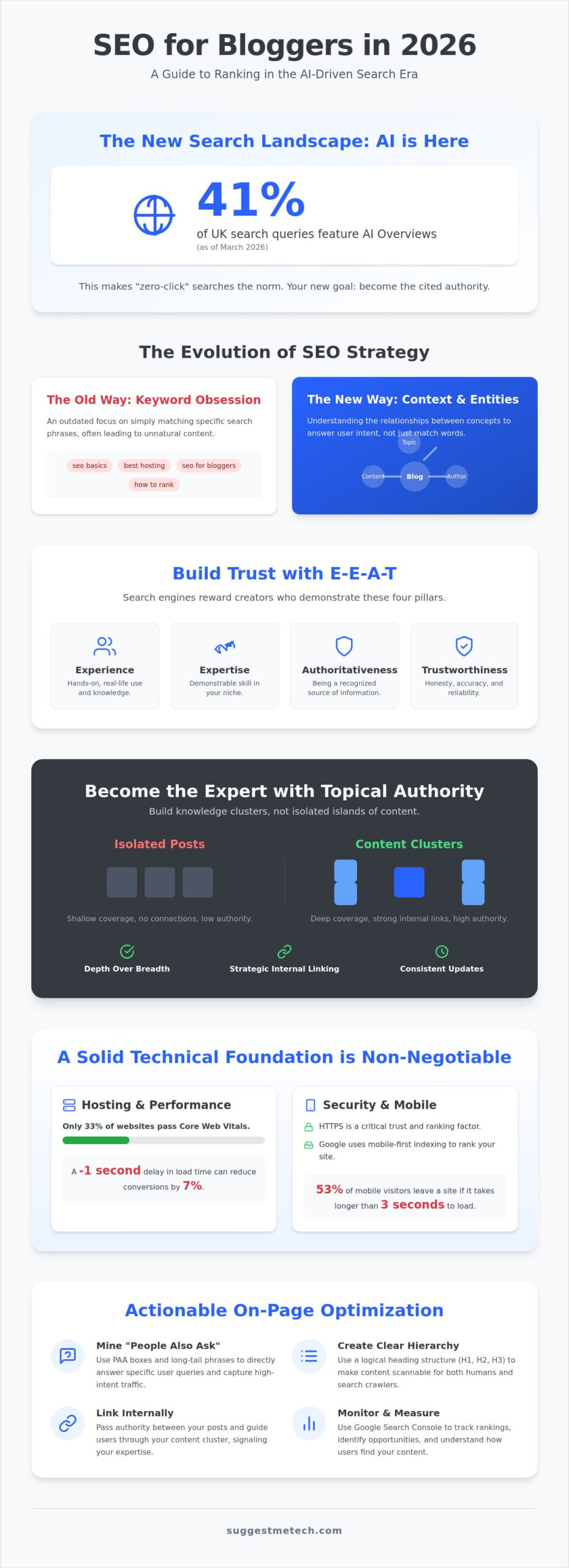
Did you know that as of March 2026, Google’s AI Overviews appear in 41% of UK search queries? If you feel like the goalposts for ranking are moving faster than you can type, you aren’t alone. It’s frustrating to pour your heart into high-quality posts only to see stagnant traffic and confusing algorithm updates. You’ve likely felt the sting of information overload while trying to figure out how to stay relevant in an AI-driven search world.
This guide is designed to cut through that noise. You’ll learn the essential seo basics for bloggers that will help your site stand out to both human readers and AI search engines. We’ve distilled the complex world of 2026 search into a practical framework that focuses on the 20% of strategies that drive 80% of results. We’ll cover everything from building topical authority to the technical infrastructure choices, such as high-performance hosting, that keep your Core Web Vitals in the green. By the end of this guide, you’ll have a clear, future-proof content plan that actually ranks.
Key Takeaways
- Understand the shift from keyword stuffing to “entities” and context, ensuring your blog is structured for how AI search engines interpret information in 2026.
- Learn why your choice of web hosting is a foundational SEO decision that directly impacts your site speed and Core Web Vitals performance.
- Master the seo basics for bloggers by using “People Also Ask” boxes and long-tail phrases to capture traffic from specific audience queries.
- Implement a clear heading hierarchy and on-page optimization strategy to make your content easy for both human readers and search crawlers to digest.
- Use Google Search Console and strategic internal linking to monitor your rankings and pass authority between your most important posts.
SEO Basics for Bloggers: Why Search Engines Care About You in 2026
To understand What is SEO?, you have to look past the technical jargon. At its core, SEO is the practice of making your blog content understandable to search engines. When you master the seo basics for bloggers, you’re essentially building a bridge between your ideas and the people searching for them. In 2026, this bridge isn’t just built with keywords; it’s built with “entities.” Search engines now focus on the relationship between concepts, people, and brands rather than just matching a specific phrase you typed into a box.
Context is the new currency. Google’s algorithm has evolved to prioritize user intent over simple word matches. It asks why someone is searching. Is this person looking to buy something, or do they just want a quick answer? This is where E-E-A-T comes in. Bloggers must demonstrate Experience, Expertise, Authoritativeness, and Trustworthiness. If you’re writing about tech, your personal hands-on experience with a device carries more weight than a generic summary. Search engines want to reward creators who’ve actually “been there and done that.”
The Role of AI in Modern Search
AI Overviews have fundamentally changed how readers consume content. Since these summaries appear in 41% of UK search queries as of March 2026, “zero-click” searches are becoming the norm. This means a user gets their answer without ever clicking your link. While this sounds scary, it makes your brand authority vital. If an AI cites your blog as the source, you become the trusted expert in the reader’s mind. You need to adapt your tone. Be direct and authoritative so AI can parse your facts easily, but stay engaging enough for humans.
Topical Authority: The Blogger’s Secret Weapon
Stop thinking about individual blog posts as isolated islands. Instead, think in “clusters.” Topical authority is the cumulative trust earned in a specific niche. When you write deeply about one subject, you signal to search engines that you’re a specialist. For example, if you’re building a resource for health-conscious home cooks, you can learn more about Meghna’s Food Magic to see how a dedicated recipe database establishes authority. This is one of the most effective seo basics for bloggers because it builds a moat around your traffic that AI updates are less likely to wash away. Moving beyond single-post thinking to cluster thinking creates a network of value.
- Depth over breadth: Covering one niche extensively is better than touching on ten topics shallowly.
- Internal connections: Link your related posts together to show the “map” of your knowledge.
- Consistency: Regular updates on a single theme build a reliable data trail for AI search agents.
Building a Solid Technical Foundation for Your Blog
Many creators focus entirely on their writing, but a poor technical foundation will bury even the best prose. Understanding the technical side of seo basics for bloggers is about removing the friction between your content and your readers. If search engines struggle to crawl your site or if users find it slow, your rankings will suffer regardless of your quality. Think of technical SEO as the plumbing and electricity of your digital home; it’s invisible when it’s working but disastrous when it fails.
Security and mobile compatibility are the non-negotiable table stakes in 2026. HTTPS isn’t just a recommendation; it’s a critical ranking factor that protects user data and builds trust. Similarly, Google’s mobile-first indexing means the search engine primarily looks at the mobile version of your site to determine your rank. With 53% of mobile visitors leaving a site if it takes longer than three seconds to load, your mobile experience is effectively your only experience.
Web Hosting and Performance
Your choice of the best web hosting is your first major SEO decision. It’s the engine under the hood. Server response time directly impacts your Core Web Vitals, specifically the Largest Contentful Paint (LCP). Only 33% of websites currently pass all three Core Web Vitals metrics, so optimizing your speed gives you a massive competitive advantage. A one-second delay in page load time can reduce conversions by 7%. If your site experiences frequent downtime, search engines will quickly view your blog as unreliable and drop your position in the results. Reliable hosting ensures you’re always open for business.
Domain and URL Architecture
Selecting a domain name that reflects your niche and authority is vital for long-term branding. Once your domain is set, your URL architecture must remain logical and clean. Use descriptive slugs that tell search engines exactly what the page contains. Instead of a generic string like yoursite.com/p=123, use a readable format like yoursite.com/seo-basics-for-bloggers. Avoid using “stop words” or including specific dates in your URL strings. This keeps your links evergreen and makes them easier to share on social platforms. For a deeper dive into these fundamentals, you can consult this comprehensive SEO beginner’s guide to ensure your setup is flawless.
If you’re unsure if your current setup is holding you back, you can explore our detailed tech guides at SuggestMeTech to find the right infrastructure for your goals.
Keyword Research: Finding What Your Audience is Actually Asking
Keywords are the heartbeat of your content strategy. While previous sections focused on the technical infrastructure of your blog, keyword research focuses on the “what.” Mastering seo basics for bloggers means moving beyond guessing what people want to read. You need to identify the exact phrases your audience uses when they’re looking for solutions. If you don’t align your language with their search queries, your high-quality writing will remain invisible.
Start by distinguishing between short-tail and long-tail keywords. Short-tail terms are broad, like “blogging.” They’re incredibly difficult to rank for because every major site is competing for them. Long-tail keywords, such as “how to start a tech blog in 2026,” are more specific. They usually have lower search volume, but the intent is much clearer. When someone uses a long-tail phrase, they’re closer to taking an action or making a decision.
Google’s “People Also Ask” (PAA) boxes are a free goldmine for identifying these specific needs. When you search for a topic, Google displays related questions users are actually asking. These questions are ready-made subheadings for your posts. By answering them directly, you align your content with search intent. This intent generally falls into four categories:
- Informational: The user wants to learn something (e.g., “what is a domain name”).
- Navigational: The user is looking for a specific site or brand.
- Commercial: The user is researching products before a purchase.
- Transactional: The user is ready to buy or sign up.
Uncovering Low-Competition Gems
Don’t be discouraged by low search volumes. A keyword with 50 monthly searches can be more valuable than one with 5,000 if those 50 people are looking for a specific solution you provide. To find these gems, head to niche-specific discussion boards or online community platforms. Look for threads where people are frustrated by a lack of clear information. These gaps are your ranking opportunities and represent essential seo basics for bloggers who want to build authority quickly. You can also use the “Alphabet Soup” method. Type your primary topic into Google and then type the letter “a.” Note the autocomplete suggestions, then move to “b.” This reveals real-time search trends that traditional tools often miss.
Topical Mapping and Content Pillars
Organizing your blog into logical categories is essential for both readers and search bots. Instead of writing random posts, create a “Pillar Page.” This is a broad, high-level guide on a main topic that links out to more detailed “cluster” posts. For example, a pillar page about web hosting would link to specific reviews and setup guides. This internal linking structure passes authority between your posts and proves to search engines that you have a deep understanding of your niche. It turns your blog from a collection of articles into a comprehensive resource that’s easy to navigate.
On-Page SEO: Optimising Your Posts for Maximum Visibility
Once you’ve handled the technical setup and keyword research, it’s time to focus on the content itself. On-page SEO is about structuring your individual posts so search engines understand exactly what you’re offering. It’s not just about “writing good content.” It’s about providing a clear map that crawlers can follow. When you follow these seo basics for bloggers, you ensure your expertise isn’t lost in a sea of unstructured data.
A perfectly optimised post starts with a logical heading hierarchy. Your H1 tag is your title; you should only have one per page. Use H2 tags for your main sections and H3 tags for sub-points within those sections. Never skip levels. This structure tells search engines which information is most important. It also helps readers scan your post to find the answers they need quickly. Clear headings are essential for 2026 search engines that prioritise structured data.
Your title tag and meta description are your first impression in the search results. Think of them as your “ad copy.” A compelling title tag increases your Click-Through Rate (CTR), which signals to search engines that your content is what users want. Don’t forget image alt text, either. Describing your images helps visually impaired users and allows your blog to show up in image search results. This provides another valuable traffic source that many bloggers overlook.
The Power of the First 100 Words
The beginning of your post is prime real estate. You must include your primary keyword within the first 100 words to confirm the topic for search engines. It’s equally important to hook your reader immediately. If a visitor lands on your page and leaves right away, your bounce rate increases. Bounce rate is a secondary signal of content relevance; it tells search engines that your page might not have satisfied the user’s query.
Readability and User Experience
Reading on a screen is different from reading a book. Use short paragraphs and frequent bullet points to improve scannability. This keeps readers engaged and increases your “dwell time,” which is the total time a visitor spends on your page. The longer they stay, the more authority you build in the eyes of the algorithm. If you’re still in the early stages of your journey, check out our guide on how to start a blog to ensure your site’s foundation is ready for these advanced strategies.
Consistent on-page optimisation turns your blog into a high-performance asset. For more hands-on advice and expert tool reviews, visit SuggestMeTech to level up your digital strategy.
Post-Publishing: Measuring Success and Building Authority
Publishing your post is only the beginning of the journey. To truly master the seo basics for bloggers, you must understand how to measure your performance and grow your site’s authority over time. Search engines don’t just look at what you wrote today; they look at how your entire site evolves and how other creators interact with your work. If you stop at the “publish” button, you’re leaving most of your potential traffic on the table.
Google Search Console (GSC) is your most important post-publishing tool. It’s your direct line to how Google sees your site. Unlike third-party tools that estimate your rankings, GSC provides actual data on which queries bring people to your blog and whether your pages have indexing issues. While you wait for organic rankings to climb, use social media to drive initial traffic. These early visits send positive signals to search engines about your content’s relevance and user engagement.
Building authority also requires a smart link strategy. While many experts obsess over external backlinks, internal linking is often the most underrated part of seo basics for bloggers. By linking your new posts to older, high-performing articles, you pass “link juice” throughout your site. This helps search engines crawl your content more efficiently and keeps readers on your site longer. When you do pursue backlinks from other sites, remember that quality always beats quantity. One link from a trusted, relevant source in your niche is worth more than a hundred links from low-quality directories.
Essential SEO Tools for Bloggers
You don’t need a massive budget to track your success, but you do need the right data. Google Search Console tells you how you’re performing in search results, while Google Analytics (GA4) tells you what users do once they arrive. Use free tools like PageSpeed Insights to monitor your mobile-friendliness and loading times. On the technical side, performing regular maintenance like cache clearing and cleaning up your database keeps your site lean and fast for your visitors.
The Long Game: Updating and Pruning Content
SEO isn’t a “set it and forget it” task. Often, refreshing an old blog post with updated data or better images is faster and more effective than writing something from scratch. Review your content quarterly to identify underperforming pages. If a post no longer adds value, you have three choices:
- Refresh: Update the information and re-publish it with a current date.
- Redirect: Point the URL to a newer, better post on the same topic to preserve authority.
- Delete: Remove content that’s irrelevant or low-quality to improve your overall site health.
A consistent audit schedule ensures your blog remains a high-authority resource that search engines love to recommend in 2026 and beyond.
Master Your Search Strategy Today
Success in the 2026 search landscape isn’t about chasing every minor algorithm tweak. It’s about building a reliable framework of topical authority and technical excellence. You’ve learned how to transition from keywords to entities, why your hosting choice directly impacts your Core Web Vitals, and the importance of a logical heading hierarchy. These seo basics for bloggers ensure your content is citable by AI while staying deeply engaging for your human audience.
Your journey doesn’t end with a single post. It requires consistent measurement and the right infrastructure to support your growth. At SuggestMeTech, we provide unbiased technology comparisons and practical guides for digital creators. We’re a community-focused team dedicated to demystifying the tech side of blogging. If you’re ready to solidify your site’s foundation, check out our expert reviews of the best web hosting for bloggers.
SEO is a marathon, not a sprint. By focusing on the strategies that drive the most impact, you’ll build a blog that stands the test of time. Keep refining your approach, stay curious about new updates, and get ready to see your traffic reach new heights.
Frequently Asked Questions
How long does it take for a blog post to rank on Google?
It typically takes three to six months for a new blog post to reach its peak position on Google. This timeframe depends on your site’s existing authority and the level of competition for your specific topic. While some posts might appear in search results within days, the algorithm needs time to evaluate user engagement signals and compare your content against established competitors.
Do I need a paid SEO tool to be successful as a blogger?
You don’t need expensive paid tools to find success when starting with seo basics for bloggers. Free resources like Google Search Console and Google Analytics provide the most accurate data directly from the source. While paid platforms offer advanced competitor research, you can achieve significant results by mastering these free tools and focusing on high-quality, helpful content that answers user questions.
Is keyword stuffing still a thing in 2026?
Keyword stuffing is completely obsolete and will likely result in a ranking penalty in 2026. Search engines now use sophisticated AI to understand the context and intent of your writing rather than just counting words. Instead of repeating the same phrase, focus on using related terms and providing a comprehensive answer to the user’s query. Natural language is always the best choice.
How often should I publish new blog posts for SEO?
Quality and consistency are far more important than the total number of posts you publish each week. Aiming for one high-quality, well-researched post per week is often more effective than publishing mediocre content daily. Search engines reward blogs that provide reliable, deep-dive information rather than those that produce shallow, repetitive updates just to stay active. Consistency helps crawlers index your site regularly.
What is the most important SEO factor for a new blog?
Establishing topical authority is the most critical factor for a new blog’s success. You should focus on becoming the go-to resource for a specific niche rather than covering broad, unrelated topics. When you combine this focused content with a fast, secure technical foundation, you signal to search engines that your site is a trustworthy and expert source of information for your audience.
Can I do SEO for my blog without being a tech expert?
You definitely don’t need to be a technical expert to implement effective seo basics for bloggers. Most modern blogging platforms handle the heavy lifting, like creating sitemaps and mobile-responsive designs, automatically. To gain more confidence in building your site, check out TechKnowPhobia for coaching specifically designed to help you launch your first income-generating website. By following simple structural rules, such as using descriptive URLs and proper heading hierarchies, you can compete with larger sites without ever needing to write a single line of code.
How do I know if my SEO strategy is actually working?
The best way to know if your strategy is working is to monitor your “Impressions” in Google Search Console. This metric shows how often your site appears in search results, even if users don’t click yet. An upward trend in impressions is the earliest sign of SEO success. This is usually followed by an increase in clicks and higher rankings for your target keywords.
Should I focus on backlinks or content quality first?
You should always prioritize content quality over backlink building in the early stages of your blog. A site filled with low-quality content won’t rank even with hundreds of links; however, exceptional content often attracts natural backlinks on its own. Focus on creating the best possible resource for your audience first, then look for opportunities to promote it and earn mentions from other authoritative sites.