What if the “HEPA-type” filter you bought is actually doing nothing to stop your morning sneezing fits? It’s incredibly frustrating to spend money on a device only to wake up with the same itchy eyes and congestion you had before. Finding the best air purifier for allergies shouldn’t require a degree in atmospheric science, but confusing marketing terms and hidden filter costs make the process feel like a gamble. You want a home or office where the air is actually clean, not just a machine that makes a lot of noise while your symptoms persist.
We’ve analyzed the latest 2026 tech to help you cut through the jargon and find a solution that works. You’ll discover which air purification technologies actually neutralize allergens and which models, like the Levoit Core 400S or the Rabbit Air A3, offer the best real-world performance for your space. We’ll show you how to use CADR ratings and smart sensor automation to achieve a significant reduction in sneezing without the high noise levels that ruin your sleep. This guide breaks down the total cost of ownership and highlights the top smart features that make managing your air quality as simple as checking your smartphone.
Key Takeaways
- Learn why True HEPA H13 or H14 filtration is the only non-negotiable standard for neutralizing airborne allergens effectively.
- Identify common marketing gimmicks like ionizers and UV-C lights that often provide more hype than actual health benefits.
- Discover how to automate your environment using PM2.5 sensors and smartphone integration for hands-off air quality management.
- Calculate the “filter tax” and energy efficiency ratings to choose the best air purifier for allergies that fits your long-term budget.
- Find specialized quiet-operation units designed to keep your home office productive without disrupting video meetings or focus sessions.
Understanding the Tech: HEPA, CADR, and Micron Ratings
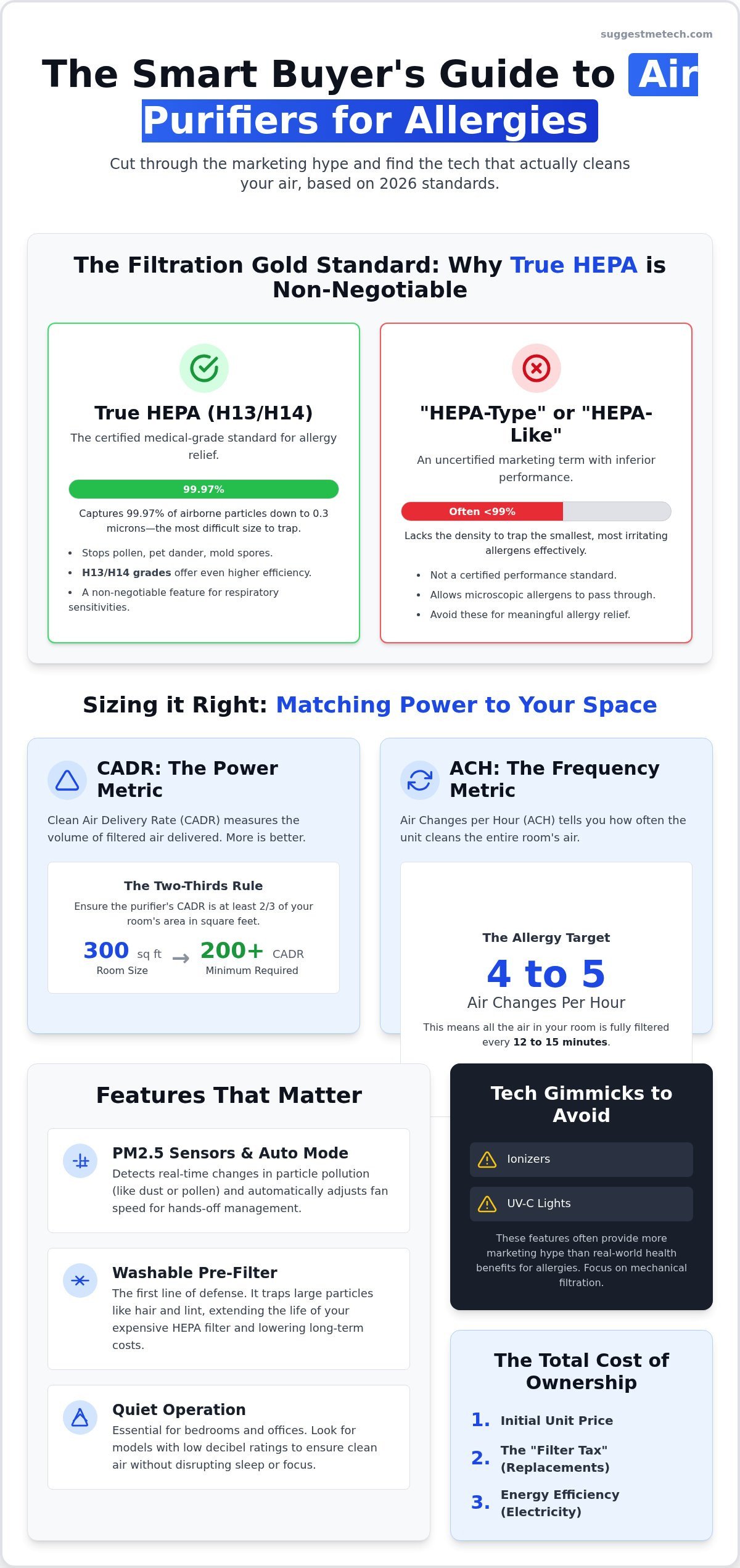
Selecting the best air purifier for allergies requires looking past glossy plastic exteriors and focusing on the physics of filtration. Most common allergens like pollen, pet dander, and mold spores are microscopic. To stop them, a device needs to target particles as small as 0.3 microns. This specific size is known as the most penetrating particle size because it is the hardest to trap. If your purifier cannot handle this threshold, the smallest and most irritating allergens will simply cycle back into your living space.
You should also look for a robust pre-filter. This is the first line of defense that captures large dust bunnies, hair, and lint. While it doesn’t stop the tiny allergens, it prevents the more expensive HEPA filter from clogging prematurely. Many modern units use washable or vacuum-friendly pre-filters, which helps lower your long-term maintenance costs while keeping the main filtration system efficient.
HEPA vs. HEPA-Type: The Marketing Trap
Marketing teams often use the term “HEPA-like” or “HEPA-type” to suggest high performance without the cost of certification. These filters are usually made of synthetic materials that lack the density of a True HEPA filter. HEPA is a mechanical standard for 99.97% efficiency at the 0.3-micron level. For those with severe respiratory sensitivities, medical-grade H13 or H14 filters are the non-negotiable gold standard. These higher classifications, such as H13, capture 99.95% of particles down to 0.2 microns, providing a much higher level of protection than uncertified alternatives.
CADR Ratings: Matching Tech to Your Square Footage
The Clean Air Delivery Rate (CADR) is a metric from the Association of Home Appliance Manufacturers that measures the volume of filtered air a unit delivers in cubic feet per minute. It’s not enough to have a great filter; the machine must move enough air to clean the entire room. Follow the “two-thirds” rule: your unit’s CADR should be at least two-thirds of the room’s square footage. For example, a 300-square-foot room requires a CADR of at least 200 for effective results.
Aim for a device that provides 4 to 5 Air Changes per Hour (ACH). This ensures the air is cycled and cleaned every 12 to 15 minutes. A smart strategy for a home office or bedroom is to buy a high-CADR unit and run it on a lower speed. This allows the machine to maintain high air quality while operating at a much lower decibel level, ensuring your work calls or sleep remain undisturbed. Using the best air purifier for allergies means finding this balance between raw power and quiet, real-world usability.
The Best Air Purifiers for Allergies in 2026
Finding the best air purifier for allergies means matching specific hardware to your daily environment. We’ve evaluated the current market to find models that balance filtration efficiency with user-friendly tech. For large open floor plans, the Coway Airmega 400s remains a powerhouse. It uses a dual-suction design with True HEPA filters on both sides to maximize air intake. This setup allows it to handle high-ceiling spaces without struggling, making it ideal for living rooms or large studios where allergens tend to settle.
If you’re outfitting a workspace, silence is just as important as air quality. The Blueair Blue Pure 311i+ Max offers an excellent noise-to-performance ratio. It clears the air effectively without creating a hum that disrupts your video calls or focus. It’s a natural addition to a desk featuring the best laptops of the year. For those on a strict budget, look for reliable H13 filtration units under $150. These models often strip away “smart” features to focus purely on mechanical filtration, providing medical-grade air cleaning without the premium price tag.
For a “Buy It For Life” approach, prioritize units with industrial-grade components. Models with DC motors and heavy-duty steel casings might cost more upfront, but they offer significantly better long-term durability than all-plastic alternatives. If you’re building out a complete tech ecosystem, browse our other curated guides to see how these devices fit into a modern home.
The Premium Pick: Maximum CADR and Sensor Precision
The Rabbit Air A3 stands out for users who want granular control over their environment. It features a high-precision laser particle sensor that provides real-time feedback on air quality, adjusting fan speeds instantly when it detects a spike in pollen or dust. While its proprietary filter tech is highly effective at neutralizing allergens, the specialized replacement filters can be more expensive than standard H13 options. It’s a trade-off between top-tier technical performance and ongoing maintenance costs.
The Best Compact Tech for Bedrooms and Small Offices
Sleep quality often dictates how well you manage allergy symptoms. The Levoit Core 400S is a standout for bedrooms because of its dedicated sleep mode. This setting drops noise levels to near-silent decibels and dims all display lights to prevent sleep disruption. Remember that small units require more frequent maintenance to stay efficient. Check your pre-filter every two weeks to ensure pet hair isn’t choking the intake and forcing the motor to work harder than necessary.
Allergy Tech to Avoid: Marketing Gimmicks vs. Science
When searching for the best air purifier for allergies, you’ll encounter plenty of “breakthrough” technologies that promise to destroy pollutants at a molecular level. While these features look great on a spec sheet, many are ineffective or even counterproductive for respiratory health. It’s vital to separate clinical-grade filtration from high-priced marketing gimmicks that offer little real-world benefit. Some electronic features can even introduce new irritants into your home, defeating the purpose of buying a purifier in the first place.
Ozone generation is a primary concern with certain “electronic” or “ionic” air cleaners. While ozone is effective at neutralizing odors in industrial settings, it is a known lung irritant that can trigger asthma attacks and worsen allergy symptoms. Even “low ozone” models can reach problematic levels in small, poorly ventilated rooms like a home office or nursery. If a product description focuses more on “refreshing the air” than on its CADR rating or HEPA certification, it is likely relying on chemistry rather than physics to clean your air.
Why Ionization Can Backfire for Allergy Sufferers
Ionizers work by releasing negative ions that attach to airborne particles like dust and pollen. This process makes the particles clump together so they become heavy and fall out of the air. However, this creates a significant problem: those clumped particles often settle on your furniture, walls, and floors. They don’t disappear; they just wait to be kicked back into the air when you sit on the couch or walk across the room. More importantly, these charged particles are actually more likely to stick to your lung tissue than uncharged ones. Most experts recommend identifying the ionization setting on your device and disabling it to avoid these risks.
The Efficiency Gap: Washable vs. Disposable Filters
The allure of a “permanent” filter is strong because it promises to eliminate the “filter tax” of ongoing replacements. Unfortunately, these filters rarely meet True HEPA standards after their first few months of use. The technical decline of filtration efficiency is steep; each wash cycle can create microscopic tears in the filter media or cause the fibers to shift and bunch. These tiny gaps allow the very allergens you’re trying to avoid to pass right through the system. Because of this inevitable degradation, mechanical disposable filters remain the safest bet for allergy tech, as they provide a guaranteed level of particle capture throughout their entire lifespan.
UV-C lights and PECO (Photoelectrochemical Oxidation) are other high-priced additions that often fail to deliver. For UV-C to kill mold or bacteria, the air must have a specific “dwell time” under the light. In a fast-moving air stream, the exposure lasts only a fraction of a second, which is insufficient for sterilization. Stick to the proven science of high-density mechanical filters to ensure you are getting the best air purifier for allergies without wasting money on unproven tech.
Smart Home Integration for Automated Allergy Relief
Modern air quality management is moving away from manual dials and toward reactive automation. The best air purifier for allergies in 2026 isn’t just about the filter; it’s about the onboard intelligence that detects a problem before you start sneezing. By utilizing high-precision PM2.5 sensors, these devices can trigger a high-speed “Turbo Mode” the moment they detect a spike in airborne particles. This proactive approach ensures your home remains a sanctuary even during peak pollen seasons or after you’ve finished a dusty cleaning session.
Sensor Accuracy: Laser vs. Infrared
If you want reliable automation, you must look at the sensor technology under the hood. Older or budget models often rely on infrared sensors, which struggle to distinguish between actual pollutants and simple steam or heavy humidity. Tech-savvy buyers should insist on laser-based particle counters. These sensors provide a much more accurate reading of the Air Quality Index (AQI), allowing the machine to calibrate its auto-mode sensitivity with professional-grade precision. Check the device’s physical display; a real-time numerical AQI readout is a hallmark of a high-quality sensor setup.
Ecosystem Compatibility: Alexa, Google, and HomeKit
A truly smart purifier should work with your existing lifestyle tech. Whether you are listening to music on your headphones or working at your desk, voice assistant integration allows for hands-free control. Brands like Rabbit Air and Coway offer some of the best native app experiences in 2026, featuring detailed filter life tracking and remote scheduling. You can even set up geofencing so the unit kicks into high gear thirty minutes before you arrive home, ensuring the air is scrubbed clean the moment you walk through the door.
Managing these smart features requires a responsive mobile interface. If your smart home dashboard feels sluggish, you might need to learn how to clear cache on iPhone to keep your apps running at peak speed. For advanced automation, link your purifier to local weather data via IFTTT. This allows the device to ramp up filtration automatically when local pollen counts reach a specific threshold, providing a layer of defense that traditional machines simply cannot match. Explore our full library of tech reviews to find the perfect smart device for your home ecosystem.
Total Cost of Ownership: The 5-Year Tech Strategy
The sticker price of a new device is only the first chapter of your investment. When you’re hunting for the best air purifier for allergies, you have to look at the long-term “filter tax” and energy requirements. Over a five-year period, maintenance costs can easily double the initial purchase price. Choosing a unit with a low upfront cost but expensive, proprietary filters can be a financial trap. A smarter strategy is to evaluate the total cost of operation, including replacement intervals and electricity draw, to ensure your clean air doesn’t become a budget burden.
Filter Longevity and Genuine vs. Third-Party Tech
Filter life is the biggest variable in your ongoing costs. While cheap third-party HEPA filters are tempting, they often feature poor seal gaskets that allow unfiltered air to bypass the media entirely. This effectively ruins the performance of even the best air purifier for allergies. Genuine filters are designed for specific airflow resistance, ensuring the motor doesn’t overheat. Many modern brands now offer subscription memberships. These can be a good deal if they provide a 10% to 15% discount on filters you’d buy anyway, but always check if the “smart” sensor is actually extending your filter life or just running on a fixed timer.
Energy Consumption: The Silent Cost
Since allergy relief requires 24/7 operation, the motor type matters immensely. DC motors are the superior choice over older AC motors because they consume significantly less power at lower speeds. Look for the Energy Star 2.0 certification, which requires a smoke CADR of at least 2.9 times the wattage for larger units. Running a high-efficiency model on “Auto Mode” is your best tool for reducing bills. This allows the device to sip power when the air is clean and only ramp up when the laser sensors detect a spike in pollutants.
Build quality also dictates your long-term satisfaction. Identifying “Buy It For Life” candidates means looking for warranties that cover the motor for at least five years. A productive home office depends on reliable tech that won’t fail during a peak allergy season. We want to hear from our community: what has your long-term experience been with filter replacement costs? Share your thoughts in the comments below.
Final Checklist: 5 Questions Before You Buy
- Annual Filter Cost: Is the replacement cost less than 20% of the initial unit price?
- Motor Type: Does the unit utilize a high-efficiency DC motor?
- Sensor Type: Is the automation driven by a laser-based particle counter?
- Warranty: Does the manufacturer offer a multi-year guarantee on the fan and motor?
- CADR Match: Is the CADR rating at least two-thirds of your room’s square footage?
Take Control of Your Indoor Air Quality Today
Investing in a healthier home environment starts with looking past the marketing buzz and focusing on verified mechanical standards. You now know that True HEPA H13 or H14 filtration is the only way to effectively capture 0.3-micron allergens; matching your device’s CADR to your specific room size is critical for real-world performance. By avoiding gimmicks like ozone-generating ionizers and prioritizing smart, laser-based sensors, you can create an automated system that protects your respiratory health around the clock.
Choosing the best air purifier for allergies doesn’t have to be a guessing game when you have the right technical data. We’ve done the heavy lifting by conducting independent testing of over 50 models. Our evaluations focus on the long-term cost of ownership and provide expert smart home integration advice for a seamless setup.
Check out our top-rated air purifiers on SuggestMeTech to find the perfect match for your lifestyle. You’re just one step away from waking up without the congestion and itchy eyes that have held you back. Clearer air and better sleep are well within your reach.
Frequently Asked Questions
Do air purifiers really help with seasonal allergies?
Air purifiers effectively reduce seasonal allergy symptoms by physically removing pollen and mold spores from your indoor environment. When you use the best air purifier for allergies, the mechanical filtration traps these particles before they can settle on surfaces or be inhaled. This leads to a noticeable decrease in sneezing and nasal congestion. To get the most benefit, keep windows closed during high pollen days to prevent new allergens from entering the space.
Where is the best place to put an air purifier for allergies?
The ideal placement is in the room where you spend the most time, typically the bedroom or home office. Position the unit at least three feet away from walls or furniture to ensure unobstructed airflow into the intake vents. For maximum relief, place the device near the head of your bed or close to your desk. Avoid corners or tucked-away spots that prevent the machine from circulating air throughout the entire room.
How long should I run my air purifier each day for best results?
You should run your air purifier 24 hours a day to maintain a consistent level of clean air. Allergens are constantly introduced into your home through open doors, clothing, and pets, so a “set it and forget it” approach is most effective. Modern units with high-efficiency DC motors consume very little electricity on lower speeds. If your device has an auto-mode, it will adjust fan speeds based on real-time air quality spikes while you sleep.
Can an air purifier help with pet dander and cat allergies?
Air purifiers are highly effective at capturing pet dander, which consists of tiny skin flakes and proteins that trigger cat and dog allergies. Because these particles are extremely light, they remain airborne for long periods. A True HEPA filter captures 99.97% of these irritants. Using the best air purifier for allergies in homes with pets also helps reduce the overall dust load, though you should still vacuum frequently to handle hair on carpets.
Is a HEPA filter enough, or do I need an activated carbon filter too?
A HEPA filter is essential for physical particles like pollen, but an activated carbon filter is necessary if you also want to remove odors, smoke, or volatile organic compounds (VOCs). Most top-rated models use a multi-stage system that includes both. While the HEPA filter handles the microscopic allergens, the carbon layer uses a process called adsorption to trap gases. This combination provides the most comprehensive protection for a modern indoor environment.
How often do I realistically need to replace the HEPA filter?
Realistically, you should replace your HEPA filter every 6 to 12 months. This timeframe varies based on your local air quality and whether you have pets or smokers in the house. Heavy pollen seasons might clog filters faster than usual. Always check the manufacturer’s indicator light, but also perform a visual inspection. If the filter media appears dark gray or visibly dusty, it is time for a fresh replacement to maintain airflow and efficiency.
Do air purifiers help with dust mites in the bedroom?
Air purifiers help by capturing airborne dust mite waste and body parts, which are common respiratory triggers. However, they cannot remove mites living deep inside your mattress, pillows, or carpets. To fully manage dust mite allergies, combine your air purifier with allergen-proof bed covers and regular hot-water washing. The purifier acts as a secondary defense by cleaning the air that gets disturbed when you move around or make the bed during the day.
What is the difference between an air purifier and an air humidifier?
An air purifier cleans the air by removing pollutants like dust and pollen through a filtration system. In contrast, an air humidifier adds moisture to the air to prevent dryness that can irritate the throat and skin. While they serve different purposes, they can be used together. A purifier removes the allergens that cause inflammation, while a humidifier keeps your respiratory passages moist, which can help soothe existing allergy-related irritation during dry seasons.