

You have the perfect business idea, but every killer .com you come up with is already taken. This common roadblock makes learning how to choose a domain name feel more like a compromise than an exciting first step. You’re left staring at a sea of .io, .co, and .tech extensions, wondering if they’ll help or hurt your brand while fearing you might pick a name that limits your growth before you even launch. The pressure to get this foundational piece right is immense, but you don’t have to navigate it alone.
In this strategic guide, we’ll show you how to master the art of domain selection for 2026 and beyond. We’ll demystify the new TLDs, provide a practical framework for brainstorming a memorable and brandable name, and outline a clear path to registration. By the end, you’ll have the confidence and the tools to secure a domain that not only represents your vision but also sets your website up for long-term SEO success.
Key Takeaways
- Treat your domain name as a primary branding investment to build instant credibility and user trust.
- Understand the psychological impact of different TLDs to make a strategic choice that aligns with your brand’s long-term goals.
- Master how to choose a domain name by applying proven brainstorming methods and using modern tools to find great alternatives.
- Finalize your choice with a pre-registration checklist that covers registrar reputation and essential privacy protection.
Why Your Domain Name is Your Most Critical Digital Asset
Before you even think about website design or content strategy, you need to secure your digital real estate: your domain name. This isn’t just a web address; it’s the foundation of your online brand, the first impression you make on visitors, and a critical factor in your long-term SEO success. Understanding its importance is the first step in learning how to choose a domain name that will serve you for years, because changing it later is a technical and branding nightmare we wouldn’t wish on anyone.
Your domain is woven into every link, email address, and piece of marketing material you create. It’s how customers will find, remember, and trust you online. Getting this foundational piece right from the start saves you from costly and complex migrations down the road.
The Psychology of a Great Web Address
A great domain is easy for the human brain to process. This concept, known as cognitive ease, means a simple, intuitive name like dropbox.com is remembered far longer than a complex or hyphenated one. This directly impacts “type-in” traffic-users who remember your name and type it directly into their browser. On mobile, where every character counts, a shorter, clearer domain reduces typos and frustration, creating a smoother user experience from the very first interaction.
Domain Names vs. Brand Names: Do They Have to Match?
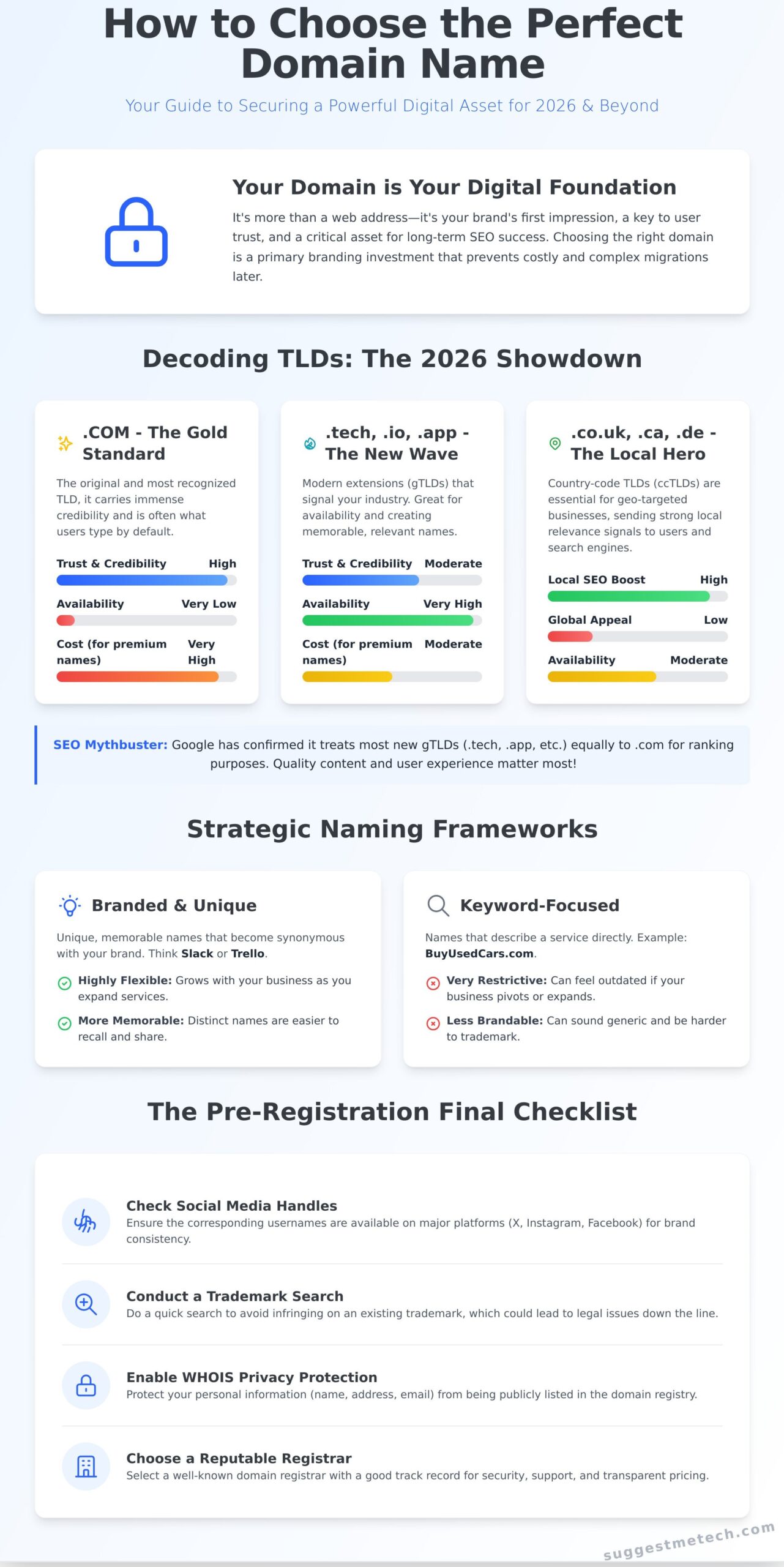
While an exact-match domain (EMD) like buyusedcars.com was once an SEO shortcut, modern strategy favors unique, branded domains. Names like slack.com or trello.com contain no keywords but are memorable and distinct. This approach provides crucial flexibility. If your business pivots or expands, a branded name grows with you, whereas a keyword-focused domain can feel restrictive and outdated when you want to offer new services.
Ultimately, your domain is the human-friendly label for your website’s numerical IP address, translated by the global Domain Name System (DNS). Migrating to a new domain means rebuilding SEO authority from scratch, updating countless business assets, and risking massive brand confusion. Investing the time to choose the right one now is the most valuable decision you can make for your digital future.
Decoding TLDs: Is the .com Still the Gold Standard in 2026?
Your Top-Level Domain (TLD) is the part of your web address that comes after the final dot-think .com, .org, or .net. While it may seem like a small detail, your TLD plays a crucial role in shaping user perception, building trust, and defining your brand’s identity online. For decades, .com has been the undisputed champion, but with hundreds of new options available, the digital landscape has evolved.
The historical dominance of .com is undeniable. As one of the original TLDs, it built immense credibility and became a mental shortcut for internet users. Many people still instinctively type .com when searching for a business, giving it a powerful psychological advantage. However, this popularity means that short, memorable .com domains are incredibly scarce and often expensive, forcing businesses to explore alternatives.
This scarcity has fueled the rise of a new generation of TLDs. These generally fall into two categories:
- Generic TLDs (gTLDs): These are descriptive extensions like .tech, .app, .store, or .io that can immediately signal your industry or purpose.
- Country-Code TLDs (ccTLDs): These are tied to specific countries, like .co.uk (United Kingdom) or .ca (Canada), and are essential for businesses focused on a local market.
The Pros and Cons of Alternative Extensions
Opting for a gTLD like yourbrand.design offers a huge availability advantage and can create a highly relevant, memorable name. However, some newer or more obscure extensions can be perceived as less credible, so it’s vital to choose one that aligns with your industry. Your domain is a core business asset, and learning protecting your brand identity starts with picking an extension that inspires confidence. A key part of learning how to choose a domain name is balancing creativity with credibility.
The SEO Impact of Your Extension
Many business owners worry that a non-.com domain will hurt their search rankings. While .com may have a slight edge due to user familiarity, Google has stated it does not give them preferential treatment. In fact, Google treats most new generic TLDs equally for ranking purposes. The primary exception is ccTLDs; using a .de extension, for example, sends a powerful signal to search engines that your site is highly relevant to users in Germany, which can significantly boost your local search visibility. Ultimately, a quality website with a relevant, trustworthy domain will perform well, regardless of the TLD.
Strategic Naming Frameworks: How to Brainstorm the Perfect Name
Staring at a blank screen is often the hardest part of finding the perfect domain. Instead of waiting for a single brilliant idea to strike, a structured approach can help you generate dozens of high-quality possibilities. These proven frameworks move you from brainstorming to a solid shortlist, making the process of how to choose a domain name far more efficient.
Consider these four popular naming strategies:
- The Dictionary Method: Using a single, real word can create an authoritative, premium feel. Think Stripe.com or Plum.com. These are often difficult to find as available .coms but are incredibly powerful when you can secure one.
- The Compound Method: Join two relevant words to create a clear, descriptive concept. This is the model behind giants like FaceBook and YouTube. It’s memorable and immediately communicates what you do.
- The Blended Method: Create a unique, brandable name by merging parts of two different words. Instagram (Instant + Telegram) and Pinterest (Pin + Interest) are classic examples of this creative and effective approach.
- The Prefix/Suffix Strategy: Add a common word to your primary keyword to increase availability. Think GetResponse, MyFitnessPal, or adding modifiers like “HQ,” “Lab,” or “Co” at the end (e.g., DesignCo.com).
Once you have a list of potential names, it’s time to put them through a few critical real-world tests.
The Loud Bar Test and Phonetic Branding
Your domain must be easy to say and spell. Imagine telling someone your website over a poor phone connection or in a loud room. If they have to ask, “Is that with two T’s?” you have a problem. Avoid confusing double letters (like businesssolutions.com) and hyphens, which are impossible to communicate verbally. The best test is a practical one: tell a non-tech friend your top choice and see if they can type it correctly on the first try.
Keyword Integration Without Looking Like Spam
A key challenge in learning how to choose a domain name is balancing SEO with brandability. While including a keyword can help search engines understand your site, avoid over-optimizing. A name like buycheapdslrcamerasonline.com looks spammy and severely limits your brand’s future. Instead, aim for a broader term that allows for growth, such as cameragearpro.com, which signals authority without locking you into a single, narrow niche.
How to Find a Domain When Everything is Taken
You’ve found the perfect name, but the .com is already registered. It’s a common roadblock, but it’s not the end of the road. Learning how to choose a domain name often involves creative problem-solving when your first choice is gone. Here are four practical strategies to find a great alternative.
First, try the “Modifier Hack.” This simple trick involves adding a verb or descriptor to your core idea. If “PixelPro.com” is taken, you could try “GetPixelPro.com,” “PixelPro.co,” or “PixelProStudio.com.” This approach is fast, easy, and can often produce a memorable and available option.
Using AI Tools for Creative Brainstorming
Leverage AI to scale up your brainstorming. Prompt a tool like ChatGPT or a dedicated generator with your core keywords, industry, and desired tone. For example: “Suggest 10 short, brandable .com domains for a tech review site.” Filter the results for simplicity and brand appeal. Our top AI-powered tool suggestions are:
- NameLix: Generates short, catchy names based on keywords.
- Porkbun’s AI Generator: Uses AI to find creative and available domains.
- Namecheap’s Domain Name Generator: Offers ideas based on a “Beast Mode” that combines words in unique ways.
If creativity doesn’t work, you can try to buy the domain you want from the current owner. Check domain marketplaces like Sedo or GoDaddy Auctions to see if it’s listed for sale. For domains that are registered but not actively used (a “parked domain”), you can use a WHOIS lookup tool to find the owner’s contact information and make a direct offer-though be aware that many owners use privacy services.
Legal and Social Media Availability Checks
Before you purchase any domain, perform due diligence. Avoid the “Trademark Trap” by running a quick search on the U.S. Patent and Trademark Office (USPTO) database to ensure your name isn’t already trademarked. Next, check for matching social media handles using a tool like Namechk. Consistent branding across your website and social platforms is crucial for building a strong online presence. This final check is a critical part of how to choose a domain name that will serve you well long-term. For more tech guides, explore the resources at suggestmetech.com.
From Selection to Registration: The Final Checklist
You’ve done the hard work of brainstorming and vetting the perfect domain. Now, it’s time to make it officially yours. The final step in learning how to choose a domain name is navigating the registration process securely and efficiently. This checklist ensures you don’t stumble at the finish line, protecting your investment and setting your website up for success from day one.
Evaluating Domain Registrars
Not all registrars are created equal. Look beyond the flashy $0.99 introductory offers and check the renewal price-this is where many companies make their money. A reputable registrar offers transparent pricing, an intuitive dashboard for managing your DNS settings, and responsive customer support. Many top-tier hosting companies also offer a free domain for your first year. Check our review of the best web hosting providers to see which offer the best value.
Before you click “buy,” make sure you add WHOIS Privacy Protection to your cart. This service hides your personal information (name, address, email) from the public database, preventing spam and protecting your privacy. Also, always enable auto-renewal. Letting a great domain expire by accident is a costly mistake, and it opens the door for domain hijackers to snatch it up. Once registered, you’ll simply need to point your domain’s nameservers to your web host to bring your site online.
The 5-Minute Registration Process
Securing your domain is surprisingly fast. Here’s a typical workflow:
- Step 1: Search for your chosen domain on the registrar’s site and add it to your cart.
- Step 2: Add WHOIS Privacy Protection and select your registration term (usually 1-3 years).
- Step 3: Create an account, enter your payment information, and complete the purchase.
Immediately after, you’ll receive a verification email-click the link inside to activate your domain. We also strongly recommend setting up Two-Factor Authentication (2FA) on your registrar account for an extra layer of security. Your final step is connecting it to your website, whether that’s a WordPress installation or a platform like Shopify.
Your Digital Foundation Starts Here
Choosing your domain is more than a technical step-it’s the cornerstone of your brand’s digital identity. By now, you understand that the best names are memorable, brandable, and strategically chosen, even in a crowded 2026 landscape. The key is to think beyond the obvious, leverage creative naming frameworks, and select a TLD that aligns with your long-term vision. Mastering how to choose a domain name is about blending this creative foresight with a clear understanding of your audience.
With your perfect domain selected, the next critical step is securing a reliable online home for it. Find the best web hosting for your new domain with our expert-tested reviews. Trusted by thousands of new site owners and based on the latest 2026 performance benchmarks, we make it simple to find a provider that ensures your site is fast, secure, and ready for growth.
You’ve laid the groundwork. Now, go build something amazing.
Frequently Asked Questions
Is it worth buying a .com domain if it costs more?
Yes, in most cases. The .com extension is the most recognized and trusted TLD (top-level domain) globally. While it might cost more, that investment buys instant credibility and makes your address easier for users to remember. People often default to typing .com when searching for a website. For businesses aiming for a broad audience, securing the .com is a smart, long-term branding decision that builds trust from the start.
Can I change my domain name later if I don’t like it?
Technically, you cannot edit a domain name once it’s registered. If you want a different name, you must purchase a new one and then redirect traffic from the old domain to the new one. This process can be complex and may cause a temporary drop in SEO rankings and brand recognition. It’s far better to spend extra time getting your domain right the first time to avoid future complications and protect your brand.
Do hyphens in domain names hurt SEO?
While search engines can technically read and index domains with hyphens, they are generally not recommended. Hyphenated domains can be difficult to communicate verbally (“my-cool-site dot com”) and are often associated with spammy or low-quality websites. This can hurt user trust and brand perception. For a clean, professional, and memorable brand, it’s best to avoid using hyphens in your domain name whenever possible for a better user experience.
What is the difference between a domain registrar and a web host?
Think of it this way: a domain registrar is like the land registry office where you secure the official title to your address (yourdomain.com). A web host is the company that owns the actual land and property where you build your house (your website files). Many service providers offer both services, allowing you to register your domain and buy hosting in one convenient place.
How much should I realistically pay for a new domain name?
For a brand new, unregistered domain name with a common extension like .com, .net, or .org, you should expect to pay between $10 and $20 per year. Be wary of very low introductory prices, as renewal rates can be much higher. Premium or aftermarket domains (names already owned by someone) can cost hundreds or thousands of dollars, but for a standard registration, a small annual fee is the norm.
What happens if someone already has the social media handle for my domain?
This is a critical step in learning how to choose a domain name. Before you buy, check for matching usernames on major social media platforms. If your ideal handle is taken, consider a slight variation, such as adding a word like “Get” or “HQ” (e.g., @GetYourDomain). If brand consistency is crucial across all channels, it may be better to find a different domain name that has available social handles from the start.
Is it better to use my own name or a business name for a blog domain?
This depends entirely on your long-term goal. Using your own name (e.g., johnsmith.com) is excellent for building a personal brand as a consultant, author, or freelancer. A business name (e.g., smartgadgetreviews.com) is better if you plan to build a larger brand, hire other writers, or potentially sell the website in the future. It creates an asset that exists independently of you, offering more flexibility for growth.
Can I register a domain name for free?
Truly free domains (like .tk or .ml) are not recommended for any serious project, as you often don’t have full ownership and they look unprofessional. However, many web hosting providers offer a free domain name for the first year when you purchase one of their hosting plans. While you are paying for the hosting, this is the most common and legitimate way to get a .com domain without an upfront registration fee.