

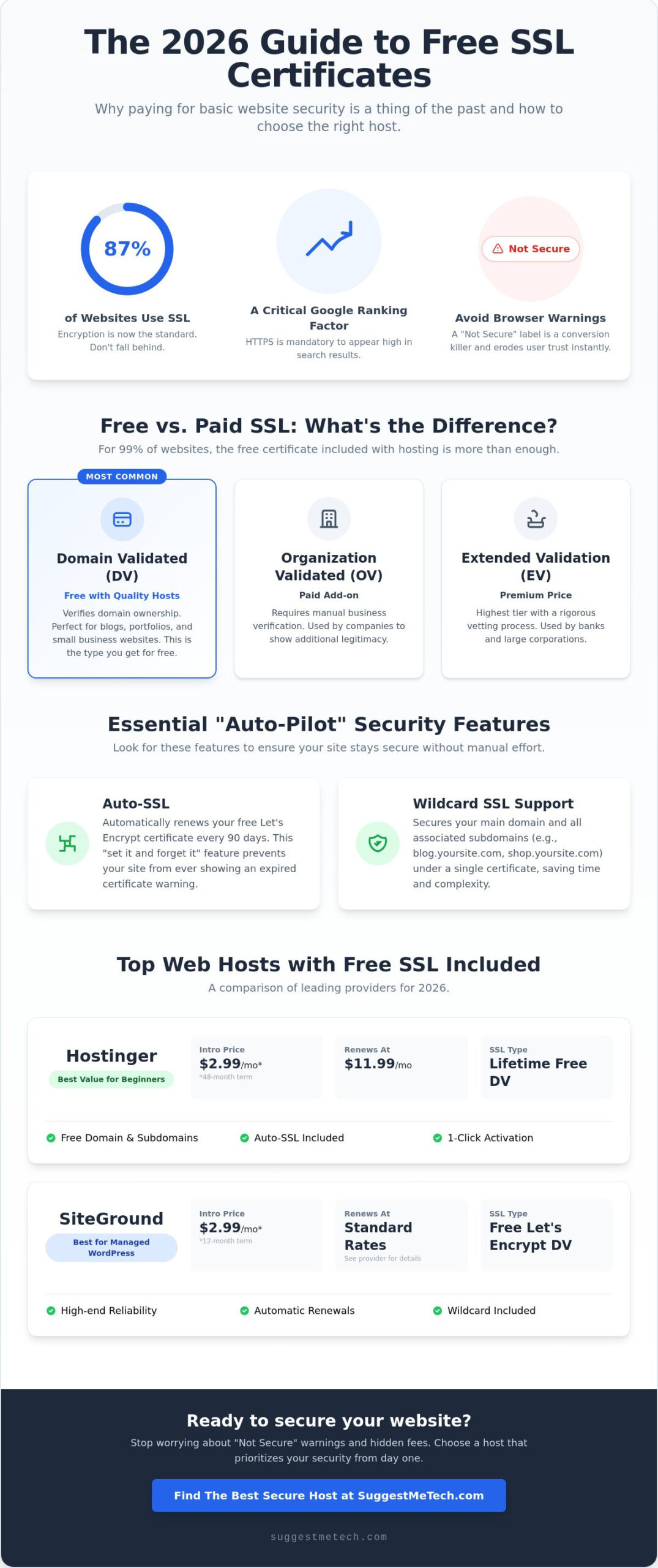
In 2026, paying for a basic SSL certificate is a relic. The best hosts treat security as a fundamental right, not a paid add-on. You’ve likely seen those “Not Secure” warnings in your browser and know how quickly they drive visitors away. It’s frustrating to find a great hosting deal only to realize you’re being charged an extra $70 annually just to keep that padlock icon active. With 87% of all websites now using valid encryption, you shouldn’t have to navigate confusing technical jargon or hidden costs to protect your users.
We’ve done the heavy lifting to help you find the most reliable web hosting with free ssl certificate so you can secure your site instantly. You deserve a setup where HTTPS is the standard, not an upsell. Our guide compares top-rated providers like Hostinger, SiteGround, and IONOS, focusing on automated renewals and high-performance features. You’ll learn which companies offer the best value for 2026, ensuring your site stays safe and professional from day one without any surprise renewal bills.
Key Takeaways
- Understand why SSL encryption is a critical ranking factor for Google and a non-negotiable security requirement for every website in 2026.
- Compare the top 5 providers offering web hosting with free ssl certificate to find a plan that balances high performance with zero hidden security fees.
- Learn how to identify “Auto-SSL” features and Wildcard support to ensure your subdomains stay protected without manual intervention.
- Follow our step-by-step guide to verifying your security status and activating certificates through your hosting control panel.
- Discover the “Best Value” pick for 2026 to secure your tech stack while avoiding the high costs of traditional certificate renewals.
Why Web Hosting with a Free SSL Certificate is Non-Negotiable in 2026
An SSL certificate acts as a digital passport for your website. It encrypts the data moving between your visitor’s device and your server, making it unreadable to hackers. This security layer is built on a public key infrastructure (PKI) that verifies the legitimacy of the connection. In 2026, finding web hosting with free ssl certificate is the first step any serious site owner must take to protect their reputation and their users.
Google treats HTTPS as a core ranking signal. If you want to appear in search results, encryption is mandatory. Without it, you are effectively handing your competitors an advantage. Modern browsers like Chrome and Safari also label non-encrypted sites as “Not Secure.” This warning is a conversion killer. It tells your visitors that their data isn’t safe, causing them to leave before they even see your content. For any site handling logins, contact forms, or payments, this protection is the bare minimum requirement for operation.
The Shift from Luxury to Necessity
The hosting industry has undergone a massive transformation. Only a few years ago, a basic SSL certificate could cost $100 or more annually. The rise of Let’s Encrypt turned this luxury into a commodity. Today, 87% of websites use valid encryption because the barrier to entry has vanished. If a provider still tries to charge you for a basic certificate, they are likely using outdated business models. Beyond simple trust, SSL is also a vital part of PCI compliance. If you intend to sell products or services, you must have an active certificate to meet financial security standards.
Free vs. Paid SSL: Do You Really Need to Pay?
A common myth persists that free certificates provide weaker encryption than paid versions. This is false. Both use the same industry-standard encryption levels to secure data. The real difference is found in the validation process and the insurance warranties offered. Most website owners only need a Domain Validated (DV) certificate, which is exactly what you get with web hosting with free ssl certificate.
- Domain Validated (DV): Best for blogs, portfolios, and small businesses. It verifies you own the domain.
- Organization Validated (OV): Requires manual business verification. It’s used by mid-sized companies to show additional legitimacy.
- Extended Validation (EV): The highest tier, used by banks and massive corporations. It involves a rigorous vetting process.
For 99% of websites, the free DV certificate provided by your host is more than enough. It provides the padlock icon, enables HTTPS, and satisfies search engine requirements. You don’t need to pay for an expensive certificate unless you are a large enterprise requiring specific legal warranties or high-level identity verification.
Top 5 Web Hosting Providers with Free SSL Certificates (Ranked)
Choosing the right provider involves more than just looking at the price tag. You need a host that manages security automatically so you don’t have to manually renew certificates every few months. Most modern providers offer Domain Validated (DV) certificates for free, which are perfect for personal sites and blogs. However, if you’re running a high-traffic enterprise site, you might eventually look for Organization Validated (OV) or Extended Validation (EV) options. These involve manual vetting and typically come as paid add-ons. For most of us, web hosting with free ssl certificate is the ideal starting point.
A valid website certificate ensures that your site isn’t just encrypted, but recognized as legitimate by modern browsers. Since Let’s Encrypt certificates expire every 90 days, the “Auto-SSL” feature provided by these hosts is essential. It handles the renewal process in the background, preventing your site from ever showing a “Not Secure” warning due to an expired certificate.
Hostinger: Best for Budget-Conscious Beginners
Hostinger is a top choice for those watching their budget. Their Premium Shared Hosting starts at $2.99/month for a 48-month term, renewing at $11.99/month. They include a free, lifetime, domain-validated SSL for all domains and subdomains. You can activate this with one click in their custom hPanel. For more performance data, you can read our Hostinger Review 2026.
SiteGround: Best for Managed WordPress Security
SiteGround stands out for managed WordPress security and high-end reliability. Their StartUp plan is priced at $2.99/month for a 12-month term, though it renews at $17.99/month. They offer free Let’s Encrypt Standard and Wildcard SSLs. A Wildcard SSL is especially valuable because it secures your primary domain and all subdomains at once. Their “Auto-SSL” system is remarkably reliable, handling all renewals behind the scenes without any user input required.
Bluehost: The Classic Choice for New Bloggers
Bluehost remains a classic entry point, especially for those learning how to start a blog. SSL is included automatically upon domain registration, so your site is secure the moment it goes live. Their Basic Shared Hosting starts at $3.95/month for a 36-month term. The user-friendly dashboard makes managing certificates across multiple sites straightforward, which is ideal for beginners who aren’t tech-savvy.
When searching for web hosting with free ssl certificate, you should also consider IONOS. They offer an introductory price of just $1/month for their Plus plan during the first year, which includes a free Wildcard SSL. You can find more detailed comparisons in our technology reviews and guides to help you build a secure and affordable tech stack.
How to Choose the Right Host for Your Security Needs
Selecting a host requires looking past the marketing banners. While many companies promise web hosting with free ssl certificate, the quality of that implementation varies wildly between providers. You need a solution that fits your long term growth, not just your first week of site building. Security isn’t a one time setup; it’s an ongoing process that should happen automatically in the background while you focus on your content.
A trusted certificate authority (CA) issues the credentials that browsers rely on, but your host manages the technical handshake. If you plan to use subdomains for a store or a blog, verify that the host includes Wildcard SSL support. Some hosts limit their free certificates to the primary domain, which can lead to unexpected costs later. You should also check if the host allows you to import external certificates. This flexibility is vital if you ever decide to upgrade to a specialized certificate from a different provider.
Evaluating SSL Renewal Policies
Automation is your best friend. Most free certificates, especially those from Let’s Encrypt, have a 90 day lifespan. If your host doesn’t offer “Auto-SSL” or automated renewals, you’ll have to manually update your certificate four times a year. Missing a single deadline results in immediate site downtime and “Not Secure” warnings. Watch out for “First Year Free” traps where the host provides a certificate for the initial term but charges a high fee upon renewal. Reliable providers like Hostinger and SiteGround ensure these certificates remain free for the life of your hosting plan.
Performance Impact of SSL
There’s a persistent myth that encryption slows down server response times. In reality, SSL is a prerequisite for modern performance technologies like HTTP/3. This protocol significantly speeds up the loading process by reducing the number of round trips between the server and the visitor. When you choose web hosting with free ssl certificate, you’re actually setting the foundation for a faster site. To maximize this benefit, prioritize hosts that integrate a global Content Delivery Network (CDN). A CDN caches your SSL handshake at various edge locations, ensuring that visitors from around the world experience the same rapid, secure connection regardless of their physical distance from your main server.
Step-by-Step: How to Activate Your Free SSL Certificate
Most modern providers for web hosting with free ssl certificate handle the heavy lifting automatically. However, you should still know how to verify the installation or trigger it manually if the automation fails. A secure site is only useful if it’s configured correctly from the start. If you skip the final configuration steps, your visitors might still see security warnings despite having a valid certificate installed.
Follow these steps to get your certificate running:
- Step 1: Log in to your hosting control panel. This will be cPanel for most traditional hosts, hPanel for Hostinger, or a proprietary dashboard for managed providers.
- Step 2: Locate the “Security” or “SSL/TLS” section. You can usually find this by searching for “SSL” in the dashboard search bar.
- Step 3: Select your domain from the list. Click “Install” or “Activate.” If your host uses Let’s Encrypt, the process usually takes less than a minute.
- Step 4: Force HTTPS redirection. This is a critical step. Find the toggle labeled “Force HTTPS” or “Redirect to HTTPS” to ensure all visitors are sent to the secure version of your site.
Fixing Common SSL Activation Errors
Even with the best web hosting with free ssl certificate, you might run into the “Mixed Content” warning in WordPress. This happens when your site is secure, but some images or scripts are still loading via the old HTTP protocol. You can fix this by using a plugin like “Really Simple SSL” or manually updating your site URLs in the WordPress settings. If your certificate shows as “Pending” for more than 24 hours, check your DNS settings. Your domain must be pointed correctly to your host for the validation to complete. Finally, always clear your browser cache if you don’t see the padlock icon immediately after activation.
Verifying Your Installation
Once activated, use a free tool like SSL Labs to test your encryption strength. It provides a detailed report on your security configuration and ensures there are no vulnerabilities. Checking your site on a mobile device is equally important to ensure the layout remains consistent under HTTPS. If you’re using an Apple device and the changes aren’t appearing, you should learn how to clear cache on iPhone to see the live, secured version of your pages. For more detailed tutorials on securing your tech stack, check out our latest technology reviews and guides.
Final Verdict: Which Host Should You Suggest to Your Tech Stack?
Choosing the right web hosting with free ssl certificate is a decision that impacts your site’s security, speed, and budget for years to come. In 2026, 87% of all websites use valid encryption, making HTTPS the absolute baseline for professional credibility. You don’t need to be a security expert to maintain a safe site; you simply need a provider that treats encryption as a standard feature rather than a profit center. The era of paying for basic Domain Validated certificates is over, and your choice of host should reflect that reality.
Our “Best Value” pick for 2026 is Hostinger. They offer a compelling balance of low entry costs and high-performance features. While their promotional price of $2.99/month is attractive, it’s the automated, lifetime SSL that provides the real long-term benefit. You won’t have to worry about manual renewals or surprise security bills. If you require more advanced features like Wildcard SSL for multiple subdomains, providers like IONOS or SiteGround offer excellent alternatives, though their renewal rates are generally higher, often jumping to $14 or $17.99 per month respectively.
Our Top Recommendation
Hostinger remains our top recommendation for most beginners and small business owners in 2026. Their custom hPanel makes it incredibly easy to manage security settings without touching a single line of code. Before you sign up, do a final check to ensure the plan matches your expected traffic and team size. If you’re planning a massive e-commerce launch, you might need the extra resources of their Business or Cloud plans. To see a full breakdown of how these providers performed in our speed and uptime tests, visit our Best Web Hosting 2026 Pillar.
Next Steps for Your Website
Once you’ve secured your web hosting with free ssl certificate, your technical foundation is ready. Your next priority should be your brand identity and content strategy. Remember that your domain name is the first thing visitors see; it works in tandem with the SSL padlock icon to establish immediate trust. After your site is live, focus on SEO and marketing to drive traffic to your secure environment. Don’t let the fear of technical setup hold you back. Modern hosting tools are designed to be intuitive, allowing you to launch today and scale tomorrow.
Never pay for a basic DV SSL certificate again. It’s a cost you don’t need to bear in the modern hosting market. We want to hear about your experiences with these providers. Which host are you using for your latest project? Let us know in the comments!
Secure Your Digital Future with Automated Protection
Website security in 2026 is about more than just a padlock icon; it’s the foundation of your speed, search engine ranking, and user trust. You’ve seen that the industry has moved toward total automation, making manual renewals and hidden fees a thing of the past. By selecting reliable web hosting with free ssl certificate, you ensure that your site remains compliant with modern browser standards while protecting every visitor interaction from day one. There’s no reason to settle for providers that treat basic encryption as a paid luxury.
Don’t let technical hurdles or unexpected renewal costs stall your progress. It’s easier than ever to deploy a site that is both high-performing and fully encrypted. Check out our #1 recommended host with free SSL. This provider is tested for 99.9% uptime, offers one-click SSL activation, and provides expert 24/7 support to keep your site running smoothly. It’s time to stop worrying about security warnings and start focusing on your content. Take the leap today and launch your project with confidence.
Frequently Asked Questions
Is a free SSL certificate as safe as a paid one?
Yes, the encryption level is identical. Both free and paid certificates use the same 256-bit encryption standards to secure data as it travels between the server and the visitor. The primary difference isn’t safety, but rather the level of identity validation and the insurance warranties provided. For most personal sites and small businesses, a free certificate provides all the security you’ll ever need.
How often do free SSL certificates need to be renewed?
Free SSL certificates typically expire every 90 days. This short lifespan is a security measure designed to ensure the domain ownership is frequently verified. Because of this, it’s vital to choose a provider for web hosting with free ssl certificate that offers automated renewals. These systems handle the update process in the background so your site never experiences downtime or “Not Secure” warnings.
Will a free SSL certificate work for an e-commerce store?
Yes, a free certificate is perfectly suitable for processing payments on a standard e-commerce store. It provides the necessary HTTPS protocol and padlock icon that builds customer trust. While massive enterprises might buy Extended Validation (EV) certificates for higher insurance limits, small to medium shops can safely use free Domain Validated (DV) certificates to meet PCI compliance and protect customer transaction data.
Can I get a free SSL certificate if my host doesn’t offer one?
Yes, you can use third-party services like Cloudflare or manual tools like ZeroSSL to secure your site. However, this process is often technical and requires you to manually re-upload files every few months. It’s much more efficient to use a host that integrates Let’s Encrypt or a similar service directly into your dashboard. This saves you from the tedious task of manual certificate management.
Does a free SSL certificate help with SEO rankings?
Yes, any valid SSL certificate provides the same SEO boost regardless of whether you paid for it. Google uses HTTPS as a confirmed ranking signal to encourage a more secure web. Since 87% of websites now use encryption, not having a certificate will actively hurt your rankings. A free certificate satisfies Google’s requirements, prevents browser warnings, and helps keep your bounce rate low by proving your site is trustworthy.
What is the difference between Let’s Encrypt and a standard SSL?
The main difference lies in the validation process and the cost. Let’s Encrypt is a non-profit authority that provides automated Domain Validated (DV) certificates for free. Standard paid certificates often offer higher levels of validation, such as Organization Validation (OV), which requires a manual check of your business’s legal identity. Unless you’re a large corporation needing to prove your legal status, Let’s Encrypt is the industry standard.
Why does my site still say “Not Secure” after installing an SSL?
This usually occurs because of mixed content errors where your site loads some elements via HTTP instead of HTTPS. Even if the certificate is active, images or scripts with old links will trigger a browser warning. You can solve this by forcing HTTPS redirection in your hosting panel or using a WordPress plugin to update your URLs. Don’t forget to clear your browser cache to see the updated status.
Do I need a dedicated IP address for a free SSL certificate?
No, a dedicated IP address is not required thanks to a technology called Server Name Indication (SNI). SNI allows a single server to host multiple SSL certificates on one IP address. This makes web hosting with free ssl certificate accessible for everyone on shared hosting plans. You don’t need to pay for an expensive dedicated IP just to keep your visitors’ data encrypted and your site looking professional.