
That $1,500 pair of boutique headphones might only sound 10% better than a well-engineered set costing less than $200. It’s a frustrating reality for many music lovers who think they need to spend a fortune to escape the “muddy” sound of mainstream brands. You shouldn’t have to decode complex technical jargon or buy expensive external amplifiers just to hear your favorite tracks with crystal clear instrument separation. Finding high-quality audiophile headphones on a budget is about knowing exactly where the law of diminishing returns kicks in.
We agree that great sound should be accessible to everyone, not just those with deep pockets. This guide promises to show you how to achieve professional-grade audio clarity through our expert-vetted selections for 2026. We’ll preview the best-performing gear, including the $199 Sennheiser HD 560 S and the high-value Philips SHP9500. You’ll discover which models offer the comfort needed for four-hour listening sessions and the durability to last for five years or more.
Key Takeaways
- Learn why the $100 to $250 price range represents the current “golden era” for audio value, delivering high-fidelity sound without the premium markup.
- Understand how impedance ratings determine whether your smartphone can power your gear or if you’ll need to budget for a specialized amplifier.
- Discover how high-end technologies like planar drivers have become accessible when shopping for audiophile headphones on a budget, offering superior detail for under $150.
- Identify the best listening environment for your setup to choose between the immersive soundstage of open-back models or the isolation of closed-back designs.
- Master the “Apple Dongle” strategy to get professional-grade digital-to-analog conversion for a fraction of the cost of traditional desktop equipment.
What Defines Audiophile Headphones on a Budget in 2026?
Audiophile quality isn’t about a brand name or a high price tag. It’s about “high fidelity,” which means the headphones aim to reproduce sound exactly as the artist intended in the studio. Most consumer headphones have different audio reproduction quality capabilities that often color the music with artificial boosts. When looking for audiophile headphones on a budget, you’re searching for gear that prioritizes accuracy over marketing gimmicks.
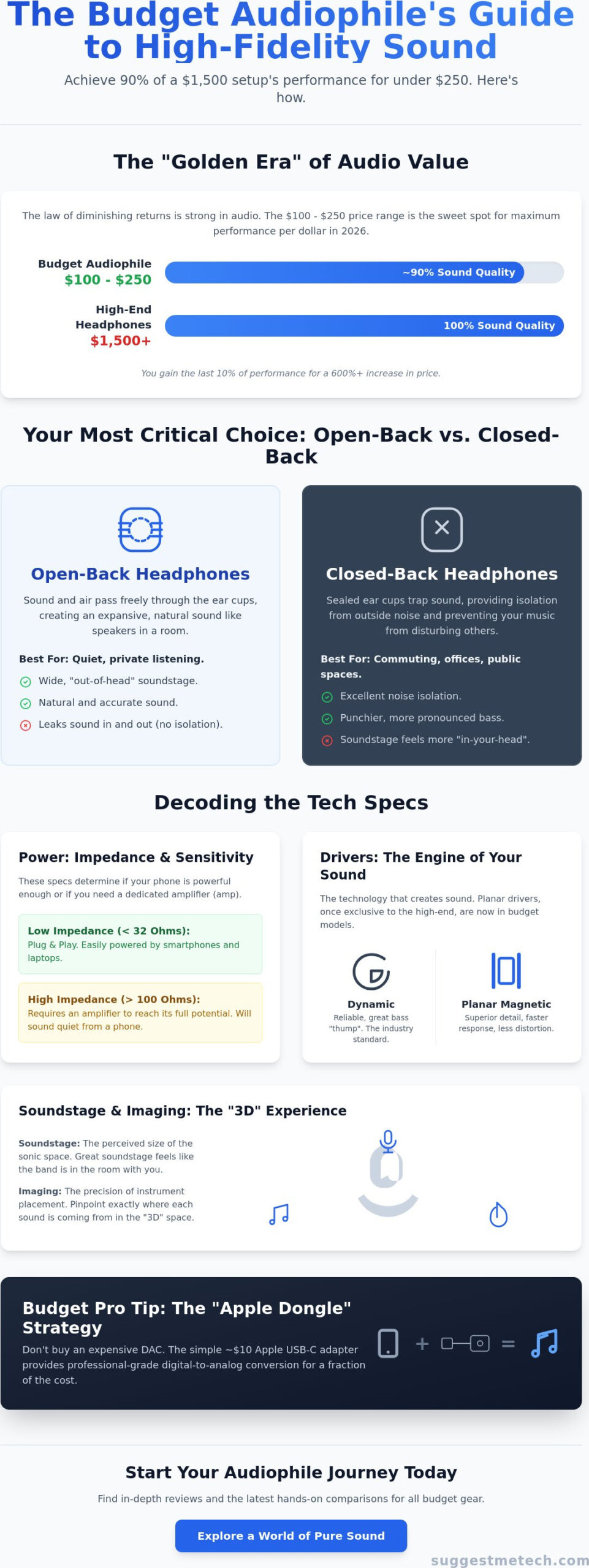
In 2026, the $100 to $250 range has become the golden era for value. Manufacturers have refined driver technology so much that entry-level models now capture about 90% of the performance found in flagship units. You’re no longer paying for status; you’re paying for the engineering. This shift means you can find incredible clarity without the four-figure investment that used to be mandatory for serious listeners.
To keep prices low, companies often use high-quality internals housed in simpler plastic frames. You might sacrifice fancy leather or metal hinges, but the sonic performance remains uncompromised. It’s a trade-off most enthusiasts are happy to make to get premium sound for less. Finding the right audiophile headphones on a budget requires looking past the exterior to see what’s happening inside the ear cups.
The Neutral Sound Signature Explained
“Flat” sound might feel boring if you’re used to the heavy bass of mainstream brands. This is often called a “V-shape” signature, where bass and treble are boosted while the middle frequencies are buried. A neutral signature brings those mids back. This reveals “transparency,” allowing you to hear the subtle breath of a singer or the distinct vibration of a guitar string that was previously hidden in the mix.
Open-Back vs. Closed-Back: The Critical Budget Choice
Choosing between these designs is the most important decision you’ll make. Open-back headphones have perforated ear cups that let air pass through. This creates a wide, “airy” soundstage that feels like the music is happening in the room around you. However, they leak sound and offer zero isolation. Closed-back models provide privacy and punchier bass, making them better for commuting or shared offices. For pure music enjoyment in a quiet room, open-back designs almost always offer better value for your dollar.
Technical Specs Beginners Must Know Before Buying
Spec sheets can look like a confusing math test. You don’t need an engineering degree to understand them, but you do need to know which numbers actually affect your experience. Frequency response tells you the range of notes the headphones can hit. Most manufacturers claim a range of 20Hz to 20kHz because that is the standard limit of human hearing. However, this number doesn’t tell you if the bass is bloated or the treble is piercing. You want a response that feels balanced rather than one with massive peaks that drown out the details.
Decoding Impedance and Sensitivity
Impedance is a measure of how much electrical resistance your headphones have, which determines how much power your device needs to provide to reach a clear listening volume. If you buy a pair with low impedance, typically under 32 Ohms, your smartphone or laptop will drive them perfectly. High impedance models, often over 100 Ohms, require more voltage to move the drivers effectively. Without a dedicated amplifier, these high-end options will sound thin and quiet, even at max volume. Sensitivity works alongside this, measuring how loud the headphones get per milliwatt of power. If you want a simple setup, look for high sensitivity and low impedance.
Driver types are the engines of your audio. Dynamic drivers are the standard; they use a voice coil and magnet to move a diaphragm. They’re reliable and offer a physical thump in the bass. Planar magnetic drivers use a thin film suspended between magnetic arrays. They were once exclusive to the high-end market, but they’ve recently disrupted the space for audiophile headphones on a budget. They offer faster response times and less distortion, making them a great choice if you prioritize detail over raw bass impact. If you’re unsure which technology fits your playlist, check out our latest technology reviews and guides for hands-on comparisons.
Soundstage and Imaging: The “3D” Audio Experience
Soundstage refers to the perceived physical space of the music. In a great pair of open-back headphones, it feels like the singer is standing three feet in front of you while the drums are positioned five feet to the left. Imaging is the precision within that space. It allows you to pinpoint exactly where each instrument is located in the recording. Budget open-back models often punch way above their weight here. Because the ear cups aren’t sealed, the sound can breathe, providing a much more natural and immersive experience than typical closed-back alternatives.
Top Audiophile Recommendations Under $200
Finding the sweet spot for audiophile headphones on a budget often leads to a specific price bracket: the $100 to $200 range. This is where you stop paying for brand hype and start paying for actual acoustic engineering. While some enthusiasts claim you need $500 to start your journey, the market in 2026 has proven that entry-level gear can deliver staggering performance. You don’t need a massive bank account to hear the difference between a standard MP3 and a high-resolution lossless track.
The Sennheiser HD 560 S stands as the current entry-level king. It recently saw a price adjustment to $199, down from its original $274, making it a steal for anyone seeking clinical neutrality. It offers a “flat” sound that reveals every flaw and flourish in a recording. Because it’s incredibly lightweight, it stays comfortable for those marathon four-hour listening sessions without causing “hot spots” on the top of your head.
Best Open-Back Options for Critical Listening
If you want to experience the immersive soundstage we discussed earlier, open-back models are your best bet. The Sennheiser HD500 series remains the gold standard for creating a sense of space. For those wanting to try planar magnetic technology, the HiFiMAN HE400se is a major disruptor. It brings high-end speed and detail to the sub-$150 market. Keep in mind that planar drivers are heavier than dynamic ones. The HE400se provides better detail, but it might feel more substantial on your head during long use. If your budget is strictly under $100, the Philips SHP9500 remains a legendary choice for its airy presentation and extreme value.
Best Closed-Back Options for Versatility
Not everyone has a quiet room for open-back listening. The Beyerdynamic DT 770 Pro is a studio legend because it’s virtually indestructible. Professionals have trusted it for decades because every part is replaceable, from the ear pads to the headband. It offers the physical isolation needed for recording or commuting. Another strong contender is the AKG K371, which follows the “Harman Target” tuning that most listeners find naturally pleasing. These closed-back options are the perfect companions for the best laptops when you’re working in a noisy coffee shop or a shared office space.
For those who need a mix of wireless convenience and sound quality, 2026 has brought several strong options. The Sennheiser Accentum Wireless ($189.95) and the JBL Live 670NC ($129.95) offer active noise cancellation without completely sacrificing the audiophile signature. While they don’t match the pure clarity of a wired HD 560 S, they provide a functional middle ground for modern life. Choosing audiophile headphones on a budget is finally about preference rather than settling for less.
The Hidden Costs: Do You Need a DAC or Amp?
Don’t let gear elitists convince you that a $500 amplifier is mandatory to enjoy high-fidelity music. When you’re hunting for audiophile headphones on a budget, your existing hardware might already be up to the task. Most modern laptops and high-end motherboards feature decent internal audio components that can power efficient drivers. You’ll only need to invest in an external amp if your headphones sound “thin,” lack bass impact, or fail to reach a comfortable volume level at 100% power. This usually occurs with high-impedance models like the 250-ohm versions of the studio gear we’ve discussed.
The most famous budget “hack” in the audio community is the $10 Apple USB-C to 3.5mm adapter. It’s a shockingly clean device that often outperforms the internal audio of computers costing twenty times as much. It effectively eliminates the background “hiss” or static noise caused by electronic interference inside your PC case. For many entry-level listeners, this tiny adapter is the only upgrade they’ll ever need.
Portable DAC/Amps: The Modern Budget Solution
USB-C “dongle” DACs have revolutionized the entry-level market by packing a digital-to-analog converter and a small amplifier into a tiny footprint. A DAC’s primary job is to translate the digital bits of your music file into the continuous electrical signal that moves your headphone drivers. These devices are essential for modern smartphones that have abandoned the headphone jack. They allow you to maintain professional-grade clarity without carrying a bulky stack of equipment in your pocket.
Desktop Stacks vs. All-in-One Units
If you’re setting up a permanent listening station at home, you have two main paths: a “stack” or an all-in-one unit. An all-in-one combines the DAC and Amp into a single chassis, which saves desk space and reduces cable clutter. A stack consists of two separate units connected by cables. While a stack might require a slightly higher initial investment, it offers better future-proofing because you can upgrade the amplifier later without replacing your entire setup. For a deeper look at how these components interact with specific driver types, see our comprehensive headphones guide.
You can find excellent combined units for under $100 that will drive 90% of the audiophile headphones on a budget available today. If you’re ready to build your first high-end listening station, browse our latest technology reviews and guides to find the best current deals on desktop audio gear.
Final Checklist: How to Start Your Audiophile Journey
Before you click “buy,” run through these final considerations to ensure your choice fits your life. Your environment is the biggest factor. If you share a room or commute, open-back headphones will annoy everyone around you because they leak sound like tiny speakers. Next, verify your source device. While we’ve discussed how the Apple dongle helps, check if your PC motherboard has a dedicated “amplified” headphone port, which might save you from needing any extra gear at all. These small details prevent the frustration of buying gear that doesn’t work with your current setup.
You must decide on your “sound flavor.” Neutral headphones provide a flat response that’s perfect for critical listening or professional mixing. However, many listeners prefer a “warm” or “fun” signature, which adds a slight boost to the bass and smooths out the treble for a more relaxed experience. High-quality files are the final piece of the puzzle. Services like Spotify Lossless or Tidal ensure your new audiophile headphones on a budget aren’t being bottlenecked by low-bitrate audio that strips away the detail you just paid for.
Where to Buy and How to Test
Don’t judge your new gear in the first five minutes. “Brain burn-in” is a real phenomenon where your ears need time to adjust to a new, more accurate sound signature, especially if you’re moving from bass-heavy consumer brands. It can take several days for your brain to stop looking for the “missing” bass and start hearing the new details. Always check the return policy of your retailer to ensure you have at least 14 days to test. Use reference tracks you know by heart, such as classic tracks with complex layers or acoustic recordings with clear guitar plucks, to test for instrument separation.
Maintenance and Longevity
You can easily make a purchase last five years or more with basic care. Look for models with detachable cables; the cable is usually the first part to fail, and a cheap replacement is better than buying new headphones. Replacing ear pads every 18 to 24 months is the easiest way to restore the original sound and comfort. Store your headphones on a stand or in a case when they aren’t in use to prevent the headband from stretching or the drivers from collecting dust. This simple maintenance keeps your investment sounding like new for years.
Finding the perfect audiophile headphones on a budget is a personal process that improves your daily life. We invite you to join the SuggestMeTech community to share your setup and get tailored gear picks from our experts. Browse our latest technology reviews and guides to stay updated on the newest releases and find the best deals in the audio world.
Start Your High-Fidelity Listening Experience
You now have the roadmap to professional-grade sound without the typical high-end price tag. We’ve shown how the $100 to $250 range is the current sweet spot for value. By understanding impedance and choosing between open or closed-back designs, you avoid the common pitfalls of buying gear that doesn’t fit your lifestyle. Our focus on the price-to-performance ratio ensures you get the best possible return on your investment.
Every recommendation in this guide has been updated for 2026 hardware standards and tested by audio enthusiasts to guarantee clarity. Finding audiophile headphones on a budget is no longer a compromise; it’s a smart strategy for music lovers. If you’re ready to dive even deeper into specific brand comparisons and technical teardowns, check out our Ultimate Guide to Choosing Your Perfect Pair of Headphones for more expert recommendations.
Your favorite albums are waiting to be rediscovered with new layers of detail. Trust your ears, take your time with the adjustment process, and enjoy the journey toward perfect sound.
Frequently Asked Questions
Can I use budget audiophile headphones for gaming?
Yes, you can absolutely use these for gaming. Many gamers actually prefer audiophile gear because the superior imaging helps you pinpoint footsteps and reloads more accurately than most “gaming” headsets. Open-back models are particularly effective for an immersive soundstage in single-player titles. Since they lack a built-in microphone, you’ll just need to pair them with a standalone USB or mod-mic to complete your communication setup.
Do I really need a DAC if my laptop has a headphone jack?
You only need a DAC if your laptop’s internal audio produces audible static or a faint hiss when no music is playing. If your current jack sounds clean and reaches a comfortable volume, a separate DAC won’t provide a night-and-day difference for most listeners. However, a cheap external unit can bypass a noisy motherboard to ensure your signal remains pure and free from distracting electronic interference.
What is the difference between “neutral” and “flat” sound?
There is virtually no difference between these terms in the audio world. Both “neutral” and “flat” describe headphones that don’t emphasize any particular frequency range, such as heavy bass or piercing treble. This tuning ensures you hear the recording exactly as the producer intended. While some listeners find this style clinical at first, it’s the gold standard for those seeking the most accurate representation of their music.
Why do some audiophile headphones have a curly cord?
Coiled or “curly” cords are a legacy of professional studio environments. They are designed to stay compact and out of the way when you’re sitting at a desk, but they can stretch if you need to reach for a piece of gear across the room. These are common on professional models like the DT 770 Pro, though many modern designs now include straight, detachable cables for easier daily use.
Is Spotify high-quality enough for audiophile headphones?
Spotify is sufficient for most listeners, especially when set to the “Very High” 320kbps quality setting. However, as you get used to audiophile headphones on a budget, you might notice the subtle benefits of lossless streaming. Services that offer CD-quality audio provide a bit more “air” and detail in the high frequencies that lossy compression sometimes smooths over during the digital encoding and compression process.
How long do budget audiophile headphones usually last?
Wired audiophile headphones often last five to ten years or even longer with basic maintenance. Unlike wireless earbuds that become e-waste when their internal batteries fail, wired headphones rely on simple, durable components. If you choose a model with user-replaceable ear pads and a detachable cable, you can keep your audiophile headphones on a budget in “like-new” condition for a decade without needing to replace the entire unit.
What happens if I use high-impedance headphones without an amp?
Your headphones will likely sound quiet and lack dynamic punch. High-impedance drivers require more voltage to move the diaphragm effectively. If your source device can’t provide enough power, the bass will sound weak and the overall audio will feel “thin” or compressed. This is why checking the Ohms rating is a critical step before finalizing your purchase of audiophile headphones on a budget to ensure compatibility.
Are wireless headphones ever considered truly “audiophile”?
Wireless headphones are now considered a viable entry-level audiophile option as of 2026. Thanks to advanced Bluetooth codecs like LDAC and AptX Lossless, the audible difference between wired and wireless has narrowed significantly. While purists still prefer a wired connection for the absolute best signal integrity, modern models provide a high-fidelity experience that satisfies most critical listeners who need the convenience of a cable-free setup.