

Did you know that 76.4 million Americans are now freelancing in 2026, and the highest earners are those leveraging specialized technical expertise? If you’re tired of generic lists suggesting low-pay tasks, it’s time to focus on side hustles using your tech skills that actually move the needle. You’ve spent years mastering complex tools and languages; you shouldn’t have to settle for pocket change gigs that ignore your professional value.
We know how frustrating it is to sift through outdated advice while wondering which skills are currently in high demand. You want a clear path to extra income without the guesswork. This guide will help you discover the most profitable technical niches for 2026, from AI prompt engineering to specialized web development. We’ll show you exactly how to turn your current knowledge into a scalable business that fits your schedule.
You’ll get a curated list of high-paying roles, practical advice on the hosting and hardware tools required to launch, and a proven strategy for scaling from your first gig to a full business. Let’s identify the right tech stack and start growing your income today.
Key Takeaways
- Learn why “fractional” tech roles offer a significantly higher return on investment than traditional side gigs in the 2026 remote economy.
- Explore the top five most profitable side hustles using your tech skills, ranging from custom niche web development to technical writing for SaaS brands.
- Understand the distinction between active freelance coding and passive income streams like digital templates to build a sustainable, balanced revenue model.
- Get a practical checklist for your professional toolkit, including selecting the right web hosting and hardware to showcase your technical authority.
- Discover how to build a “Minimum Viable Portfolio” that effectively proves your expertise to high-paying clients and simplifies your first launch.
Why Technical Skills are the Ultimate Side Gig Asset in 2026
The 2026 economy has fundamentally changed how we view extra income. While many people look for a basic what is a side hustle definition to find ways to earn quick cash, tech professionals have a distinct advantage. With 76.4 million Americans now engaged in freelance work, the competition for general tasks is high, but the demand for technical depth is even higher. Companies no longer just need general help; they need “fractional” experts who can solve specific architectural or data problems without the overhead of a full-time senior salary.
This shift has turned 2026 into the year of the technical solopreneur. Unlike manual labor or delivery apps where your income is strictly capped by physical hours, side hustles using your tech skills allow for value-based pricing. If you automate a complex workflow that saves a client 20 hours a week, the value of that solution is worth thousands, regardless of whether it took you five hours or fifty to code. This move away from hourly billing is a primary reason why over five million independent workers are now clearing six-figure incomes.
The Scalability of Tech vs. Traditional Side Hustles
Most traditional gigs are a time-for-money trap. If you stop driving or delivering, the money stops. Technical side hustles break this cycle through digital leverage. By building assets like specialized API integrations, custom CMS themes, or AI-driven automation scripts, you create products that can be sold repeatedly. You aren’t limited to your local geography. You can support a startup in London or a small business in Tokyo from your home office using a single high-performance laptop and a professional hosting environment. The ROI on your time is simply unmatched in any other sector.
Future-Proofing Your Career Through Diversified Income
A technical side gig is the ultimate low-risk laboratory. It’s the perfect environment to experiment with emerging stacks like Agentic AI or advanced cybersecurity protocols without risking your primary career. With AI-tagged skill demand growing by 109% recently, staying stagnant is a risk you can’t afford. This hands-on experience builds a public portfolio that serves as a live, breathing resume. In 2026, having multiple technical income streams provides a financial safety net and a professional edge that a single traditional job simply cannot offer.
Top 5 Side Hustles Using Your Tech Skills
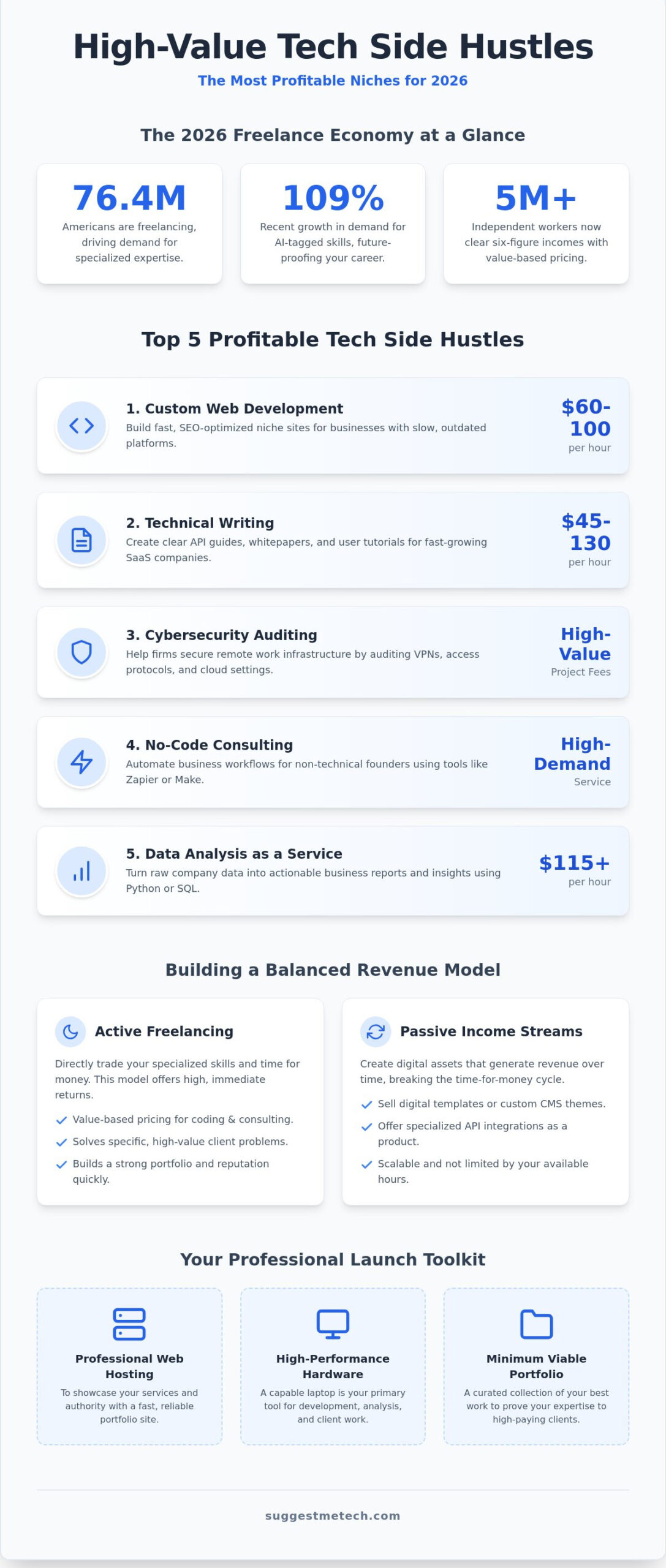
In 2026, the most profitable technical gigs have moved away from general “IT help” toward high-value, specialized solutions. Businesses are looking for experts who can solve specific bottlenecks, and they are willing to pay a premium for it. Here are the five most lucrative side hustles using your tech skills this year:
- Custom Web Development: Local businesses are often stuck with slow, outdated websites. Mid-level developers can earn between $60 and $100 per hour by building fast, SEO-optimized niche sites that actually convert visitors into customers.
- Technical Writing: SaaS companies are launching new features faster than they can document them. Writing clear API guides, whitepapers, or user tutorials pays between $45 and $130 per hour depending on your seniority level.
- Cybersecurity Auditing: With remote work as the standard, small firms are vulnerable to data breaches. You can earn a significant fee by auditing their VPN configurations, access protocols, and cloud security settings.
- No-Code Consulting: Demand for AI-driven automation grew by 109% recently. You don’t always need to write raw code to be valuable; helping non-technical founders automate their workflows with tools like Zapier or Make is a high-demand service.
- Data Analysis as a Service: Companies are drowning in raw data but lack the insights to use it. Expert analysts using Python or SQL can command rates over $115 per hour to turn that data into actionable business reports.
Development and Coding Opportunities
If you enjoy deep work, focus on ecosystems with high growth. WordPress performance optimization is a massive market because site speed directly impacts search rankings. You can also create custom Shopify apps for e-commerce brands looking to add specific functionality to their stores. Offering API integration services for small business software stacks is another way to secure recurring work. If you’re building a portfolio to showcase these services, browse our technology reviews and guides to find the best hosting and hardware for your development environment.
Technical Content and Education
High-Effort vs. Passive Income Tech Hustles
Deciding how to allocate your time is the most critical step in building a sustainable revenue stream. Active tech hustles, such as freelance coding, IT support, and consulting, require a direct exchange of your hours for a paycheck. If you stop writing code or solving tickets, the money stops flowing. Passive income models, like SaaS products, digital templates, and affiliate marketing, require significant upfront work but generate revenue with minimal daily maintenance. Choosing between these side hustles using your tech skills depends entirely on your current 9-to-5 workload and your immediate financial needs.
If you’re already working 50 hours a week at a software firm, taking on a high-intensity freelance project might lead to quick burnout. In that case, a passive approach is often more sustainable. However, if you need to build a financial cushion quickly, active gigs provide the fastest path to liquidity. The most successful technical solopreneurs in 2026 typically start with active work to fund the development of passive assets. This hybrid model allows you to leverage immediate cash flow while building long-term wealth.
The Active Path: High Rates, Immediate Cash
Active gigs are perfect for experts who want to see results on their bank statement by the next billing cycle. Mid-level Python developers and data scientists currently command rates between $65 and $110 per hour. To land these high-ticket clients, you should look beyond generic marketplaces and focus on LinkedIn or specialized tech networks. Always use clear, professional contracts to define your scope of work. Pricing your technical consulting based on the value delivered, rather than just the hours spent, ensures you aren’t penalized for being efficient. This approach protects your time and increases your overall profitability.
The Passive Path: Long-term Wealth Building
Building a digital asset is the gold standard for creating a scalable income. A highly effective strategy is building a niche tech blog to share your specific expertise. Once you establish authority, you can monetize the traffic through display advertising space and affiliate links for the tools and hardware you already use. Other passive options include creating “set it and forget it” digital tools, such as custom Figma templates for UI designers or boilerplate code for specific API integrations. While these assets take longer to gain traction, they eventually provide income regardless of whether you’re at your desk or on vacation.
Setting Up Your Infrastructure: The Tech Side Hustle Toolkit
Launching side hustles using your tech skills requires more than just talent; it requires a professional foundation. You wouldn’t build a house on sand, and you shouldn’t build a business on generic platforms that you don’t own. Your infrastructure is your digital storefront. It signals to potential clients that you’re a serious professional rather than a casual hobbyist. A well-organized toolkit reduces friction, allowing you to focus on billable work instead of troubleshooting your own systems.
Building Your Online Presence
Your first priority is a professional identity. A custom URL is the cornerstone of this identity. If you aren’t sure where to start, our guide on what is a domain name explains why owning your digital address is non-negotiable for brand authority. Once you have a name, you need a place for your portfolio to live. Performance matters here. A slow site kills conversions and hurts your professional image. We recommend using our web hosting reviews to compare providers based on uptime, speed, and budget. For most technical portfolios, a managed host provides the best balance of security and ease of use.
Hardware and Productivity Tools
Your laptop is your primary revenue generator. In 2026, entry-level machines often struggle with local development environments or heavy AI-assisted design software. Investing in one of the best laptops of 2026 ensures you won’t be slowed down by hardware bottlenecks. Productivity also extends to your mobile devices. If you’re managing clients on the go, knowing how to clear cache on iPhone can keep your mobile browser snappy during high-stakes communication. To stay focused during deep work sessions, high-quality headphones are essential for blocking out distractions in a home office or co-working space.
Beyond hardware, your software stack keeps the business running. Professional project management tools like monday.com (starting at $9 per seat per month) or ClickUp ($7 per user per month) help you track deliverables without dropping the ball. For designers, Figma Professional ($12 per editor per month) or Adobe Creative Cloud ($54.99 per month) are the industry standards. These tools don’t just make you faster. They allow you to collaborate seamlessly with agency clients who already use these systems. Selecting the right stack is a balance of performance and cost. You can find more detailed breakdowns in our technology reviews and guides to ensure you’re making the best investment for your specific niche.
How to Launch and Land Your First Tech Client
Having the right tools is only half the battle. To successfully monetize side hustles using your tech skills, you must bridge the gap between having expertise and solving specific problems for a paying customer. Most beginners wait until they have a perfect website to start; however, high earners in 2026 focus on a Minimum Viable Portfolio (MVP). Your MVP should feature just three case studies that highlight a specific business problem, your technical solution, and the measurable result. Clients don’t buy code; they buy the efficiency or revenue your code provides.
Start with your existing network. Reach out to former colleagues or LinkedIn connections with a helpful, non-desperate approach. Instead of asking for a job, mention that you’re taking on a few fractional projects in your specific niche. This subtle shift positions you as a high-demand expert rather than a seeker. Once you land that first gig, capture the social proof immediately. A single video testimonial from a satisfied client is worth more than a dozen paragraphs of self-written copy. It allows you to justify higher rates for your next project because the trust is already established.
Marketing Your Tech Skills
LinkedIn is your primary lead generator. Optimize your profile by including keywords like “Fractional Developer” or “Automation Consultant” in your headline. This ensures you appear in searches by founders looking for specialized help. Contributing to open-source projects is another powerful marketing tool; it provides public proof of your coding standards and places you in front of other technical leaders who often have overflow work. If you have a small budget, running targeted ads on specialized developer forums or industry-specific communities can help you test which of your service offerings resonates most with your target audience before you invest more time.
Scaling and Professionalism
Success brings administrative responsibility. As your side gig grows, you’ll need to manage your taxes and legal structure carefully. In 2026, the self-employment tax rate is 15.3% on net earnings. Keep in mind that businesses are now required to issue a 1099-NEC if they pay you $2,000 or more during the year, which is a significant increase from the previous $600 threshold. Setting aside money for quarterly estimated tax deadlines in April, June, September, and January is non-negotiable for staying compliant and avoiding penalties.
Transitioning from a side hustle to a full-time business is a major milestone. You’ll know it’s time when your side income consistently matches or exceeds your primary salary for at least six consecutive months. Before you make the leap, ensure your automated onboarding process is seamless. Using the project management tools we discussed in the infrastructure section ensures that every new client feels like they are your only priority. With your portfolio, infrastructure, and tax strategy in place, you are ready to scale your technical expertise into a thriving business. If this growth involves moving your equipment to a new office, comparing rental services through DityTruck ensures your physical relocation is as efficient as your digital workflow.
Start Scaling Your Technical Income Today
The shift toward a fractional economy in 2026 has created a massive opportunity for anyone ready to launch side hustles using your tech skills. You’ve seen how moving away from hourly billing and focusing on high-value niches like AI automation or specialized development can transform your earning potential. Success in this competitive landscape requires more than just talent; it requires a professional foundation built on reliable infrastructure and the right hardware.
Don’t let the complexity of choosing your tech stack slow your progress. SuggestMeTech provides unbiased comparisons of over 50 web hosts and tested hardware recommendations designed specifically for professionals. We offer step-by-step guides for digital entrepreneurs to help you clear every technical hurdle with confidence. Making the right choices now ensures your business is scalable and professional from day one.
Check out our expert reviews to build your side hustle tech stack and turn your technical expertise into a thriving income stream. You already have the skills. Now it’s time to give them the professional platform they deserve.
Frequently Asked Questions
What are the most in-demand tech skills for side hustles in 2026?
AI and machine learning integration, cybersecurity auditing, and cloud computing are the most sought-after skills this year. Demand for AI-tagged freelance skills grew by 109% recently, specifically in areas like agentic AI and automated workflow development. Businesses also need experts in data science to turn raw metrics into actionable reports. Focusing on these high-growth niches allows you to command premium rates compared to general IT support roles.
Do I need a degree to start a tech-based side hustle?
You don’t need a formal degree to launch successful side hustles using your tech skills in 2026. Clients prioritize a “Minimum Viable Portfolio” and verified technical proficiency over academic credentials. Demonstrating your expertise through open-source contributions, specialized certifications, or real-world case studies is often more persuasive than a diploma. In the tech space, your ability to solve a specific business problem is the ultimate currency.
How much can I realistically earn from a tech side hustle?
Realistic earnings vary based on your specialization and experience level. Mid-level full-stack developers currently earn between $60 and $100 per hour; meanwhile, specialized AI prompt engineers can command up to $150 per hour. High earners who transition into value-based pricing or passive income models often clear over $100,000 annually. Your income potential depends on your ability to market your skills and the complexity of the problems you solve.
What is the easiest tech side hustle for beginners?
Technical writing and no-code automation are the most accessible entry points for beginners. Technical writing involves creating documentation or tutorials for SaaS companies, with junior rates starting around $25 to $45 per hour. No-code consulting uses visual tools to automate workflows, which doesn’t require deep programming knowledge. Both paths allow you to build a reputation and learn the ropes of freelancing with a lower barrier to entry.
How do I balance a tech side hustle with a full-time job?
Balancing side hustles using your tech skills with a 9-to-5 requires strict time management. Focus on “fractional” projects that require a set number of hours per week rather than open-ended contracts. Use project management software to track deliverables and set clear boundaries with clients regarding your availability. Automating your onboarding and invoicing processes saves valuable time, allowing you to focus on the work that generates revenue.
Should I use a website or just social media for my side gig?
You should prioritize a professional website because it serves as a central hub for your portfolio and reviews. While social media is great for networking, a website you own provides long-term authority and better SEO for your brand. Using professional hosting ensures your site is fast and reliable for potential clients. Social media should function as a marketing channel that directs traffic back to your site where you can capture leads and showcase your expertise.