

What if that $0.01 domain deal you just signed is actually a $23 trap waiting to spring next year? It’s a frustrating reality for many. You start with a bargain, but by the time renewal rolls around, you’re hit with fees that double your costs while dodging pushy upsells for basic security. We’ve all felt that sting of realizing “free” WHOIS privacy was only a first-year teaser. When you’re searching for the best domain registrars, you aren’t just looking for a cheap entry point; you want a partner that stays affordable and secure for the long haul.
We’ve done the heavy lifting for you by analyzing the top players in 2026. This guide promises to reveal the most reliable providers that offer fixed, transparent pricing and essential features like 2FA and privacy protection at no extra charge. You’ll learn which companies, like Cloudflare and Porkbun, are leading the market with at-cost or flat-rate models. We’ll compare the top 10 registrars side-by-side so you can secure your digital identity with confidence and zero surprises on your next invoice.
Key Takeaways
- Avoid “bait-and-switch” pricing by calculating the 3-year Total Cost of Ownership (TCO) to identify the true long-term cost of your domain.
- Ensure your digital identity is secure by choosing providers that include two-factor authentication (2FA) and WHOIS privacy protection at no extra charge.
- Compare the best domain registrars of 2026 to find top-rated options like Cloudflare for at-cost pricing and Porkbun for an intuitive user experience.
- Learn why a $1 introductory domain offer can often cost you more than $60 over three years compared to transparent, flat-rate alternatives.
Understanding Domain Registrars: Why Your Choice Matters
A domain name registrar is an ICANN-accredited organization that manages the reservation of internet domain names. Think of your domain as your digital street address. It tells people where to find you online, but it isn’t the house itself. That “house” is your web hosting, where your website’s actual files are stored. While many people treat these as the same thing, choosing from the best domain registrars requires understanding that your address is your most valuable digital asset. If you lose control of your address, it doesn’t matter how high-quality your hosting is; nobody can get to your front door.
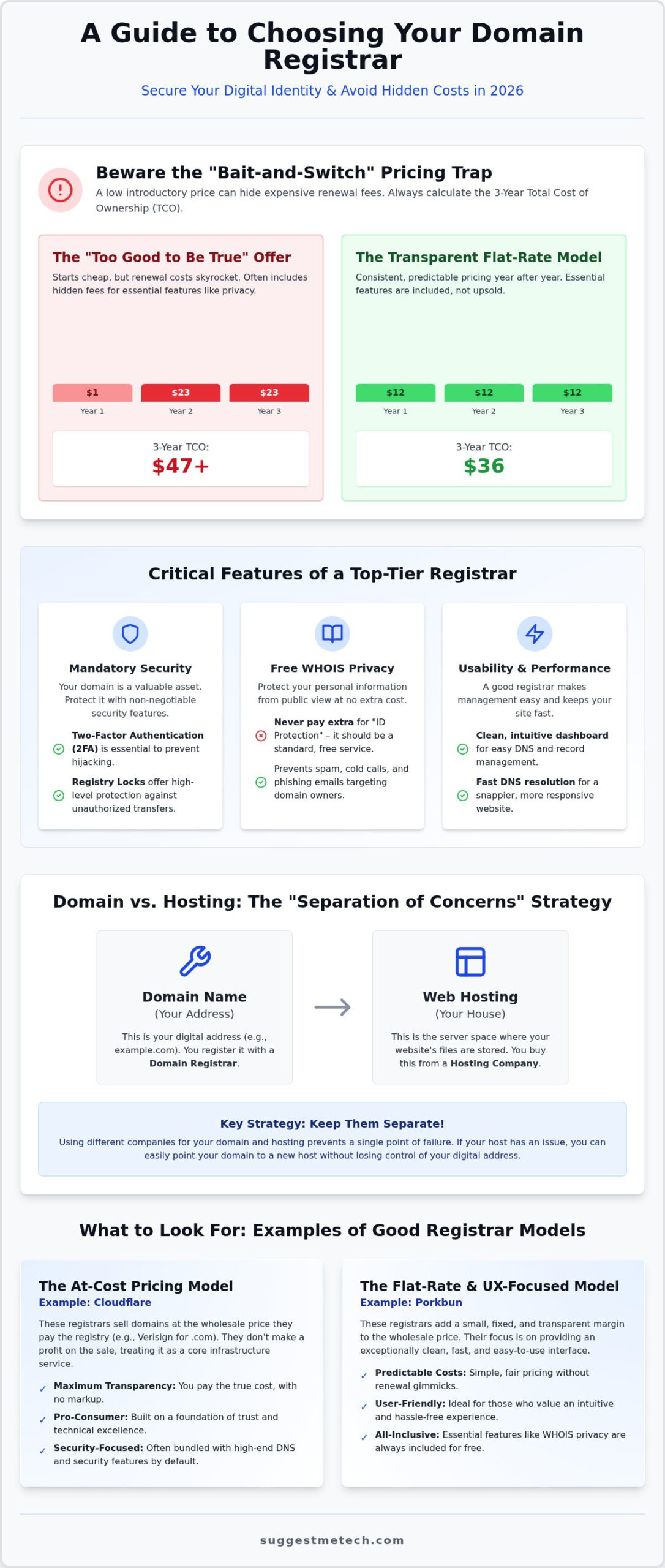
Your choice of registrar directly impacts your website’s long-term security and ownership. A poor choice can lead to hidden fees, difficult transfer processes, or even the loss of your domain if the company goes under or has weak security. We advocate for a strategy called “Separation of Concerns.” This simply means keeping your domain and your web hosting with two different companies. It might seem convenient to bundle them, but it creates a single point of failure. If your host has a technical issue or locks your account, they also hold your domain hostage. By keeping them separate, you can point your domain to a new host in minutes, ensuring you maintain total flexibility.
The Role of ICANN in Domain Registration
ICANN accreditation is your primary consumer protection. It ensures the registrar follows global rules regarding data accuracy and domain transfers. In the domain industry, the “registry” functions as the wholesaler. For example, Verisign manages the .com registry. The registrar is the retailer you buy from. You should avoid using non-accredited resellers for your primary domain. These middleman services often lack the robust security features, like 2FA and registry locks, that the best domain registrars provide to prevent hijacking.
Domain vs. Web Hosting: Clearing the Confusion
It is easy to confuse your URL with the server where your site lives. To keep it simple: the domain is the name, and hosting is the storage space. If you want a deeper dive into the basics, check out our guide on what is a domain name? Many companies offer a “free domain with hosting” deal to get you in the door. While tempting, these offers often come with high renewal rates after the first year. They can also make the transfer process more complicated if you decide to switch hosts later. Maintaining a separate, dedicated registrar gives you the upper hand in managing your digital identity.
Critical Features of a Top-Tier Domain Registrar
Selecting from the best domain registrars isn’t just about finding the lowest price. It’s about building a technical foundation for your brand. In 2026, security is the top priority. Two-factor authentication (2FA) is no longer a “nice-to-have” feature; it’s mandatory. If someone steals your domain account, they effectively own your entire digital business. You need a provider that treats your account like a bank vault, not a social media profile.
Your personal data is also a major target. When you register a domain, your name, email, and phone number are added to a public database. The best domain registrars now include WHOIS privacy for free as a standard service. You should never pay a $10 or $15 annual fee for “ID Protection.” This is often a way for legacy companies to pad their profit margins. Some lower-tier registrars even sell your contact data to “web design” spammers, leading to an endless stream of cold calls and phishing emails that clutter your inbox.
Security and Privacy Standards
High-end security includes features like registry locks. This prevents any changes to your domain without a manual, offline verification process. For power users, support for hardware keys like Yubikey adds a physical layer of defense that software-based 2FA can’t match. This level of oversight is vital because consumer protection issues are common in the rapidly expanding domain market. You want a registrar that actively protects you from these vulnerabilities rather than profiting from your lack of technical knowledge.
User Interface and DNS Performance
A cluttered dashboard is more than an eyesore; it’s a liability. If you can’t find your MX records or DNS settings, you’ll waste hours on basic maintenance. Quick DNS resolution is also critical. If your registrar’s DNS servers are slow, your entire website feels sluggish before a single file even loads from your host. Managing complex setups, like How to set up GoDaddy email, becomes much easier when the interface is intuitive and the DNS propagation is near-instant. If you’re still unsure which features you need for your specific project, you can check our latest tech guides for personalized advice.
- 2FA Support: Look for TOTP apps or hardware key support.
- Free WHOIS Privacy: Don’t pay for what should be included.
- Registry Lock: Essential for high-value business domains.
- Intuitive DNS: Easy management of A, CNAME, and MX records.
The Best Domain Registrars of 2026: Our Top Recommendations
Choosing from the best domain registrars requires looking past the flashy $0.99 banners and focusing on long-term value. In our evaluation, four providers stand out for their commitment to transparency and security. Cloudflare remains the gold standard for at-cost pricing, charging just $10.44 per year for a .com domain. They don’t add a markup to the wholesale price, making them the most honest option for budget-conscious owners. Porkbun follows closely with a flat rate of $11.08, which includes free WHOIS privacy and SSL certificates. If you prefer a balance of promotional starters and reliable management, Namecheap offers .com domains at $11.28 for the first year. For those managing dozens of assets, Dynadot provides powerful bulk-buying tools and a clean interface that professional domain investors swear by.
Cloudflare vs. Porkbun: Which is Right for You?
The choice between these two often comes down to your technical comfort level. Cloudflare’s model is unique because they don’t make a profit on your domain registration. Their goal is to get you into their ecosystem for security and CDN services. It’s a “set-and-forget” platform built for stability. Porkbun, on the other hand, is the favorite for small business owners and creatives. Their interface is approachable, and their support is famously quirky but highly effective. When you consult ICANN’s guide for choosing a registrar, you’ll see that reputation and support models are just as vital as price. While Cloudflare relies on a ticketing system, Porkbun offers live chat that connects you with a human quickly.
The Best Options for Domain Transfers
The recent shutdown of Google Domains left millions of users looking for a new home. If you’re stuck in the Squarespace transition and want out, Porkbun and Cloudflare are the top destinations for a smooth move. Most of the best domain registrars will add an additional year to your expiration date when you transfer, so you don’t lose the time you’ve already paid for. To ensure a zero-downtime transfer, follow this quick checklist:
- Unlock your domain: Disable the registrar lock at your current provider.
- Get the Auth Code: Request the EPP or authorization code from your dashboard.
- Verify WHOIS email: Ensure you can receive the confirmation link.
- Update Nameservers first: If you’re changing hosts, do it before the transfer starts.
We’ve found that moving to a registrar with a flat pricing model saves you from the “bait-and-switch” tactics common with legacy providers. It’s a simple way to take control of your digital assets without checking your invoice for hidden fees every twelve months.
How to Avoid the ‘Bait-and-Switch’: Navigating Pricing and Renewals
The $1 domain offer is the most effective trap in the industry. It sounds like a steal, but it’s often the start of an expensive cycle. For instance, some legacy registrars offer a .com for as little as $0.01 for the first year, but the renewal fee jumps to $22.99. When you calculate the 3-year Total Cost of Ownership (TCO), that “penny” domain actually costs you nearly $46. In contrast, the best domain registrars like Cloudflare or Porkbun offer flat, transparent rates of roughly $10.44 to $11.08 per year. Over three years, you’d save about $15 by avoiding the “deal” and choosing a provider with honest pricing from day one.
You should also be ruthless when skipping checkout upsells. Registrars often try to bundle email forwarding, “Premium” DNS, or proprietary site builders into your cart. Most of these are unnecessary. Reliable hosting often includes email features, and standard DNS is more than fast enough for 99% of websites. Furthermore, watch out for hidden “Transfer-Out” fees. While ICANN rules generally prevent registrars from charging a specific fee just to leave, some companies bury “administrative costs” in their fine print that make moving your domain a financial headache. If you want to stay ahead of these tactics, read our detailed registrar comparison guides to see which companies respect your budget.
Understanding TLD Pricing Differences
The .com extension remains the gold standard for price stability. While it currently accounts for about 45% of all registrations, its renewal rates are predictable. New generic Top-Level Domains (gTLDs) like .tech, .online, or .store are much more volatile. These often feature massive introductory discounts, sometimes under $2, but their renewal spikes can be shocking. It is not uncommon for a .store domain to jump to $50 or more after the first year. Always check the “Renewal Price” column, not just the “Register” price, before committing to a trendy extension.
Red Flags in a Registrar’s Terms of Service
Always check who is listed as the “administrative contact” in the Terms of Service. If a registrar lists themselves instead of you, they technically maintain control over the asset, making it difficult to prove ownership during a dispute. Another major red flag is the “restoration fee.” If you accidentally let your domain expire, the best domain registrars offer a grace period with standard renewal rates. However, predatory providers may charge $80 or more to “restore” the domain from a redemption state. Avoid any company that uses your data or your expiration date as a ransom opportunity.
- Calculate TCO: Always multiply the renewal rate by two and add the starting price.
- Check WHOIS: Ensure you, and only you, are the registered owner.
- Verify Grace Periods: Know exactly how many days you have to renew after a missed payment.
Final Verdict: Which Registrar Should You Choose?
Selecting from the best domain registrars shouldn’t be a stressful decision. For 90% of users in 2026, the answer is simple: choose a provider with flat, transparent pricing like Cloudflare or Porkbun. These companies have eliminated the “bait-and-switch” model that legacy registrars use to inflate their profits. If you prioritize at-cost pricing and advanced security, Cloudflare is your best bet. If you want a friendly interface with human support, Porkbun is the clear winner. By avoiding the introductory rate trap, you ensure your digital identity remains affordable for years to come.
Once you’ve secured your domain, your next priority is pairing it with a high-quality server. We recommend integrating your choice with our top picks for the best web hosting to ensure maximum uptime and speed. Remember to keep your domain and hosting accounts separate to maintain full control over your assets. With your infrastructure in place, you can finally move on to the creative phase. Check out our step-by-step guide on How to start a blog to get your content online quickly and professionally.
Summary Recommendations by Use Case
Different projects require different tools. Here is how we categorize the best domain registrars based on user intent and technical requirements:
- Best for Beginners: Namecheap or Porkbun. Both offer intuitive dashboards and helpful support that won’t leave you stranded during your first setup.
- Best for Developers: Cloudflare. The at-cost pricing and powerful API make it the industry standard for technical users who manage multiple assets.
- Best for Small Business Bundles: DreamHost. If you prefer to manage everything in one place, DreamHost offers reliable service without the predatory upsells found at other hosting-first companies.
Your Domain Registration Checklist
Before you close your browser, run through this final checklist to protect your new investment. These steps take less than five minutes but can save you from a major security breach or an accidental domain expiration.
- Verify WHOIS privacy: Confirm that your personal contact info is hidden from the public database. It should be free; if it isn’t, switch providers.
- Enable 2FA: Turn on two-factor authentication immediately after purchase to prevent unauthorized account access.
- Set a calendar reminder: Don’t rely solely on auto-renew. Set an annual reminder to check your payment method and renewal status thirty days before the expiration date.
We want to hear from you. Have you dealt with a “bait-and-switch” pricing surprise recently? Or perhaps you found a registrar that exceeded your expectations with great support? SuggestMeTech is a community-focused platform, and your feedback helps other users make better choices. Share your registrar success or horror stories in the comments below.
Take Control of Your Online Identity Today
Choosing a registrar is the first real step in building your online presence. You’ve learned that the best domain registrars aren’t always the ones with the loudest marketing or the lowest first-year prices. By focusing on long-term renewal rates and demanding free security features like WHOIS privacy, you’re protecting both your wallet and your data. Remember to keep your domain and hosting separate to maintain the flexibility your project deserves. This simple strategy ensures you’re never locked into a service that no longer meets your needs.
If you are establishing your domain to launch a retail brand, you can learn more about MONEYMAKER – Expertos y Tecnología para vender en internet to discover how expert strategy and technology can help you scale on marketplaces like Amazon and Shopify.
Our expert analysis of over 20 registrars focuses on 2026 pricing transparency. We provide user-first, non-jargon recommendations to help you skip the technical headaches and move straight to building your brand. If you’re ready to take the next step and launch your vision, Find the perfect domain for your next project on SuggestMeTech. To explore how content marketing can then help grow your business, you can find out more about professional digital media solutions. We’re here to help you navigate these complex choices with confidence. Your digital identity is your most valuable asset; treat it with the care it deserves and start building something great today.
Frequently Asked Questions
What is the cheapest domain registrar for .com domains in 2026?
Cloudflare is the cheapest option for .com domains in 2026, offering at-cost pricing of $10.44 per year for both registration and renewal. While IONOS or GoDaddy might tempt you with $1 introductory rates, their renewals often jump to $20 or $23. Choosing a transparent provider helps you avoid the “bait-and-switch” pricing that adds up over several years.
Do I really need WHOIS privacy protection?
You absolutely need WHOIS privacy to prevent your personal contact details from being harvested by scammers and spammers. Most best domain registrars, including Porkbun and Namecheap, now include this protection for free. If a company tries to charge you an extra $10 or $15 for “ID Protection,” it’s a major red flag that they’re using outdated business practices.
Can I change my domain registrar after I buy a domain?
You can change your registrar any time after the initial 60-day “lock” period required by ICANN. This process is called a domain transfer and requires an authorization code from your current provider. It’s a standard procedure that allows you to move your assets if your current registrar raises prices or provides poor customer support.
Is it better to buy a domain from my web host?
It’s generally better to keep your domain and web hosting separate to maintain total flexibility. While hosting companies often offer a “free domain” for the first year, this can make it more difficult to switch hosts later if you’re unhappy with their service. Keeping your domain at a dedicated registrar ensures you always have control over your digital address.
How long does it take to transfer a domain to a new registrar?
A domain transfer typically takes between 5 and 7 days to complete. This timeline is largely determined by how quickly your current registrar releases the domain. Some modern providers allow you to manually approve the transfer in their dashboard, which can speed up the process significantly compared to legacy companies that wait out the full week.
What happens if I forget to renew my domain name?
If you miss your renewal, your domain enters a “Grace Period,” which usually lasts about 30 days. You can still renew it at the standard price during this window. After that, it enters a “Redemption Period” where registrars often charge $80 or more to recover the domain before it’s eventually deleted and made available to the public again.
Which registrar offers the best security for high-value domains?
Cloudflare offers the most robust security for high-value domains through their “Registry Lock” and support for physical hardware keys like Yubikeys. These features prevent unauthorized transfers even if a hacker gains access to your email or password. For businesses where a stolen domain would be catastrophic, these enterprise-grade protections are essential for peace of mind.