

What if the rise of AI search engines isn’t the blogging apocalypse everyone predicted, but actually your biggest competitive advantage? You’ve likely spent hours crafting the perfect post only to see zero comments and a flatline in your analytics. It’s frustrating to follow conflicting advice while feeling like you’re shouting into a digital void. You aren’t alone in fearing that AI will steal your clicks before they even reach your site. Learning how to get traffic to a new blog in 2026 requires a shift from chasing keywords to building a brand people actually search for by name.
We’re going to fix that by mastering a multi-channel distribution strategy designed for the current digital environment. Recent industry data from late 2025 shows that 72% of successful new blogs now prioritize platform-native content over simple link sharing to bypass algorithm filters. This guide promises to take you from zero to 100,000 monthly visitors by leveraging information gain and community-led growth. You’ll get a clear daily checklist for promotion that ensures your content reaches the right eyes. We’ll dive into the exact steps needed to build a loyal audience that sticks around long after the first click.
Key Takeaways
- Move beyond the “build it and they will come” mindset to master a multi-channel strategy tailored for the 2026 AI-driven landscape.
- Learn how to get traffic to a new blog by using content clusters and long-tail keywords to prove your authority to search engines.
- Scale your reach using the “Content Atomization” method to transform a single post into a high-impact social media distribution engine.
- Future-proof your site with Answer Engine Optimization (AEO) techniques that help AI agents like Perplexity and Gemini recommend your content.
- Establish a high-performance foundation by selecting the specific tech stack and plugins required to meet modern Core Web Vitals standards.
Understanding the 2026 Blog Traffic Landscape
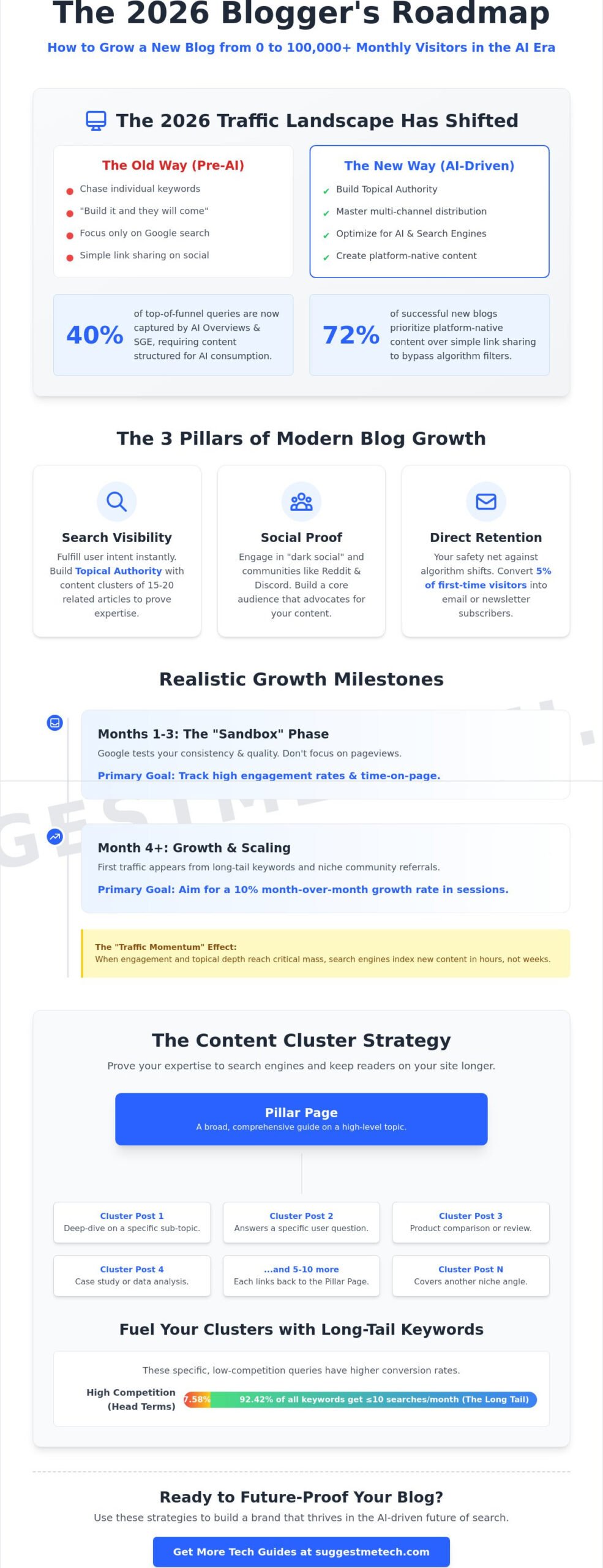
By 2026, the definition of blog traffic has shifted from simple pageviews to a complex mix of organic search, social discovery, and AI-driven citations. You can’t just publish a post and wait for readers. That “build it and they will come” strategy died years ago. Today, search engines prioritize deep expertise and verified human experience. To understand what is a blog in this era, you have to view it as a hub of verified information rather than just a collection of articles. Learning how to get traffic to a new blog requires mastering the interplay between traditional search visibility and AI visibility.
AI Overviews and Search Generative Experience (SGE) now capture 40% of top-of-funnel queries. This means your content must be structured to feed AI models while still providing unique value that triggers a click. High-ranking sites in 2026 focus on “Topical Authority.” Google’s algorithms now evaluate your entire site’s depth on a subject rather than looking at individual keywords in isolation. If you want to rank for a specific topic, you need a cluster of at least 15 to 20 related articles to prove your expertise.
The 3 Pillars of Modern Blog Growth
Success relies on three core areas. Search visibility now demands fulfilling user intent instantly. If a reader wants a comparison, don’t give them a history lesson. Social proof has moved to “dark social” and community platforms. Reddit and Discord are essential for building a core audience that shares your work. Finally, direct retention is your safety net. You must convert 5% of your first-time visitors into email or newsletter subscribers immediately to survive periodic algorithm shifts.
Setting Realistic Growth Milestones
New blogs usually enter a “Sandbox” phase during months 1 to 3. During this time, Google and other search engines test your consistency and content quality. Don’t obsess over raw pageviews yet. Instead, track your engagement rate and time-on-page. High engagement signals to search engines that your content is worth promoting. By month 4, you should see the first signs of how to get traffic to a new blog through long-tail keywords and niche community referrals. Aim for a 10% month-over-month growth rate in sessions once you exit the initial three-month window.
Mastering Keyword Research and Content Clustering
To understand how to get traffic to a new blog, you shouldn’t guess what your audience wants. You need data. Start by identifying “low-hanging fruit” through long-tail keyword research. Ahrefs data shows that 92.42% of all keywords get ten searches per month or fewer. While that sounds small, these specific queries are easier to rank for and often have higher conversion rates because they match specific needs.
Identifying the searcher intent for every phrase is your next priority. Is the user looking for a quick definition or a product comparison? Google’s recent algorithm updates prioritize pages that satisfy this intent immediately. If you target an informational phrase with a sales pitch, your bounce rate will climb and your rankings will drop. Mix your content between evergreen guides that provide value for years and trending topics that capture immediate interest spikes.
Finding Your Niche Gaps
Google’s “People Also Ask” (PAA) boxes are a goldmine for finding unanswered questions. If a top-ranking site provides a thin, 100-word answer to a PAA question, you can win that traffic by writing a comprehensive 500-word response. Analyze competitor weaknesses by looking for outdated statistics or broken links in their top-performing posts. If you’re still setting up your site, our guide on how to start a blog in 2026 ensures your technical foundation is ready for these strategies.
The Content Cluster Strategy
Mapping out a content cluster is the most efficient way to prove expertise to search engines. Start with a broad Pillar Page that covers a high-level topic. Then, create five to ten supporting articles that dive into specific sub-topics. Link these supporting pages back to the pillar to pass link juice and keep readers on your site longer. Your choice of domain names also plays a role here, as a relevant name reinforces your niche authority from the first click.
Finally, use the Skyscraper Technique 2.0 to outperform existing results. Don’t just make your post longer; make it better by adding original research, 2026 industry data, or interactive tools. Integrating a solid content marketing strategy ensures your keyword research translates into a cohesive brand voice. This structured approach is the most reliable way to learn how to get traffic to a new blog without relying on luck. If you need help picking the right analytics tools to track this growth, check out our latest tech reviews for the best SEO software on the market.
Building a Multi-Channel Distribution Engine
Relying 100% on SEO is a dangerous strategy for new blogs in 2026. With AI-driven search results claiming more real estate, organic clicks are harder to capture than they were five years ago. A single algorithm update can wipe out 70% of your visibility overnight if you don’t have diverse traffic sources. While mastering the fundamentals found in a Beginner’s Guide to SEO is essential for long-term health, you need “Seed Traffic” to jumpstart your growth. This means bringing visitors to your site through active distribution rather than waiting for Google to find you.
The most efficient way to do this is the Content Atomization method. Don’t just hit publish and hope for the best. Turn one 2,000-word article into ten distinct snippets. This might include three LinkedIn carousels, two Reddit summaries, and five unique Pinterest graphics. This strategy ensures you’re visible where your audience already spends their time. It’s a proven framework for how to get traffic to a new blog while your domain authority is still low.
Social Media for Bloggers: Quality Over Quantity
In 2026, the “Fresh Pin” strategy on Pinterest is vital for visual niches. Recent data from late 2025 shows that accounts using unique, high-contrast imagery see a 40% higher click-through rate than those using stock photos. For B2B bloggers, LinkedIn is the primary engine for growth. Focus on building a personal brand by sharing the “why” behind your blog posts. Don’t just post links; share a controversial take or a data point from your article to spark a discussion. You can also leverage micro-influencer outreach by tagging creators with 5,000 to 10,000 followers in your posts. These creators are 15% more likely to engage and share your content than major celebrities, providing a direct pipeline to their established audiences.
Community Engagement and Networking
Niche communities on Discord and Slack have replaced broad forums for high-quality engagement. Find three relevant servers in your niche and become a regular contributor. The rule is simple: provide value first. Spend 80% of your time answering questions and only 20% sharing your own work. When you do share a link, ensure it directly solves a problem discussed in the thread. This builds a reputation as a helpful expert rather than a spammer. To keep these visitors coming back, set up an automated notification system. Whether it’s a simple email list or a dedicated Telegram channel, giving your core fans a way to know when you’ve published new content ensures you aren’t starting from zero every time you post. Collaborative growth through expert roundups also remains effective. By featuring 5 to 10 peers in a single post, you encourage them to share the link with their own networks, which is a fast track for how to get traffic to a new blog in any competitive niche.
Optimizing for AI Search and Core Web Vitals
By 2026, search engines have evolved into sophisticated answer engines. If you want to know how to get traffic to a new blog today, you must optimize for platforms like Perplexity and Gemini alongside traditional Google searches. This shift, known as Answer Engine Optimization (AEO), requires your content to be easily digestible for AI agents. These bots don’t just scan for keywords; they look for structured data via Schema.org to understand the intent and context of your advice. If your technical foundation is weak, these agents will skip your site entirely.
Technical performance is the top ranking factor because users in 2026 expect instant gratification. Site speed is no longer a “nice to have” feature. With 70% of web traffic now coming from mobile devices, including the latest foldable smartphones, your blog must adapt its layout seamlessly across varying aspect ratios. A clunky interface that breaks on a foldable screen will tank your bounce rate and kill your visibility in the SERPs.
Winning the AI Answer Box
To capture the top spot in AI-generated summaries, use “Question-Heading” structures. Start your sections with the exact question your audience asks. Follow this immediately with a 40-word, fact-dense summary. This “TL;DR” approach helps AI models extract your core message quickly. Your authority hinges on E-E-A-T. Google’s March 2024 core update emphasized that real-world experience is vital. Include personal anecdotes, original data, or specific case studies to prove you aren’t just another AI-generated site. AI agents prioritize sources that offer unique, human-verified insights.
Technical SEO for Beginners
Load times are critical for keeping visitors. Switch your image formats to WebP or AVIF, which reduce file sizes by up to 35% compared to standard JPEGs without losing quality. Just as you might learn how to clear cache on iPhone to restore its original speed, you need to clear the digital clutter from your blog. Use lazy loading so images only load when they enter the user’s viewport. This saves bandwidth and improves the user experience. Implementing a Content Delivery Network (CDN) like Cloudflare ensures your blog loads fast for a global audience by serving files from the nearest server location.
Scaling Your Growth with the Right Tech Stack
Your blog’s technical foundation determines how high you can climb. You can’t build a skyscraper on a cracked slab. In 2026, user experience and page speed are non-negotiable ranking factors. If your site takes longer than 2.5 seconds to load, you’ll lose 53% of mobile visitors before they even see your headline. This is why your choice of tools is just as critical as your content strategy when learning how to get traffic to a new blog.
Choosing the Best Infrastructure
Server performance is the silent killer of SEO. Google prioritizes sites with a Time to First Byte (TTFB) under 200ms. If your host is slow, your rankings will suffer regardless of your content quality. Managed hosting is the best investment for a growing blog because it provides specialized caching, staging environments, and automatic security updates. We’ve done the heavy lifting for you; see our review of the best web hosting services to find a high-performance partner. Reliable providers offer 99.99% uptime, ensuring your site stays live during viral traffic spikes.
Converting Visitors into a Retainable Audience
Traffic is a vanity metric unless you can keep it. Transitioning from “growth” to “monetization” requires owning your audience. Don’t rely on social media algorithms that change overnight. Start an email list on Day 1. Use a “Lead Magnet,” such as a 10-page PDF guide or a specific template, to encourage sign-ups. Data from 2024 shows that email marketing still delivers a 3,600% return on investment. You should also implement push notifications. These allow you to send a direct alert to a user’s desktop or phone, which can increase repeat visitor rates by 20% without spending a dime on ads.
To keep your growth consistent, use essential WordPress plugins like Rank Math for SEO and WP Rocket for speed. Track everything through Google Search Console and GA4. These tools reveal exactly which search terms are working and where your funnel is leaking. Use this final checklist every time you hit “Publish” to ensure your post is optimized for the long haul:
- Keyword Placement: Ensure your primary keyword is in the first 100 words and the H1 tag.
- Image Optimization: Compress all images to under 100KB using the WebP format to maintain fast load times.
- Internal Linking: Add at least three links to older, relevant posts to keep readers on-site longer.
- Mobile Audit: Test the page on a mobile device to ensure buttons are clickable and text is legible.
- Social Metadata: Set a custom Open Graph image so your post looks professional when shared on LinkedIn or Pinterest.
By combining a fast host with smart retention tools, you create a flywheel effect. Every new visitor has a higher chance of becoming a long-term fan, which is the most sustainable way to master how to get traffic to a new blog and keep it growing through 2026 and beyond.
Build Your 100k Audience in 2026
Success in the 2026 digital landscape requires more than just writing. You need a strategy that prioritizes AI search optimization and multi-channel distribution to reach that 100,000 monthly visitor milestone. Mastering how to get traffic to a new blog depends on your ability to implement content clusters that answer complex user intents while maintaining perfect Core Web Vitals scores. High-performing sites in 2026 rely on expert-tested hosting that delivers sub-500ms load times and 99.99% uptime. Don’t waste months on trial and error with outdated tools. Use community-driven tech reviews and 2026-ready digital growth guides to build your foundation. Our community tests over 50 different platforms to ensure you choose the most reliable tech stack for your specific niche. You can Start your blogging journey with the right tools at SuggestMeTech. Our platform provides the data-backed recommendations you need to scale your traffic without the technical headaches. It’s time to turn your ideas into a high-traffic reality. You’ve got the roadmap; now it’s time to execute and watch your community grow.
Frequently Asked Questions
How long does it take to get traffic to a new blog in 2026?
Most new blogs see consistent traffic within 6 to 9 months of active publishing. Hitting the milestone of 100,000 monthly visitors typically requires 18 months of disciplined content creation. In 2026, search engines prioritize established authority, so your first 30 posts serve as a foundation. Expect your growth curve to remain flat for the first 180 days before you see a 20% month over month increase.
Can I get traffic to my blog without using social media?
You can build a high traffic site without social media by focusing entirely on search engine optimization and email list growth. Data shows that 70% of blog traffic still originates from search queries rather than social feeds. If you skip social platforms, you must invest that time into building a newsletter. Email lists typically see a 3% to 5% click through rate, which far exceeds the 0.5% organic reach on platforms like X.
How many blog posts should I write per week to see growth?
Aim for 2 to 3 high quality posts per week to maintain a steady growth trajectory. Publishing 10 to 12 times per month allows you to cover a broad range of keywords while maintaining the depth required by 2026 search algorithms. Research indicates that blogs publishing at least 11 times monthly receive 3 times more traffic than those posting fewer than 4 times. Focus on quality over raw volume to satisfy readers.
What is the best free way to promote a new blog?
The most effective free method for how to get traffic to a new blog is active participation in niche communities like Reddit or specialized Discord servers. By answering 5 to 10 user questions daily with helpful links back to your content, you establish immediate authority. This strategy can drive your first 1,000 visitors within 30 days without spending a single dollar on advertising or premium marketing tools.
Is SEO still relevant for new blogs with the rise of AI?
SEO remains the primary driver of growth, though it now requires optimizing for AI overviews and traditional results. By 2026, roughly 40% of search queries result in AI generated summaries, so your content must provide clear, structured data to be cited as a source. Focus on information gain by including unique data or personal testing that AI models cannot replicate from existing web scrapes or generic databases.
How do I know if my blog traffic is “good” or “bad”?
Good traffic is defined by a bounce rate below 70% and an average session duration of over 90 seconds. If a new blog reaches 5,000 monthly sessions within its first 6 months, it’s performing in the top 15% of new sites. Don’t just look at the total numbers. Check your conversion rate to ensure readers are actually taking action on your recommendations or signing up for your newsletter.
What happens if my blog traffic suddenly drops?
A sudden traffic drop of 20% or more usually indicates a technical error or a search engine algorithm update. Start by checking Google Search Console for manual actions or indexing errors. If you’re learning how to get traffic to a new blog, remember that volatility is normal. Use analytics tools to see if your top 10 ranking pages lost their positions to new competitors or updated AI search features.