

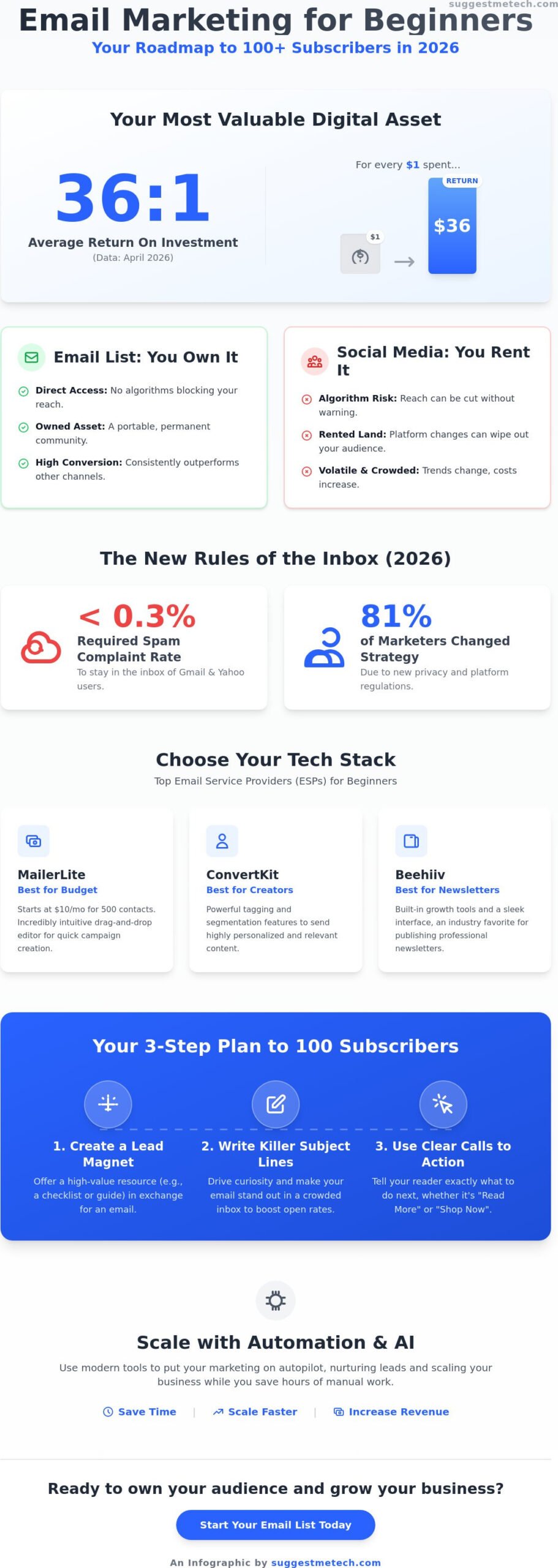
Your social media following is essentially rented land, but an email list is the only digital asset you truly own. With an average ROI of 36:1 in 2026, it remains the most effective way to build a business; yet, 81% of marketers say privacy regulations have completely changed how they collect opt-ins. If you feel overwhelmed by software choices or fear being marked as spam, you aren’t alone. Most people starting email marketing for beginners get stuck before they even send their first message because the technical requirements seem too steep.
We understand that you want a clear path to your first 100 subscribers without a tech headache. This guide provides a practical roadmap to help you master the fundamentals of building and monetizing your list. You’ll learn how to meet the latest authentication rules, such as the 0.3% spam threshold required by Gmail and Yahoo, and which tools like Brevo or MailerLite offer the best value for your budget. We’ll start by choosing your tech stack and move directly into a step by step strategy for sending emails that your customers will actually appreciate.
Key Takeaways
- Understand why owning your audience list is safer than relying on social media algorithms that can change without warning.
- This guide to email marketing for beginners helps you select the right tech tools based on deliverability, ease of use, and your specific budget.
- Learn how to create a high-value lead magnet that attracts your first 100 subscribers by offering a clear value exchange.
- Discover the anatomy of emails that get opened, including subject line secrets that drive curiosity and clear calls to action.
- Use automation and AI to put your marketing on autopilot, allowing you to scale your business while saving hours of manual work.
Why Email Marketing is Your Most Valuable Asset in 2026
Think of email marketing as your direct, private line to a group of people who have specifically asked to hear from you. It isn’t just about blasting messages to a list. It’s about nurturing a self-selected audience that has given you permission to enter their inbox. For those seeking a comprehensive overview of email marketing, it’s clear that this channel has survived every “death of email” prediction for three decades. In 2026, its value has only increased as social media platforms become more crowded and expensive.
The numbers tell a compelling story. Recent data from April 2026 shows that email marketing delivers an average return on investment of 36:1. That’s a higher yield than any other digital channel available. While social media trends come and go, the number of active email users continues to climb globally. Effective email marketing for beginners focuses on this high-return potential by building a foundation that doesn’t rely on volatile external platforms.
The Core Benefits of Starting Now
The primary advantage is direct access. You don’t have to pay an “algorithm tax” to reach your own followers. When you send an email, it lands in the inbox. Period. Beyond reach, the level of personalization available is unmatched. You can segment your audience based on their specific interests, which is something a social media feed simply can’t do. Because of this relevance, email conversion rates consistently outperform search and social traffic by a wide margin. It’s the most efficient way to turn a casual browser into a loyal customer.
Email vs. Social Media: The Ownership Factor
Social media platforms are “rented media.” You’re essentially a tenant on someone else’s land. If a platform changes its ranking rules, restricts your reach, or shuts down entirely, you lose your connection to your audience instantly. This isn’t a theoretical risk; 81% of marketers reported in April 2026 that privacy and platform changes have already forced them to rethink their strategies. They’re moving back to channels they actually control.
Your email list is an insurance policy for your business. It’s a portable asset that you own and control. If you’ve already followed our guide on how to start a blog, an email list is the natural next step. It allows you to capture the traffic you’re working so hard to build and turn it into a permanent community. Without an email list, you’re essentially starting from zero every time you post new content. Owning your audience data is the only way to ensure long-term stability in a changing tech world.
Choosing Your Email Marketing Tech Stack
You might be tempted to start your journey by BCC’ing your contact list from a personal Gmail or Outlook account. Don’t do it. Personal email accounts aren’t designed for bulk sending; they lack the automation tools, legal compliance features, and analytics you need to succeed. Using a personal account also risks your messages being flagged as spam immediately. To execute email marketing for beginners effectively, you need an Email Service Provider (ESP). An ESP is a specialized platform that manages your subscriber list and ensures your messages actually reach the inbox.
Choosing the right ESP depends on three main factors: deliverability, ease of use, and pricing tiers. Deliverability is the most critical because a beautiful email is useless if it lands in the junk folder. As of May 2026, major providers like Gmail and Yahoo require strict authentication for all senders to maintain a presence in the primary inbox. Your ESP choice should also integrate seamlessly with your best web hosting provider to ensure a smooth technical setup. For more context on high-level strategy, you can refer to this comprehensive email marketing guide.
Top ESP Recommendations for Beginners
MailerLite is an excellent choice for those on a tight budget. As of April 17, 2026, their paid plans start at $10 per month for 500 contacts, and their drag-and-drop editor is incredibly intuitive. If you’re a creator or blogger, ConvertKit offers powerful tagging and segmentation features that help you send the right message to the right person. For those focused purely on building a newsletter, Beehiiv has become an industry favorite due to its built-in growth tools and sleek interface. If you’re still weighing your options, take a look at our hosting reviews to see how different platforms handle integrated email services.
Connecting Your Domain and Hosting
To look professional, you must send from an address like name@yourdomain.com. Using a free @gmail.com address for business mail is a fast track to the spam folder. You’ll first need to secure a domain that matches your brand. Once you have your domain, you’ll need to update your DNS records with SPF (Sender Policy Framework) and DKIM (DomainKeys Identified Mail) settings provided by your ESP. These records act like a digital passport, proving to receiving servers that you’re a legitimate sender. Following these technical steps ensures your spam complaint rate stays below the 0.3% limit enforced by major providers in 2026, which is a vital part of mastering email marketing for beginners.
Building Your List: From Zero to Your First 100 Subscribers
People don’t give away their email addresses for nothing. In 2026, where 68% of users avoid brands that send unsolicited emails, you must offer something of real worth. This is the “Value Exchange.” You provide a solution, and the visitor provides access to their inbox. For those diving into email marketing for beginners, this first step is often the hardest, but it’s where your list’s quality is decided. If you don’t offer immediate value, you won’t get the signup.
A lead magnet is a transaction of value where no money changes hands. It must solve a specific, immediate problem for your visitor. If you’re a productivity blogger, a “5-Minute Morning Routine Checklist” is far more effective than a generic “Monthly Newsletter.” Placement matters just as much as the offer. Don’t hide your signup forms in the footer alone. Use a combination of a “sticky” top bar, an exit-intent popup, and a dedicated landing page to capture attention without being intrusive.
We strongly recommend using a “Double Opt-In” process. This requires new subscribers to click a link in a confirmation email before they’re officially added to your list. While it adds a step, it ensures your list stays healthy and your spam complaint rates remain below the 0.3% threshold enforced by Gmail and Yahoo. It’s a simple way to filter out bots and people who aren’t truly interested in your content, which is a vital part of email marketing for beginners.
Creating a High-Converting Lead Magnet
Your lead magnet doesn’t need to be an 80-page ebook. In fact, shorter is often better. High-converting options include one-page checklists, discount codes, or spreadsheet templates. The key is immediate gratification. If your visitor can use your freebie to solve a problem in under five minutes, you’ve won their trust. This trust is the foundation of long-term monetization and list engagement.
Compliance and Privacy: Staying Legal
Email marketing is governed by strict laws that carry heavy penalties. As of January 21, 2026, CAN-SPAM violations can cost up to $51,744 per email. If you have subscribers in the EU, GDPR fines can reach €20 million or 4% of your global turnover. You must include a physical mailing address and a clear unsubscribe link in every email footer. An unsubscribe link isn’t a failure; it’s a tool that keeps your list clean of unengaged users. Always link to a simple privacy policy on your signup forms to explain exactly how you’ll use subscriber data. Since 81% of marketers have changed their opt-in methods due to these regulations, staying compliant is no longer optional; it’s a business necessity.
How to Write Emails People Actually Want to Open
Writing is the heart of email marketing for beginners. Even the best tech stack can’t save a boring message. To get results, you must master the anatomy of a high-performing email. This includes a compelling subject line, an informative pre-header, a concise body, and a clear Call to Action (CTA). The most successful senders follow the “One Goal” rule. Every email should ask the reader to do exactly one thing. Whether it’s clicking a link or replying to a question, clarity beats cleverness every time.
Your subject line has one job: get the email opened. Use curiosity to pique interest or urgency to encourage action. Personalization is also key, but it goes beyond just using a name. It’s about sending content that matches the subscriber’s specific interests. Remember that 68% of users avoid brands that send unsolicited or irrelevant content. If you want to keep your subscribers, your voice should be that of a helpful guide rather than a pushy salesperson. Being useful is the fastest way to build the trust needed for future sales.
The 3-Part Welcome Sequence Every Beginner Needs
Your first few emails are your most important. Start with Email 1: The Delivery. Send this immediately to give them the lead magnet they signed up for. Next, send Email 2: The Value. Share a “best of” resource or a specific tip that solves a small problem. Finally, send Email 3: The Connection. Ask a simple question to encourage a reply. When subscribers reply to your emails, it signals to providers like Gmail that you’re a trusted sender. This helps ensure your future messages stay in the primary inbox.
Design vs. Plain Text: Which Wins in 2026?
While flashy templates look nice, plain text emails often perform better. They feel like a personal message from a friend, which leads to higher deliverability and click rates. Use designed templates for e-commerce or product showcases, but stick to plain text for personal brand updates. No matter which you choose, prioritize mobile-first design. Most people will read your emails on their phone before they ever open them on a laptop. Keep your paragraphs short and your links easy to tap.
Ready to start writing? Explore our latest tech reviews to find the best writing tools for your business.
Scaling with Automation and AI Tools
Automation is the secret to growing your business without increasing your daily workload. It allows you to deliver the right message at the right time without manual intervention. For those just starting email marketing for beginners, automation acts as an autopilot for your marketing strategy. Instead of sending one-off blasts, you create sequences that trigger based on subscriber behavior, ensuring your brand stays top of mind while you focus on other tasks.
Analytics provide the roadmap for improvement. Your open rate reveals how well your subject line performed, while your click-through rate (CTR) measures the effectiveness of your body copy and call to action. Since email databases experience a natural decline of about 23% each year, according to reports from April 10, 2026, scaling requires constant optimization. Use your data to identify which emails are underperforming and adjust your strategy to keep your audience engaged.
Basic segmentation is another pillar of scaling. You shouldn’t send the same message to a “Newbie” who just joined as you do to a “Customer” who has purchased three times. By separating your list into groups, you ensure higher relevance. This relevance is what keeps your engagement high and prevents subscribers from hitting the unsubscribe button. Effective email marketing for beginners relies on this targeted approach to build long-term loyalty.
Practical AI Tools for Email Creators
Generative AI has changed the workflow for creators in 2026. Tools like ChatGPT or Claude are excellent for brainstorming subject lines or drafting content outlines based on your specific brand voice. AI is a co-pilot for creativity, not a replacement for your unique voice. Many platforms now include AI-powered send-time optimization. These tools analyze user behavior to deliver your message exactly when a subscriber is most likely to be checking their inbox, significantly boosting your visibility.
Setting Up Your First “Evergreen” Workflow
An evergreen workflow is a sequence of emails that stays relevant over time. It follows a simple logic: Trigger, Delay, and Action. For example, a signup (Trigger) leads to a one-day wait (Delay), followed by a helpful resource (Action). This structure keeps your list engaged even when you aren’t writing new content. As you master this, you can move subscribers from Top of Funnel (TOFU) education to Middle of Funnel (MOFU) and Bottom of Funnel (BOFU) offers. This logical transition ensures you aren’t just building a list, but building a profitable business asset.
Start Building Your Owned Audience
Mastering email marketing for beginners isn’t about complex code; it’s about building a direct connection with your audience on land you actually own. You now have the roadmap to move from zero to your first 100 subscribers while staying compliant with the strict 2026 sender requirements. By leveraging AI as a creative co-pilot and setting up evergreen workflows, you can nurture a community that generates a 36:1 ROI without spending every hour at your desk.
A successful strategy starts with the right technical infrastructure. Your domain and hosting determine your sender reputation, which is why choosing a reliable provider is essential. Check out our top-rated Web Hosting services to power your email strategy. Our guides include Editor’s Picks for beginner-friendly tech and have been 2026 performance tested for speed and reliability. We also feature community-suggested tools that our readers have vetted in real-world scenarios.
Your audience is waiting to hear from you. Don’t wait for the next algorithm change to reach your customers. Take that first step and start building your most valuable business asset today.
Frequently Asked Questions
Is email marketing still effective in 2026 with all the privacy changes?
Email remains the most effective channel in 2026 because it’s a direct, owned asset. While privacy changes have altered how marketers collect data, the average return on investment of $36 for every $1 spent holds steady. Users are more protective of their data now, but they still value high quality, personalized content in their inbox. It’s the only platform where you aren’t fighting a social media algorithm to reach your followers.
How much does it cost to start email marketing for a beginner?
Starting email marketing for beginners is very affordable. As of April 17, 2026, providers like Brevo and Moosend start at $9 per month for 500 contacts. MailerLite is also a popular choice at $10 per month for the same list size. If you have a larger initial list, HubSpot offers plans starting at $15 per month for 1,000 contacts. These low entry points allow you to scale as your subscriber count grows.
What is a good open rate for a beginner email list?
A good open rate for a new, small list typically falls between 25% and 40%. While industry averages across all sectors hover around 21%, beginners often see higher engagement because their subscribers are more targeted and fresh. If your open rates drop below 20%, it’s usually a sign that your subject lines need more curiosity or that your list needs cleaning to remove unengaged users who haven’t opened an email in 90 days.
Can I use my personal Gmail or Outlook account for email marketing?
You cannot use personal accounts for bulk marketing. Gmail and Outlook have strict limits on how many emails you can send daily. More importantly, personal accounts lack the required one click unsubscribe links and physical address footers mandated by the CAN-SPAM Act. Using a professional Email Service Provider ensures you comply with the $51,744 per email fine risk associated with non compliant messages. It also keeps your personal account from being blacklisted.
How often should I send emails to my list without being annoying?
Send at least once a week to stay relevant without being intrusive. Consistency is more important than high frequency. If you only email once a month, subscribers might forget who you are and mark your message as spam. If you email daily, you risk burnout and high unsubscribe rates. Start with a weekly newsletter and adjust based on your audience engagement and the specific goals of your campaign.
How do I stop my marketing emails from going to the Promotions tab or Spam?
To avoid the spam folder, you must authenticate your domain with SPF, DKIM, and DMARC records. As of May 2026, Gmail and Yahoo require all senders to keep their spam complaint rates below 0.3%. You should also avoid spammy trigger words in your subject lines. Encouraging subscribers to reply to your first email or “whitelist” your address also signals to providers that your content is wanted and belongs in the primary inbox.
What is the difference between a newsletter and an automated sequence?
A newsletter is a one time broadcast sent to your entire list at a specific date and time. An automated sequence is a series of emails triggered by a specific action, such as signing up for a lead magnet. While newsletters keep your list updated on current news, automated sequences ensure every new subscriber receives a consistent welcome experience. Both are essential for a balanced strategy in email marketing for beginners.
Do I need a website to start an email marketing list?
You don’t strictly need a full website, but you do need a landing page. Most Email Service Providers offer free landing page builders where you can host your signup form. However, having your own domain and a simple site built on a reliable host provides more credibility. It also gives you a central hub to host your lead magnets and privacy policy, which are required for legal compliance in 2026.