

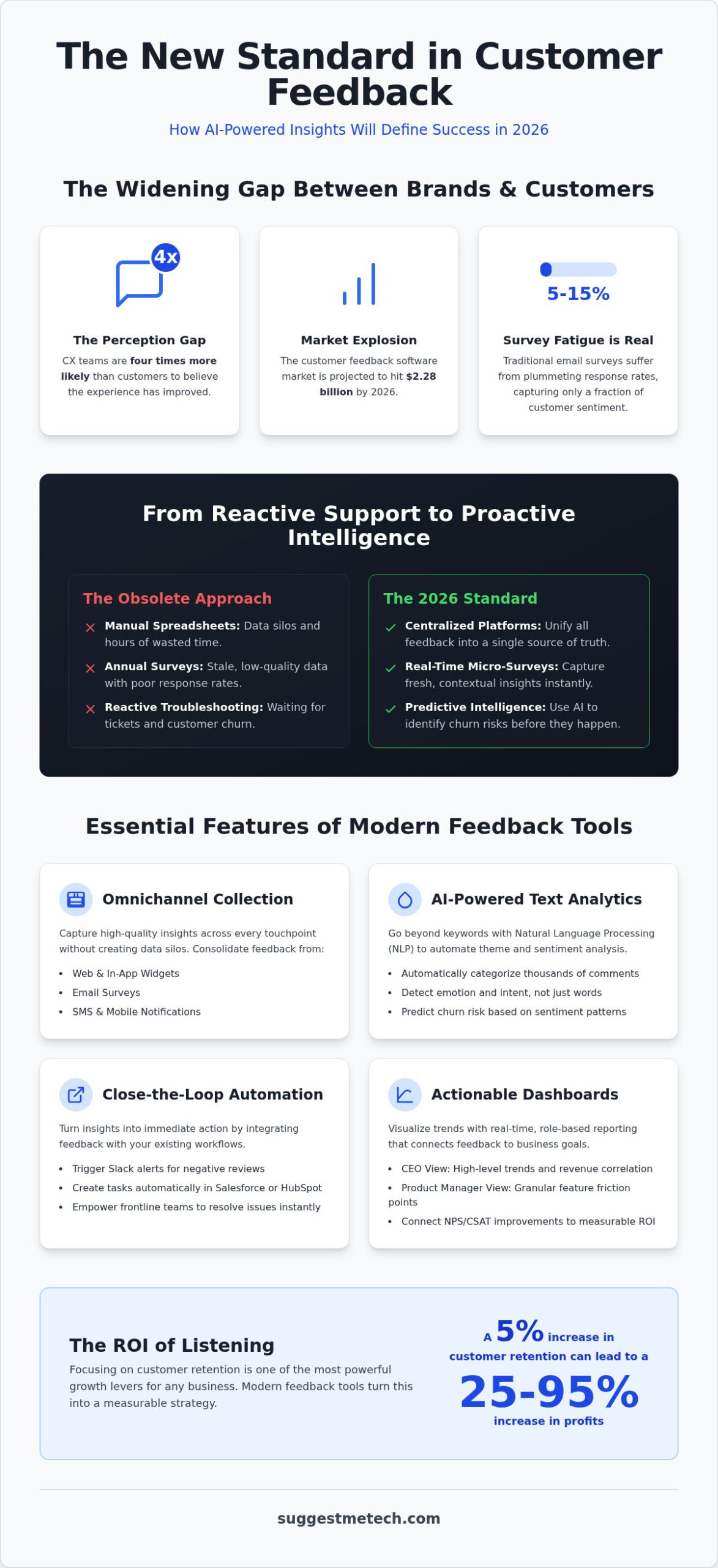
With the customer feedback software market hitting $2.28 billion in 2026, the gap between brands and consumers is actually widening; CX teams are four times more likely than their customers to believe the experience has improved. If you’re still relying on manual spreadsheets or tools like the now-defunct Delighted, you’re likely missing the “why” behind your metrics. Finding the best customer feedback software isn’t just about sending surveys anymore. It’s about using AI to predict churn and centralize insights before your customers walk away.
You likely feel the frustration of feedback being scattered across different tools while response rates on traditional emails stall at just 15%. I’ve evaluated the most effective tools to help you break down those data silos and automate sentiment analysis. In this guide, you’ll discover the best customer feedback software for 2026 that transforms raw comments into measurable improvements for your NPS and CSAT scores. We’ll compare top-rated platforms based on real-world applications, pricing, and AI capabilities so you can choose the right partner for your growth.
Key Takeaways
- Understand how AI has shifted feedback from static data points to predictive signals that help you stop churn before it happens.
- Learn which omnichannel features are essential for capturing high-quality insights across web, mobile, and SMS touchpoints.
- Discover how to identify the best customer feedback software for your specific needs, whether you require deep research capabilities or visual in-app tools.
- Avoid overpaying by matching your tool selection to your business model, focusing on the pros and cons of “per response” versus “per seat” pricing.
- Master a simple two-step process for building an automated feedback loop that consistently tracks core metrics like NPS and CSAT.
Why Customer Feedback Software is Critical in 2026
In 2026, the traditional approach to customer support is no longer enough to maintain a competitive edge. We’ve seen a massive shift from reactive troubleshooting to proactive customer intelligence. Modern businesses don’t wait for a ticket to be filed; they use the best customer feedback software to identify friction points before they lead to churn. This transition is fueled by the need for real-time insights that can guide product development and marketing strategies instantly.
The cost of ignoring these signals is higher than ever. With brand reputation tied to digital-first experiences, a single unresolved issue can spiral into a public relations problem. Research shows that a 5% increase in customer retention can lead to a 25% to 95% increase in profits. To capture these gains, companies are moving toward customer feedback management services that offer omnichannel collection. Relying on isolated email surveys is a recipe for failure when your customers are interacting with you via mobile apps, SMS, and web widgets.
The Death of the Annual Survey
The yearly check-in is officially obsolete. Modern consumers suffer from intense survey fatigue, leading to plummeting response rates for traditional, lengthy questionnaires. In fact, email surveys often see response rates as low as 5% to 15%. To combat this, successful brands have pivoted to real-time, transactional feedback. These “micro-surveys” are delivered in context, such as immediately after a purchase or inside a mobile app after a specific feature is used. This approach ensures the feedback is fresh, accurate, and far more likely to be completed.
AI and Machine Learning: The New Standard
Natural Language Processing (NLP) allows the best customer feedback software to automatically categorize and tag thousands of open-ended comments in seconds by identifying recurring themes and sentiment. This technology has transformed feedback from static data points into predictive signals. Instead of employees spending hours manually reading through comments, automated theme clustering identifies hidden product issues that might otherwise go unnoticed. Predictive analytics can then use these patterns to flag high-churn risk accounts, allowing your team to intervene before a customer cancels their subscription.
Key Features to Look for in Feedback Management Tools
Selecting the best customer feedback software requires looking past basic survey templates. In 2026, the standard is omnichannel distribution. This means your tool must capture insights across web, mobile apps, email, and SMS without creating data silos. If your feedback is stuck in one channel, you’re only seeing a fraction of the customer journey. You need a centralized repository where every interaction, from a quick SMS rating to a detailed email response, lives in one place.
Close-the-loop automation is another non-negotiable feature for driving growth. When a customer leaves a negative review, your software shouldn’t just store it; it should automatically alert account managers via Slack or trigger a task in Salesforce or HubSpot. Learning how to build a feedback loop that empowers your frontline staff is the difference between losing a high-value account and earning long-term loyalty. This integration ecosystem ensures that feedback isn’t just a metric, but a trigger for immediate action.
Sentiment Analysis and Text Analytics
Modern AI has moved beyond simple keyword matching. It uses sophisticated Natural Language Processing to detect the underlying emotion and intent behind a message. For instance, it can distinguish between a user who is genuinely frustrated by a technical bug and one who is providing constructive criticism regarding a new feature request. This nuance is critical for prioritizing your product roadmap. For global organizations, multi-language support is essential to ensure sentiment isn’t lost in translation. Look for platforms that offer visual aids like heatmaps and dynamic word clouds, as these turn thousands of qualitative comments into scannable trends that your team can act on instantly.
Reporting and Actionable Dashboards
In a fast-paced market, real-time data is the only dashboard speed that matters. If your analytics take days to process, you’re reacting to old problems. Effective reporting must also be role-based. A CEO needs to see high-level trends and how feedback correlates with revenue growth, whereas a Product Manager needs granular detail on specific feature friction points. By linking feedback improvements to measurable ROI, you turn a cost center into a growth engine. If you’re still deciding which platform fits your workflow, you can browse our expert technology guides to compare the reporting capabilities of top-tier tools.
The Best Customer Feedback Software for 2026: Top Picks
Choosing the best customer feedback software depends on where your customers live. In 2026, we’ve moved beyond the “email survey” era into a product-led approach. This means capturing feedback directly inside your app or website while the experience is fresh. Mobile in-app surveys now see response rates as high as 36.1%, far outperforming traditional methods. To help you navigate these choices, I’ve curated the top tools based on real-world utility and ROI.
- SurveyMonkey: This remains the industry standard for deep, customizable research. With plans like the Standard tier starting at $39/month, it’s accessible for teams that need robust logic and branching.
- Hotjar & Userback: These are the leaders for visual feedback. Hotjar’s Plus plan starts at $32/month and is perfect for seeing exactly where users struggle via heatmaps.
- Canny: A top choice for product teams. It centralizes feature requests so you can build what users actually want rather than guessing.
- Chattermill: This tool excels at unifying massive volumes of feedback. It uses AI to pull insights from disparate sources like support tickets, reviews, and surveys into one view.
- Qualtrics: The enterprise powerhouse for full-scale Experience Management (XM). It’s built for organizations that need to manage the entire customer journey at scale.
- SuggestMeTech: As your partner in decision-making, we provide the authoritative technology reviews and guides you need to compare these platforms side-by-side without the marketing fluff.
Best for SaaS and Product Teams
For SaaS companies, feedback must integrate directly into the agile development cycle. Tools like Canny and Productboard lead the way here. Productboard, with plans starting at $19 per maker per month, helps you link customer needs to your product roadmap. If your team struggles with bug reporting, Userback allows users to send annotated screenshots. This visual data cuts down on back-and-forth emails between developers and users, accelerating your release cycles. By capturing feedback in-app, you ensure that your product decisions are backed by real-time user sentiment.
Best for E-commerce and Retail
In the retail space, feedback is a powerful tool for social proof and SEO. Platforms like Trustpilot and Yotpo help you leverage customer reviews to build trust and improve search rankings. Post-purchase surveys are critical for capturing the “unboxing” experience and identifying shipping friction. To reach mobile-first shoppers, many brands now use SMS feedback tools. Since 93% of consumers state that authentic engagement builds trust, responding to these mobile snippets can significantly boost your brand loyalty and repeat purchase rates.
Choosing the Right Tool for Your Business Model
Selecting the best customer feedback software is a foundational decision for your tech stack, much like choosing a web hosting provider. You’re committing to a platform that will store your most sensitive customer data for years. For a small business, more features isn’t always better. You need a tool that drives high response rates without requiring a developer to install it. Platforms like SurveyMonkey start at $39 per month for their Standard plan, which is often enough for teams just starting out. Enterprise players require deep API integrations and SOC2 compliance to handle the security needs of thousands of users.
Budgeting for these tools requires understanding two primary pricing models. Some tools, like SurveySparrow or Qualaroo, start around $19 to $20 per month and scale based on the number of responses you collect. Others, like Productboard at $19 per maker or SmartSurvey at £100 per user, charge per seat. If your entire product team needs to collaborate on insights, per-seat pricing offers more transparency. If you’re running high-volume transactional surveys where you expect to hit that 27.5% average response rate across thousands of customers, per-response billing can become expensive quickly. Technical barriers also matter; no-code widgets are perfect for marketing, but API-heavy platforms like Mopinion, starting at €279 per month, offer the customization needed for complex user journeys.
Evaluating Your Team’s Capacity
Scalability and Future-Proofing
Your software must grow as you do. A tool that works for 100 responses might buckle under 100,000. Ensure the platform allows for easy data portability. If you decide to switch tools in two years, you don’t want your historical sentiment data trapped in a proprietary format. For larger organizations, GDPR and SOC2 compliance aren’t optional. They’re essential for protecting customer trust and meeting legal requirements. To see how these tools stack up against each other, check out our detailed software comparison guides.
How to Build an Effective Feedback Loop
Building a strategy is just as important as choosing the best customer feedback software. A feedback loop is a four-step process: define, collect, analyze, and act. Start by identifying your core metrics. Then, automate collection at high-impact touchpoints. For example, trigger a survey the moment a user completes a checkout or interacts with support. By 2026, manual collection is too slow. Your software should trigger these prompts based on real-time behavior to capture the most accurate sentiment.
Not all metrics serve the same purpose. Net Promoter Score (NPS) measures long-term loyalty and the likelihood of referrals. Customer Satisfaction Score (CSAT) is better for immediate reactions to a specific product or service experience. If you want to optimize your support team, use Customer Effort Score (CES). This measures how easy it was for the user to resolve their issue. Combining these provides a 360-degree view of the customer experience, ensuring you don’t miss hidden pain points in the journey.
Closing the Loop: The Most Important Step
Closing the loop is where you turn detractors into fans. When negative feedback arrives, an automated alert should trigger a personal reach-out from an account manager. This proactive approach shows the customer they aren’t just a number in a database. You must also decide between public and private loops. Sharing a public roadmap on a platform like Canny builds community trust and excitement for future updates. Private loops are better for sensitive enterprise accounts that require personalized attention. Just as you’d start a blog with a clear plan, your feedback loop needs a documented strategy to ensure no insight is wasted. By using the best customer feedback software to manage these interactions, you ensure your brand remains responsive and customer-centric.
Ready to Transform Your Customer Intelligence?
The landscape of customer experience has shifted from reactive support to proactive intelligence. By prioritizing AI-driven sentiment analysis and omnichannel collection, you can finally eliminate data silos and predict churn before it happens. Remember that the best customer feedback software for your business is one that fits your team’s capacity and technical requirements while maintaining a clear path to ROI. Success in 2026 isn’t just about collecting data. It’s about closing the loop and showing your customers that their voices drive real change.
At SuggestMeTech, we’ve conducted independent testing of over 50 CX tools and analyzed real-world implementation case studies to bring you unbiased, affiliate-supported research. We’re here to help you navigate these complex tech choices with confidence. Check out SuggestMeTech’s top-rated business software reviews for more insights to find the perfect fit for your growth strategy. You’ve got the roadmap. Now it’s time to start listening.
Frequently Asked Questions
What is the best free customer feedback software available in 2026?
SurveyMonkey and Typeform provide the most reliable free options for small projects in 2026. SurveyMonkey’s free tier allows for 25 responses per survey, while Typeform offers a limited 10 responses per month. These plans are excellent for testing the interface, but most growing businesses quickly outgrow them. If you need a more robust free experience, look for tools with “pay-as-you-grow” models that offer basic functionality without an upfront monthly fee.
How do I increase my customer survey response rates?
To increase your response rates, shift from email to in-app and mobile surveys. Data shows that mobile in-app surveys achieve a 36.1% response rate, significantly higher than the 5 to 15% seen with traditional email surveys. You should also focus on “micro-surveys” that ask only one or two questions. By keeping prompts contextual and short, you reduce survey fatigue and encourage customers to provide honest feedback during their actual product experience.
Is NPS still the best metric for measuring customer loyalty?
NPS remains a vital “North Star” for long-term loyalty, but it isn’t a silver bullet. While it’s great for tracking overall brand health, it often lacks the granularity needed for tactical improvements. Successful teams combine NPS with CSAT for immediate satisfaction and CES for support efficiency. This multi-metric approach provides a 360-degree view, helping you identify the specific drivers behind your loyalty scores and where your brand might be falling short.
Can I integrate feedback software with my existing CRM like HubSpot or Salesforce?
Integrating your best customer feedback software with CRMs like HubSpot or Salesforce is standard practice. Most top-tier tools offer native integrations that sync sentiment data directly to customer records. This allows your sales and success teams to see a customer’s recent feedback before a renewal call. You can also automate survey triggers based on CRM stages, ensuring you capture insights at the exact moment a deal closes or a ticket resolves.
What is the difference between customer feedback and customer experience (CX) management?
Customer feedback is the raw data you collect through surveys, reviews, and interviews. Customer experience (CX) management is the overarching discipline of using that data to design and optimize every interaction a user has with your brand. While feedback provides the “what,” CX management focuses on the “how” and “why.” It involves cross-departmental collaboration to ensure that insights from your best customer feedback software lead to tangible product or service changes.
How does AI help in analyzing qualitative customer feedback?
AI uses Natural Language Processing to analyze thousands of open-ended comments in seconds. Instead of having a team manually tag comments, AI automatically identifies sentiment and clusters recurring themes. This helps you spot “hidden” issues, such as a specific bug mentioned by dozens of users in different ways. Companies using AI for feedback analysis report a 20% increase in customer satisfaction because they can respond to emerging trends much faster than competitors.
How much should I expect to pay for a professional feedback tool?
Budgeting for a feedback tool depends on your specific needs and volume. Entry-level professional plans from SurveyMonkey start at $39 per month, while specialized tools like Refiner begin at $79 per month. If you require enterprise-grade features and high-volume tracking, platforms like AskNicely start at $449 per month billed annually. Always check whether a tool charges “per response” or “per user,” as high-growth companies can see costs spike quickly under response-based pricing models.
Is visual feedback better than text-based surveys for UX design?
Visual feedback is generally better for UX design because it removes the guesswork from bug reporting. Tools that allow users to annotate screenshots or record their screens provide developers with immediate context that text-based surveys lack. While text is great for general sentiment, visual cues show exactly where a user clicked or felt confused. For product teams, this specific data is far more actionable and leads to faster iterations and a more intuitive user interface.