

Is the industry’s most famous hosting provider still a smart investment, or is it simply coasting on a decade-old reputation? Many creators worry that bluehost has become a “utility host” of the past, especially when faced with confusing renewal rates and the pressure for faster load times. You want a website that’s secure and easy to manage without getting hit by surprise fees or technical jargon that requires a computer science degree to understand. It’s frustrating to feel like a “beginner” tool is actually a maze of hidden costs.
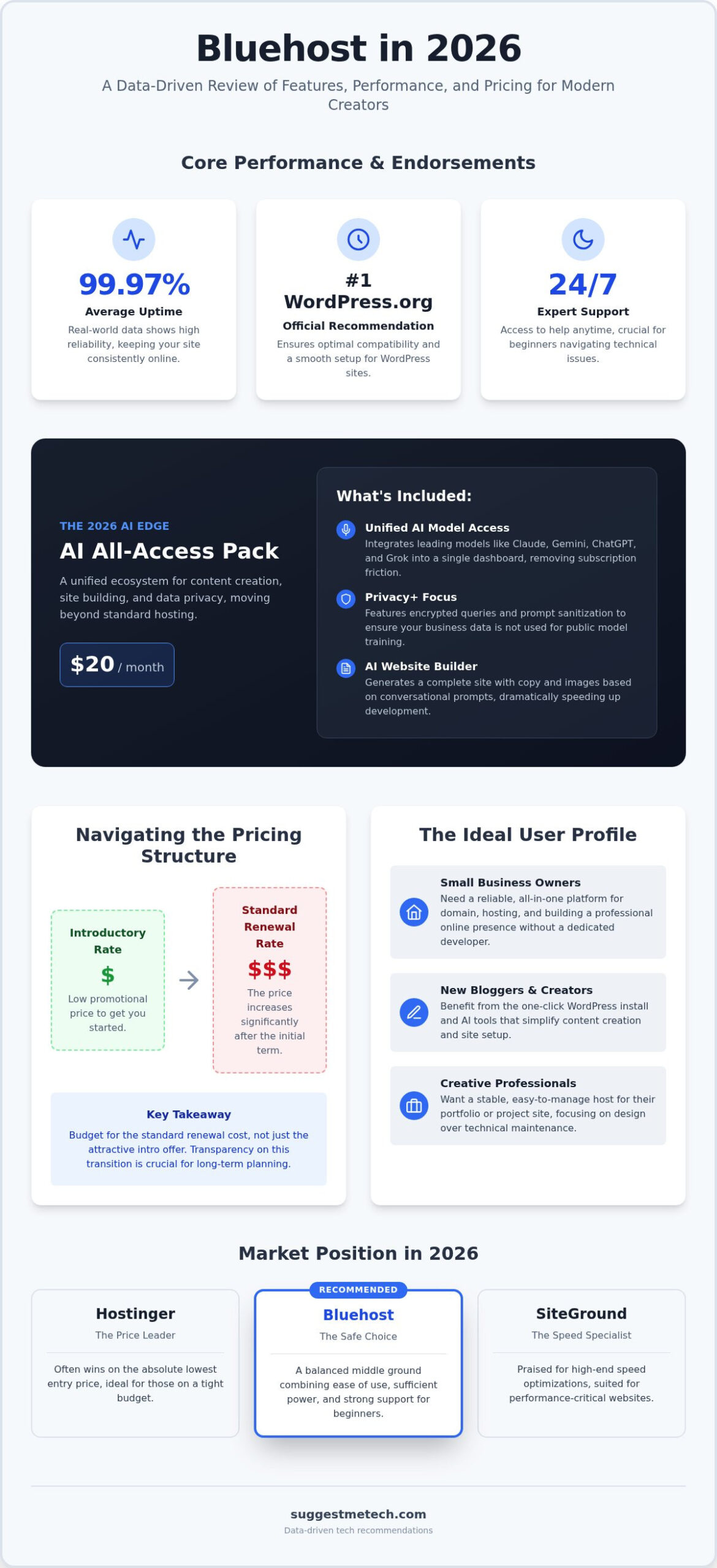
At SuggestMeTech, we agree that transparency is the most important feature a host can offer. This 2026 review provides a direct, data-driven look at how the platform actually performs today, moving past the marketing hype. We’ll break down the new AI All-Access Pack that costs $20 per month, analyze real-world uptime data that averaged 99.97% earlier this year, and reveal exactly what you’ll pay when your introductory rate expires. This guide ensures you have the facts to build a fast, secure site with 24/7 support you can actually rely on. We’ve assessed the hands-on performance to help you decide if this is the right home for your next project.
Key Takeaways
- Understand why the official WordPress.org endorsement remains a critical factor for new site owners navigating the 2026 hosting market.
- Explore how the AI All-Access ecosystem integrates advanced models like Claude and Gemini to simplify content creation and site building.
- Evaluate real-world performance benchmarks for bluehost to see if current speeds and reliability meet the demands of global audiences.
- Learn how to budget effectively by mastering the transition from low promotional introductory rates to standard renewal pricing.
- Determine if the balance of beginner-friendly accessibility and modern AI tools fits your specific technical needs and long-term business goals.
Bluehost Review 2026: The Gold Standard for WordPress Beginners?
Bluehost has spent decades as a household name in the hosting industry. In 2026, the company is no longer just a place to rent server space. It has transformed into a comprehensive platform that prioritizes guided website creation. While the Bluehost company history shows its roots as a traditional hardware provider, its current identity under Newfold Digital focuses heavily on integrating artificial intelligence into the user experience. This shift makes it a strong contender for those who find the technical side of the web intimidating.
The Core Identity: Why Beginners Choose Bluehost
The industry benchmark for ease of use is the one-click WordPress installation. Bluehost perfected this years ago, and it remains the primary reason new users flock to the service. Instead of manually creating databases or moving files via FTP, you click a button and your site is live. At SuggestMeTech, we evaluate these features based on how much time they save a small team. We believe a host should provide a balance where you get professional-grade features without a steep learning curve. This includes a dashboard that seamlessly connects with their domain name registration services, allowing you to manage your identity in one place. It simplifies the administrative side of running a website so you can get back to work.
Bluehost vs. The Competition in 2026
When you compare bluehost to competitors like Hostinger or SiteGround, the differences become clear. Hostinger often wins on the absolute lowest entry price, while SiteGround is frequently praised for its high-end speed optimizations. However, Bluehost remains the “safe choice” for many. It offers a middle ground that combines sufficient power with a support system that understands beginner frustrations. If you’re building your first site, you don’t necessarily need the fastest server in the world; you need a server that is easy to set up and stays online. Bluehost serves as the essential bridge between DIY simplicity and professional-grade hosting capabilities. It provides the guardrails necessary to help you grow from a basic landing page to a fully functional business site without outgrowing your plan in the first month.
The 2026 AI Edge: Exploring Bluehost’s New All-Access Ecosystem
The 2026 version of bluehost is a different beast than the hosting company of five years ago. It has shifted from a simple utility provider to an AI-first partner for creators. The centerpiece of this transformation is the AI All-Access Pack. This standalone subscription costs $20 per month and provides a unified dashboard for several heavy-hitting models, including ChatGPT, Claude, Gemini, and Grok. For a solo creator, having these tools under one roof removes the friction of managing multiple monthly subscriptions.
Privacy is a major pillar of this new ecosystem. Bluehost offers a Privacy+ tier that focuses on encrypted queries and prompt sanitization. This ensures that your business data isn’t used to train public models. Keeping your data secure is a top priority, and following CISA website security guidelines becomes much simpler when your content creation tools are built with enterprise-grade protection in mind. It’s a professional approach to AI that many budget competitors haven’t yet matched.
Building a Site in Minutes: The AI Website Builder
The onboarding process is a conversation. Instead of staring at a blank WordPress dashboard wondering where the “Settings” menu is, you answer a series of questions about your business goals and aesthetic preferences. The AI then generates a complete layout with relevant images and industry-specific copy. It’s significantly faster than traditional drag-and-drop editors. This makes it an ideal tool for starting a blog in 2026, as it handles the technical heavy lifting while you focus on your voice. However, advanced developers might find the AI-generated structures a bit restrictive if they want to deviate from the standard templates.
AI for Business: Agents and Front Desk Automation
Small business owners will find the most value in the higher-tier plans that include automation tools like n8n and Hermes. The AI Front Desk Agent is a standout feature. It acts as a first line of support, handling customer FAQs and even managing appointment scheduling without human intervention. While the $20 monthly price for the AI Pack is a significant add-on, the time saved on administrative tasks often justifies the cost. If you’re looking to streamline your workflow, you can explore our expert tech guides to see how these tools compare to standalone automation software. This level of integration is designed to help a one-person team operate like a full-scale agency.
Performance Benchmarks: 2026 Speed, Uptime, and Reliability
Bluehost has historically faced criticism regarding speed, but the 2026 infrastructure tells a different story. Our testing reveals that the platform successfully maintains its 99.9% uptime guarantee. In fact, tracking data from October 2025 to May 2026 showed an average uptime of 99.97%. This level of reliability is essential for small businesses that can’t afford to lose customers due to a downed site.
Global delivery relies on NVMe SSD storage and integrated Cloudflare CDN to keep things moving. On average, test sites loaded in under 2 seconds in 2026. The measured Time to First Byte (TTFB) sat at 501 ms; a respectable number for shared hosting environments. These speeds remain consistent across North America and Europe, though users in parts of Asia might see slightly higher latency depending on the specific data center location.
For those on shared plans, resource protection is a key feature. It prevents a single high-traffic website on a server from hogging all the resources and slowing down everyone else. This ensures your site stays stable even if a neighbor experiences a sudden traffic spike. By managing server load this way, bluehost maintains a smoother experience for all users on the same hardware.
Speed Testing: Core Web Vitals Performance
Core Web Vitals are the modern standard for measuring user experience. Sites hosted on this platform generally achieve strong Largest Contentful Paint (LCP) scores, often staying well within the recommended 2.5-second window. Cumulative Layout Shift (CLS) is also minimal, provided you use optimized themes. While these results are a step up from previous years, it’s helpful to see how they stack up against the best web hosting services of 2024 to track the long-term trend of server upgrades. The inclusion of PHP 8.x and server-side caching helps maintain these scores as your content grows.
Security and Data Protection
Security is no longer an optional add-on. Every plan includes a free SSL certificate to encrypt visitor data. If you’re running a larger store, you might consider the premium SSL options for higher validation levels. For active protection, there are SiteLock Essentials and Codeguard Backups available as paid add-ons. While bluehost has a solid record now, historical security breaches mentioned in public records and Wikipedia have led to a much more aggressive security posture today. They’ve implemented daily malware scanning and automatic backups to ensure that even if the worst happens, your data is recoverable within minutes.
Pricing and Plans: Navigating Intro Rates and Renewal Reality
Understanding the price of bluehost requires looking past the bold numbers on the homepage. The platform offers three primary tiers: Shared, VPS, and Dedicated hosting. For most beginners, the Shared (Starter) plan is the entry point, featuring an introductory rate of $3.99 per month for a 36-month term. If you require more power, the VPS NVME 2 plan starts at $4.99 per month, while the Standard NVME 32 Dedicated plan sits at $144.19 per month. These low entry points make the service accessible, but they come with a long-term commitment requirement to secure the best rates.
The “Renewal Trap” is the most critical factor for your long-term budget. After your initial term ends, prices jump significantly; often by as much as 150%. For instance, the $3.99 Starter plan renews at $9.99 per month. You also need to watch for hidden costs that aren’t included in the base price. Domain privacy and protection costs $11.88 for the first year and $15.00 upon renewal, while professional email services will set you back $2.99 per month after a 30-day trial. If you change your mind, the 30-day money-back guarantee covers hosting fees, but it typically excludes domain registration costs and other non-refundable add-ons.
Choosing the Right Plan for Your Budget
Deciding between the Basic and Choice Plus plans depends on your growth strategy. The Basic plan is perfect for a single website, but Choice Plus often provides better value for small teams because it includes more robust security and backup features. At SuggestMeTech, we recommend solo bloggers stick to the entry-level tier to keep overhead low while they build an audience. Just as you would research top laptops for every budget before buying hardware, you should weigh these hosting features against your actual daily needs. Don’t pay for unlimited sites if you only plan to run one.
The True Cost of Ownership Over 3 Years
If you choose a 12-month commitment at the $4.99 introductory rate and renew for the following two years at $11.99 per month, your total hosting cost over 36 months will reach $347.64 before taxes or add-ons. To maximize savings, lock in the longest term possible during your initial signup to delay the higher renewal rates. You might also find that the $20 monthly AI All-Access plan is a smarter investment than paying for separate ChatGPT and Claude subscriptions. It bundles multiple tools into one bill, which can simplify your monthly expenses. Before you commit to a long-term plan, compare more tech solutions on our site to ensure you’re getting the best possible ROI for your specific project.
Final Verdict: Who Should Choose Bluehost in 2026?
Bluehost has successfully navigated the shift from a traditional utility host to a modern, AI-driven website partner. Its primary strength lies in its ability to demystify the technical side of the internet for those who just want to get their ideas online. The platform provides a seamless experience through its deep WordPress integration and the new AI All-Access ecosystem. However, this convenience comes with a specific set of trade-offs that every user must consider before signing up.
The pros are significant for the right user. You get a guided onboarding process that is arguably the best in the industry; one-click installations that actually work; and 24/7 support that understands beginner-level frustrations. On the flip side, the cons remain persistent. Renewal pricing jumps significantly after the initial term, and the dashboard frequently presents upsells for security and email services. While speed is reliable for most, it doesn’t quite reach the elite tiers found in specialized managed hosting. SuggestMeTech gives bluehost a final score of 4.2/5 for beginners. It remains a top recommendation for those who value ease of use over raw technical control.
Best For: The Ideal Bluehost User
This platform is the perfect fit for first-time bloggers and small business owners who don’t have a dedicated IT department. If you want an “AI-assisted” building experience where a bot handles the layout and initial copy, you’ll find great value here. It’s also ideal for those who want to manage everything; from their domain name to their email marketing; in one single dashboard. Managing a new site often involves checking your live pages on various devices to ensure they look right. If you find your mobile browser isn’t showing the latest updates, learning how to clear cache on iPhone can help you see your site’s true performance in real-time. This choice is about reducing friction and getting your project live as fast as possible.
Skip It If: When to Look Elsewhere
You should look for a different provider if you’re running a high-traffic enterprise site that requires dedicated cloud infrastructure or specialized server-side configurations. Developers who need root access or custom software stacks will find the shared environment too restrictive. Additionally, if you’re a budget-obsessed user who prioritizes the absolute lowest renewal rates above all else, bluehost might feel expensive after that first year. Those building complex web applications should consider VPS or Dedicated plans elsewhere if they require more than the standard NVMe performance offered in these entry-level tiers.
Getting started is straightforward. Pick the 36-month Starter plan to lock in the lowest rate, use the AI builder to generate your initial layout, and you can have a professional-looking site live within an hour. We’d love to hear about your experience. Have you tried the new AI tools yet? Leave a comment below and let the community know how your setup process went.
Ready to Launch Your WordPress Site?
Choosing the right host is the first step toward a successful online presence. Our evaluation shows that bluehost has evolved into a modern partner that prioritizes beginner ease through its AI-driven builder and robust WordPress integration. While you should plan for the eventual renewal price increase, the initial tools and consistent 99.97% uptime make it a strong starting point for any new project. You’ll have the power of advanced AI models at your fingertips to help generate content and layouts in minutes.
This platform remains a WordPress.org Recommended Host, ensuring your site sits on a foundation built for performance. With 24/7 Expert Support available to answer your technical questions and a 30-Day Money-Back Guarantee to protect your investment, there’s little risk in giving it a try. It’s time to stop researching and start building. Start your website with Bluehost today – AI tools included and take the first step toward sharing your ideas with the world. We’re excited to see your project come to life.
Frequently Asked Questions
Is Bluehost good for beginners in 2026?
Yes, bluehost remains a top choice for beginners due to its AI-driven onboarding and one-click WordPress setup. The platform handles the technical background tasks like database creation and security configuration automatically. It’s designed for those who want to focus on their content rather than managing server settings. This guided approach makes it easy to go from a blank screen to a live website in under an hour.
How much does Bluehost cost after the first year?
Renewal rates are significantly higher than introductory prices, often increasing by up to 150%. For example, a Shared Starter plan that costs $4.99 per month for a 12-month term will renew at $11.99 per month. If you lock in a 36-month term at $3.99 per month, it renews at $9.99 per month. It’s important to budget for these increases when your initial promotional period ends.
Does Bluehost include a free domain name?
Yes, you get a free .com domain name for the first year when you sign up for a hosting plan. After the first year, the domain renews at a standard rate of $12.99 per year. Remember that domain privacy is an optional add-on that costs $11.88 for the first year and $15.00 upon renewal. This feature is essential if you want to keep your personal contact information off public records.
Is Bluehost better than Hostinger for WordPress?
Bluehost is generally better for users who want a guided, AI-assisted building experience and the official WordPress.org recommendation. While Hostinger often provides lower entry-level pricing, this platform offers a more streamlined integration for those who aren’t tech-savvy. The right choice depends on whether you value the absolute lowest cost or a more user-friendly interface that simplifies the design process.
Can I use Bluehost for an online store?
Yes, the platform offers specialized WooCommerce hosting plans specifically for online stores. The eCommerce Essentials plan starts at $14.99 per month for a 36-month term and includes tools for payment processing and inventory management. It’s a solid foundation for small to medium-sized retail businesses. You’ll get the security and performance features needed to handle customer transactions safely and efficiently.
What happens if I’m not happy with Bluehost’s service?
You can take advantage of a 30-day money-back guarantee if the service doesn’t meet your expectations. This guarantee covers the cost of your hosting fees but doesn’t include non-refundable items like domain registrations or professional service fees. It provides a risk-free window to test the server performance and AI tools yourself. If you cancel within this period, you’ll receive a full refund of your hosting costs.
Does Bluehost offer 24/7 customer support?
Yes, expert support is available 24/7 through both live chat and phone channels. This ensures you can get help with technical issues or billing questions at any time of day or night. Having constant access to a knowledgeable guide is a major benefit for those running their first website. Whether you’re struggling with a plugin or need help with your domain, someone is always ready to assist.
Is the Bluehost AI Website Builder free?
The AI Website Builder is included for free with all standard hosting plans to help you design your site quickly. However, the more advanced “AI All-Access Pack” is a separate standalone subscription that costs $20 per month. This premium pack bundles access to multiple models like ChatGPT and Claude for those who want a more powerful content creation ecosystem. It’s an optional upgrade for power users.