

You shouldn’t pay a single cent for domain privacy in 2026, yet some major registrars still try to charge you $11.99 or more for it. It’s frustrating to see a basic privacy feature treated as a premium upsell when you just want to keep your personal phone number and home address off the public record. If you’re staring at a checkout screen wondering, domain privacy protection is it worth it, you aren’t alone in your skepticism. Most people feel that familiar sting of anxiety about their inbox being flooded with spam the moment they hit “buy.”
We agree that your personal data shouldn’t be a profit center for your registrar. This guide breaks down the technical, legal, and financial realities of the updated May 2026 Registration Data Policy and the industry’s shift to the RDAP protocol. We’ll show you exactly how to get this protection for free, which registrars are still charging for it, and the crucial difference between hiding your data and actually securing your site. You’ll walk away with a definitive answer on whether to pay up or switch providers to keep your identity safe.
Key Takeaways
- Learn how to evaluate your specific online presence to determine if domain privacy protection is it worth it for your personal or professional goals.
- Identify which high-authority registrars now offer lifetime privacy for free and which ones are still charging outdated premium fees.
- Understand the critical difference between technical data redaction and comprehensive site security to keep your digital assets safe.
- Discover how the 2026 transition from WHOIS to RDAP affects your legal rights and the visibility of your registration data.
- Assess the real-world risks of public data exposure, from relentless marketing spam to physical privacy threats for home-office owners.
What is Domain Privacy Protection and How Does It Work?
Every domain name registered on the internet is tied to a public record. This database, known as WHOIS, acts like a global directory for domain ownership. ICANN requires every registrar to maintain accurate data for three specific roles: the Registrant, the Admin, and the Tech contact. For most individual site owners, these roles are all filled by the same person, meaning your private details are listed multiple times. To understand if domain privacy protection is it worth it, you first need to see how a proxy service model functions. The registrar lists their own company information in the directory while keeping your actual data in a private, secondary database. You maintain full legal control, but the public only sees the proxy.
The system relies on three distinct contact fields that are often overlooked:
- Registrant: The person or entity who legally owns the domain name.
- Admin: The contact responsible for administrative decisions, such as domain transfers.
- Tech: The person who handles technical issues like DNS settings or server configurations.
When evaluating if What is domain privacy? fits your needs, remember that this service is a technical shield, not a legal loophole. You’re still the owner in the eyes of the law, but you’re invisible to the casual observer.
The Public WHOIS Record: What Everyone Can See
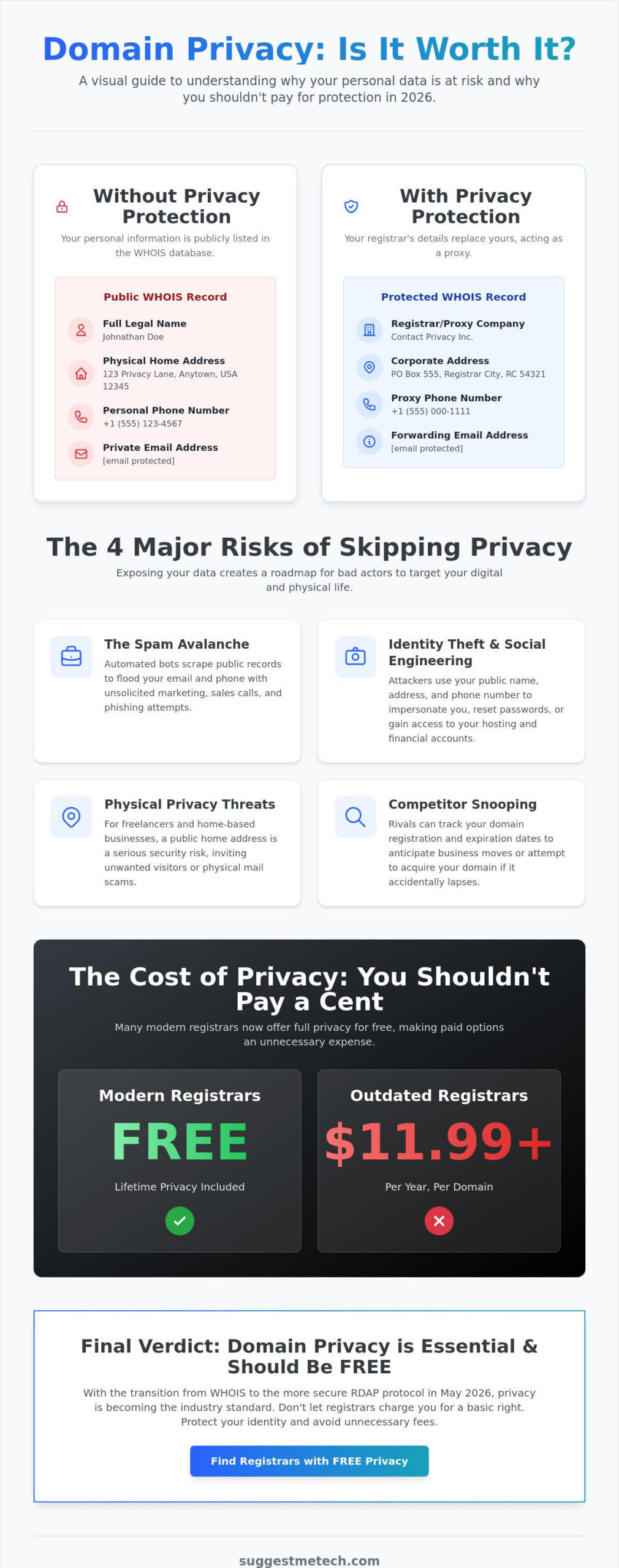
Without protection, the WHOIS record is an open book. Anyone with an internet connection can see your full legal name and physical home address. This is a significant concern for bloggers or freelancers working from a home office. Beyond physical location, your personal phone number and private email are also exposed. This often leads to WHOIS scraping, where automated bots harvest your data to build marketing lists. Additionally, the record shows your registration and expiration dates. Competitors often use these dates to track your business moves or swoop in if you accidentally let a domain lapse. It’s a goldmine of data for anyone looking to exploit your privacy.
How Privacy Protection Masks Your Identity
When you enable privacy, the registrar replaces your sensitive details with generic placeholders. Instead of your home address, the public sees a corporate address for a company like “Contact Privacy Inc.” This creates a vital layer of anonymity. The most effective services include a specialized email forwarding system. Instead of your real email, a unique, temporary address is listed in the directory. Any legitimate inquiries are forwarded to you, while the system automatically filters out the bulk of spam and phishing attempts. This setup ensures you remain the legal owner without sacrificing your personal safety. If you’re weighing the pros and cons, consider that domain privacy protection is it worth it simply for the peace of mind that comes from knowing your front door isn’t a click away for every stranger on the web.
The 4 Major Risks of Skipping Domain Privacy
Deciding if domain privacy protection is it worth it requires looking at what happens when you opt out. While the transition to the RDAP protocol in 2026 has improved how data is handled, your personal information remains vulnerable to those who know how to look. Exposure isn’t just a minor technical oversight; it creates a roadmap for bad actors to target your digital and physical life. You face four primary threats when your registration data stays public.
The Spam Avalanche: Why Your Inbox Will Never Be the Same
The moment you register a new domain, automated scraper bots scan the registry for fresh contact details. These bots build massive marketing lists that are sold to low-tier agencies and aggressive telemarketers. You’ll quickly notice a surge in calls from “SEO gurus” and “web design experts” who claim your site has critical errors. These callers often use high-pressure tactics to sell services you don’t need. A single public record can haunt your phone line with unsolicited calls for years. This persistent noise makes it difficult to distinguish legitimate business inquiries from predatory sales pitches.
Identity Theft and Social Engineering
Sophisticated attackers don’t just want to sell you things; they want to own your assets. By analyzing the risks of public WHOIS data, security experts have shown how easily your home address and phone number can be used to bypass security questions. An attacker might call your hosting provider, posing as you, and use your public address to “verify” their identity. This often leads to targeted phishing attacks where you receive emails that look like official registrar communication. You might even encounter “Domain Slams,” which are fake paper or digital invoices designed to trick you into transferring your domain to a different, more expensive registrar under the guise of a renewal.
Physical privacy is another major concern for the growing number of home-based entrepreneurs. Linking your residence to your website can lead to unwanted visitors or harassment if your site handles controversial topics. Additionally, leaving your data public allows rivals to perform competitive intelligence. They can easily see every domain in your portfolio, uncovering your future product launches or niche market tests before you’re ready to go live. If you want to keep your business strategy under wraps, staying anonymous is a practical necessity. You can find more detailed evaluations of these security trade-offs in our latest technology reviews and guides. Protecting your data now prevents the headache of reclaiming a hijacked identity or a stolen domain later.
Domain Privacy vs. GDPR: Is Law Enough to Protect You?
Many site owners assume that the General Data Protection Regulation (GDPR) made paid privacy services obsolete. Since 2018, the WHOIS landscape shifted significantly, leading to the “Redacted for Privacy” tags you often see today. If you’re wondering domain privacy protection is it worth it in 2026, you have to look past that label. GDPR is a legal framework, not a technical masking tool. It primarily protects individuals within the European Economic Area. If you live in the United States or other regions without similar strict mandates, your registrar might still publish your full details by default. Even under the updated May 2026 Registration Data Policy, the level of protection you receive depends heavily on your location and your registrar’s specific interpretation of the law.
There are also clear limitations for business owners. GDPR protections are designed for “natural persons,” not legal entities. If you register your domain under a business name, your office address and corporate phone number are frequently excluded from redaction. This leaves your professional contact points vulnerable to the same scrapers and social engineers we discussed in the previous section.
Why Redacted Data is Not the Same as Private Data
Redaction is incredibly inconsistent across different Top-Level Domains (TLDs). While a .uk or .ca domain might offer strong default redaction, a .com or .net address remains a global wildcard. Registrars often apply the bare minimum redaction required to avoid fines, which doesn’t always include your phone number or email. A dedicated privacy service is a proactive choice. It replaces your sensitive data with a proxy identity, whereas redaction simply places a temporary digital curtain over your actual information. This curtain is much thinner than you might think.
The “Legitimate Interest” Loophole
The biggest threat to your anonymity is the “legitimate interest” clause. Legitimate interest is the legal gateway that allows third parties to access non-public registration data for purposes like intellectual property enforcement or criminal investigations. Through ICANN’s Registration Data Request Service (RDRS), which is currently slated to operate through 2027, lawyers and copyright holders can request your unredacted data. If someone claims your site infringes on a trademark, they can often pierce the GDPR veil with a standardized request. A dedicated privacy service provides a much stronger legal buffer. Because the registrar’s proxy information is the official record, it adds a layer of bureaucracy that discourages casual data harvesters and protects your home address from being handed over without a court order or a verified legal claim.
The Cost-Benefit Analysis: When Should You Pay?
Evaluating the financial side of your domain registration is essential. In 2026, the industry average cost for privacy protection typically sits between $10 and $20 per year. While that sounds like a small amount, it adds up quickly if you manage multiple domains. If you’re with a registrar that charges $11.99 annually, you’re essentially paying a recurring tax for a feature that many competitors now treat as a standard right. When asking domain privacy protection is it worth it, the answer depends entirely on your choice of provider and your tolerance for daily interruptions.
Consider the return on investment. For about $1 a month, you can effectively block dozens of daily spam calls and phishing attempts. For a home-based business, this is a negligible price to pay for security. However, if your registrar is one of the few still charging for this service, the benefit comes with the realization that you’re being overcharged for a basic proxy. You should also account for the mandatory ICANN fee, which remains around $0.18 per year, regardless of your privacy settings. This fee is unavoidable, but paying an extra $15 for privacy doesn’t have to be.
Registrars That Give It Away for Free
The market has shifted. Leading registrars like Namecheap, Cloudflare, Porkbun, and Hover now offer free, lifetime WHOIS privacy as a standard feature. They recognize that charging for data protection is a competitive disadvantage. If you’re just starting your digital journey, you can find more context on how these registrations work in our guide on What is a Domain Name?. If your current provider still lists privacy as a paid add-on, it’s often more cost-effective to transfer your domain to a registrar that includes it for free. Most transfers even include a one-year registration extension, making the move financially sound.
When Paid Privacy is a Scam
Watch out for “Full Domain Protection” bundles. Some legacy registrars and big-name providers still charge around $11.99 per year for privacy. They often package it with security features that are either redundant or overpriced. If a registrar asks for more than $5 for basic WHOIS masking without providing significant extra value, you’re likely being upsold on a service that costs them virtually nothing to maintain. These bundles frequently include “website monitoring” or “malware scans” that are better handled by dedicated security plugins or CDN services. You can find more honest evaluations of these service tiers in our technology reviews and guides. Don’t let a registrar trick you into paying a premium for a tool that the rest of the industry provides for $0.00.
Final Verdict: Is Domain Privacy Worth It for You?
After weighing the technical risks against the financial costs, we can reach a definitive conclusion. The answer to domain privacy protection is it worth it depends entirely on who you are and what address you’re using to register your site. For the vast majority of individual users, the answer is a resounding yes. If you’re using your home address, personal phone number, or private email to register a domain, the protection is a vital shield. However, if you’re a large corporation with a public headquarters and a dedicated legal department, the extra layer of a proxy service becomes redundant.
The “Yes” Verdict applies to:
- Personal Bloggers: Your safety shouldn’t be the price of having an online voice.
- Freelancers and Home-Based Businesses: Keeping your residence private prevents unwanted visitors and harassment.
- High-Profile Individuals: Anonymity is your first line of defense against targeted social engineering.
The “No” Verdict applies to:
- Established Corporations: Your business address is already public record on your website and tax filings.
- Government Entities: Transparency is often a legal requirement for these registrations.
Recommendations by Use Case
If you’re a hobbyist blogger, privacy isn’t just about avoiding spam; it’s about physical safety. Before you even pick out your theme or write your first post, you should ensure your registration is masked. If you’re still in the planning stages, check out our guide on How to Start a Blog to see how privacy fits into the initial setup. For small business owners, the decision is a balancing act. You want customers to trust you, but you don’t want your personal cell phone ringing with “SEO expert” robocalls at dinner time. Using a professional VOIP number and a PO Box can help, but a privacy proxy is the most efficient solution.
How to Check Your Current Privacy Status
Don’t guess whether your information is exposed. Use a public WHOIS or RDAP lookup tool to search for your domain name. If you see your name, home address, or phone number in the results, your data is currently being harvested by scrapers. To fix this, follow these three steps in your registrar’s dashboard:
- Log in and navigate to your “Domain Management” or “My Domains” section.
- Look for a toggle or menu item labeled “Privacy,” “WHOIS Privacy,” or “ID Protection.”
- Enable the service. If your registrar charges for this, consider if a transfer to a free provider is better for your budget.
Protecting your identity is a fundamental part of modern web ownership. We encourage you to audit your domain security today to ensure your personal details aren’t an open book for the entire internet. For more hands-on assessments of the tools that keep your site safe, explore our latest technology reviews and guides.
Secure Your Digital Identity Today
Securing your personal data is a baseline requirement for any site owner in 2026. While you’ve likely seen registrars try to frame this as a premium add-on, we’ve shown that it’s often a standard feature you can get for free. When deciding domain privacy protection is it worth it, remember that your home address and phone number are too valuable to leave to chance or inconsistent legal redactions. Protecting your identity shouldn’t be a profit center for your provider.
We’ve conducted an expert analysis of 50+ registrars to bring you unbiased tech comparisons and user-first privacy recommendations. You deserve a partner that prioritizes your safety without hidden taxes or redundant upsells. Our research shows that the right choice today prevents years of spam and security risks tomorrow. Don’t let your data remain an open book for scrapers and social engineers.
Ready to find a provider that respects your data? Check out our Best Web Hosting Services of 2026 for registrars that include free privacy!
Take control of your digital footprint and build your online presence with confidence.
Frequently Asked Questions
Does domain privacy protection hide my name from the government?
No, privacy protection only masks your details from the public WHOIS and RDAP databases. Registrars are legally required to maintain accurate records and will disclose your identity if presented with a valid subpoena, court order, or law enforcement request. It’s a tool for personal privacy against scrapers and marketers, not a way to bypass legal accountability or government oversight.
Will domain privacy affect my SEO or search engine rankings?
No, using privacy protection won’t hurt your search engine rankings. Google and other major search engines treat privacy masking as a standard security best practice rather than a sign of a low-quality site. When asking domain privacy protection is it worth it for your SEO strategy, the answer is that it has zero direct impact on how you rank in results.
Can I add privacy protection after I have already registered my domain?
Yes, you can enable privacy protection at any point through your registrar’s management dashboard. However, you should be aware that once your data has been public, it might have already been harvested by third-party archive sites. While adding it late stops new scrapers from finding you, it won’t necessarily remove your information from historical databases that already recorded your details.
Is WHOIS privacy the same as an SSL certificate?
No, these are two completely different security tools. WHOIS privacy protects your personal identity by hiding your contact information in the domain registry. An SSL certificate encrypts the connection between your website’s server and your visitors’ browsers to keep their data safe during transit. You need both to ensure a fully secure and private online presence for yourself and your users.
Does domain privacy prevent people from contacting me about my website?
No, it doesn’t cut off communication from legitimate parties. Most privacy services provide a proxy email address that automatically forwards messages to your real inbox. If you’re wondering domain privacy protection is it worth it for business inquiries, remember that this system filters out the majority of automated spam while still allowing potential partners or customers to reach you through the proxy.
Are there any domain extensions (TLDs) that do not allow privacy protection?
Yes, certain country-code top-level domains (ccTLDs) have strict transparency rules that prohibit privacy masking. For example, the .us domain extension requires all registrant data to be public to verify residency. Other extensions like .ca or .uk have their own specific privacy frameworks that might offer some redaction by default but don’t allow the same proxy services you find with .com or .net addresses.
What happens to my privacy protection when I transfer my domain to a new host?
Privacy protection usually terminates at your old registrar the moment the transfer process begins. You’ll need to ensure that your new registrar offers privacy and that you enable it immediately after the move is complete. Since many modern registrars now include this for free, it’s a great time to audit your settings and make sure your data doesn’t accidentally become public during the transition.