Buying the wrong JBL speaker in 2026 could mean your brand-new device won’t talk to the ones you already own. It’s frustrating when you just want a reliable sound system for the beach or backyard, but the difference between a Flip, Charge, and Pulse feels like a riddle. You want a speaker that survives a dunk in the pool and delivers enough bass to fill a room without draining your wallet. We know you don’t want to buy a model today only to see a better version drop next week.
This guide simplifies the current lineup with direct, expert insights to help you find your perfect match. We’ll explain why the shift from PartyBoost to Auracast is the most critical factor in your decision. We’ll also compare the real-world performance of the latest IP68-rated models like the Flip 7, the 24-hour battery life of the Charge 6, and the massive 130W output of the Xtreme 5. We’re curious to hear from you too. How has your current gear held up? Share your durability stories with our community as we help you find your next upgrade.
Key Takeaways
- Learn the difference between the “Core 4” series and high-output powerhouses to select the right chassis for your specific environment.
- Understand the shift to Auracast technology and how it affects your ability to pair a new jbl speaker with legacy devices.
- Identify the specific trade-offs between the Charge series’ power bank features and the Flip series’ unmatched portability.
- Decode the “JBL Original Pro Sound” signature to understand how passive radiators deliver that characteristic low-end punch.
- Access curated recommendations that prioritize long-term value and real-world durability for 2026.
Navigating the JBL Speaker Hierarchy in 2026
Understanding the JBL catalog starts with recognizing that they don’t just sell one type of sound. They’ve built a hierarchy based on how you actually live. The “Core 4” consists of the Go, Clip, Flip, and Charge series. These models represent the backbone of the brand’s portable offerings. For those who need to fill a backyard or a beach, the Xtreme and Boombox series provide the necessary scale. This structured approach stems from a long JBL company history that prioritizes specialized audio for specific environments.
Choosing a jbl speaker often means balancing portability with power. While these devices are famous for outdoor use, they also serve as vital components in a modern tech ecosystem. A Charge 6 or Xtreme 5 can easily supplement the audio from your best laptops, providing a much-needed bass boost for video editing or casual streaming. If you’re looking for aesthetics over ruggedness, the Pulse and Authentics lines offer visual flair and Wi-Fi connectivity, though they often sacrifice the extreme durability found in the core portable models.
Ultra-Portable vs. Mainstream Portables
The Go and Clip series are designed for absolute mobility. These are pocket-sized units where every ounce matters. The Clip 5 is the choice for hikers, while the Go 4 fits into a jacket pocket. However, the JBL Flip 7 remains the “Goldilocks” choice for most users. It balances a 14-hour battery life with a chassis that still fits in a backpack side pocket. The primary trade-off here is the acoustic chamber size; a smaller speaker simply cannot move as much air, resulting in less low-end punch compared to the larger mainstream models.
The Party and Home Audio Outliers
Models like the PartyBox 330 and 130 are “transportable” rather than truly portable. They weigh significantly more and are designed for high-output events. In contrast, the Authentics line targets the home, merging retro styling with modern features like the JBL One App. When evaluating the best battery-to-weight ratio, the Charge 6 is the clear winner. It offers up to 24 hours of playback and an IP68 rating in a frame that weighs much less than the 6.4 lb Xtreme 5. This makes the Charge series the most efficient choice for users who need all-day power without the bulk of a dedicated party unit.
JBL Sound Signature: Pro Sound vs. Real-World Performance
JBL’s “Original Pro Sound” isn’t designed for clinical, flat-response accuracy. It’s engineered for energy. Since the acquisition of Harman by Samsung, the brand has refined this signature into a distinct V-shape. This means the bass and treble are slightly boosted to create a lively, engaging experience. Every jbl speaker aims to deliver that “front row at a concert” feeling, which makes them ideal for modern pop, hip-hop, and electronic music where the beat is the priority.
A key part of this performance comes from the hardware design. Most models use dual passive radiators on the ends of the chassis. Passive radiators are non-powered diaphragms that react to internal air pressure to amplify bass frequencies without requiring a battery-draining woofer. This clever use of physics allows a compact jbl speaker to produce deep, resonant tones that usually require a much larger cabinet. While most models are directional and sound best when pointed toward the listener, the Pulse series offers 360-degree dispersion for social settings where people are moving around.
Bass Response and Outdoor Utility
If you listen to a JBL at very low volumes, you might think it sounds thin. These speakers are tuned for the “sweet spot” at approximately 70% volume. This is where the Digital Signal Processing (DSP) truly shines. Unlike some competitors that sound muddy outdoors, JBL’s DSP dynamically adjusts the frequencies to ensure the bass doesn’t get lost in open spaces. It actively prevents distortion, even when you’re pushing the volume to its limit at a beach or park. For those who want more control over this output, you can explore our detailed tech comparisons to see how JBL stacks up against brands like Sony in high-noise environments.
App Integration and Software Updates
The JBL One App has become a mandatory tool for getting the most out of your hardware in 2026. It’s no longer just for renaming your device. The app provides access to critical features that improve the user experience:
- Custom EQ: Models like the Charge 6 now offer a 7-band equalizer to fine-tune your sound.
- Genre Presets: Quickly switch between “Podcast” for vocal clarity and “Bass Boost” for high-energy tracks.
- Firmware Maintenance: Regular updates are released to optimize battery health and improve Auracast stability.
JBL’s software is more direct and solution-oriented than the often-convoluted apps from Bose. It focuses on the features you actually use daily rather than burying them under layers of menus. Keeping your firmware updated is the easiest way to ensure your connectivity remains seamless as new Bluetooth standards emerge.
Comparing the Best-Sellers: Flip vs. Charge vs. Xtreme
Choosing the right jbl speaker depends entirely on your transport method. The Flip 7 remains the king of the backpack side pocket because it mimics the dimensions of a standard water bottle. It’s the “grab and go” choice for students and hikers who prioritize weight over raw power. In contrast, the Charge 6 offers a distinct advantage for long days away from a wall outlet. Its internal battery doubles as a power bank, allowing you to charge your smartphone via the USB-C port while the music keeps playing.
When you need to fill a backyard or a large campsite, the Xtreme 5 becomes the necessary upgrade. While some reviews overlook this detail, the Xtreme’s 6.4 lb weight makes it significantly less portable than its smaller siblings. It requires the included shoulder strap for true mobility. This model bridges the gap between personal audio and the massive PartyBox series, delivering 130W of power when plugged into AC. Both the Charge and Xtreme now utilize Auracast™ broadcast audio, ensuring they can lead a synchronized network of speakers for larger gatherings.
Battery Life and Charging Speed
Advertised battery specs usually reflect playback at 50% volume. In real-world testing at 70% volume, expect the Flip 7 to last closer to 10 hours rather than its 14-hour rating. The Charge 6 and Xtreme 5 fare better, offering a true all-day experience. If you’re running low, these newer models support “Playtime Boost” via the app, which can squeeze out an extra 3 to 4 hours by optimizing the frequency response. They also support USB-C Power Delivery (PD), allowing for faster top-offs if you have a compatible high-wattage charger.
Physical Build and Ruggedness
JBL uses a signature tight-weave fabric mesh that survives drops better than the hard plastic found on many budget alternatives. It absorbs impact and resists scuffs, though it does require maintenance. If you take your jbl speaker to the beach, sand can get trapped in the mesh. Always rinse your IP68-rated device with fresh water after saltwater exposure to prevent the charging port from corroding. The Clip 5 has also evolved its integrated carabiner to be wider, making it easier to hook onto thick backpack straps or fence links. Ask the community: have you ever had a speaker survive a major drop? We’d love to hear about your durability wins.
The Connectivity Maze: Auracast, PartyBoost, and Beyond
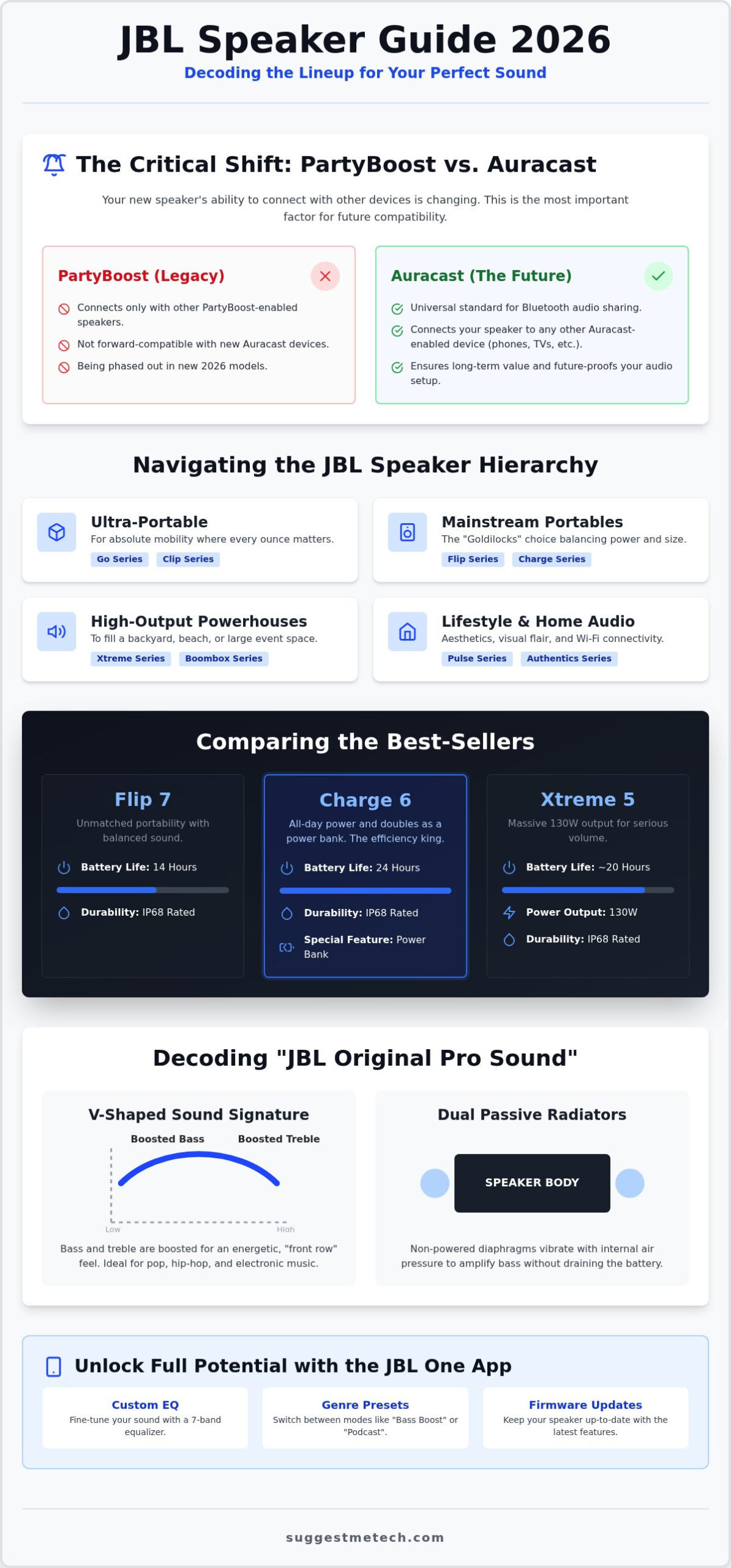
Building a wall of sound with multiple speakers used to be simple, but JBL’s evolving standards have created a bit of a headache for long-time fans. If you own an older jbl speaker, you’re likely familiar with PartyBoost. This technology allowed you to link up to 100 compatible units for a massive synchronized output. However, the 2026 lineup marks a definitive hard break from the past. The latest models, including the Flip 7 and Charge 6, have transitioned to Auracast, which is not backward compatible with PartyBoost or the even older Connect+ standard.
This means a Flip 6 cannot wirelessly pair with a Flip 7. It’s a frustrating reality for users who want to expand their existing setup. When buying a new unit today, you must decide if you’re starting a new ecosystem or trying to match what you already have in your cabinet. If you’re building from scratch, sticking to the 2026 models is the only logical path forward to ensure all your devices can actually communicate with each other.
Auracast: The Future of JBL Ecosystems
Auracast functions like a miniature radio station rather than a traditional one-to-one Bluetooth link. Instead of a “master” speaker struggling to push data to several “slaves,” the primary device broadcasts a signal that an unlimited number of nearby Auracast-enabled speakers can simply tune into. You’ll find a dedicated button on the chassis to toggle between “Broadcast” and “Listen” modes. Investing in a 2026 model ensures your hardware stays relevant as Auracast becomes the universal standard for public and private audio broadcasting. For a deeper look at how this fits into your total mobile setup, check out our full comparison database for real-world performance data.
Multi-Point Connection and Latency
Modern JBL units excel at multi-point connectivity, allowing you to stay paired with two devices simultaneously. You can seamlessly switch between a playlist on your phone and a video call on your laptop without diving into settings menus. This is particularly useful if you frequently switch between your speaker and your headphones during a workday.
Latency is the other major factor to consider. Older Bluetooth versions often suffered from a noticeable delay between a character’s lips moving on screen and the sound hitting the speaker. The Bluetooth 5.4 and 6.0 standards found in the latest Flip and Xtreme models include a specialized “Video Mode” accessible via the JBL One App. This mode prioritizes sync over absolute range, though you can still typically walk about 30 meters away in an open field before the signal begins to stutter. If you’re watching movies, always ensure this mode is active to avoid the “dubbed movie” effect.
Our Top JBL Speaker Recommendations for 2026
Selecting the right jbl speaker requires matching the hardware to your specific environment. We’ve evaluated the current lineup to identify which models offer the best real-world utility for different lifestyles. For 90% of listeners, the JBL Flip 7 is the definitive choice. It strikes the perfect balance between size and performance, offering a 14-hour battery and an IP68 rating that handles both dust and water with ease. It’s small enough to toss into any bag but loud enough to command a hotel room or a small campfire circle.
Best Budget and Value Picks
The JBL Go 4 is the entry-level hero of the lineup. It delivers surprisingly clear audio for under $50, making it a perfect gift or a secondary speaker for the shower. If you want more power on a budget, look for last-gen deals. You can often find the Flip 6 or Charge 5 at a 30% discount in 2026. Just keep in mind the connectivity limitations we discussed earlier; these older models won’t pair with the newer Auracast-enabled units. Refurbished speakers are also a viable path to savings, but only if they carry an official manufacturer warranty. Avoid third-party “renewed” listings where battery health is unverified.
Final Verdict: Which JBL Should You Buy?
To narrow down your choice, use this quick 3-question checklist:
- Portability: Does it need to fit in a pocket or a backpack side pocket? (Go, Clip, or Flip)
- Endurance: Will you be away from a power outlet for more than 12 hours? (Charge or Xtreme)
- Ecosystem: Are you pairing it with new 2026 models or older gear? (Auracast vs. PartyBoost)
Your favorite music genre should also influence your decision. Bass-heavy tracks like EDM or hip-hop require the larger acoustic chambers found in the Flip 7 or Charge 6 to truly shine. Smaller units like the Go 4 excel at podcasts and acoustic tracks but can’t replicate that deep physical thump. Now that you know the lineup, we want to hear from you. Have you ever had a jbl speaker survive a crazy drop or a dunk in the ocean? Share your favorite JBL “battle story” in the comments below!
Ready to Elevate Your Audio Experience?
Choosing the right jbl speaker in 2026 comes down to matching the hardware to your specific environment and understanding the shift toward the Auracast standard. You’ve seen that while older PartyBoost models offer value, the latest hardware provides essential future-proofing for multi-speaker setups. Whether you prioritize the backpack-friendly Flip 7 or the power-bank utility of the Charge 6, the goal is finding a device that survives your lifestyle. We’ve simplified the technical maze so you can focus on the music rather than the specs.
SuggestMeTech builds these guides on independent testing of over 20 JBL models to ensure you get no-jargon, practical advice. We’ve verified the latest 2026 connectivity standards to protect you from buying outdated tech. If you’re ready to make a choice, you can find the best deals on JBL speakers at SuggestMeTech. We’re here to help you navigate these complex tech decisions with confidence. Grab your new gear, head outside, and enjoy the sound you’ve been looking for.
Common Questions About JBL Speakers
Is the JBL Charge 5 still worth it in 2026?
The Charge 5 remains a solid value pick in 2026 if you find it at a steep discount, but it lacks the future-proofing of the newer models. It uses the older PartyBoost technology, meaning it won’t wirelessly pair with the newer Auracast-enabled jbl speaker iterations. If you don’t care about multi-speaker networking, its audio quality and IP67 rating still hold up well for most backyard settings.
Can I submerge my JBL speaker in a swimming pool?
Most modern JBL portables feature an IP67 or IP68 rating, which allows for submersion in up to one meter of water for 30 minutes. You can safely drop a Flip 7 or Charge 6 into a swimming pool without causing immediate damage. However, always rinse the unit with fresh water after exposure to chlorine or salt. Ensure the charging port is completely dry before plugging it in to prevent corrosion.
What is the difference between JBL PartyBoost and Auracast?
PartyBoost is a legacy technology that links up to 100 speakers in a closed, proprietary network. Auracast is the new 2026 standard that functions like a radio broadcast, allowing an unlimited number of speakers to tune in to one source. These two systems are not compatible with each other. If you’re building a new system, stick to Auracast-equipped models to ensure your gear stays relevant as the industry shifts.
Why is my JBL speaker not connecting to the app?
Your speaker must be paired via Bluetooth to your phone before the JBL One App can recognize it. If it still won’t connect, ensure your phone’s location services are turned on, as this is often required for device discovery. Check for any pending software updates on your smartphone. Sometimes a simple “forget device” in your Bluetooth settings followed by a fresh pairing resolves most app visibility issues quickly.
How do I reset my JBL speaker to factory settings?
To reset most portable JBL models, power the device on and then hold the “Volume Up” and “Play” buttons simultaneously for about five seconds. The speaker will power off once the reset is complete. This process clears all paired devices and restores original settings. It’s the most effective way to solve persistent pairing glitches or software freezes before you decide to reach out to technical support.
Can JBL speakers be used while charging?
You can absolutely use your jbl speaker while it’s plugged into a power source. Keep in mind that the battery will charge much slower if you’re playing music at high volumes simultaneously. Using the speaker while charging can also generate extra heat. If the device feels excessively warm to the touch, we recommend lowering the volume or letting it charge fully before resuming playback to protect long-term battery health.
Which JBL speaker has the loudest bass?
The JBL PartyBox 330 offers the loudest, most physical bass in the current lineup thanks to its massive drivers and AC power capabilities. If you need something portable, the Boombox 3 or Xtreme 5 are the top contenders. These models use larger passive radiators to move more air, creating the deep thump required for outdoor events. Smaller models like the Flip simply can’t match the low-end pressure of these larger cabinets.
Do JBL speakers work with Alexa or Google Assistant?
The JBL Authentics series features built-in support for both Alexa and Google Assistant simultaneously over Wi-Fi. Most standard portable models, like the Flip or Charge, don’t have built-in microphones or smart assistants. They rely on your phone’s assistant instead. You’ll need to trigger the voice command on your smartphone, and the audio will play through the speaker. If you want a dedicated smart speaker, look at the Authentics or Link lines.