
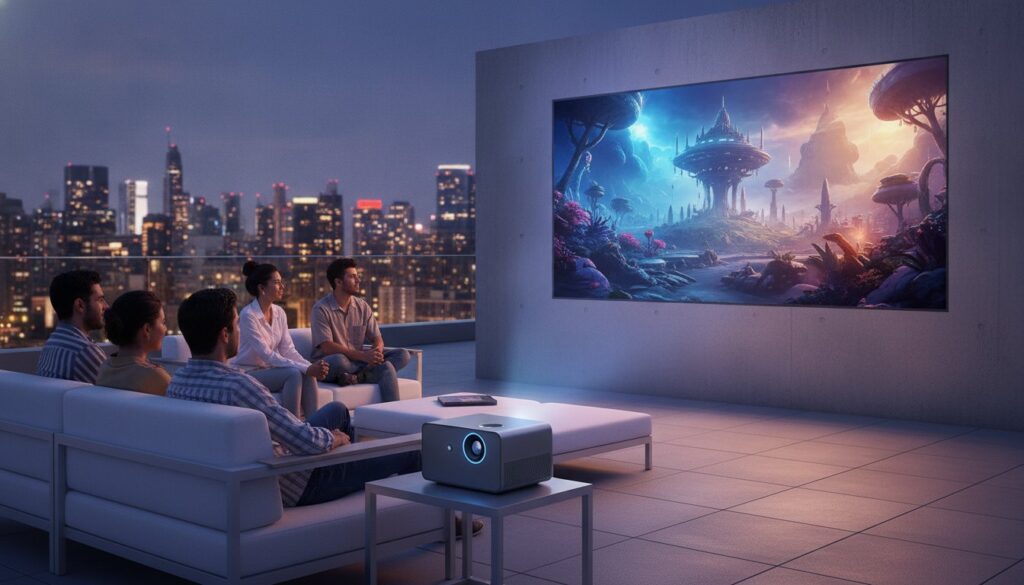
Why settle for a 50-inch television when you can carry a 100-inch cinema in your backpack? Finding the best portable projector for movie nights used to mean choosing between a clear picture and a battery that actually lasts through the credits. You’ve probably felt the frustration of confusing brightness ratings where marketing lumens don’t match reality, or built-in speakers that sound more like a tin can than a theater. It’s exhausting to research tech that promises the world but delivers a blurry, dim mess during the most important scenes.
We agree that your downtime is too valuable for technical glitches or complicated setups. You deserve a simple, plug and play experience that brings 1080p or 4K clarity to any space you choose. This guide demystifies the latest 2026 hardware, from the high-contrast LG CineBeam Q to the battery-efficient ASUS ZenBeam L2. We will show you how to evaluate true ANSI brightness, maximize your playback time, and select the perfect model for your specific environment. Discover how to transform any blank wall into a professional-grade cinematic experience with our expert-led comparison and setup guide.
Key Takeaways
- Learn to distinguish between marketing fluff and true ANSI lumens to ensure your picture stays bright even with ambient light.
- Understand why 1080p is the non-negotiable resolution standard for achieving a crisp 100-inch display in 2026.
- Identify the best portable projector for movie nights based on your unique needs, from high-durability outdoor models to ultra-quiet bedroom units.
- Master the physical setup by choosing the right projection surface and supplementing internal audio for a true cinematic soundstage.
- Streamline your entertainment with integrated smart OS features that provide instant access to your favorite apps without external hardware.
What Makes a Portable Projector Perfect for Movie Nights?
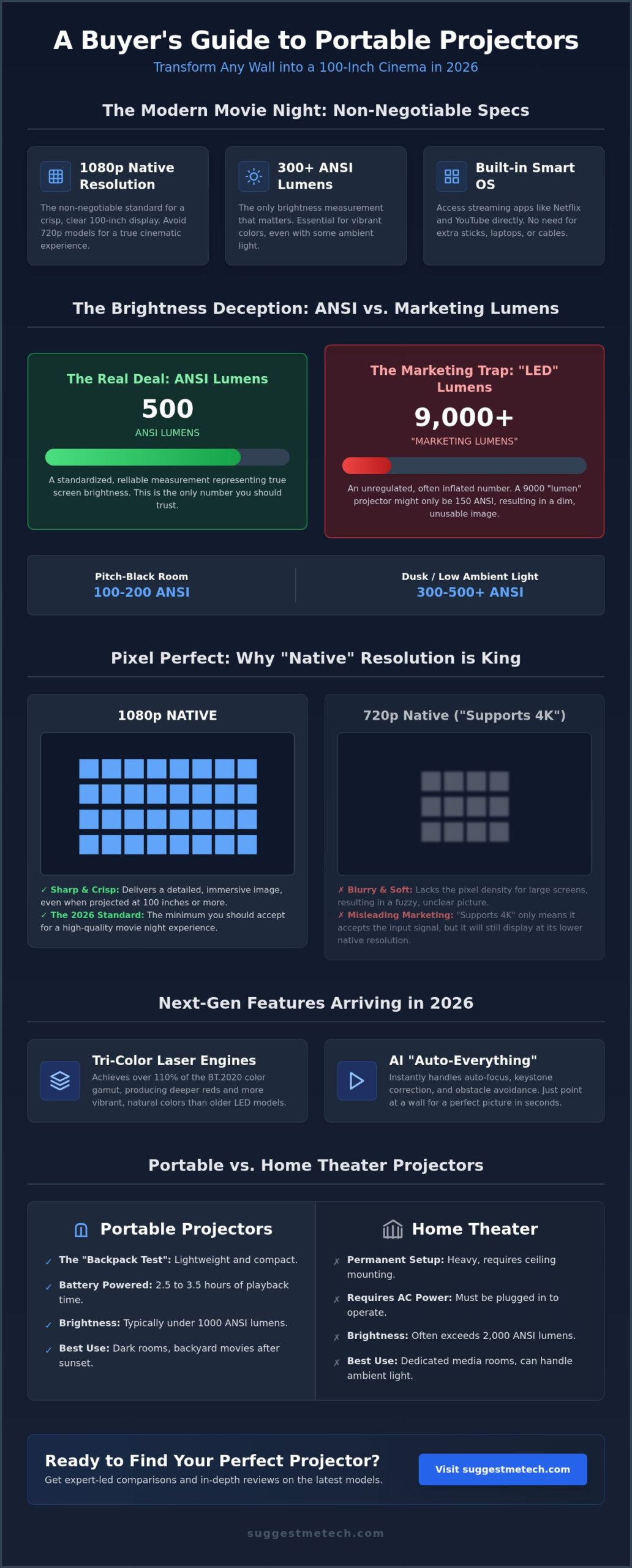
A portable projector is no longer just a dim tool for office presentations. In 2026, it’s a battery-powered, compact cinema solution that fits in a backpack and delivers a theater-like experience in almost any environment. Finding the best portable projector for movie nights used to mean choosing between a clear picture and actual portability. You either got a heavy, bright unit that needed a wall outlet or a tiny device that looked like a blurry mess. Today, the standard has shifted. To host a proper movie night, your device needs to meet a specific baseline: 1080p native resolution, at least 300 ANSI lumens, and a built-in operating system.
The transition from “business beamers” to “entertainment hubs” changed how we consume media. Older projectors were designed for static slides in fluorescent-lit rooms. Modern units prioritize high-contrast ratios and vibrant color accuracy for films. They function as all-in-one systems, meaning you don’t need to carry extra streaming sticks or tangle with HDMI cables just to start your favorite movie. Portability shouldn’t mean you have to sacrifice the immersive feel of a 100-inch screen.
The Evolution of Portable Cinema in 2026
The most significant shift this year is the miniaturization of Tri-Color Laser engines. Previously found only in high-end home theaters, this technology now appears in portable models priced between $400 and $800. These RGB lasers allow units to achieve 110% of the BT.2020 color gamut, providing deeper reds and more natural greens than older LED versions. We also see the rise of “Auto-Everything” features. Using AI-driven computational optics, these projectors handle focus, keystone correction, and even obstacle avoidance in seconds. You can set the device down on a crooked surface, and it’ll instantly square the image and dodge the light switch on your wall.
Portable vs. Home Theater Projectors: Key Differences
While both categories utilize different projection technologies like DLP, which currently holds a 65% market share, their practical applications are very different. Home theater projectors are built for high brightness, often exceeding 2,000 ANSI lumens, but they require a permanent ceiling mount and constant power. Portable projectors focus on the “backpack test.” They are lightweight and rely on internal batteries that now offer between 2.5 and 3.5 hours of playback. Because portables are generally less bright than stationary models, they perform best in darker rooms or after sunset. The trade-off is the freedom to create a 100-inch cinematic display anywhere from your bedroom ceiling to a backyard fence.
Decoding the Specs: Brightness, Resolution, and Battery Life
Understanding the spec sheet is the difference between a cinematic experience and a blurry disappointment. When searching for the best portable projector for movie nights, you’ll encounter a flood of numbers that can feel intentionally misleading. If you want a deeper look at how specific models perform in real-world tests, you can always check out our evaluations at SuggestMeTech. We prioritize clarity over jargon to help you make an informed decision.
Brightness Guide: ANSI vs. LED vs. Marketing Lumens
ANSI lumens measure the total light output of a projector as standardized by the American National Standards Institute. This is the only measurement that counts because it represents a standardized average of light output across the entire screen. Avoid “Marketing Lumens” or “Lux” ratings found on generic, low-cost devices. A projector claiming 2,000 lumens for under $100 is almost certainly using a non-standard measurement. In reality, that unit might only output 50 ANSI lumens, which is barely visible in a dark room.
Practical advice for the best portable projector for movie nights involves matching brightness to your environment. For a backyard movie night starting at dusk, you need a minimum of 300 to 500 ANSI lumens to compete with lingering ambient light. If you plan to use the projector in a pitch-black bedroom, you can get away with 100 to 200 ANSI lumens, but higher brightness always provides more vibrant colors and better contrast.
Resolution and HDR: Bringing the Theater Home
In 2026, 1080p is the non-negotiable sweet spot for portable units. While 720p models are still available, they lack the pixel density required to keep a 100-inch image looking sharp. Always look for “Native Resolution” rather than “Supported Resolution.” A projector might claim to support 4K input, but if its native resolution is 720p, the final image on your wall will still look soft and pixelated. High-end portables like the LG CineBeam Q have moved the bar to native 4K UHD, though 1080p remains the best value for most users.
High Dynamic Range (HDR10) is also vital for modern films. It expands the contrast range, ensuring that dark scenes in a movie don’t just look like a grey smudge. Sharpness is also improved by 4K downscaling, a feature in models like the BenQ GP100A that helps 1080p output look remarkably crisp. The “Three-Hour Rule” is our benchmark for portability. A movie night shouldn’t end before the credits roll. Models like the ASUS ZenBeam L2 now offer up to 3.5 hours of playtime, while the Nebula Capsule 3 Laser provides about 2.5 hours. Finally, consider the throw ratio. A 1.2:1 ratio is common, requiring about 8 feet of distance for an 80-inch screen. If you’re working with a tight space, refer to a professional home theater setup guide to optimize your layout and viewing angles.
Evaluating the Top Categories for Different Movie Night Scenarios
Choosing the best portable projector for movie nights isn’t a one-size-fits-all decision. A device that excels in a pitch-black bedroom might struggle against the ambient light of a suburban backyard. By categorizing these units by their real-world application, we can match the hardware to your specific environment. Whether you’re looking for a rugged outdoor workhorse or a tiny travel companion, understanding these categories ensures you don’t overpay for features you don’t need.
For those who want the ultimate experience without compromise, the “Premium All-In-One” category has seen the most growth in 2026. These units, like the LG CineBeam Q, offer native 4K resolution and integrated high-end audio systems that mimic a soundbar’s performance. They’re heavier than other portables, but they provide a true “cinema in a box” experience. Conversely, “The Bedroom Cinema” focuses on lifestyle features. These projectors prioritize whisper-quiet fans (ideally under 30 decibels) and vertical projection capabilities. A 180-degree rotating stand allows you to project directly onto your ceiling, turning your bed into the best seat in the house. Before you commit to a specific category, it’s helpful to review core projector specifications to see how throw distance and contrast ratios vary across these designs.
The Best Outdoor and Backyard Projectors
Outdoor projection is a distinct technical challenge that requires “The Backyard King.” These units prioritize raw brightness and rugged builds. To compete with streetlights or a neighbor’s porch lamp, you need at least 500 to 1,000 ANSI lumens. A standard tripod mount is essential here. It allows you to stabilize the image on uneven grass or patio stones without using stacks of books. While true water resistance is rare, many 2026 models feature dust-resistant seals to protect the lens during breezy nights. For the best results, use a high-gain screen rather than a bedsheet. These screens reflect more light toward your audience, significantly boosting the perceived brightness of the image.
Ultra-Portable “Soda Can” Projectors for Travel
The Setup Guide: How to Host a Flawless Movie Night
The best portable projector for movie nights only performs as well as the environment you create for it. Even a high-end 4K unit will look washed out if you don’t manage ambient light or projection surfaces correctly. If you’re projecting onto a DIY white sheet, you’ll lose about 30% of your brightness because light passes through the fabric. A professional portable screen with a gain of 1.1 or higher reflects that light back to the audience, making the image pop. For the deepest blacks outdoors, you must wait for astronomical twilight. This usually occurs about 90 minutes after sunset. If you start too early, even 1,000 ANSI lumens will struggle against the lingering blue hour light.
Connectivity is another hurdle for a seamless experience. If you’re in your backyard, ensure your Wi-Fi signal is strong enough for high-bitrate streaming. For camping trips where signal is non-existent, download your content directly to the projector’s internal storage or a USB drive. Many 2026 models include 32GB or 64GB of space specifically for this purpose. Managing your sources before the sun goes down prevents frustrating troubleshooting in the dark.
Audio Integration for a Cinematic Feel
Internal speakers are fine for a quiet bedroom, but they rarely cut it for a crowd. Pairing Bluetooth speakers is the most common solution, but you must watch for audio latency. If the sound doesn’t match the actors’ lips, check if your projector supports aptX Low Latency. For a truly private experience without disturbing neighbors, see our headphones guide to find the best wireless options for 2026. If you want a foolproof connection, use the 3.5mm auxiliary jack. A wired connection offers zero latency and is much more reliable in crowded Wi-Fi areas.
Power Management for Long Marathons
Running at high-brightness mode can drain a built-in battery in less than 90 minutes. To survive a double feature, switch to “Eco-mode” or “Standard mode” once the sun is fully down. If you need maximum brightness for a large crowd, consider using a portable power station. These can power most 65W projectors for six hours or more. You can also use the best laptops as source devices via HDMI to save the projector’s internal processing power, which can slightly extend battery life.
For more hands-on tips and deep dives into specific hardware, explore our full range of guides at SuggestMeTech.
SuggestMeTech Verdict: Choosing the Best Portable Projector for You
The 2026 market has finally ended the “era of compromise.” You no longer have to sacrifice image clarity for a battery that actually lasts through the credits. After analyzing the latest hardware and performance data, we’ve identified the standout winners for every type of viewer. Finding the best portable projector for movie nights comes down to how you balance your budget against your need for brightness.
Best Overall: The BenQ GP100A is our top recommendation for most users. At $899, it provides 1000 ANSI lumens and a sharp 1080p picture. It’s bright enough for semi-dark rooms and features a 4LED light source that ensures color stays vibrant for years. It hits the “sweet spot” of performance and portability.
Best Value: If you’re on a strict budget, the XGIMI MoGo 2 Pro is the clear winner. Currently available for as low as $299 on sale, it offers native 1080p resolution and dual 8W speakers. While its 430 ISO lumens require a dark room, the image quality is remarkable for the price point.
Ultimate Luxury: For 4K enthusiasts, the LG CineBeam Q ($1,299) is the gold standard. Its RGB laser light source delivers a massive 450,000:1 contrast ratio. It provides the closest experience to a professional home theater in a device you can carry with one hand.
Our Testing Methodology
We arrive at these conclusions through a rigorous evaluation process. We don’t just read the spec sheet. Our team measures brightness consistency across the entire screen to ensure the corners aren’t significantly dimmer than the center. We test battery drain by running high-bitrate files in standard mode until the unit shuts down. We also spend hours navigating smart interfaces like Google TV and webOS. This ensures the “plug and play” experience is smooth and the app compatibility is up to date. Our commitment to unbiased, affiliate-supported reviews means our recommendations are based solely on hands-on assessment and technical data.
Final Recommendations for 2026
- Is the brightness rated in ANSI lumens rather than “marketing” lumens?
- Does the battery life exceed 150 minutes for a full film?
- Is the native resolution 1080p or higher?
- Does it include a built-in OS like Google TV for direct streaming?
- Is the throw ratio short enough for your intended space?
Always check for firmware updates as soon as you unbox your new unit. Manufacturers frequently release patches that improve fan noise and app stability. We want to hear from you. What’s your favorite movie night setup? Are you a backyard cinema host or a bedroom ceiling viewer? Share your tips with the community below.
Ready to Build Your Ultimate Portable Cinema?
Transforming your space into a theater is now easier than ever. By focusing on true ANSI lumens and native 1080p resolution, you avoid the common pitfalls of blurry, dim images. Whether you’re setting up a rugged backyard station or a compact travel kit, the hardware in 2026 offers the perfect balance of battery life and performance. Don’t forget that the right surface and audio setup are just as important as the device itself for a truly immersive experience. Small details like managing ambient light make a massive difference in your final picture quality.
Finding the best portable projector for movie nights is a personal choice based on your specific environment. Our team provides expert hands-on testing and recommendations categorized by real-world user intent, ensuring our guides stay updated for 2026 technology standards. We take pride in being your knowledgeable guide through these technical decisions. If you’re looking for more definitive answers on your next tech purchase, check out our full comparison of the latest tech gadgets on SuggestMeTech. We’re here to help you navigate these complex choices with confidence. Grab your popcorn and enjoy the show.
Frequently Asked Questions
How many ANSI lumens do I really need for an outdoor movie night?
You need at least 500 to 1,000 ANSI lumens for a high-quality outdoor experience. While you can technically use 300 lumens in total darkness, any ambient light from streetlamps or the moon will wash out the image. If you’re hosting a large group, higher brightness ensures everyone sees vivid colors. Selecting the best portable projector for movie nights often depends on this single spec if you plan to spend your summers in the backyard.
Can I use a portable projector as my main TV?
You can use a portable projector as a main TV, but it’s best suited for dedicated viewing sessions in darker rooms. Modern LED and laser light sources last for over 20,000 hours, which is plenty for daily use. However, even the brightest portables struggle against direct sunlight in a living room. A traditional TV is still superior for daytime news or sports, while the projector excels for immersive evening cinema.
Do portable projectors work with Netflix and Disney Plus natively?
Most premium 2026 models work with Netflix and Disney Plus natively through integrated systems like Google TV. In previous years, Netflix certification was a common hurdle, but brands like BenQ and XGIMI now include these apps out of the box. Always verify the specific app support before purchasing. If a model lacks native support, you can easily bridge the gap by plugging a streaming stick into the HDMI port.
How do I connect my phone to a portable projector?
The easiest way to connect your phone is through wireless screen mirroring using built-in Chromecast or AirPlay. This allows you to cast photos or videos directly from your mobile device without cables. For a more stable connection during high-bitrate movies, use a USB-C to HDMI adapter. This wired method reduces the risk of buffering or audio sync issues, especially when you’re away from a strong Wi-Fi signal.
Is a 4K portable projector worth the extra money in 2026?
A 4K portable projector is worth the investment if you plan to project images larger than 80 inches. At smaller sizes, the difference between 1080p and 4K is difficult to see with the naked eye. However, as the screen grows, the extra pixel density of a 4K unit prevents the image from looking soft. If you want the best portable projector for movie nights with maximum detail, 4K is the future-proof choice.
What is the best way to get sound from my projector to external speakers?
Using a 3.5mm auxiliary cable is the best way to ensure zero-latency sound between your projector and external speakers. While Bluetooth is more convenient for a cable-free setup, it can occasionally suffer from minor audio delays. If you prefer wireless, look for speakers and projectors that support aptX Low Latency. This technology synchronizes the audio and video perfectly, so the sound matches the actors’ lip movements during fast-paced scenes.
How do I clean the lens of a portable projector without scratching it?
Use a manual air blower to remove loose dust before gently wiping the lens with a clean microfiber cloth. Never use paper towels, tissues, or your shirt, as these materials contain fibers that can create permanent micro-scratches on the glass coating. If there’s a stubborn smudge, apply a single drop of specialized lens cleaning fluid to the cloth rather than directly onto the lens. Proper maintenance keeps your image sharp and clear.
What happens if I use a projector in a room that isn’t completely dark?
If the room isn’t dark, the projected image will lose contrast and appear faded. Projectors can’t project black; they simply rely on the absence of light on the screen surface. When ambient light hits that surface, your dark scenes turn into a dull grey. You can mitigate this by using an Ambient Light Rejecting (ALR) screen, but the most effective solution is always closing the curtains or turning off the lights.