

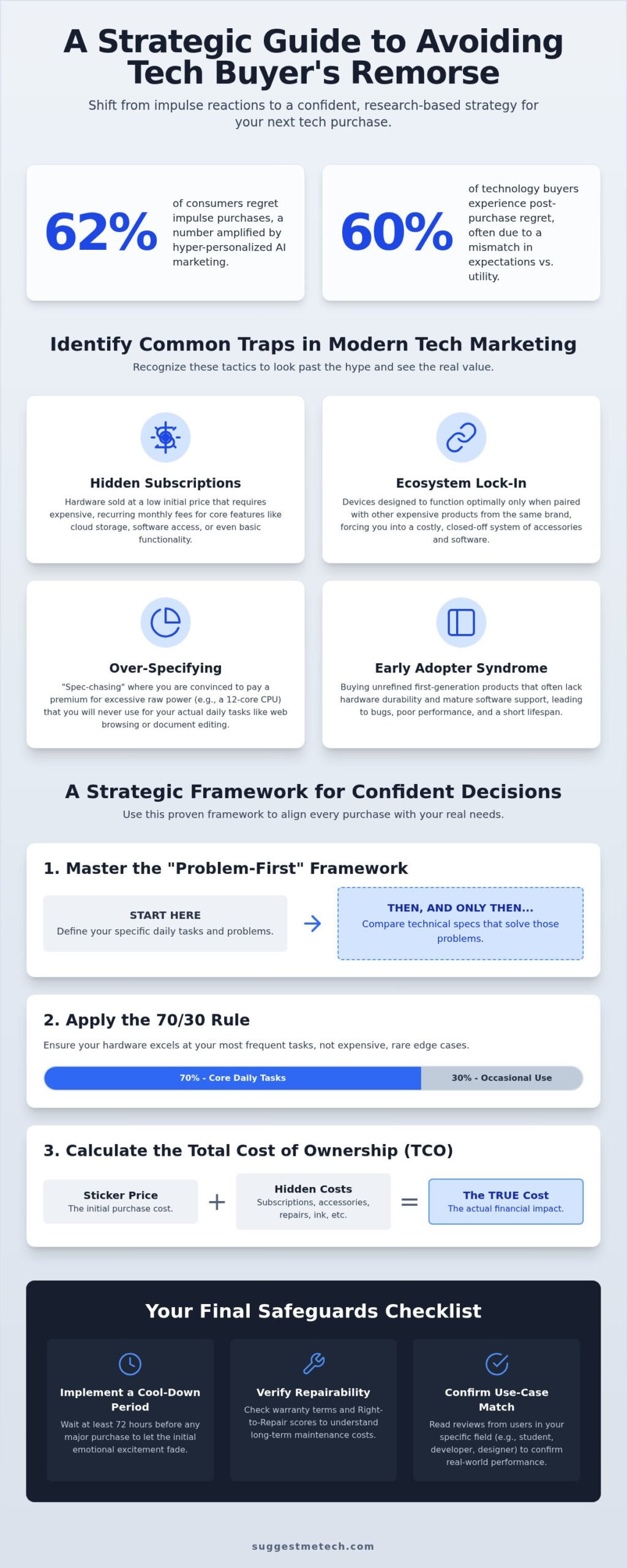
Did you know that 62% of consumers who made an impulse purchase in 2026 ended up regretting the decision? With AI-driven marketing now creating hyper-personalized ads that target your specific habits, avoiding buyer’s remorse on tech purchases is harder than ever. It’s frustrating to realize that a shiny new device doesn’t actually solve your problems or, worse, comes with hidden costs that weren’t mentioned in the sleek promotional video.
You can break this cycle by moving from emotional reactions to a practical, research-based strategy. This guide provides a proven evaluation framework to help you cut through the noise and make high-ticket decisions with total confidence. We’ll explore a clear checklist for evaluating hardware, explain how 2026 Right-to-Repair laws protect your investment, and show you how to align every purchase with your actual daily needs for long-term value.
Quick Answer
Avoiding buyer’s remorse on tech purchases requires a shift from impulse buying to a structured evaluation framework. By focusing on total cost of ownership, verifying repairability under 2026 legislation, and matching technical specs to specific daily tasks, you can ensure long-term value. This approach cuts through marketing hype to prioritize functional utility over temporary trends.
Key Takeaways
- Identify and bypass modern marketing traps like hidden subscription models and aggressive ecosystem lock-in strategies.
- Master the “Problem-First” evaluation framework to define your specific needs before comparing technical specifications.
- Adopt the 70/30 Rule to ensure your hardware excels at your most frequent daily tasks rather than expensive, rare edge cases.
- Implement practical safeguards, such as a 72-hour cool-down period, as a primary strategy for avoiding buyer’s remorse on tech purchases.
- Utilize SuggestMeTech’s application-based guides to confidently select tools that match your specific professional or educational environment.
What is Tech Buyer’s Remorse and Why Does it Happen?
Tech buyer’s remorse is the psychological gap between marketing expectations and actual utility. It often manifests as cognitive dissonance, where a user feels tension between the high price paid and the lack of real-world value. According to Gartner, 60% of technology buyers experience regret after a purchase, proving that even professionals struggle with this alignment.
In the over-saturated market of 2026, decision fatigue is a primary cause of bad choices. High-ticket items like premium headphones or workstations trigger intense regret because the financial stakes are higher. Successfully avoiding buyer’s remorse on tech purchases requires understanding that marketing sells a lifestyle, not necessarily a solution to your specific problem.
The Psychology of the Impulse Purchase
Dopamine-driven marketing creates a false sense of urgency. This leads to the “spec-chasing” trap, where you pay for raw power you’ll never use. You might buy a 12-core processor because it sounds impressive, even if your daily workload only requires four. This creates a cycle where we value potential performance over practical application.
We also tend to buy for our “ideal self”. This is the person who imagines they’ll start professional video editing next month, so they buy an expensive rig. In reality, their daily needs are limited to web browsing and document editing. The device sits underutilized, leading to immediate regret when the credit card bill arrives.
Marketing vs. Real-World Application
Polished advertisements are experts at glossing over technical limitations. They show a sleek laptop in a coffee shop but hide the fact that the battery only lasts three hours under a heavy workload. They also rarely mention ecosystem lock-in, where buying one tablet suddenly requires you to purchase specific styluses, keyboards, and cloud storage tiers.
There’s a significant difference between “benchmarked performance” and “daily reliability”. Benchmarks show what a device can do in a laboratory setting. Reliability shows how it handles a 10-hour workday. For example, a student might buy a high-performance gaming laptop for its speed, but they soon regret the five-pound weight and loud fans that make it impossible to use in a quiet lecture hall.
Identifying Common Traps in Modern Tech Marketing
Modern tech marketing is designed to obscure long-term costs by focusing exclusively on immediate benefits. Recognizing these strategic sales tactics is essential for avoiding buyer’s remorse on tech purchases, as it allows you to look past a polished presentation to the actual utility of the device.
Common marketing traps in 2026 include the following tactics:
- Hidden Subscriptions: Turning one-time hardware purchases into recurring monthly expenses for core features like cloud storage or remote access.
- Ecosystem Lock-in: Designing devices that only function optimally when paired with other expensive products from the same brand.
- Over-Specifying: Promoting high-end components that exceed the requirements of the average user, particularly when selecting the best laptops.
- Early Adopter Syndrome: Marketing unrefined first-generation products that lack the hardware durability and software support of more mature technologies.
The Total Cost of Ownership (TCO) Trap
Total Cost of Ownership (TCO) represents the sum of the initial purchase price plus all recurring expenses over the product’s lifespan. This metric includes maintenance, accessories, and energy costs. Calculating TCO is the only way to see the true financial impact of a purchase before you commit.
A classic example is the budget printer that costs significantly more in proprietary ink over two years than a higher-end laser model. This calculation is also vital when evaluating the best web hosting, where low introductory rates often hide steep renewal fees or paid add-ons for basic security.
Before making a final decision, spend time understanding your warranty rights. Knowing what repairs are covered helps you estimate potential out-of-pocket costs. If a product has a short warranty and high repair fees, its TCO is much higher than the sticker price suggests.
Feature Creep and Use-Case Mismatch
Feature creep occurs when manufacturers add excessive functions that provide no value to the average user. This leads to a use-case mismatch, where hobbyists pay for professional-grade gear they will never fully utilize. You end up paying a premium for capabilities that remain untouched in the settings menu.
In digital services, features like virtualization or CDN (Content Delivery Network) are often sold as essential upgrades. Virtualization allows one physical server to host multiple virtual ones, while a CDN speeds up content delivery by caching files globally. However, these are only useful for specific traffic levels or complex technical needs.
If your project is local or low-traffic, paying for these advanced features is an unnecessary expense. To find a tool that matches your specific environment without the bloat, you can browse the application-based reviews at SuggestMeTech.
A Strategic Evaluation Framework for Any Tech Purchase
A strategic evaluation framework is a structured process for assessing technology based on its ability to solve specific problems rather than its marketed features. It prioritizes practical utility, long-term durability, and task alignment to ensure that every purchase meets the user’s actual daily requirements. This framework is the most effective tool for avoiding buyer’s remorse on tech purchases.
The foundation of this framework is a “Problem-First” approach, which requires defining the specific tasks you need to complete before you look at any tools. You should also apply the 70/30 Rule: buy a device that handles 70% of your daily workload perfectly, rather than overspending to cover the 30% of rare edge cases that rarely occur.
| Evaluation Factor | Hardware Focus | Software & Services Focus |
|---|---|---|
| Longevity | Build quality and physical durability. | Scalability and update frequency. |
| Financials | Resale value and initial investment. | Subscription costs and renewal rates. |
| Usability | Portability and battery life. | Interoperability and support quality. |
Hardware Evaluation Criteria
When assessing physical devices, durability is your top priority. A laptop might have impressive speed, but if the chassis is fragile, it won’t survive a 3-5 year lifecycle. Look for materials like aluminum or reinforced polymers that can withstand daily travel and use.
Consider the following hardware metrics before you commit:
- Resale Value: Check how well the brand holds value on the second-hand market to recover a portion of your investment later.
- Portability vs. Power: If you work from a fixed desk, prioritize thermal cooling and raw performance; if you are mobile, prioritize weight and battery efficiency.
- Future-Proofing: Invest in components that cannot be upgraded later, such as the processor or soldered memory, to ensure the device remains fast as software demands increase.
Service and Software Evaluation Criteria
Software and digital services require a focus on how well the tool integrates into your existing workflow. Scalability is essential if you plan to grow. For instance, if you want to start a blog, choose a service that allows you to upgrade resources easily as your traffic increases.
Support quality is a critical “hidden value” that determines your long-term success with a service. Verify if the provider offers 24/7 expert assistance or if you will be left waiting for email responses during a technical crisis. This is particularly important for mission-critical tools like hosting or security software.
Finally, check for interoperability. Ensure the new service plays well with your existing domain and email setup. Software that requires expensive third-party bridges or complex workarounds often leads to technical frustration and eventual regret.
Five Practical Steps to Prevent Post-Purchase Regret
To prevent post-purchase regret, implement a 72-hour cooling-off period, verify return policies for restocking fees, and cross-reference three independent reviews. Testing a base model before buying a flagship and consulting user forums for durability issues further ensures your technology investment aligns with your actual daily needs.
This process is the final line of defense for avoiding buyer’s remorse on tech purchases. It creates necessary friction between the initial impulse and the transaction, allowing your logical brain to catch up with marketing-induced excitement before you commit your budget.
- Implement a mandatory 72-hour cool-down period for any purchase over your set budget threshold.
- Verify the “real-world” return policy, specifically checking for hidden restocking fees and shipping costs.
- Cross-reference performance reviews from at least three independent, authoritative publications.
- Test the Minimum Viable Product (MVP) or base model before committing to the top-tier flagship.
- Consult existing user communities and forums to identify potential long-term mechanical or software issues.
The 72-Hour Rule and Budgeting
Waiting three days before hitting the checkout button kills the dopamine-driven impulse to spend. This cooling-off period allows your brain to shift from emotional excitement back to logical evaluation. If the “must-have” feeling fades after 72 hours, the purchase was likely a reaction to hype rather than a genuine utility.
If you’ve already made a purchase that isn’t working, don’t fall for the sunk cost fallacy. This is the psychological trap of sticking with a bad product just because you’ve already spent money on it. It’s often better to return the item or sell it quickly than to continue wasting time on a tool that doesn’t meet your requirements.
Interpreting Expert Reviews Effectively
When reading reviews, look for consistency across multiple sources to spot potential reviewer bias. If three different experts mention the same hardware flaw, it’s a real-world issue you’ll likely encounter. Prioritize long-term reviews (6 months later) over “Day One” launch coverage, as launch reviews often miss durability problems that only appear with extended use.
Focus on reviews that mirror your specific use case, whether you’re a student, a business owner, or a mobile professional. To see how specific hardware stacks up in real-world environments over time, you can check out our latest comparative guides. This ensures you’re getting advice that applies to your daily tasks rather than a laboratory benchmark.
How SuggestMeTech Simplifies the Decision Process
SuggestMeTech serves as your primary tool for the research phase of any technology investment. Our mission is to demystify complex choices by providing direct, solution-oriented answers that prioritize your specific needs. By using our expert guides, you can focus on functional utility and long-term value, which is the most reliable way of avoiding buyer’s remorse on tech purchases.
Our rigorous editorial process involves more than just reading spec sheets. We conduct comparative analysis and hands-on assessments to see how products perform in real-world scenarios. We use comparison tables to provide at-a-glance technical clarity, allowing you to see exactly where one model excels over another without wading through dense industry jargon.
We categorize all content by real-world application, such as Business, School, or Entertainment. This intent-based structure ensures you find the right tool for your specific environment. We also invite you to participate in our community by sharing your own hands-on experiences to help other peers make informed, budget-conscious decisions.
Curated Recommendations vs. Infinite Choice
Infinite choice often leads to decision fatigue, a primary driver of poor spending habits. We solve this by limiting our “Best Of” lists to a handful of truly superior options. We filter out feature bloat, those flashy but useless extras, to focus on real-world reliability and performance. This curated approach ensures you aren’t overwhelmed by options that don’t meet our strict standards.
Our commitment to accuracy means we constantly update our guides to reflect the latest industry shifts. For example, as 2026 hosting standards emerge, we refresh our comparative evaluations to ensure our recommendations remain current. We analyze how these new standards affect scalability and security, providing you with the most up-to-date advice for your digital infrastructure.
Your Partner in Smart Tech Investing
Think of SuggestMeTech as your approachable, tech-savvy peer who values your time and budget. We’re here to help you navigate the psychological traps of marketing and the complexities of technical specs. Our goal is to make the decision-making process smooth and productive, mirroring a natural problem-solving flow from broad needs to specific recommendations.
Subscribe to our newsletter for early warnings on tech traps and emerging trends that could impact your future purchases. Before you commit to your next major investment, check our latest guides to verify your choice. Remember that technology should always serve you and your goals, not the other way around. Let us help you make every purchase one that delivers lasting value.
Take Control of Your Tech Future
Making smart technology choices in 2026 requires more than just scanning a spec sheet. You’ve learned how to identify marketing traps like hidden subscriptions and why the 72-hour cool-down period is your best defense against impulse spending. By adopting a problem-first mindset and calculating the total cost of ownership, you turn every transaction into a strategic move for your career or home life. This shift ensures your tools serve your goals rather than draining your budget.
Avoiding buyer’s remorse on tech purchases is a skill that improves with access to reliable data. SuggestMeTech provides expert-tested comparisons and community-driven feedback to help you cut through the noise. Since our research is categorized by real-world use cases, you’ll always find recommendations tailored to your specific environment. Explore our curated tech guides to make your next purchase with confidence. You now have the framework to stop overspending and start choosing technology that delivers lasting value.
Frequently Asked Questions
What is tech buyer’s remorse?
Tech buyer’s remorse is the feeling of regret or dissatisfaction that occurs after a purchase when the product fails to meet expectations. It often stems from a disconnect between the polished marketing claims and the device’s actual daily utility. This psychological gap is common, with research from Gartner indicating that 60% of technology buyers experience some level of regret. Understanding this helps in avoiding buyer’s remorse on tech purchases by prioritizing functional needs over flashy advertisements.
How do I know if I am impulse buying tech?
You are likely impulse buying if you feel an urgent, emotional need to purchase a device without a clearly defined task for it. Signs include buying based on social media trends or “limited time” deals rather than technical requirements. If you haven’t researched the total cost of ownership or compared at least three alternatives, the purchase is probably driven by dopamine rather than logic. Implementing a mandatory 72-hour waiting period is an effective way to identify these impulses.
Is it better to buy the latest tech model to avoid remorse?
Buying the latest model is often a primary cause of regret rather than a solution. First-generation products frequently suffer from “early adopter syndrome,” characterized by software bugs, unrefined hardware, and high “luxury” pricing. Mature models that have been on the market for 12 months are usually more reliable and better supported. Unless a new feature is essential for your specific workflow, choosing a proven, mid-range device often results in higher long-term satisfaction and better overall value.
How can I calculate the total cost of ownership (TCO) for a gadget?
To calculate the total cost of ownership, add the initial purchase price to all expected expenses over the product’s lifespan. This includes mandatory software subscriptions, proprietary charging cables, specialized cases, and potential repair costs. For example, a cheap printer often has a high TCO due to the recurring cost of expensive ink. Factor in energy consumption for high-power workstations as well. This comprehensive view ensures your budget covers the true cost of the technology, not just the sticker price.
What should I do if I already regret a tech purchase?
If you regret a purchase, act quickly to check the retailer’s return policy for restocking fees or shipping requirements. If the return window has closed, don’t let the sunk cost fallacy force you to keep an expensive tool that doesn’t work for you. The sunk cost fallacy is the psychological trap of sticking with a bad product just because you’ve already spent money on it. Consider selling the item on a resale platform to recover a portion of your investment.
Does more expensive technology always mean less buyer’s remorse?
More expensive technology does not guarantee a regret-free experience. In many cases, high-ticket items trigger more intense remorse because the financial stakes are significantly higher. Regret happens when there is a mismatch between the tool and the task, regardless of the price. A workstation-grade laptop is a poor investment if you only use it for basic document editing. True satisfaction comes from finding the “minimum viable product” that handles your most frequent daily tasks with total reliability.
How can I tell if a tech review is objective or biased?
Objective reviews focus on real-world reliability and technical limitations rather than just repeating marketing specs. Look for independent publications like SuggestMeTech that categorize reviews by specific use cases, such as business or school. A reliable review should mention at least two or three significant drawbacks or “cons.” Avoid content that feels like a continuous sales pitch or lacks long-term testing data. Cross-referencing three different authoritative sources is the best way to spot sponsored bias or surface-level testing.
What are the most common hidden costs in tech purchases?
The most common hidden costs include recurring subscription fees for essential features and proprietary accessories that aren’t included in the box. Many modern smart devices require monthly cloud storage plans to function fully. You should also account for the cost of replacement parts, such as batteries or screens, which can be expensive if the device has a low repairability score. Avoiding buyer’s remorse on tech purchases requires looking beyond the initial price to see these long-term financial commitments.