

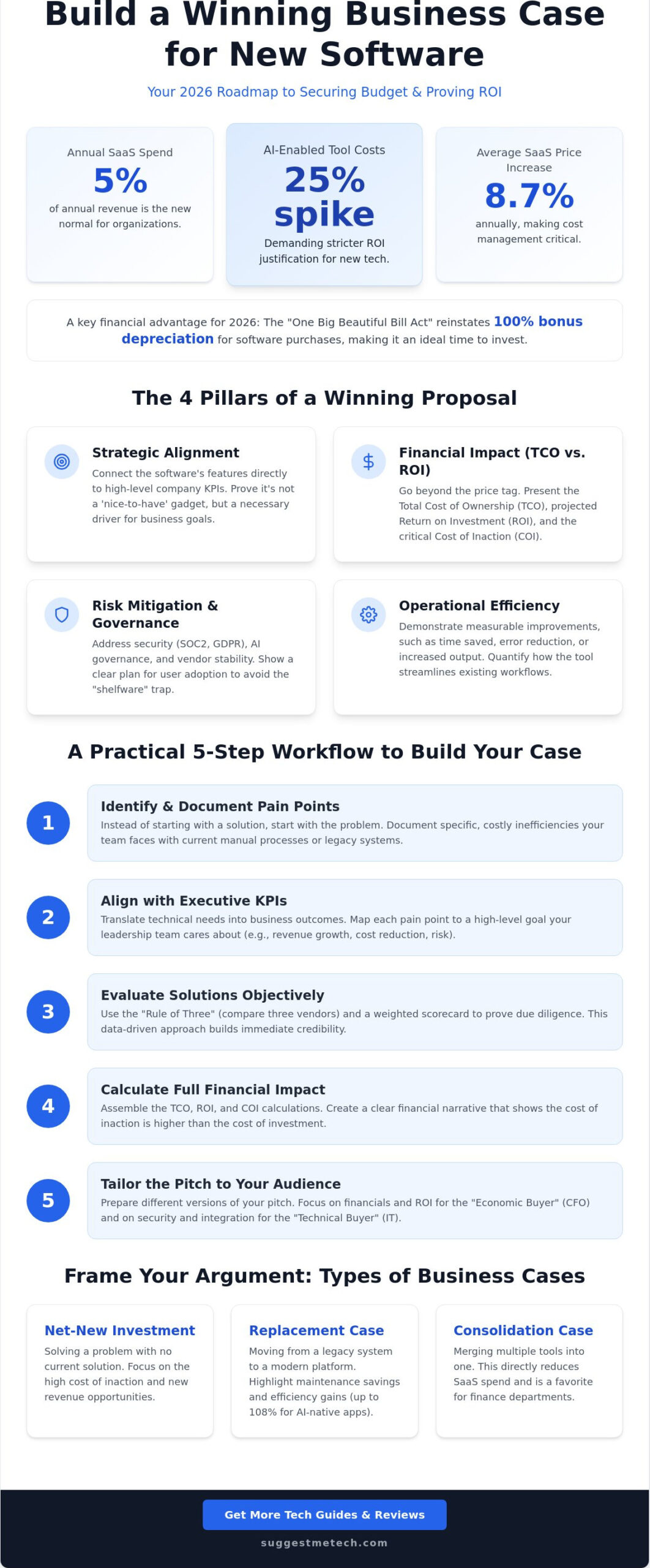
Did you know that while typical organizations now allocate up to 5% of their annual revenue to SaaS, the cost for AI-enabled tools is spiking by as much as 25%? With these rising costs, simply asking for a new tool isn’t enough anymore. You’ve probably felt the sting of a budget rejection or struggled to explain technical perks to a non-technical CFO. It’s a common hurdle, and building a business case for new software often feels like a complex maze of procurement and ROI calculations.
We’re here to help you turn that frustration into a strategy that wins. You’ll learn how to construct a data-driven, persuasive case that leverages current 2026 financial realities, like the 100% bonus depreciation restored by the One Big Beautiful Bill Act. This article provides a clear roadmap to secure your budget, avoid the “shelfware” trap, and boost your credibility with leadership. We’ll start by breaking down the essential financial metrics and then move into aligning your software needs with the specific KPIs your executives actually care about.
Key Takeaways
- Shift your strategy from highlighting vague productivity gains to proving measurable ROI that aligns with current executive KPIs.
- Evaluate the Total Cost of Ownership rather than just the initial price tag to demonstrate long-term financial responsibility to stakeholders.
- Use a structured 5-step workflow for building a business case for new software to ensure every technical feature solves a documented business pain point.
- Tailor your presentation to address the specific concerns of the “Economic Buyer” in finance and the “Technical Buyer” in IT.
- Implement a weighted scorecard and the “Rule of Three” to objectively compare solutions and build immediate credibility with leadership.
What is a Business Case for New Software and Why Does it Matter in 2026?
Think of a business case as a value-proposition bridge. It connects the technical features you want with the financial outcomes your leadership needs. In 2026, simply claiming a tool “increases productivity” is no longer enough to get a signature. Procurement has shifted toward a strict focus on measurable ROI. With the average annual price increase for SaaS hitting 8.7%, and AI-enabled tools jumping by up to 25%, executives are scrutinizing every line item. Building a business case for new software is now about proving that the cost of doing nothing is higher than the investment itself.
Your biggest competitor isn’t a rival vendor; it’s the “good enough” manual process. Many teams rely on messy spreadsheets or outdated legacy systems because they fear the complexity of change. However, these manual workarounds create hidden costs and security gaps. A formal business case helps eliminate “Shadow IT,” where departments buy tools without oversight. This is especially critical following the 2026 executive order on AI security, which encourages stricter collaboration on software safety. By presenting a clear case, you ensure the tool is vetted, secure, and aligned with company goals.
The Strategic Importance of Getting it Right
Securing a budget is harder when SBA 7(a) variable rates hover between 9.0% and 11.5%. You must show that your software choice is a smart financial move. Use the “One Big Beautiful Bill Act” (OBBB) of 2025 to your advantage; it reinstated 100% bonus depreciation for software purchases. This makes 2026 an ideal time to invest. Beyond the numbers, successfully pitching a project builds your personal authority. It shows you understand the business side of tech, not just the features. You’re positioning yourself as a partner in the company’s growth, not just a requester of funds.
Types of Software Business Cases
Not every proposal looks the same. Your approach depends on what you’re trying to achieve:
- Net-new investment: You’re solving a problem that currently has no solution. This case focuses on the “cost of inaction” and new revenue opportunities.
- Replacement cases: You’re moving from a clunky legacy system to a modern SaaS platform. Here, you’ll highlight maintenance savings and the 108% growth in efficiency seen in AI-native apps.
- Consolidation cases: You’re merging three tools into one. This is a favorite for Finance because it directly reduces the SaaS-to-revenue spend, which typically sits between 2% and 5% for most organizations.
Understanding these categories helps you frame your argument. Whether you’re replacing an old server or building a business case for new software that uses AI “digital workers,” your success depends on choosing the right narrative for your specific situation.
The 4 Pillars of a Winning Software Proposal
Executive buy-in depends on alignment. If your proposal doesn’t connect the tool to a high-level KPI, it’s likely to be ignored. Stakeholders look for four specific pillars: strategic alignment, financial impact, risk mitigation, and operational efficiency. A successful pitch demonstrates that the software isn’t just a “nice-to-have” gadget but a necessary driver for company goals. When you’re building a business case for new software, you must prove that the investment will either make the company money or save it from a costly mistake.
Calculating TCO vs. ROI
Total Cost of Ownership (TCO) is the full price of admission. It includes the subscription, implementation fees, and the man-hours required for training. With Microsoft M365 prices increasing by up to 33% for some tiers in 2026, you can’t afford to overlook these hidden costs. Return on Investment (ROI) measures the gain against that total cost. However, don’t ignore the Cost of Inaction (COI). If your team continues using a manual process that wastes 20 hours a week, that’s a recurring “tax” on your budget. Comparing these three metrics gives Finance a complete picture of the financial stakes. You can find detailed data to support these calculations in our technology reviews and guides.
Risk Assessment and Governance
Security is the fastest way to kill a deal. IT leaders need to see that the vendor meets SOC2 and GDPR standards. In 2026, you also need to address AI governance. A recent executive order has pushed for more collaboration on AI security, so your proposal should highlight how the vendor handles data privacy. Beyond security, address the risk of “shelfware.” Show a clear plan for user adoption to prove the tool won’t sit idle. Finally, check the vendor’s stability. A software provider with shaky financials is a long-term risk to your operations. Effective building a business case for new software means showing that you’ve vetted the provider as thoroughly as the product.
The final pillar focuses on operational efficiency. These “soft” benefits, like improved employee retention and reduced burnout, are harder to quantify but vital for long-term health. High turnover costs companies thousands in recruitment and training. If a new tool removes the most frustrating parts of a staff member’s day, it’s an investment in your people. Use concrete examples of how the software streamlines specific workflows to make these benefits feel tangible to leadership.
Evaluating Solutions: A Data-Driven Selection Framework
Selection shouldn’t be based on a gut feeling or a flashy demo. Executives respect data. To make your case bulletproof, you need a weighted scorecard. This tool allows you to rank vendors based on what actually matters to your department. If security is your top priority, give it a higher weight than price. If ease of use is vital for adoption, make that a primary metric. By the time you’re building a business case for new software, you should have a clear winner backed by a numerical score.
Vetting Potential Vendors
When you evaluate enterprise tools, you can use the same rigorous logic found in our guide to the best web hosting. Look beyond the marketing fluff. In 2026, a major red flag is a lack of transparency regarding AI data usage. Ask vendors how their “digital workers” are trained and if your company data remains private. Integration is another dealbreaker. If the new tool doesn’t talk to your existing tech stack, your Total Cost of Ownership will skyrocket due to custom development costs.
Don’t just take the vendor’s word for it. Leverage third-party reviews and case studies from companies in your specific industry. If possible, suggest a pilot program. Committing to a small, three-month test run is a low-risk way to prove the software’s value before the company signs a multi-year contract. This hands-on evidence is often the final nudge an “Economic Buyer” needs to release the funds.
The Alternatives Analysis
Presenting only one solution looks like a bias. Executives want to see that you’ve done your homework. Follow the “Rule of Three” by presenting these distinct options:
- Option A: The Recommended Solution. This is your top choice that hits all the strategic KPIs and offers the best long-term value.
- Option B: The Lower-Cost Alternative. This tool might lack advanced AI features but covers the basics for a smaller upfront budget.
- Option C: Doing Nothing. Clearly outline the risks of staying with your current manual process, including the “Cost of Inaction” discussed earlier.
This comparison makes your recommendation stand out. It shows you’ve considered the financial constraints of the business while keeping the focus on solving the core problem. A well-structured alternatives analysis is the backbone of building a business case for new software that stakeholders can actually trust. It transforms you from a simple requester into a strategic decision-maker who understands the broader business context.
Assembling the Case: A Practical 5-Step Workflow
Once you’ve selected a vendor, it’s time to package your findings into a document that speaks the language of the C-suite. Building a business case for new software requires a logical flow that moves from an urgent problem to a profitable solution. Executives don’t have time to dig through technical specs. They want to see a structured argument that proves you’ve considered the risks and the rewards. Follow this five-step workflow to ensure your proposal is complete and compelling.
- Step 1: Problem Identification. State the specific business pain point clearly. Use data to show how much this problem costs the company monthly in lost time or revenue.
- Step 2: Solution Mapping. Explain how the software specifically solves that pain. Move beyond features and focus on the direct impact on your team’s workflow.
- Step 3: Financial Modeling. Present a 3-year Total Cost of Ownership (TCO). Include the initial purchase, implementation, and recurring subscription fees, then contrast this with your projected ROI.
- Step 4: Implementation Roadmap. Outline who will lead the project, the timeline for the rollout, and how you’ll handle training to ensure the tool doesn’t become “shelfware.”
- Step 5: The Executive Summary. This is your elevator pitch. It should be the last thing you write but the first thing they read.
Writing the Executive Summary
Your executive summary must be concise, ideally keeping it to a single page. Use the “Hook, Value, Ask” method to grab attention quickly. The hook identifies the core business challenge. The value explains the measurable outcomes of the new software, such as a 25% reduction in manual data entry. Finally, the ask clearly states the budget and resources you need. Since this is the most read part of any business case, focus entirely on business outcomes rather than technical features. If you need help comparing specific tools before finalizing your summary, check out our latest technology reviews and guides.
Visualizing the Data
Numbers alone can be dry. Use charts to visualize your ROI projections over a 12 to 24 month period. A “Before vs. After” workflow diagram is also incredibly effective. It shows stakeholders exactly how the new software removes bottlenecks. For internal training plans, you can even create a simplified setup guide. Think of it as a how to start a blog style manual that breaks down complex software onboarding into easy, actionable steps for your team. This level of preparation proves to leadership that you have a solid plan for adoption, which is just as important as building a business case for new software in the first place.
Pitching to Stakeholders and Overcoming Rejection
A perfect document won’t help you if you can’t convince the actual decision-makers. Successfully building a business case for new software requires you to identify two distinct characters: the Economic Buyer and the Technical Buyer. The Economic Buyer, often the CFO or a department head, holds the purse strings and focuses on the bottom line. The Technical Buyer, usually an IT director or Security lead, ensures the tool won’t break your existing infrastructure. You must win over both to get the green light. If you only focus on one, you’ll likely face a veto from the other.
Department-Specific Messaging
What to Do if Your Business Case is Rejected
Rejection isn’t always a permanent “no.” Sometimes, it’s just a “not right now.” If your proposal is turned down, your first step is to ask for specific feedback. Is the budget tight because of high interest rates? Or is the implementation timeline too aggressive for the current quarter? Understanding the “why” allows you to pivot your strategy. You might suggest a “Downscope” strategy, where you start with a smaller group of users to lower the initial cost. This reduces the risk for the Economic Buyer while still getting the software in the door for a real-world trial.
Another powerful tactic is the phased rollout. Propose a pilot program with clear success metrics. If the tool meets those goals by a specific re-evaluation date, the full budget is released. This approach shows leadership that you’re responsible with company capital and aren’t just chasing the latest tech trend. Once you’ve addressed the final concerns and adjusted the scope, you can move toward closing the deal and starting the procurement process. Getting that final signature is the culmination of your hard work in building a business case for new software, turning a strategic proposal into a functional tool that drives your company forward.
Start Securing Your Software Approval Today
Successfully building a business case for new software in 2026 requires more than just a list of features. You now have the framework to align your proposal with updated procurement standards and expert-vetted ROI formulas that satisfy even the toughest CFO. By focusing on cross-departmental alignment strategies, you’ve shifted from being a simple requester to a strategic partner who understands the bottom line. You’ve learned how to handle financial scrutiny, address security risks, and navigate the complexities of modern IT governance with ease.
Now that you have the strategy to win over your stakeholders, it’s vital to ensure your team has the physical tools they need to succeed. Need the right hardware to run your new software? Check out our Best Laptops of 2026 guide. We’d love to hear which of these strategies worked best for your team, so feel free to share your success stories with our community. With a data-driven plan and the right technology in hand, you’re ready to lead your organization toward its next major milestone. Go out there and make your case with confidence; you have everything you need to secure that signature and drive real change.
Frequently Asked Questions
How long should a software business case be?
Keep your document between five and ten pages for enterprise tools, but ensure the executive summary is exactly one page. Decision-makers prioritize brevity and clarity. A lean document focuses on critical financial metrics like TCO and NPV. If you’re building a business case for new software that requires a massive infrastructure overhaul, you might need technical appendices, but keep the core argument punchy.
What is the most common reason software business cases are rejected?
Lack of clear alignment with company-wide KPIs is the primary reason for rejection. Finance teams often veto proposals that focus only on “cool features” without showing how the tool reduces costs or increases revenue. In 2026, failing to account for the 10% to 25% price jumps common in AI-enabled tools can also lead to immediate rejection during the procurement phase.
Should I include a competitor analysis in my business case?
Yes, you must include a competitor analysis to prove you’ve performed due diligence. Using a “Rule of Three” approach shows stakeholders that you’ve evaluated the market objectively. Compare your top choice against a lower-cost alternative and the cost of doing nothing. This transparency builds credibility and helps justify why your preferred tool is the best strategic fit for the organization.
How do I calculate ROI for “soft” benefits like employee satisfaction?
Convert soft benefits into hard numbers by measuring their impact on employee retention and recruitment costs. High turnover is expensive. If new software saves an employee five hours of frustration per week, calculate the hourly wage savings and the reduced risk of burnout. Use industry data for the cost of replacing a specialized staff member to show the long-term financial value.
Who should sign off on a business case before it goes to Finance?
Your IT Security lead and the head of the department using the tool should both sign off first. Security must verify the vendor meets 2026 standards, like AI data privacy compliance. Department heads ensure the tool actually solves the intended pain point. Having these signatures ready when building a business case for new software makes the final approval from Finance much smoother.
What is the difference between a business case and a project plan?
A business case justifies why the investment should happen, while a project plan details how it will be executed. The business case focuses on the “why” and the expected ROI. The project plan comes later, outlining specific tasks, deadlines, and resource allocation. You need the business case to secure the budget before the project plan can even begin.
How often should I update a business case during the software lifecycle?
Review and update your business case annually or whenever a major price adjustment occurs. With SaaS prices increasing by an average of 8.7% annually, your initial financial models will shift. Checking the case every 12 months ensures the tool still delivers the promised value. It also allows you to adjust for new regulations, such as the 2026 AI security executive order requirements.