

What if the reason your manager keeps saying “not right now” isn’t actually about the price tag, but because they don’t see how your new software solves their biggest headache? You know that the right tool could transform your daily workflow, but with credit standards tightening across the board for the 15th consecutive quarter as of June 2026, every expense is under a microscope. Learning how to justify a tech purchase to your manager is no longer just about listing features; it’s about speaking the language of the finance department.
It’s completely normal to feel overwhelmed by conversations about Total Cost of Ownership or to fear a rejection due to budget cuts. We’ve all been there, and we want to help you bridge that communication gap. This guide will help you move past that anxiety and build a bulletproof business case that turns a “maybe” into a “yes” by focusing on ROI and strategic alignment.
We’ll show you exactly how to translate technical benefits into financial gains, including how to leverage the 2026 Section 179 deduction limit of $2,560,000 to your advantage. You’ll walk away with a clear template for your proposal and the confidence to handle any “no,” ensuring you get the tools you need to improve your team’s performance.
Key Takeaways
- Shift your focus from technical features to strategic outcomes by aligning your request directly with the company’s 2026 operational goals.
- Master the “Time-Saved” calculation to learn exactly how to justify a tech purchase to your manager using concrete financial data rather than vague promises.
- Reduce friction by using the “Soft Close” strategy to socialize your proposal with key stakeholders before the formal budget cycle starts.
- Strengthen your business case and remove internal bias by incorporating objective, third-party technology reviews to validate your choice.
- Build a more resilient workflow by identifying how specialized, “best-of-breed” tools can automate manual tasks and provide real-time spend visibility.
Beyond the “I Need This” Phase: Why Managers Scrutinize Tech Spend
Tech justification is the strategic process of aligning a specific digital tool with your company’s broader organizational goals. In 2026, where “efficiency” has become the primary buzzword for every C-suite executive, simply liking a piece of software isn’t enough. You need to show how it moves the needle. Managers are currently operating in a tight economic climate where credit standards have been tightening for 15 consecutive quarters. This means every dollar spent on technology is a dollar taken away from another potential investment.
One of the biggest hurdles you’ll face is the “Shelfware” fear. Managers are haunted by memories of expensive platforms that sit unused because the team found them too complex or redundant. To overcome this, you must shift your perspective. Don’t talk about how this tool makes your life easier. Instead, frame it around how it increases team-wide productivity and eliminates bottlenecks. Building a well-structured business case is the only way to demonstrate that your request is a calculated investment rather than a frivolous expense.
The Psychology of the Budget Holder
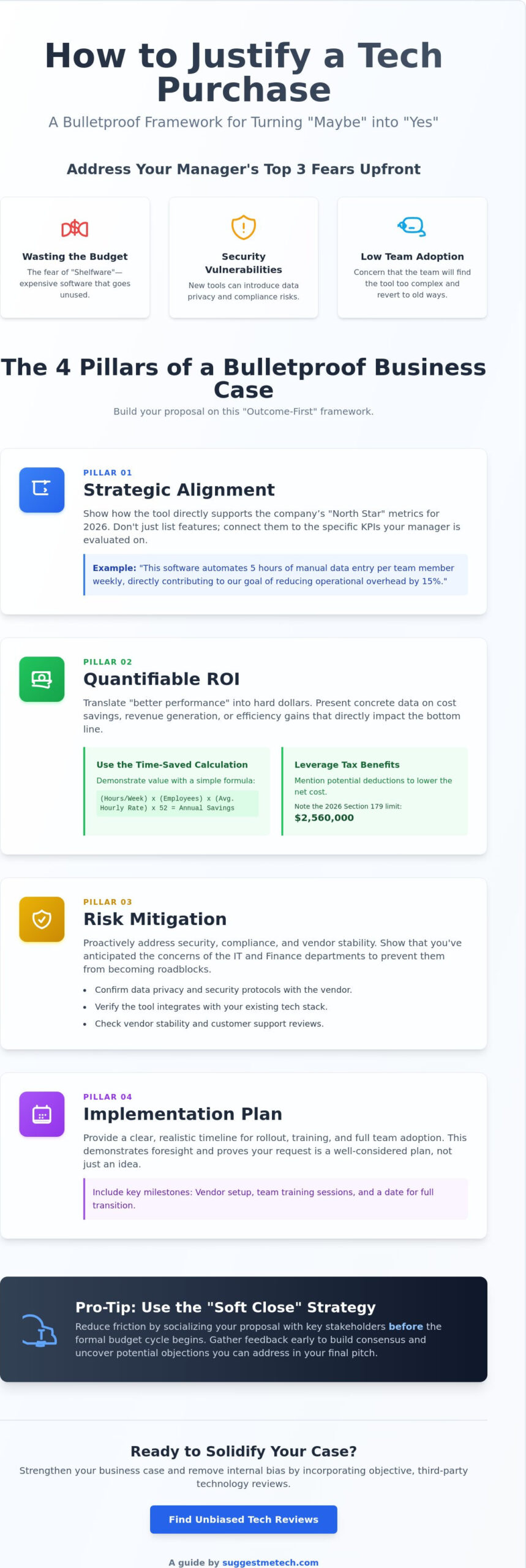
When you understand that every “yes” your manager gives represents a personal risk for them, you’ll change how you approach the conversation. If the tool fails, it’s their reputation on the line. You also need to account for “Opportunity Cost,” which is simply the value of the next best thing they could have done with that money. Managers generally fear three things: wasting the budget, creating security vulnerabilities, and seeing low adoption rates across the team. If you can address these three points upfront, you’re already halfway to a “yes.”
The Difference Between a “Want” and a “Need”
Understanding how to justify a tech purchase to your manager requires a deep dive into your current workflow. You can’t just say a tool is “better.” You have to prove a gap exists. Start by auditing your daily tasks to identify specific pain points that your manager actually feels, such as missed deadlines or data silos that lead to poor decision-making. A “Business Need” solves a documented problem that costs the company time or money, while a “Feature Desire” is simply a preference for a prettier interface or a specific brand name. Focusing on the former makes your request undeniable.
The 4 Pillars of a Bulletproof Tech Business Case
Winning over a skeptical manager requires more than a list of shiny features. You need a structured framework that prioritizes business results over technical specifications. I recommend using the “Outcome-First” framework. This approach flips the traditional pitch on its head by leading with the specific problem you’ll solve and the measurable result you’ll achieve. The technology itself is simply the vehicle to get there. To master how to justify a tech purchase to your manager, you must build your proposal on these four essential pillars.
- Strategic Alignment: Proving the tool directly supports the company’s 2026 roadmap.
- Quantifiable ROI: Delivering hard numbers on cost savings or revenue generation.
- Risk Mitigation: Addressing security, compliance, and vendor stability upfront.
- Implementation Plan: Providing a clear timeline for rollout, training, and full adoption.
By organizing your case this way, you answer the manager’s most pressing questions before they even ask them. This structure moves the conversation away from “what does it cost?” and toward “what do we gain?”
Strategic Alignment: Connecting to the Roadmap
Every organization has “North Star” metrics for 2026. Whether the focus is on reducing operational overhead or improving customer retention, your tool must act as a multiplier for those existing goals. Don’t just say the software is faster. Show how it helps the team hit the specific KPIs your manager is graded on. If your manager’s bonus depends on team output, and this tool automates five hours of manual data entry per person, the alignment is undeniable. You can find objective data to support these claims in our technology reviews and guides.
Risk and Compliance: Closing the Back Door
The Finance and IT departments are often the “Department of No” because they see risks that end users ignore. You can bypass these hurdles by addressing data privacy and security early in your proposal. It’s also vital to calculate the Total Cost of Ownership (TCO). This includes the subscription price, integration fees, and the time required for staff training. A low sticker price doesn’t matter if the implementation takes six months of billable hours. Finally, evaluate the vendor’s long-term stability. A tool is only a good investment if the provider has the support structure to grow with you; for businesses that need a reliable partner to manage this infrastructure, you can check out HJS Technology Ltd. This level of thoroughness is the secret to how to justify a tech purchase to your manager during periods of tight credit standards.
The Implementation Plan: Proving Feasibility
Managers fear “shelfware,” which is software that gets bought but never used. To ease this fear, include a 30-60-90 day rollout plan. Specify who will own the transition, how you’ll handle training, and when the team will reach full proficiency. When you show a clear path from purchase to productivity, the perceived risk of the investment drops significantly.
Measuring ROI: Turning “Better Performance” into Hard Dollars
Many employees fail to get their requests approved because they focus on how a tool feels rather than what it saves. To master how to justify a tech purchase to your manager, you have to move beyond vague descriptors like “faster” or “easier.” ROI isn’t always about generating new revenue. In the current economic climate, where the average interest rate on a business term loan sits at 7.98% as of June 2026, saving money is just as valuable as making it. You need to present a case that shows the tool pays for itself through reclaimed time and reduced errors.
The most effective way to do this is with the “Time-Saved” calculation. Take the number of hours you expect to save per week, multiply it by the hourly rate of the employees using the tool, and multiply that by 52 weeks. For example, if a team of five saves just two hours each per week at a $50 hourly rate, that’s $26,000 in reclaimed productivity annually. This simple math transforms a technical request into a clear financial benefit that any manager can understand.
Calculating Productivity Gains
Before you pitch, perform a “Time Audit” for one week to create a baseline for your ROI. Track exactly how long you spend on the specific tasks the new software will automate. Be honest about the “Onboarding Dip,” which is the temporary decrease in productivity while the team learns the new system. Acknowledging this learning curve builds trust with your manager. You can quantify “improved collaboration” into dollars by calculating the reduction in weekly sync meetings and the resulting increase in output-focused hours per employee.
The “Cost of Inaction” (COI)
The most powerful argument in your arsenal is often the Cost of Inaction. Instead of asking what the company gains, ask what it loses by doing nothing. If your current manual processes lead to a 5% error rate that costs $1,000 per mistake, the COI is easy to visualize. Show your manager the “Stagnation Gap” over the next 12 months, comparing your projected output with the tool versus the plateau you’ll hit without it. This creates a sense of urgency based on data rather than emotion, making it much easier to understand how to justify a tech purchase to your manager.
The Pitch Strategy: Timing, Objections, and the “Soft Close”
Timing is often more important than the pitch itself. Even the most logical business case can fail if you present it while your manager is stressed or during a company-wide spending freeze. Learning how to justify a tech purchase to your manager involves mastering the art of the “soft pitch,” which is the process of socializing your idea before you ever schedule a formal meeting. Mention the tool in your one-on-one sessions. Share a relevant success story from a competitor. By the time you submit your formal proposal, your manager should already be familiar with the tool’s potential value.
The best time to ask is typically during the Q4 budget planning cycle or immediately after a project kickoff where the tool’s absence is most felt. To make the decision as easy as possible, prepare a “One-Pager” executive summary. This document should highlight the specific problem, your proposed solution, the total cost, and the projected ROI you calculated in the previous section. Managers don’t have time to read 20-page decks, so keep your summary punchy and focused on the bottom line.
If you encounter a “no,” don’t treat it as a dead end. Instead, pivot to a “Phase 1” trial or a limited pilot program. This reduces the perceived risk and allows you to prove the tool’s effectiveness with real team data. You can find the data points needed to support these smaller requests in our technology reviews and guides.
Anticipating Common Objections
Expect resistance and prepare your rebuttals in advance. If the response is “we don’t have the budget,” suggest a tiered rollout or a quarterly subscription rather than an annual commitment. When they ask about security, have the vendor’s SOC2 reports or data privacy documentation ready to go. If the concern is about who will manage the tool, step up as the “Tool Champion.” Define exactly who will handle the setup and user training to show that the implementation won’t add to your manager’s workload.
The Power of the Pilot Program
A 30-day pilot program is the ultimate de-risking strategy. It’s much easier for a manager to approve a free or low-cost trial than a full-scale implementation. Before the pilot begins, set clear “Success Metrics.” These might include a 10% reduction in task completion time or a specific number of automated reports generated. Document these results meticulously. When you present the findings from a successful pilot, you aren’t just asking for a purchase anymore; you’re presenting undeniable proof of concept that makes the final “yes” automatic.
Using SuggestMeTech to Solidify Your Evidence Base
Internal bias is one of the most significant hurdles when you are learning how to justify a tech purchase to your manager. If you simply claim a tool is great, your manager might assume you’re just looking for a “new toy” to play with. To counter this, you need objective, third-party validation. Using independent reviews shifts the conversation from your personal preference to industry-standard performance. It shows you’ve done the homework and selected a tool based on merit rather than marketing hype. This strategy is essential in 2026, especially as procurement departments are managing 50% more spend per employee and looking for every reason to trim the fat.
By bringing external data into your proposal, you remove the “he-said, she-said” dynamic between you and the budget holder. You’re no longer just an employee with a request; you’re a professional presenting a researched investment. This approach is particularly effective when dealing with technical questions you might not have the answer to immediately. Expert guides can provide the deep-dive specifications on security, integration, and scalability that IT directors demand before they sign off on anything.
Curated Recommendations as Social Proof
Expert analysis provides the social proof necessary to convince a skeptical budget holder. When you cite a “Best in Class” rating from a trusted source, you’re leveraging the authority of specialists who test these tools daily. SuggestMeTech reviews are particularly useful here because they provide the detailed pros and cons managers love to see. This transparency builds credibility. Instead of hiding a tool’s limitations, you’re showing that you’ve weighed them against the benefits and still found it to be the superior choice for the team’s specific 2026 roadmap.
Comparison guides are another vital part of your evidence base. If your manager asks why you aren’t using a cheaper alternative, you can point to a side-by-side analysis. This proves that you’ve evaluated Brand A against Brand B and identified exactly where the cheaper option falls short in meeting your team’s requirements. It demonstrates that you aren’t just picking the most expensive option, but the most effective one.
Researching the Infrastructure
A successful tech purchase rarely exists in a vacuum. You need to show that you’ve considered the entire ecosystem required to make the tool work. If your proposal involves a new web presence, reference our guide on the best web hosting to prove your foundation is secure and reliable. Managers appreciate when you’ve thought through the technical details, from choosing the right domain to ensuring the team has the necessary hardware to run the software efficiently.
If your team needs new machines to handle increased workloads, include our list of the best laptops of 2026 in your proposal. This comprehensive approach demonstrates that you aren’t just asking for a single tool; you’re proposing a complete, functional solution. Showing that you’ve researched the full stack of hardware and software requirements is the ultimate secret to how to justify a tech purchase to your manager with total confidence.
Start Building Your Bulletproof Case Today
Securing new tools in a tight 2026 economy requires shifting from a “feature” mindset to a “results” mindset. By focusing on strategic alignment and using concrete metrics like the time-saved calculation, you transform your request from an expense into an investment. You now have a clear roadmap for how to justify a tech purchase to your manager by addressing risks early and de-risking the decision through pilot programs.
Success comes down to preparation and objective data. Don’t rely on internal feelings when you can point to expert-tested evidence that validates your choice. This level of thoroughness proves you’re thinking about the company’s bottom line as much as your own productivity. To get started with unbiased, expert-tested reviews and comprehensive 2026 buying guides, browse our 2026 Tech Reviews to find the evidence you need for your pitch. We provide practical advice for real-world business needs so you can walk into your next meeting with total confidence. You’ve done the work and built the case; it’s time to turn that “maybe” into a definitive “yes.”
Frequently Asked Questions
What is the most common reason tech purchases are rejected?
The most common reason for rejection is a failure to demonstrate how the tool solves a high-priority business problem. Managers often view requests as “nice-to-haves” rather than essential solutions. If your proposal doesn’t link the purchase to a specific KPI or a major team bottleneck, it is likely to be dismissed as an unnecessary expense during a tight budget review.
How do I calculate ROI for software that doesn’t directly generate revenue?
You calculate ROI by measuring efficiency gains and the reduction of manual errors. Use a time-saved formula or identify specific costs you’ll avoid, such as overtime pay or expensive data recovery. When you’re learning how to justify a tech purchase to your manager, framing the software as a way to scale without adding headcount is a highly effective strategy that speaks to the finance department.
Should I mention competitors of the tool I want in my proposal?
Including a brief comparison of two or three alternatives proves you conducted a thorough comparative analysis. It demonstrates that you’ve evaluated the market and selected the best fit for your team’s specific requirements. This transparency builds trust and helps your manager defend the purchase to higher-level executives who might ask why a cheaper or more popular option wasn’t chosen.
What is “Total Cost of Ownership” (TCO) and why does it matter?
Total Cost of Ownership includes the initial purchase price plus all hidden costs like implementation, training, and ongoing support. It matters because the sticker price of software is rarely the final expense. Accounting for integration fees and the time spent on employee onboarding prevents budget surprises. It shows your manager that you’ve considered the long-term financial impact on the department’s bottom line.
How long should a tech purchase proposal be?
A concise, one-page executive summary is the most effective format for a busy manager. It should highlight the problem, the proposed solution, the total cost, and the expected ROI. If you have complex data, comparison charts, or security documentation, include those in a separate appendix. This ensures the main proposal remains punchy and easy to digest during a quick review.
What should I do if my manager says “no” because of the budget?
If a full purchase is rejected, suggest a 30-day trial or a quarterly subscription to prove the tool’s value with minimal financial risk. Understanding how to justify a tech purchase to your manager often involves playing the long game. Ask what specific metrics would need to change for the budget to open up later in the year, such as hitting a revenue milestone.
How do I involve the IT department in my tech purchase request?
Reach out to the IT department before you finalize your proposal to check for potential compatibility issues or security vulnerabilities. Getting their pre-approval on technical requirements like SOC2 compliance prevents the request from being blocked at the final stage. An IT-vetted proposal is much harder for a manager to reject because it eliminates the risk of security breaches or integration failures.
Is it better to email the proposal or present it in a meeting?
Sending the executive summary via email first gives your manager a chance to process the data and come prepared with questions. Follow up with a brief 15-minute meeting to address their concerns and finalize the next steps. This two-step approach is more respectful of their time and leads to more productive conversations than a cold pitch during a busy afternoon.